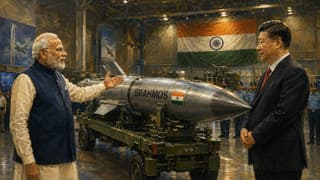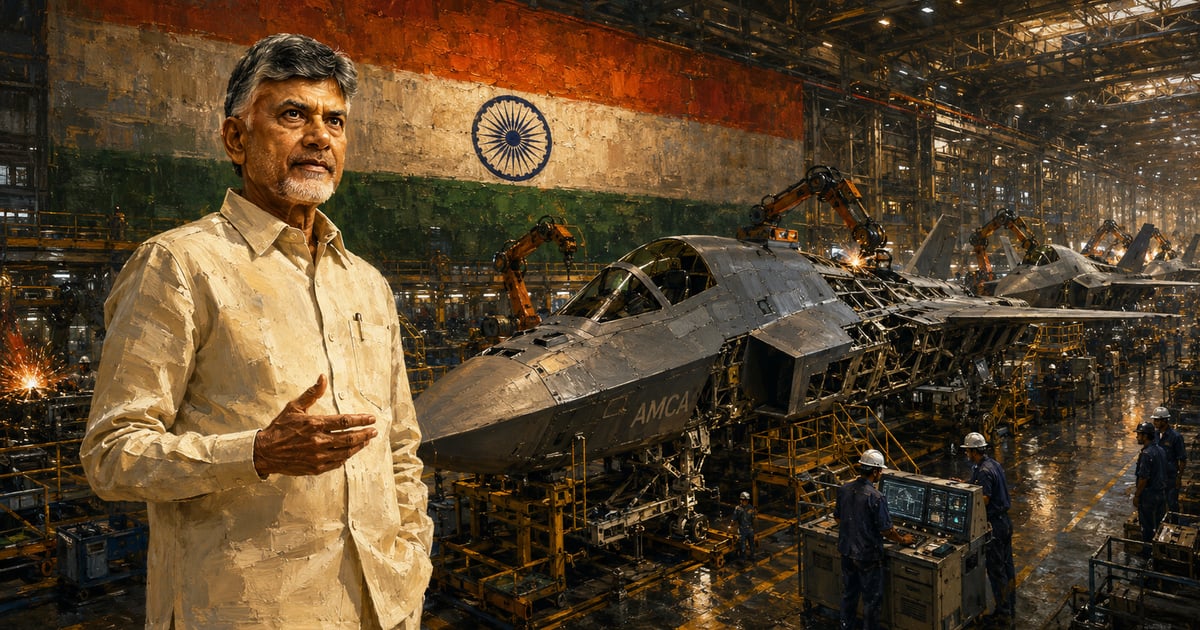
On May 15, 2026, Defence Minister Rajnath Singh and Andhra Pradesh Chief Minister Chandrababu Naidu officially launched four major defence projects across Puttaparthi, Anakapalli, and Madakasira. This ₹16,500 crore industrial cluster aims to alter India's aerospace manufacturing landscape.
The regional security environment dictates this urgency. India's Air Force currently operates 31 fighter squadrons against a sanctioned strength of 42, creating an 11-squadron deficit. Meanwhile, China deploys 195 operational J-20 fifth-generation stealth fighters, and Pakistan is actively acquiring Chinese J-35A jets. India currently possesses zero fifth-generation aircraft. The Advanced Medium Combat Aircraft (AMCA) is designed to close this gap. Puttaparthi is where that aircraft will move from blueprint to reality.
What Is the Andhra Pradesh Defence Industrial Cluster?
The Andhra Pradesh defence industrial cluster is a state-backed network of four manufacturing and testing facilities valued at over ₹16,500 crore, designed to expand India's domestic military production capabilities. The footprint spans 650 acres in Puttaparthi for aircraft integration, alongside dedicated naval and munitions plants in Anakapalli and Madakasira.
The operations break down into four targeted facilities:
Puttaparthi Integration Centre: A ₹16,000 crore facility run by the DRDO Aeronautical Development Agency, dedicated to assembling and flight-testing the country's first fifth-generation stealth fighter.
Anakapalli Naval Facility: A ₹480 crore plant operated by Bharat Dynamics Limited to manufacture autonomous underwater vehicles, torpedoes, and next-generation countermeasure systems.
Madakasira Energetics Plant: Managed by Agneyastra Energetics (Kalyani Strategic Systems) to produce specialized military propellants and explosives.
Madakasira Ammunition Plant: Built by HFCL Limited to manufacture electric fuzes, a component required for modern munitions functionality.
An adjacent Drone City cluster in Kurnool, anchored by eight private companies, supplements these nodes to form a centralized hub for unmanned aerial vehicles.
Why Does the AMCA Platform Matter for India's Air Superiority?
The AMCA platform matters for India's air superiority because successfully building it places the nation into an elite group of four countries capable of designing and manufacturing an indigenous fifth-generation stealth fighter. Currently, only the United States (F-35), Russia (Su-57), and China (J-20) possess this domestic capability.
No individual European nation has achieved this milestone independently. For Andhra Pradesh, the project is projected to attract ₹1 lakh crore to ₹2 lakh crore in follow-on investment. It is expected to create 7,500 highly skilled engineering jobs. This infrastructure establishes an aerospace corridor directly connecting Puttaparthi to the existing research ecosystem in Bengaluru.
How Can India Transition Away From Defence Imports?
India can transition away from defence imports by breaking state-run production monopolies, integrating private defense consortia into platform development, and expanding domestic component supply chains through small and medium enterprises.
Skeptics point out that India has struggled with manufacturing timelines historically. The Tejas Light Combat Aircraft was sanctioned in 1983 but did not achieve its first flight until 2001, and it still relies on an imported engine. A Comptroller and Auditor General audit revealed that 119 out of 178 high-priority DRDO projects missed their initial deadlines. As of recent assessments, 23 out of 55 mission-mode projects faced active delays.
Data from the Stockholm International Peace Research Institute (SIPRI) highlights the challenge. India remains the world's second-largest arms importer, accounting for an 8.2 percent share of global imports between 2021 and 2025. Conversely, China dropped to 21st globally after cutting its arms imports by 72 percent during the same timeframe. Hindustan Aeronautics Limited (HAL) holds an order book nearly eight times its annual revenue, showcasing the backlogs inherent in state-dependent production models.
The response to these systemic delays relies on a structural shift toward the private sector. The AMCA prototype contract is not an automatic award to state-run entities. Instead, private consortia including Tata Advanced Systems, L&T-BEL, and Bharat Forge-BEML are actively competing for the contract. Private firms already contribute 60 percent of India’s export value, backed by more than 16,000 integrated MSMEs. Defence exports grew from ₹600 crore in 2014 to ₹23,622 crore in fiscal year 2025, representing a 39-fold increase. Real hardware is moving to international buyers, including Pinaka rocket systems to Armenia and BrahMos missiles to the Philippines.
To resolve the engine vulnerabilities that halted past initiatives like the Kaveri programme, the procurement strategy has evolved. Rolls-Royce has proposed a dedicated aero-engine design centre inside India. Concurrently, DRDO is working with France's Safran to develop a 120kN AMCA engine featuring single-crystal metallurgy.
Historical Precedent: The Missile Program Blueprint
The current aerospace expansion replicates the structural path of India’s missile development. The Integrated Guided Missile Development Programme, launched in 1983 under APJ Abdul Kalam, faced initial skepticism from international analysts who questioned India's industrial base. That program eventually delivered the operational Prithvi and Agni series. It also laid the foundation for the BrahMos cruise missile, which now operates with over 65 percent indigenous content and serves as a major export asset.
Andhra Pradesh’s geographic position aligns with this blueprint. The state is situated between Bengaluru’s aerospace research hub to the west and Hyderabad’s defence electronics cluster to the north. Puttaparthi, Anakapalli, and Madakasira form a geographic triangle connecting air, sea, and munitions manufacturing. Chief Minister Chandrababu Naidu’s administration is backing this corridor with explicit land allocations and infrastructure capital, replicating the policy model that established the region's software sector in the 1990s.
Actionable Takeaways for the Aerospace Supply Chain
Monitor the private consortium bidding process between Tata Advanced Systems, L&T-BEL, and Bharat Forge-BEML to track the AMCA prototype manufacturing timeline.
Track land allocation policies and infrastructure development within the 650-acre Puttaparthi aerospace zone for local vendor integration opportunities.
Evaluate procurement pipelines within the HFCL and Agneyastra munitions facilities in Madakasira as domestic ammunition assembly scales up.
Observe technical milestones in the joint DRDO-Safran 120kN engine development project to assess long-term operational timelines.
The true metric of success for the May 15 developments will not be the scale of the initial ground-breaking ceremony, but the speed of physical execution. If the AMCA production line meets its delivery deadlines, this southern industrial corridor will mark the point where India secured its strategic self-reliance.