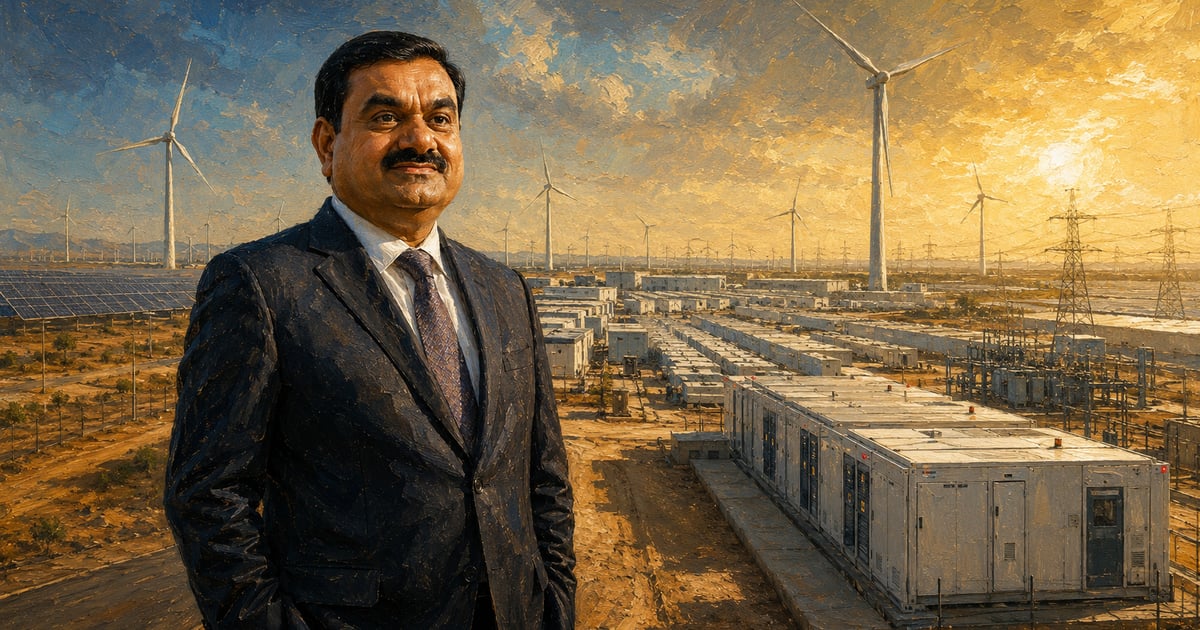
Every afternoon, something strange happens across Rajasthan's solar fields.
The sun is at its peak. Thousands of panels are generating electricity at full tilt. And grid operators are telling solar farms to switch off — not because there's no demand, but because the wires can't carry any more power.
Between May and December 2025, India threw away 2.3 terawatt-hours of solar electricity this way. That's enough to power Delhi for three weeks. On a single day in March 2026, the country lost 34 GWh of renewable energy — not to cloud cover or equipment failure, but to a grid that simply ran out of road.
This is India's solar paradox: a country that has built enormous generation capacity but lacks the infrastructure to use it properly. And it's the gap that Adani Green Energy just made a ₹15,000 crore bet on filling.
The problem, in plain terms
Solar power follows the sun. Generation peaks between 10am and 2pm, drops sharply in the late afternoon, and disappears at night. But electricity demand in India doesn't follow that pattern. Homes and businesses want power in the morning and, more importantly, in the evening — when people cook, run air conditioners, and keep the lights on.
The result is a daily mismatch. Too much power at noon, not enough by 6pm.
The obvious solution is to build more transmission lines — long-distance cables that move surplus electricity from solar-heavy states like Rajasthan and Gujarat to wherever demand is highest. India is doing that. The government has planned tens of thousands of kilometres of new inter-state transmission capacity by 2030.
The problem is that building transmission lines takes years. Land acquisition, permits, construction — a major line can take a decade from planning to operation. Meanwhile, India keeps adding solar capacity at record speed. The gap between generation and grid infrastructure isn't closing. It's widening.
In the worst-affected areas, curtailment — the technical term for forcing generators to switch off — reached 51.5% in Rajasthan during peak hours by August 2025. At least 30 solar and wind projects reported losses of up to ₹700 crore between March and August 2025 alone.
The business insight
Here's where Adani's strategic thinking comes in.
A solar farm that gets curtailed earns nothing on the power it can't sell. That electricity simply disappears. But what if you could capture it, store it, and sell it a few hours later — when evening demand kicks in and prices are at their highest?
That's exactly what a battery energy storage system does. Charge during the wasted midday hours. Discharge into the evening peak. Convert what was previously zero-value electricity into premium-priced power.
On India's electricity exchanges, evening peak prices are significantly higher than midday spot prices. The spread between the two is where the money is. And Adani, with 9.9 GW of solar already operational at its Khavda site in Gujarat — part of a planned 30 GW complex — generates enormous amounts of electricity right in the middle of the day, precisely when curtailment risk is highest.
Rather than watch that power go to waste, the company has built a battery park next door to store it.
What they built
The Khavda Battery Energy Storage System, completed in two phases across March and May 2026, has a total capacity of 3.37 GWh. It is the largest single-location battery deployment outside China, and it was built in just 10 months.
To put 3.37 GWh in context: as recently as February 2026, India's entire operational battery storage capacity was 0.8 GWh. Adani's single project is more than four times the country's previous total.
The system can deliver 1,126 MW of power — enough to supply a mid-sized Indian city — for roughly three hours. More than 700 battery containers sit on-site, charged by the same solar plant they sit beside.
How Adani gets paid
The revenue model has two layers, and understanding both is key to seeing why this is a long-term strategic play rather than a one-off project.
The first layer is stability. Around 75% of the planned storage capacity is backed by 25-year power purchase agreements — long-term government contracts that guarantee a fixed price for electricity regardless of market conditions. These contracts are the financial bedrock of the whole operation, allowing Adani to borrow at scale and repay debt predictably over decades.
The second layer is where the upside sits. The remaining 25% is sold as merchant power — at whatever the market will pay, on any given day, at the most favourable time. With storage, Adani gets to choose when to sell. That choice is valuable.
There's also a third element that's specific to India's evolving regulatory landscape. The government has introduced a new class of power contract called Round-the-Clock (RTC) and Firm and Dispatchable Renewable Energy (FDRE). These pay a premium over standard solar tariffs because the power is reliable — available when needed, not just when the sun shines. Battery storage is what makes solar electricity qualify for this premium category. Adani is positioning its storage capacity to capture exactly that.
The scale of the ambition
Khavda is not the end of the plan. It's the proof of concept.
Adani Green has committed ₹15,000 crore in capital expenditure for a 10 GWh BESS expansion in FY27. The five-year target is 50 GWh — a number that would make the company one of the largest battery storage operators anywhere in the world.
The economics support the ambition. Capital costs for utility-scale battery projects fell to around $125/kWh by late 2025. India's first solar-plus-six-hour storage auction in early 2026 cleared at ₹3.12/kWh. New coal power, for comparison, now costs more at auction than solar paired with storage.
The curtailment problem, meanwhile, is not going away. India keeps adding solar faster than it builds transmission capacity. Every new gigawatt of panels installed without corresponding grid investment makes storage more valuable, not less.
The risks worth knowing
This is a capital-intensive, debt-funded business model. Long-term contracted revenues are used to repay borrowings over decades, which works well when interest rates are stable and tariffs hold. Any sustained rise in borrowing costs, or pressure on contracted prices, narrows the margin for error.
Battery cells also degrade over time. Lithium-ion technology loses capacity across 10 to 15 years of cycling, and replacing the cells inside a 3.37 GWh system midway through a 25-year contract is a significant cost that has to be planned for from day one.
The most uncertain variable is the supply chain. India has no domestic lithium production and depends heavily on imports, primarily from China. Beijing tightened export controls on critical minerals in 2025. A trade disruption or sharp tariff increase on battery cells would feed directly into project costs across the entire pipeline.
Why it matters beyond Adani
India's grid problem is structural and it's growing. The country has set itself ambitious renewable energy targets, keeps hitting them ahead of schedule, and keeps finding that the grid infrastructure needed to use that power isn't keeping pace.
Battery storage is the most practical short-term answer available. It doesn't require years of land acquisition. It can be deployed at the same site as generation. And it turns the curtailment problem — which currently costs the industry hundreds of crore a year in lost revenue — into a business opportunity.
Adani has moved faster and at greater scale than anyone else in this space. Whether the 50 GWh ambition holds together over five years, across changing interest rates, battery technology cycles, and supply chain pressures, is a question that will take years to answer.
But the strategy is coherent. India has too much solar power at the wrong time of day. Adani is building the infrastructure to fix that — and charging for the privilege.