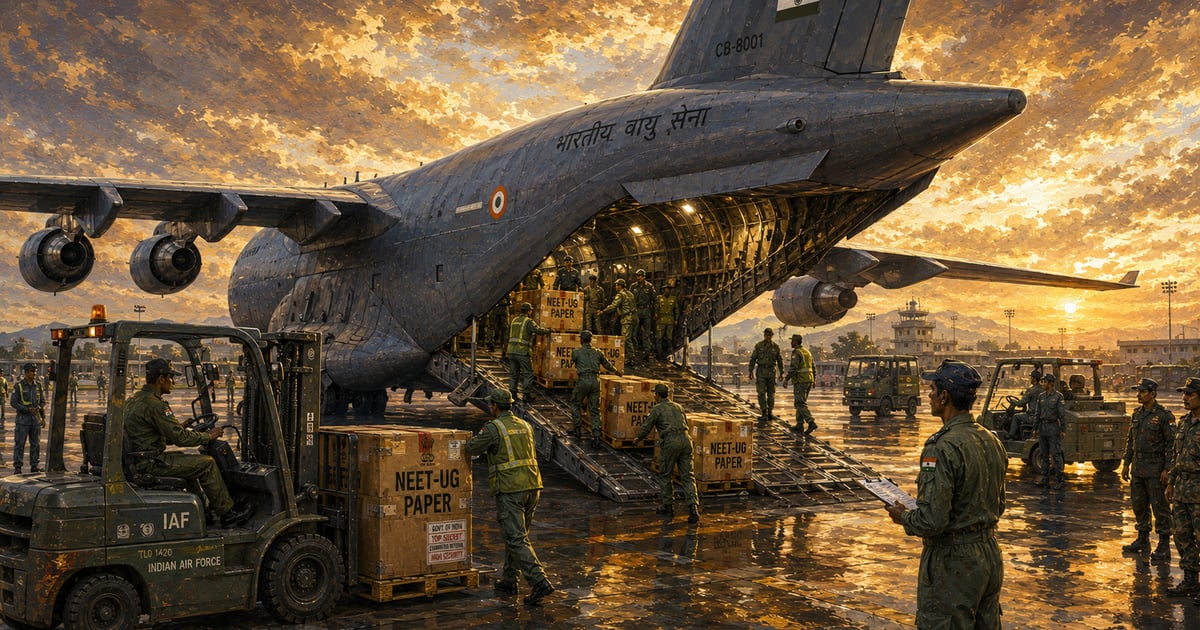
Education Minister Dharmendra Pradhan confirmed that the Indian Air Force (IAF) will transport NEET-UG question papers for the June 21, 2026 re-examination. This decision emerged from high-level security discussions held at the residence of Defence Minister Rajnath Singh. The operational plan targets every phase of the ecosystem: question setting, printing, transportation, and final distribution. Prime Minister Narendra Modi is personally monitoring these logistics, maintaining final sign-off authority on all implementation details.
Consider the reality of this development. India is deploying military aircraft, strategic assets built to defend national airspace, to act as couriers for a medical entrance test. This is not an administrative upgrade. It is an explicit admission of institutional vulnerability.
The state is deploying the military because the domestic criminal network known as the "NEET paper mafia" has rendered civilian systems untrustworthy. When a government must leverage its armed forces to protect a written test from local leak networks, the traditional machinery of governance has already defaulted.
The Massive Logistics of a 38-Day Reset
The National Testing Agency (NTA) is attempting to rebuild its entire operational infrastructure from scratch in just 38 days, a process that normally requires a six-month window. To compensate for this compressed timeline, the state is assembling a multi-agency security architecture.
What is the 2026 NEET Security Framework? The emergency architecture integrates IAF aircraft for transit, paramilitary units (CRPF, CISF, and ITBP) for exam center security, state police forces for perimeter control, and the postal department for last-mile delivery. The Central Bureau of Investigation (CBI) runs parallel enforcement operations under direct daily oversight from the Prime Minister’s Office.
This mobilisation pits the collective resources of the Indian state against an agile, decentralised network of coaching centre executives, corrupt academics, and middlemen armed with basic digital tools.
The Inside Threat: Anatomy of the 2026 Network
Tightening physical transit loops misses the core vulnerability of the system. The paper mafia thrives because it is embedded directly within the institutions tasked with safeguarding the exams.
The Multi-State Digital Pipeline
The 2026 leak trace demonstrates extreme logistical speed. A physical copy of the question paper was procured from a printing press in Nashik, Maharashtra. From there, the material passed to a doctor in Gurugram, Haryana, before expanding to Sikar in Rajasthan.
Within 24 hours, the document was converted into digital PDF files by accomplice Dinesh Biwal and distributed across eight states, including Bihar, Jammu and Kashmir, Kerala, and Uttarakhand. Access to these PDFs was sold to candidates for sums ranging between ₹2 lakh and ₹5 lakh. A single compromised employee at a printing press combined with a WhatsApp network outpaced state-level enforcement before the military was even considered.
Compromise at the Source
The structural breakdown did not occur during transit or at the test centres. The CBI arrested Manisha Gurunath Mandhare, a Pune-based Botany professor appointed directly by the NTA as an official subject expert. Mandhare possessed full access to the Botany and Zoology question pools during the paper-setting phase.
Investigators allege she directly shared answers and guided students during structured meetings organised at a private residence in Pune. She was linked to the network via Professor P.V. Kulkarni, a Chemistry lecturer from Latur who also maintained close ties to the NTA. When the individuals choosing the questions are active participants in the leak network, tactical transport security becomes entirely irrelevant.
The Subverted Heroes
The commercial intersection between the coaching industry and the paper mafia is exemplified by Shivraj Raghunath Motegaonkar, known publicly to his 68,000 social media followers as "M Sir." Motegaonkar built a prominent public profile as an anti-corruption advocate following the 2024 NEET scandals. He simultaneously operated the Renukai Career Centre, a ₹1,500 crore coaching empire spanning nine branches across Maharashtra.
On May 17, 2026, the CBI arrested Motegaonkar after discovering the leaked 2026 NEET question paper stored directly on his personal mobile phone. The entities generating revenue by preparing students for these examinations are fundamentally aligned with the networks selling the shortcuts.
Five Institutional Failures Exposed by the Military Pivot
The decision to involve the Indian Air Force highlights five deep structural vulnerabilities within India's current competitive exam framework:
Complete Attrition of Civilian Trust: Utilising military and paramilitary forces to transport and guard academic documents proves the central government no longer trusts its own civilian departments, including the postal system, state police, and local administrative staff.
The Demise of NTA Credibility: The NTA has suffered a systemic loss of public faith. According to a CVoter public opinion survey, 52 per cent of respondents state they do not trust the integrity of national entrance exams (29 per cent responding "not much," 23 per cent responding "not at all"). An evaluation body operating with a majority deficit in public trust cannot function as a viable state institution.
Superior Operational Continuity of the Mafia: Despite a sweeping CBI crackdown following the 2024 leaks, the exact same geographic corridors (the Bihar-Rajasthan axis and Sikar hubs) reconstituted themselves seamlessly for the 2026 cycle. The criminal enterprise demonstrates more resilient operational continuity than the agency tasked with stopping it.
Misallocation of High-Value Strategic Assets: Operating costs for major IAF transport assets, such as C-17 Globemasters and AN-32s, range from $16,000 to $40,000 per flight hour. These high-value military tools, funded via the national defence budget to manage border security and strategic operations, are being diverted to outrun local text-message networks.
Misplaced Tactical Focus: Military aircraft can only protect a physical box during transit. They cannot secure the internal room where NTA subject experts assemble the question pool, nor can they audit the digital devices of coaching network executives weeks before the examination date.
The Structural Realities of Centralisation
The state’s primary justification for the deployment centres on seasonal logistics. The June monsoon presents severe geographical challenges across India, making weather-resilient, rapid air transport a practical necessity for a tightly compressed 38-day re-examination timeline. Furthermore, the state notes that utilising multi-agency security models is standard practice for national events like general elections.
However, this logic treats the paper mafia as an external threat. Elections deploy paramilitary forces to shield citizens from physical, external intimidation. The exam crisis is a problem of internal, systemic corruption.
The root cause rests on extreme centralisation. Compressing over 22 lakh medical aspirants into a single, high-stakes national exam creates a massive single point of failure.
When a single gate controls access to an entire national sector, the market value of breaching that gate escalates dramatically. The paper mafia is the inevitable shadow economy generated by this monopoly, drawing in corrupt academics, state employees, and commercial coaching hubs. Security theatre at the runway cannot fix a structural vulnerability embedded deep within the design of the institution itself.