In brief
- Adani Enterprises has signed a three year supply agreement worth roughly $1 billion with Noida based recycler Attero to source 2,000 tonnes of copper anode a month for its Kutch Copper smelter in Mundra, Gujarat.
- The contract, disclosed by Reuters on 24 November 2026, marks the largest commercial bridge yet between India’s formal electronic waste sector and heavy primary metallurgy.
- The deal will supply 24,000 tonnes of copper anode a year, reducing India’s copper import reliance by about 5% and representing less than 3% of India’s total annual copper imports.
- Ultimately the contract is not enough to close India’s trade deficit on copper, but it allows Adani to bypass the global shortage of mined copper concentrate by using recycled domestic anode at Mundra before electro refining.
Adani Enterprises has locked in a three-year supply agreement worth roughly $1 billion with Noida-based recycler Attero to source 2,000 tonnes of copper anode a month for its Kutch Copper smelter in Mundra, Gujarat (Mining Weekly / Reuters, Economic Times). Disclosed by Reuters on 24 November 2026—roughly three months after it was quietly signed—the contract marks the largest commercial bridge yet between India’s formal electronic-waste sector and heavy primary metallurgy (Mining Weekly / Reuters).
On the surface, a $1 billion domestic supply pact looks like a decisive blow to India’s copper import dependence. Look closer at the tonnage, however, and a more nuanced picture emerges: 24,000 tonnes of copper anode a year will trim Kutch Copper’s import reliance by only about 5%—and represents less than 3% of India’s total annual copper imports (Mining Weekly / Reuters). The deal’s real significance is not volume alone; it is that recycled domestic anode allows Adani to bypass a brutal global shortage of mined copper concentrate.
The Arithmetic: How Much Does 2,000 Tonnes a Month Actually Move the Needle?
India’s copper market is defined by a persistent mismatch between its downstream industrial appetite and its domestic ore supply. Although the country holds nearly 13 lakh tonnes (1.3 million tonnes) of annual copper refining capacity, several processors operate below capacity due to raw-material constraints (Mining Weekly / Reuters).
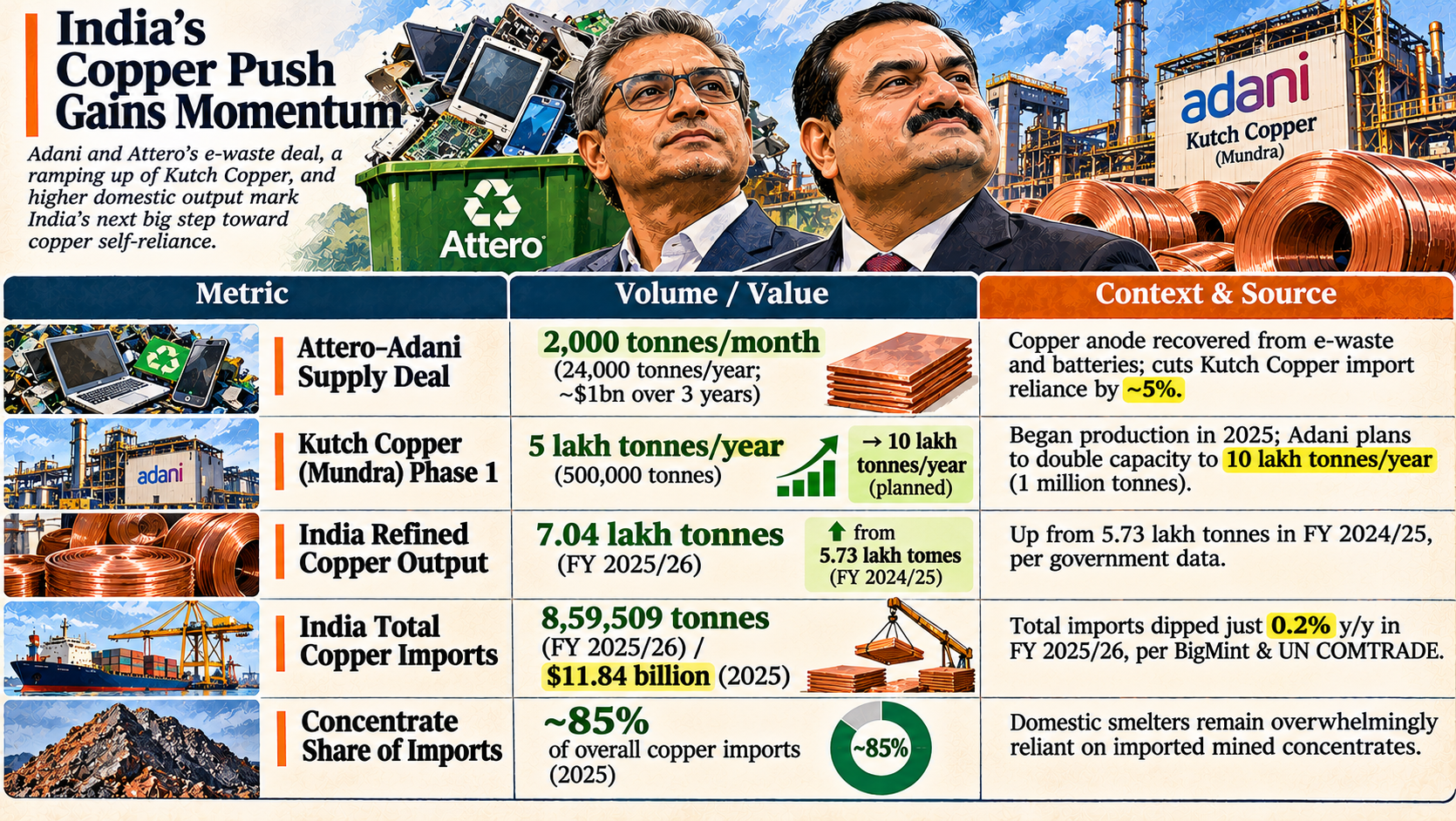
Measured against those national totals, Attero’s 24,000 tonnes a year—roughly 4.8% of Kutch Copper’s current 5 lakh-tonne capacity, and just 2.8% of India’s 8.59 lakh-tonne annual import volume—will not close India’s trade deficit on its own. Once Mundra doubles to 10 lakh tonnes a year to become the world’s largest single-location copper smelter, Attero’s current contracted volume would cover roughly 2.4% of plant demand unless scaled further (Mining Weekly / Reuters).
Why Recycled Anode Beats Imported Concentrate Right Now
If 24,000 tonnes a year is modest in tonnage, the economics behind it explain why Adani locked it in for three years.
S&P Global Market Intelligence reported in August 2026 that while India’s refined copper imports are set to shrink as Mundra ramps up, the country’s concentrate import needs remain acute—accounting for roughly 85% of overall copper imports in 2025 (S&P Global). Globally, mined copper supply has fallen far behind smelting capacity. According to DBS Bank, the global copper market deficit is projected to widen from 2.49 lakh tonnes (249,000 tonnes) in 2025 to 3.16 lakh tonnes (316,000 tonnes) in 2026, exacerbated by mine disruptions such as the September 2025 mudslide at Freeport-McMoRan’s Grasberg mine, pushing average London Metal Exchange (LME) prices toward $9,900 per tonne (DBS Bank).
That imbalance has crushed smelter economics worldwide. When concentrate is scarce, miners charge smelters negative treatment and refining charges (TCs/RCs)—meaning custom smelters effectively operate at a loss just to process ore (DBS Bank). Buying copper anode—an intermediate metallic product already stripped of rock and slag—from a domestic recycler like Attero bypasses the primary concentrate market altogether and feeds directly into Mundra’s electro-refining stage.
Attero’s ₹3,000 Crore Bet and Adani’s Three-Pronged Feedstock Strategy
For Attero, the Adani contract anchors a massive industrial scale-up. On 23 November 2026—the day before news of the Adani pact broke—Attero announced a ₹3,000 crore investment plan over the next five years to expand its critical-minerals facilities and quadruple its e-waste recycling capacity from 2.25 lakh tonnes (225,000 tonnes) to 10 lakh tonnes (1 million tonnes) a year within four years (ScrapC, ET Manufacturing). Recovering copper alongside gold, silver, nickel, aluminium, and lithium from discarded electronics and EV batteries gives India a domestic "urban mine" backed by tightening Extended Producer Responsibility (EPR) rules (ET Manufacturing, Attero).
For Adani, Attero is one leg of a wider three-pronged feedstock strategy designed to insulate Mundra from volatile spot markets:
Domestic Urban Mining: Three-year, 24,000-tonne/year recycled anode supply from Attero (Mining Weekly / Reuters).
Australian Concentrates: A strategic MoU with Caravel Minerals establishing an exclusive framework to negotiate up to 100% offtake from its Western Australian copper project (Adani).
Chilean Exploration: A November 2026 MoU with Chile’s state-owned giant Codelco to jointly explore the Kaburkaala copper project in the Antofagasta region (Adani, Business Standard).
The Attero contract alone will not eliminate India’s $11.84 billion copper import bill. What it does is prove that India’s formal e-waste recyclers can deliver industrial-grade, multi-year feedstock at billion-dollar scale—turning urban scrap into a bankable hedge against global mining bottlenecks.