In brief
- BCCI explored expanding the Indian Premier League from 10 to 12 teams for 2028, with Pune and Vadodara as frontrunner host cities and each new franchise valued at more than $1 billion (roughly ₹8,400+ crore).
- BCCI Secretary Devajit Saikia said there were no immediate plans for a 12 team league in 2028 and the focus is the 20th edition in 2027, indicating conflicting headlines about expansion.
- The expansion debate sits against a backdrop of cooling media-rights inflation and a projected plateau in the 2028 to 2032 rights cycle, making franchise expansion a key financial lever and a concern for existing owners.
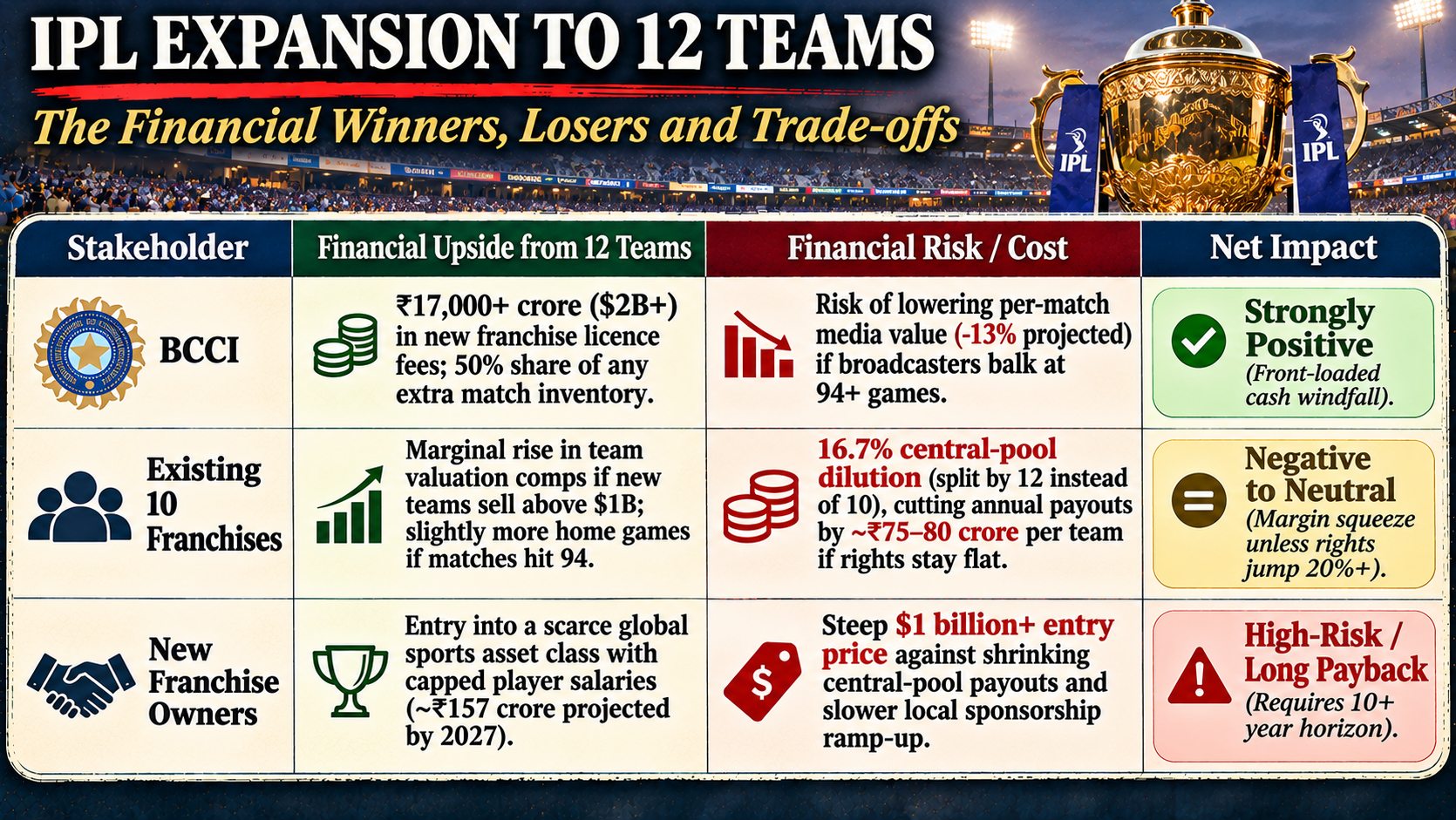
- Analysts cited by Business Standard estimate two new franchises could fetch more than $1 billion each, potentially yielding ₹17,000 crore to ₹20,000 crore ($2 billion+) in guaranteed licence revenue to offset broadcast growth.
Reports surfaced on 10 November 2026 that the Board of Control for Cricket in India (BCCI) had held preliminary talks with private equity funds, sovereign wealth funds, and Indian conglomerates to expand the Indian Premier League (IPL) from 10 to 12 teams from 2028, with Pune and Vadodara emerging as frontrunner host cities and each new franchise expected to be valued at over $1 billion (roughly ₹8,400+ crore). Barely 24 hours later, BCCI Secretary Devajit Saikia publicly pushed back, insisting there were "no immediate plans" for a 12-team league in 2028 and that the Board’s sole focus was the 20th edition in 2027.
Even with that official denial, the debate has refused to fade—and for good reason. On 14 November, Punjab Kings co-owner Mohit Burman warned against expanding beyond 10 teams without a longer tournament window, while Kolkata Knight Riders co-owner Juhi Chawla floated shifting the IPL to January.
Beneath the conflicting headlines sits a structural commercial problem. For nearly two decades, the IPL’s economics relied on relentless media-rights inflation. As the league approaches its 2028–2032 commercial cycle, that growth engine is cooling—making franchise expansion both the BCCI’s most tempting financial lever and existing team owners’ biggest anxiety.
The Why: A Media-Rights Plateau Meets a $2 Billion Franchise Windfall
To understand why expansion chatter keeps resurfacing ahead of 2028, one must look at the twin financial pressures reshaping Indian cricket’s balance sheet:
The End of the Bidding-War Era: In 2022, a fierce bidding war between Disney Star (which paid ₹23,575 crore for TV) and Viacom18 (₹20,500 crore for digital) drove the 2023–2027 IPL media rights to a record ₹48,390 crore ($6.2 billion at 2022 exchange rates). Since then, Disney Star and Viacom18 have merged to form JioStar (JioHotstar), eliminating the league’s primary source of competitive auction tension.
Broadcaster Losses and Ad-Market Contraction: According to a March 2026 study by Media Partners Asia (MPA), IPL broadcasters face cumulative losses of $1.8 billion to $2 billion during the 2023–2027 cycle. Policy-driven exits by real-money gaming platforms (such as Dream11) and ed-tech firms, alongside a ban on crypto advertising, have slowed annual ad-revenue growth to 7% over the past three seasons, down from 18% in the prior cycle. Consequently, MPA projects the 2028–2032 media rights cycle will plateau at roughly $5.4 billion.
The Expansion Cash Injection: When the BCCI added Lucknow Super Giants (₹7,090 crore / $940 million) and Gujarat Titans (₹5,625 crore / $750 million) ahead of the 2022 season, it netted ₹12,715 crore in upfront franchise fees. After 2026 secondary sales valued Royal Challengers Bengaluru at $1.78 billion and Rajasthan Royals at $1.65 billion, analysts cited by Business Standard estimate two new franchises could fetch more than $1 billion each—handing the BCCI upwards of ₹17,000 crore to ₹20,000 crore ($2 billion+) in guaranteed licence revenue to offset stagnant broadcast growth.
The When: Why 2027 Is Locked and 2028 Is the Inflection Point
Any structural expansion is mathematically and contractually impossible before 2028:
2027 Is Fixed: IPL 2027 (starting March 2027, with an auction scheduled for 16 December 2026) is the final year of both the current 2023–2027 media-rights contract and the International Cricket Council’s (ICC) Future Tours Programme (FTP). As BCCI Secretary Devajit Saikia confirmed, no team additions or purse hikes are planned for the 20th edition.
2028 Opens Two Windows: Both the new 2028–2032 media rights cycle and the next ICC FTP cycle begin in 2028. Notably, IPL Chairman Arun Dhumal had already flagged plans in 2025 and May 2026 to expand the IPL from 74 matches to 94 matches from 2028—initially by keeping 10 teams and moving to a full home-and-away schedule (18 league games per side). Whether the BCCI uses that 94-match inventory for 10 teams or 12 teams will be decided during 2027 tender negotiations with JioStar and potential challengers.
How Expansion Would Change the IPL
Moving from 10 to 12 teams would fundamentally alter the tournament’s competition format, player market, and geography.
1. The Format and Calendar Squeeze
A true double round-robin (home-and-away) for 10 teams requires 94 matches (90 league games plus 4 playoffs), which already demands extending the IPL window by roughly two weeks in the international calendar. A 12-team double round-robin would require 136 matches—an impossibility in a two-to-three-month window without regular weekday double-headers or simultaneous games. Broadcasters resist afternoon matches because viewership drops roughly 30% outside evening primetime.
As a result, a 12-team IPL would almost certainly adopt two groups of six (playing group rivals twice and cross-group rivals once, yielding ~88 to 94 matches). That compromise is precisely what owners such as Mohit Burman oppose, arguing it weakens competitive fairness when teams do not face every opponent home and away.
2. Talent Dilution and the 2028 Mega Auction
Two new squads would require roughly 50 additional contracted players, including at least 34 to 36 domestic Indian cricketers. While India’s white-ball talent pool is deep, marquee Indian stars and frontline fast bowlers would be spread thinner across 12 dressing rooms—raising the risk of lopsided mid-season fixtures. A 2028 expansion would also mandate a mega auction, forcing existing franchises to release hard-built core squads.
3. New Geographic Markets: Why Pune and Vadodara?
Pune offers proven commercial infrastructure, a large corporate base, and prior IPL history (having hosted Pune Warriors India from 2011–2013 and Rising Pune Supergiant in 2016–2017).
Vadodara, located roughly 110 km from Ahmedabad, reflects Gujarat’s aggressive investment in international sports infrastructure linked to India’s 2036 Olympic bid—though placing a second franchise in the same state as Gujarat Titans risks local sponsorship cannibalisation compared with untapped markets such as Guwahati, Kochi, or Indore.
The Financial Implications: BCCI vs Existing Teams vs New Owners
The core tension over IPL expansion lies in how the league’s 50:50 central revenue-sharing formula distributes risk and reward.
In FY 2024–25, BCCI’s audited IPL income reached a record ₹12,005.55 crore, of which media rights accounted for ₹8,744.24 crore (72.8%), generating an annual league surplus of ₹5,113 crore. Under the IPL’s central pool rules, the BCCI retains 50% of net central media and sponsorship revenue and divides the remaining 50% equally among all participating franchises.
The Dilution Arithmetic for Existing Teams
Media rights currently supply roughly 75% of an average IPL franchise’s total revenue (up from 48% in 2017). Under the 2023–2027 cycle, each of the 10 teams receives approximately ₹484 crore per season from media rights alone, plus ₹50–60 crore from central sponsorships.
If the 2028–2032 media-rights cycle plateaus at MPA’s projected $5.4 billion (~₹45,360 crore over five years, or ~₹9,072 crore annually), the 50% franchise pool equals ₹4,536 crore per year:
Divided by 10 teams: ₹453.6 crore per franchise per year.
Divided by 12 teams: ₹378.0 crore per franchise per year.
That is a 16.7% structural pay cut—roughly ₹75.6 crore less per season for every existing owner—at a time when player salary purses are climbing toward ₹157 crore and match-fee obligations (₹7.5 lakh per player per game) are rising. Even if the BCCI matches the current ₹48,390 crore cycle, a 12-way split drops per-team media income from ₹483.9 crore to ₹403.25 crore.
This arithmetic explains why several legacy investors—including Diageo at RCB and existing stakeholders at Rajasthan Royals—chose to sell stakes at peak 22.9x revenue multiples in 2026 before the 2028 rights reset. For the BCCI, adding two teams is an attractive way to monetise global private-equity appetite and refill its coffers. For the 10 teams already inside the tent, however, expansion only makes financial sense if the BCCI can break JioStar’s monopsony—perhaps by carving out Connected TV or digital sub-packages—to push the 2028–2032 media rights well past ₹58,000 crore ($6.9 billion).