In brief
- AirTrunk filed a detailed project report for two Andhra Pradesh data centre campuses worth ₹1.03 lakh crore ($11 billion) and 1.8 GW capacity, exceeding India's entire 1.2 GW operational capacity as of April 2025.
- Since April 2026 AirTrunk acquired Lumina CloudInfra for 600 MW, signed a Maharashtra LoI for 3 GW at ₹2 lakh crore, and now added 1.8 GW in Andhra Pradesh, reaching a 5.4 GW development pipeline.
- Andhra Pradesh attracts hyperscale investment due to Singapore's sustainability caps and Malaysia's overflow, with Chief Minister Naidu offering land rebates and power incentives alongside Google-Adani, Digital Connexion and CleanMax commitments.
- Delivering 1.8 GW requires dedicated extra-high-voltage substations, transmission upgrades, captive renewable contracts and water clearances, while industry revenue of $1.7 billion in FY26 lags behind over $100 billion in pledged investment.
Blackstone-backed hyperscale operator AirTrunk has filed a detailed project report (DPR) to build two massive data centre campuses in Andhra Pradesh, committing an estimated ₹1.03 lakh crore ($11 billion) for up to 1.8 gigawatts (GW) of combined capacity, according to reports on 14 November 2026 by The Economic Times and Bloomberg (via Binance News).
Even in a year defined by supersized artificial intelligence announcements, the scale of the filing stands out. A single 1.8 GW power envelope is roughly equivalent to the output of nearly two large nuclear reactors—and exceeds the 1.2 GW of live operational data centre capacity that India possessed across the entire country as recently as April 2025.
For AirTrunk—which Blackstone acquired in a landmark A$24 billion deal completed in December 2024—the Andhra Pradesh submission marks a decisive shift from headline pledges to formal state-level execution.
Seven Months from Zero to 5.4 Gigawatts: AirTrunk’s India Playbook
Before spring 2026, Sydney-headquartered AirTrunk had no operating footprint in India. Rather than spending years assembling land banks from scratch, Blackstone engineered a three-step entry:
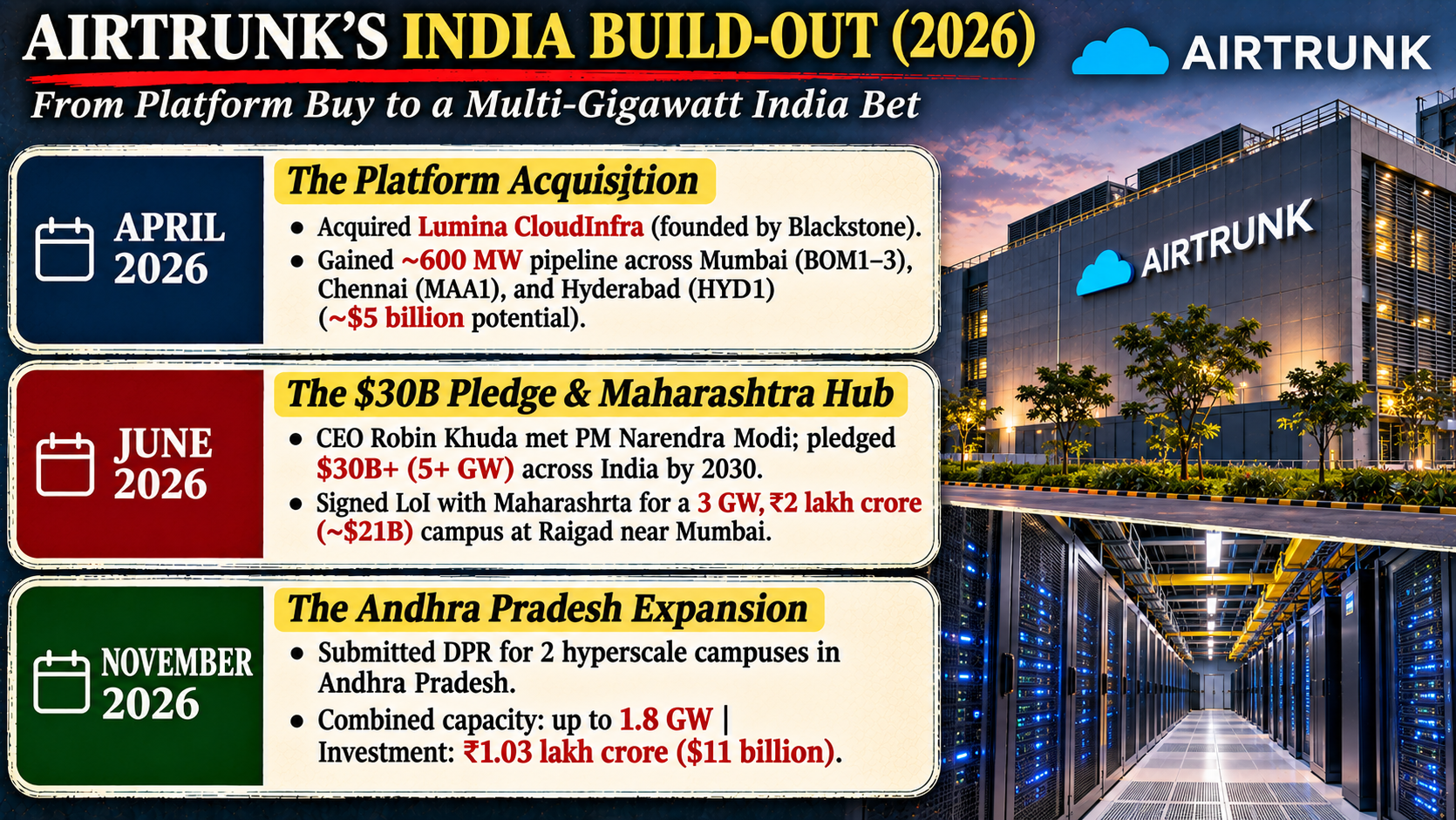
The Lumina Hand-Off (April 2026): AirTrunk entered India by acquiring Lumina CloudInfra, a Mumbai-based developer founded by Blackstone itself. That internal transfer immediately handed AirTrunk five planned sites—three in Mumbai and one each in Chennai and Hyderabad—representing roughly 600 MW of capacity.
The Maharashtra Mega-Campus (June 2026): On 5 June 2026, AirTrunk Chief Executive Robin Khuda met Prime Minister Narendra Modi in New Delhi and announced a $30 billion-plus commitment to build more than 5 GW of AI-ready data centre capacity by 2030. That same week, AirTrunk signed a Letter of Intent (LoI) with the Maharashtra government for a 3 GW campus in Raigad, outside Mumbai, pegged at roughly ₹2 lakh crore ($21 billion).
The Andhra Pradesh DPR (November 2026): With the new 1.8 GW / ₹1.03 lakh crore ($11 billion) filing in Andhra Pradesh, AirTrunk’s combined development blueprint across Maharashtra, Andhra Pradesh, and the Lumina sites now reaches roughly 5.4 GW—turning its 2030 national target into concrete state-level project pipelines.
Why Southern India—and Why Andhra Pradesh?
Historically, India’s data centre industry clustered tightly around Navi Mumbai and Chennai, where subsea internet cables make landfall. Yet two structural shifts have propelled Andhra Pradesh—particularly its coastal Visakhapatnam corridor—into the centre of global hyperscale capital.
First, Asia-Pacific spillover. Mature regional hubs such as Singapore have severely rationed new data centre approvals under strict sustainability caps (requiring Power Usage Effectiveness of ≤1.25 and ≥50% green-energy pathways). While Malaysia’s Johor Bahru absorbed the first wave of overflow—including AirTrunk’s own $3 billion Johor expansion in May 2026—AI model training requires multi-gigawatt campuses with cheap land and scalable renewable power that tiny city-states cannot supply.
Second, aggressive state-level industrial policy. Under Chief Minister N. Chandrababu Naidu, Andhra Pradesh has courted digital infrastructure aggressively, announcing ₹9.89 lakh crore in investment Memoranda of Understanding (MoUs) at its recent CII Summit and competing directly with Tamil Nadu and Maharashtra on land rebates and power-wheeling incentives. AirTrunk is far from alone in choosing the state: Google and the Adani Group have outlined a $15 billion AI hub in Visakhapatnam, Digital Connexion (backed by Reliance, Brookfield, and Digital Realty) has committed $11 billion for a 1 GW AI campus there, and CleanMax recently pledged ₹50,000 crore for a 2 GW green-compute facility in the state.
How AirTrunk Compares in India’s Hyperscale Arms Race
AirTrunk’s $30 billion-plus overall India ambition—anchored by its $21 billion Maharashtra LoI and $11 billion Andhra Pradesh DPR—places a pure-play infrastructure developer alongside the world’s largest cloud hyperscalers:
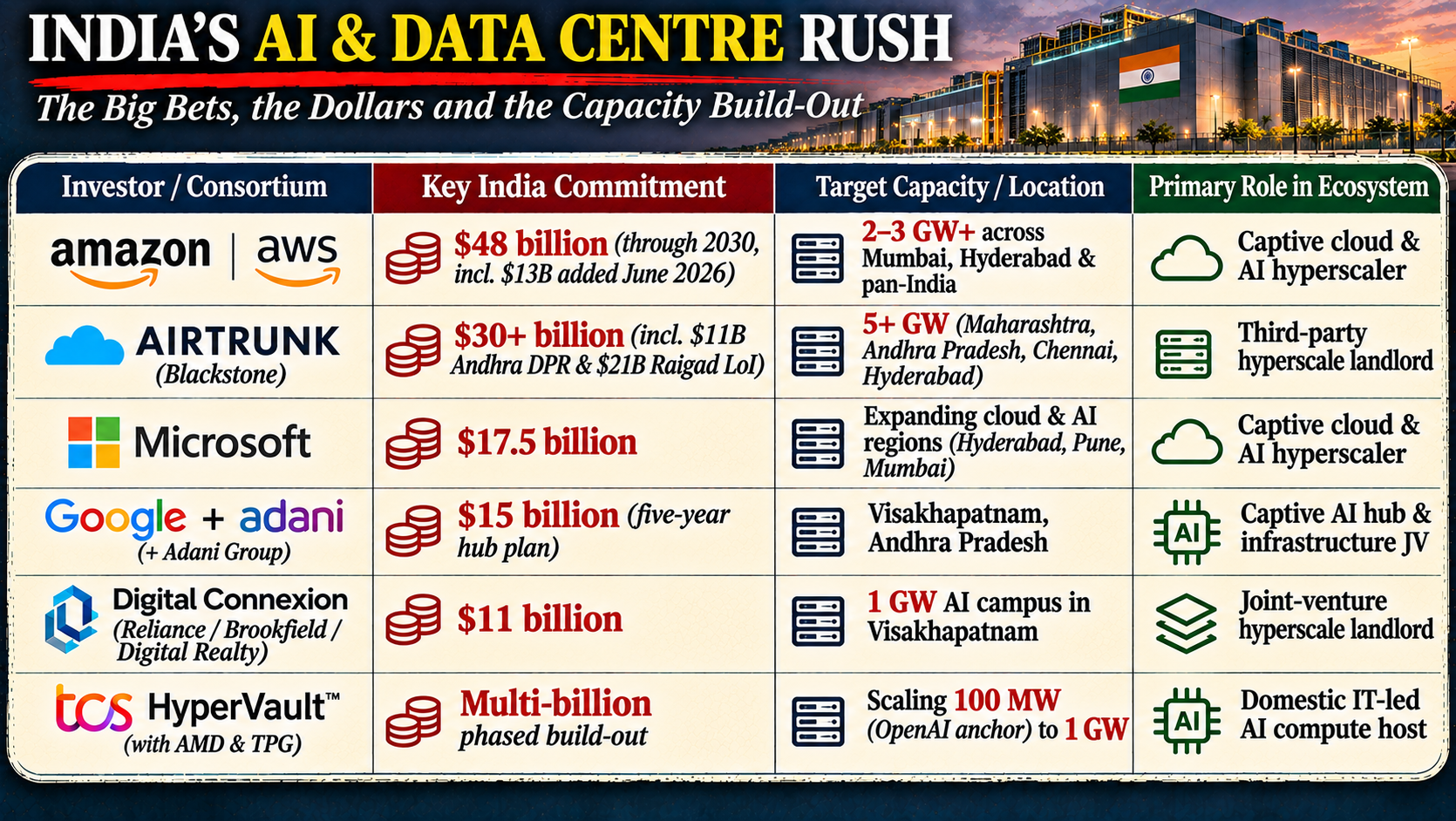
Unlike Amazon, Microsoft, or Google, AirTrunk does not sell cloud software or consumer AI tools. Its model resembles a specialised industrial landlord: Blackstone raises institutional debt and equity, AirTrunk secures land, grid substations, and liquid-cooled shells, and global tech giants sign long-term, credit-backed leases to house their GPU clusters.
The Execution Test: Power Grids, Water, and the Revenue Gap
Filing a ₹1.03 lakh crore detailed project report is an important milestone, yet turning 1.8 GW of blueprints into live servers in Andhra Pradesh carries formidable execution risks:
The Power Bottleneck: AI server racks—such as Nvidia’s high-density liquid-cooled systems—draw vastly more power per square foot than legacy enterprise cloud servers. Delivering 1.8 GW in Andhra Pradesh and 3 GW in Raigad requires dedicated extra-high-voltage (EHV) substations, multi-year transmission upgrades, and massive captive solar-wind hybrid contracts to keep operating costs globally competitive.
Thermal & Water Stress: Hyperscale AI halls require closed-loop direct-to-chip liquid cooling to avoid straining municipal water supplies in hot coastal climates. Securing environmental and water clearances without local pushback will be essential.
Capital Ahead of Revenue: According to research by KPMG cited in October 2026, India’s entire data centre industry generated roughly $1.7 billion in revenue in FY26, projected to reach $6.8 billion by 2030. Set against more than $100 billion in cumulative industry investment pledges, infrastructure builders are spending far ahead of current domestic revenue—betting that sovereign AI workloads, data-localisation mandates, and global AI inference traffic will fill these multi-gigawatt halls on schedule.
For Blackstone, however, the strategic calculus is clear. With Singapore grid-locked and US power queues stretching half a decade, India offers one of the few remaining democracies with the land, engineering talent, and renewable potential to build gigawatt-scale AI factories. If AirTrunk clears Andhra Pradesh’s grid and land hurdles, southern India’s coast could soon sit at the heart of Asia’s computing supply chain.