In brief
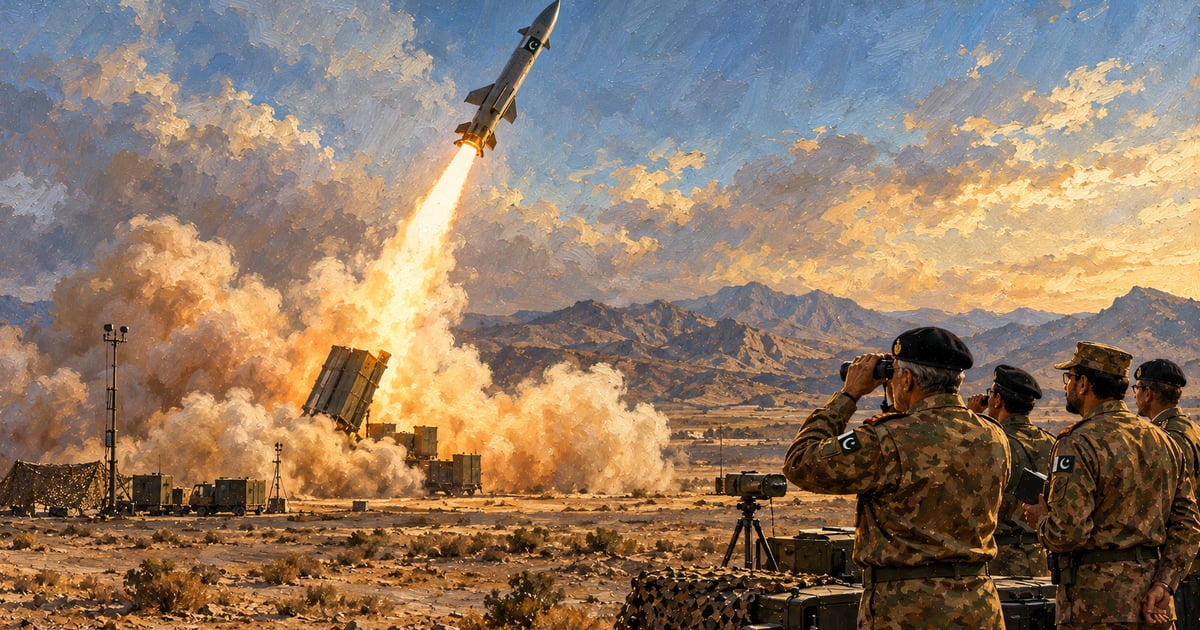
- On 6 October 2026, Pakistan test-fired an extended-range Fatah-4, a ground-launched cruise missile run by its Army Rocket Force.
- It’s slow (about Mach 0.7) and flies very low, 50-100 metres, to hide from radar. Range is 750 km, possibly 900-1,000 km in the new version.
- BrahMos isn’t its real match, since BrahMos flies at Mach 3. The closer match is India’s Nirbhay/LR-LACM, which reaches 1,000-1,500 km.
- India leads in fast missiles and air defence. Pakistan’s edge is cost: Fatah-4 is about $1 million each against $3.5-4 million for BrahMos, so it can build more.
- The article says this isn’t a new arms race, but a more dangerous stage of an old one, with less warning time in a crisis.
On 6 October 2026, Pakistan’s military conducted a successful test-launch of an extended-range variant of its indigenously developed Fatah-4 (Fatah-IV) ground-launched cruise missile. Coming just four months after an initial operational training launch in May 2026 and a year after the system was first unveiled in September 2025, the test by the Pakistan Army Rocket Force Command (ARFC) drew immediate regional scrutiny.
Public commentary in Islamabad and New Delhi quickly framed the Fatah-4 as Pakistan’s direct reply to India’s supersonic BrahMos and long-range subsonic Nirbhay (now evolving into the Long-Range Land Attack Cruise Missile, or LR-LACM). Popular narratives have intensified because BrahMos underwent extensive operational deployment during the May 2025 cross-border conflict—codenamed Operation Sindoor—and has since secured major foreign export contracts across Southeast Asia.
However, treating the Fatah-4 as a direct peer to BrahMos conflates two entirely different engineering philosophies. Understanding who holds the tactical advantage requires deconstructing the aerodynamics of supersonic kinetic shock versus subsonic terrain masking, examining the operational lessons of Operation Sindoor, and assessing whether the subcontinent has entered a destabilising new arms race.
1. What Is Pakistan’s Fatah-4?
The Fatah-4 (frequently designated Fatah-IV) represents a key structural evolution in Pakistan’s land-attack doctrine. Developed under the umbrella of Global Industrial & Defence Solutions (GIDS) and assigned to the Pakistan Army’s ARFC, the system marks a transition in how Pakistan organises its conventional standoff fires.
Historically, Pakistan’s cruise missile arsenal was anchored by the Babur (Hatf-VII) ground-launched series and the air-launched Ra'ad (Hatf-VIII). Both programmes were developed under the Strategic Plans Division (SPD) and remained closely associated with nuclear delivery. By contrast, the Fatah lineage—which began with the Fatah-1 guided multi-launch rocket system (140 km range) and the Fatah-2 quasi-ballistic missile (400 km range)—is explicitly managed as a conventional artillery and rocket corps asset.
The Fatah-4 adopts cruise missile technology derived from the Babur family, packaged into a mobile, road-transportable launcher designed for rapid tactical employment by conventional field units.
Core Technical Profile of Fatah-4
Flight Regime: Subsonic, cruising at roughly Mach 0.7.
Propulsion: Solid-propellant rocket booster for canister ejection, transitioning to a small turbojet or turbofan engine for sustained cruise flight (Quwa Analysis).
Range: The baseline Fatah-4 demonstrated a strike radius of 750 km. While official ISPR disclosures withheld precise numbers for the 6 October 2026 Fatah-4 ER test, external assessments from Janes Defence point to a lengthened airframe and expanded fuel volume pushing range toward 900–1,000 km.
Flight Profile: Low-altitude terrain-hugging, flying at altitudes between 50 and 100 metres above ground level (Economic Times).
Guidance and Navigation: Inertial Navigation System (INS) integrated with satellite positioning (primarily utilizing China's BeiDou constellation), complemented by Terrain Contour Matching (TERCOM) and Digital Scene Matching Area Correlation (DSMAC) optical/radar seekers for terminal accuracy.
2. Comparing Fatah-4 Against BrahMos: Apples to Oranges
Comparing Pakistan’s Fatah-4 with India’s BrahMos is common in media reporting, but the comparison is technically mismatched. The two weapons operate on opposite aerodynamic paradigms.
Speed and Kinetic Energy
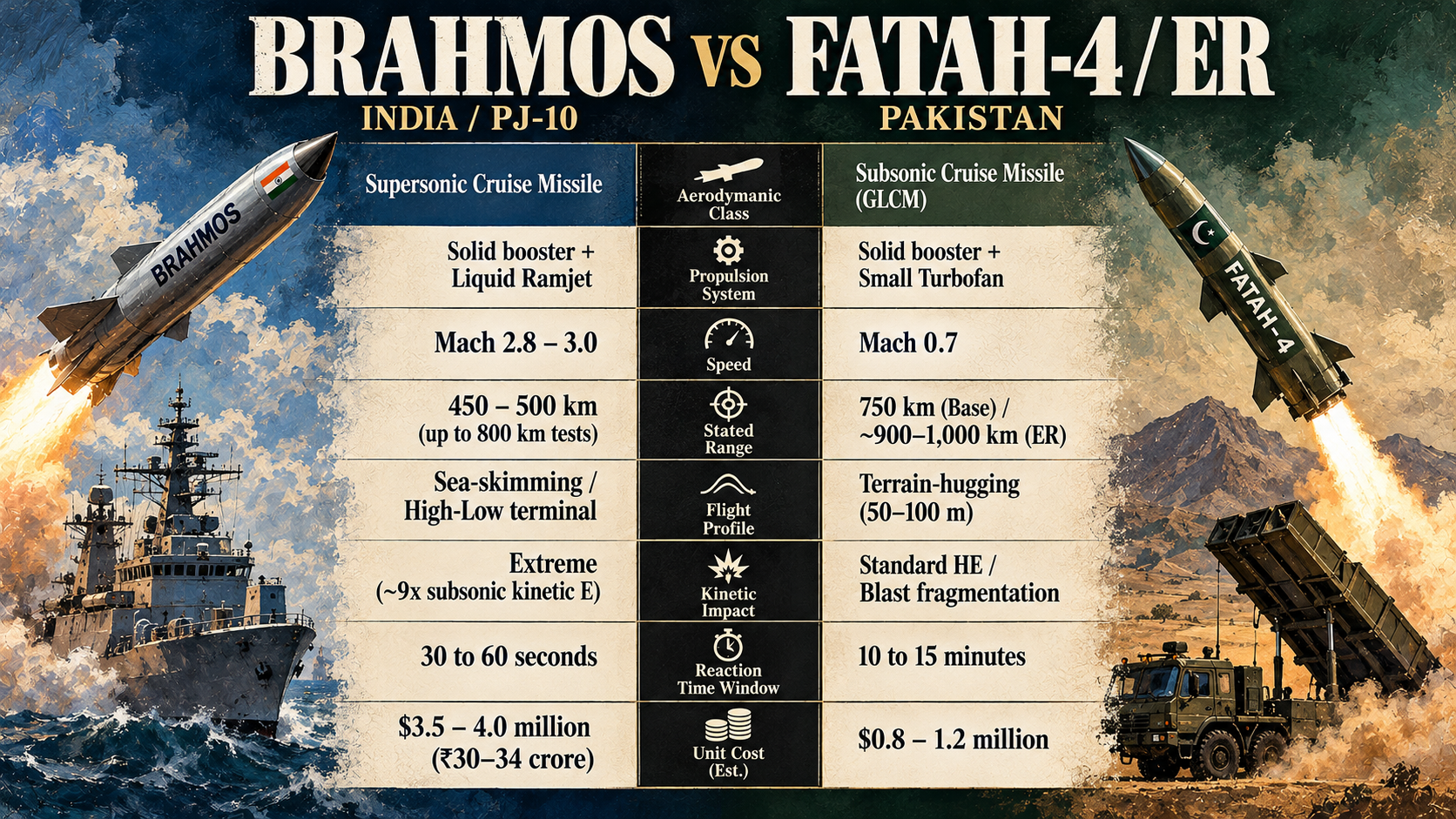
BrahMos is powered by a liquid-fuel ramjet engine that propels the missile at Mach 2.8 to 3.0. At this velocity, the weapon inflicts catastrophic structural damage through kinetic energy alone, before its 200–300 kg warhead detonates. This makes it devastating against hardened targets like reinforced aircraft shelters, subterranean command bunkers, and naval vessels.
The Fatah-4, by contrast, travels at high subsonic speeds (roughly 240 metres per second). Its destructive impact relies almost entirely on its high-explosive chemical warhead rather than kinetic energy.
Penetration Mechanics: Reaction Time vs Radar Horizon
The tactical divergence between the two missiles lies in how they bypass air defences:
BrahMos overwhelms defending radars through sheer speed: When flying at Mach 3, BrahMos covers one kilometre every second. An air defence battery that detects the missile at its radar horizon (roughly 30 to 40 km for low-altitude incoming threats) has fewer than 40 seconds to identify, track, compute a firing solution, and launch interceptors.
Fatah-4 evades detection through terrain masking: Because it travels at subsonic speed, Fatah-4 would be vulnerable to standard surface-to-air missile (SAM) batteries if detected early. Its survivability relies on flying below radar coverage (50 metres or lower), weaving through river valleys, hills, and ridgelines to avoid line-of-sight detection by ground radars until it is near the target.
3. The True Peer: Fatah-4 vs Nirbhay / LR-LACM
The proper technological comparison for the Fatah-4 is not BrahMos, but India’s Nirbhay programme and its operational successor, the Long-Range Land Attack Cruise Missile (LR-LACM).
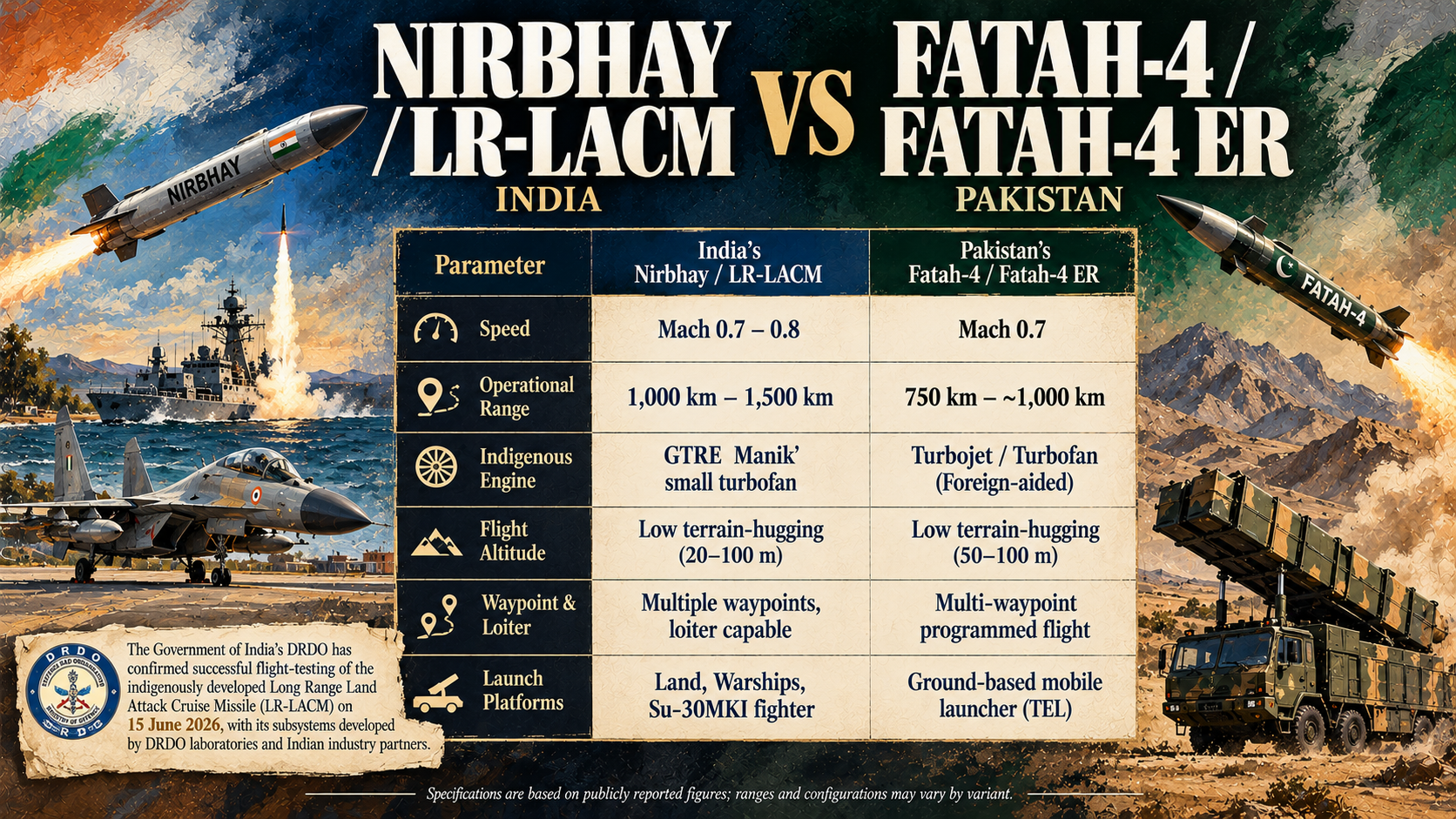
Both systems share identical mission profiles: deep conventional interdiction, long endurance, and complex waypoint navigation. However, the Indian LR-LACM holds several distinct advantages:
Range and Strategic Depth: The LR-LACM delivers an operational reach of 1,000 to 1,500 km (Defence.in). This allows Indian forces to strike targets throughout Pakistan from launching positions deep within central or southern India, well outside the range of Pakistani counter-battery fire. Fatah-4, even in its extended-range form, covers roughly 750 to 1,000 km.
Propulsion Self-Reliance: After early reliance on Russian NPO Saturn engines during initial Nirbhay trials, the Defence Research and Development Organisation (DRDO) successfully integrated the indigenous 'Manik' small turbofan engine developed by the Gas Turbine Research Establishment (GTRE). Pakistan’s Fatah-4 remains reliant on propulsion designs heavily influenced by Chinese or imported component supply chains.
Tri-Service Integration: The LR-LACM was designed from inception for deployment across the Indian Army, Indian Navy (via universal vertical launch modules on destroyers and frigates), and the Indian Air Force (integrated on the Su-30MKI). The Fatah-4 remains primarily a ground-launched Army system, though air- and sea-launched roles in Pakistan are addressed separately by the Ra'ad and Harbah/Babur variants.
4. Operation Sindoor and the BrahMos Combat Precedent
The operational urgency behind Pakistan’s push for the Fatah-4 cannot be understood without reviewing the air and missile operations of May 2025.
During Operation Sindoor (7–10 May 2025), India executed precision standoff strikes targeting terrorist infrastructure and supporting military facilities in Pakistan. Independent analyses and strategic assessments (Observer Research Foundation) estimate that approximately 15 to 19 BrahMos supersonic cruise missiles were launched from mobile ground platforms and Su-30MKI fighters.
The operational results reshaped South Asian military planning:
Air Defence Stress: Pakistan’s modern Chinese-supplied air defence systems—including the long-range HQ-9/P and medium-range HQ-16FE—struggled to intercept supersonic BrahMos salvos due to the compressed engagement window and high terminal speeds.
Runway and Base Denial: BrahMos strikes inflicted serious damage on command facilities, fuel depots, and aircraft shelters across multiple Pakistani forward operating locations.
Doctrinal Validation: The operation showed that precision supersonic cruise missiles could carry out punitive, non-nuclear strikes deep inside adversary territory without requiring strike aircraft to cross hostile borders, fundamentally altering escalation management.
The Export Surge
The operational validation of BrahMos in Operation Sindoor accelerated its export prospects. Having fulfilled a $375 million (approx. ₹3,100 crore) coastal defence contract to the Philippines, India concluded a procurement deal with Vietnam and entered advanced negotiations with Indonesia, pushing its confirmed and projected BrahMos export book past $600 million (approx. ₹5,000 crore). This export success provides India with economies of scale and production funding that Pakistan’s domestic missile industry cannot match.
5. Who Leads? Assessing the Tactical Balance
Declaring a single "leader" requires dividing the assessment into three distinct dimensions: technological maturity, defensive countermeasures, and operational economics.
Dimension 1: High-Speed Strike and Combat Maturity — India Leads
India holds a decisive lead in supersonic missile propulsion, terminal guidance, and operational induction. BrahMos is mature, fully integrated across all three services, and combat-proven in high-intensity operations. Furthermore, India’s ongoing tests of the BrahMos-ER (extending range to 800 km) and the lighter, stealthier BrahMos-NG for integration on MiG-29K, Rafale, and Tejas Mk1A platforms place India a generation ahead in high-speed standoff capabilities.
Dimension 2: Subsonic Long-Range Strike — India Leads in Range, Pakistan Leads in Rapid Deployment
In the subsonic cruise missile category, India’s Nirbhay / LR-LACM holds the technological edge in range (up to 1,500 km) and engine indigenisation (Manik turbofan). However, Pakistan has moved swiftly to operationalise the Fatah-4 under the ARFC. While India took years to refine the Nirbhay through iterative trials, Pakistan leveraged its mature Babur engineering baseline to field the Fatah-4 quickly as a mobile, conventional rocket-force weapon.
Dimension 3: Air Defence Interception Dynamics — Advantage India
Cruise missiles do not operate in a vacuum; their effectiveness depends on the opposing air defence network:
Pakistan’s Challenge Against BrahMos: Intercepting a Mach 3 missile remains technically difficult for Pakistan’s HQ-9/P and HQ-16FE systems, as demonstrated during the May 2025 strikes.
India’s Defence Against Fatah-4: Detecting low-flying subsonic cruise missiles travelling at 50 metres presents a real challenge for ground-based radar due to radar horizon limitations. However, India possesses a dense, multi-layered integrated air defence network featuring the Russian S-400 Triumf, Indo-Israeli MRSAM (Barak-8), Akash-Prime, and Akash-NG. Crucially, India operates Netra and Phalcon Airborne Early Warning and Control (AEW&C) aircraft capable of "look-down/shoot-down" radar tracking, mitigating ground-level terrain masking and allowing interceptors to engage low-flying subsonic cruise missiles before they reach their targets.
Dimension 4: Production Economics and Asymmetric Saturation — Pakistan’s Strategic Lever
Where Pakistan achieves parity is in production economics. A supersonic ramjet missile like BrahMos costs upwards of $3.5 million to $4.0 million (approx. ₹30 crore to ₹34 crore) per unit. A subsonic cruise missile like Fatah-4 can be manufactured for a fraction of that cost (an estimated $800,000 to $1.2 million). This allows Pakistan to build larger inventories designed to saturate Indian air defence radars through swarm salvos paired with Fatah-1 and Fatah-2 rockets.
6. The Beginning of a New Arms Race?
Is the Fatah-4 the opening salvo of a new arms race in the subcontinent?
The answer is no, but it marks a dangerous escalation in an existing one.
South Asia is not witnessing the start of an arms competition; rather, it is experiencing the maturation of a second-generation conventional standoff race below the nuclear threshold.
For three decades following the 1998 nuclear tests, the India-Pakistan missile dynamic was defined by nuclear-capable ballistic missiles (India’s Prithvi and Agni series versus Pakistan’s Ghauri, Shaheen, and Ghaznavi). That dynamic rested on strategic deterrence: the belief that any major cross-border military operation would risk nuclear escalation.
That paradigm shifted permanently between the 2019 Balakot airstrikes and the May 2025 Operation Sindoor strikes. Operation Sindoor proved that conventional, high-precision standoff weapons could be launched in volume to strike critical military targets without crossing the nuclear threshold.
The introduction of the Fatah-4 ER is Pakistan’s direct attempt to restore balance to this conventional strike equation. Having witnessed the operational impact of BrahMos against its bases in 2025, the Pakistani military concluded that relying on strategic nuclear deterrence was insufficient to prevent Indian conventional strikes. The ARFC needed its own conventional, long-range, precision weapon to threaten Indian military targets in depth, creating a symmetrical counter-strike capability.
The danger of this shift lies in crisis stability. Subsonic and supersonic cruise missiles have short flight profiles and can hug the terrain or skim the surface, leaving little time for warning or verification. In a future military standoff, the temptation to launch pre-emptive counter-force strikes against mobile missile batteries and airfields will be high. As both nations deploy hundreds of precision conventional cruise missiles alongside layered air defence shields, the margin for error in South Asian crisis management has grown narrower than ever.