On 12 August 2026, Natarajan Chandrasekaran, the first non-Parsi professional to chair Tata Sons, brought an abrupt end to months of corporate speculation by announcing that he would not seek reappointment when his second term concludes on 20 February 2027. His public statement laid bare a stark corporate reality: after four decades within the Tata Group and nearly a decade at its summit, his bid for a third five-year term had run aground on the rock of boardroom dissent.
Unlike the tumultuous, security-escorted dismissal of Cyrus Mistry on 24 October 2016, Chandrasekaran’s departure has been couched in the language of voluntary withdrawal. Yet the tranquil phrasing cannot mask the magnitude of the tremor. Within three trading sessions of his announcement, listed Tata Group companies shed more than ₹40,000 crore ($4.8 billion) in market capitalisation, with crown jewel Tata Consultancy Services (TCS) sinking over 5% as reported by The New Indian Express.
Beneath the surface lies an intricate web of competing interests: the tension between long-gestation industrial capital expenditure and philanthropic cash-flow requirements, a regulatory clampdown on the trusts that hold the group's equity, and a high-stakes standoff with the Reserve Bank of India (RBI) over whether the holding company must surrender its private status and list publicly.
The Anatomy of an Impasse: The 24 February Boardroom Split
The genesis of the rupture dates back nearly a year before Chandrasekaran's announcement. On 11 September 2025, the two principal philanthropic vehicles of the conglomerate—the Sir Dorabji Tata Trust (SDTT) and the Sir Ratan Tata Trust (SRTT), which together hold a 51.54% stake in Tata Sons—unanimously recommended that Chandrasekaran be granted a third five-year term starting in February 2027. The recommendation was subsequently vetted and endorsed by the Tata Sons Nomination and Remuneration Committee.
When the matter reached the nine-member Tata Sons board on 24 February 2026, ratification was widely expected to be procedural. Instead, it triggered a deadlock. Noel Tata—half-brother of the late patriarch Ratan Tata, Chairman of the Tata Trusts, and a director on the Tata Sons board—withheld his support, as detailed by The Hindu.
Under Article 118 of the Tata Sons Articles of Association, the appointment or renewal of the executive chairman requires unanimous board consent. Faced with Noel Tata’s dissent, Chandrasekaran deferred the resolution.
For six months, backchannel negotiations failed to bridge the philosophical gulf between the two leaders. With Tata Sons' Annual General Meeting (AGM) looming on 18 August 2026—where his directorship would have required confirmation—Chandrasekaran realised that an unresolved directorship rendered his chairmanship untenable. Rather than face a public rejection or an open floor fight at the AGM, he elected to withdraw his candidacy.
The Dual Balance Sheet: Growth versus Capital Attrition
To understand why Noel Tata broke ranks, one must examine the divergent economic realities within the conglomerate.
On headline metrics, Chandrasekaran’s decade-long stewardship delivered extraordinary expansion:
Group Revenues: Expanded from ₹6.72 lakh crore ($80.6 billion) in FY16 to ₹16.24 lakh crore ($194.9 billion) in FY26.
Net Profit: Surged more than fivefold to ₹1.72 lakh crore ($20.6 billion).
Consolidated Market Capitalisation: Rose from ₹9.3 lakh crore ($111.6 billion) to ₹24.4 lakh crore ($292.8 billion).
Yet this expansion masked a deepening structural reliance on legacy engines to subsidise speculative new bets. The group had committed over ₹10 lakh crore ($120 billion) to emerging technologies and turnaround assets over a five-year horizon, following an initial ₹5.5 lakh crore ($66 billion) tranche.
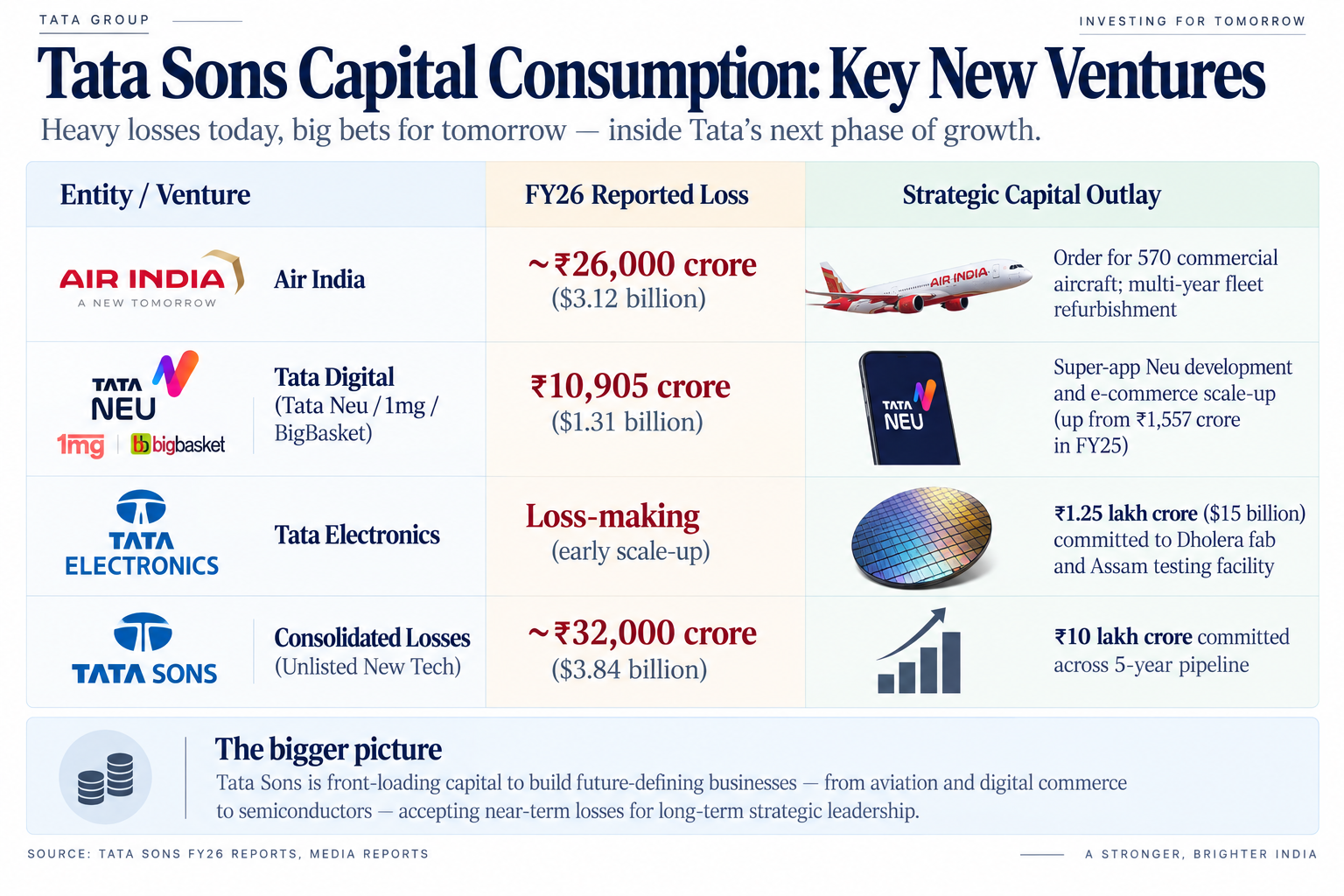
At the 12 June 2026 board meeting, financial reviews confirmed that the group's unlisted subsidiaries recorded aggregate losses close to ₹32,000 crore ($3.84 billion) in FY26, according to reporting by The New Indian Express. Air India alone bled approximately ₹26,000 crore ($3.12 billion) as it absorbed the costs of fleet integration and legacy restructuring. Simultaneously, traditional cash cows experienced friction: TCS encountered margin pressures from enterprise generative AI transitions, while Jaguar Land Rover suffered a 20% revenue drop in FY26, driven by Western tariff adjustments and operational disruptions.
For Noel Tata and the allied trustees, this cash burn represented an existential risk to the philanthropic mandate. The 13 allied Tata Trusts depend almost exclusively on Tata Sons’ dividend declarations to fund nationwide philanthropic programmes. As hundreds of billions of rupees were diverted to sustain capital-intensive manufacturing, battery gigafactories (such as Agratas), and loss-making consumer portals, the dividend stream shrank, sharpening fiduciary resistance inside the trusts.
Governance Paralysis: The Charity Commissioner’s Intervention
While financial friction provided the motive, administrative paralysis supplied the mechanism that made compromise impossible.
In May 2026, the Maharashtra Charity Commissioner issued an ex-parte directive barring the Sir Ratan Tata Trust (SRTT), owner of a 23.56% stake in Tata Sons, from convening trustee meetings. The order arose from a legal petition alleging that SRTT’s board composition violated a September 2025 amendment to the Maharashtra Public Trusts Act, which mandates that lifetime or permanent trustees cannot exceed 25% of a trust’s governing body.
SRTT had operated with half of its six trustees serving lifetime appointments—namely Noel Tata, Jimmy Tata, and Jehangir H.C. Jehangir—all instituted years prior to the statutory amendment. While the trust contested the order on the grounds that statutory modifications cannot apply retrospectively to settled appointments, the legal injunction remained in force throughout the summer.
This restriction created an insurmountable administrative bottleneck:
Quorum Void at Tata Sons: Under Tata Sons’ charter, the Sir Dorabji Tata Trust and Sir Ratan Tata Trust must jointly nominate their representatives to establish a valid shareholder quorum.
The 18 August AGM Collapse: Because SRTT was legally incapacitated from assembling and voting, the Tata Sons AGM scheduled for 18 August 2026 could not achieve quorum and had to be adjourned, as revealed by NDTV Business. The company subsequently obtained a three-month extension from the Registrar of Companies (ROC).
Impaired Selection Machinery: The governance freeze also prevented SRTT from delegating members to the five-member chairman search panel, leaving the succession process stranded in procedural limbo.
The RBI Ultimatum: The Forced Public Listing
Compounding the internal crisis is an external confrontation with the banking regulator. In October 2022, the Reserve Bank of India classified Tata Sons as an Upper-Layer Non-Banking Financial Company (NBFC-UL) under its Scale-Based Regulatory Framework, which mandates that entities of systemic size must list on public bourses within three years.
To preserve its private corporate character, Tata Sons restructured its balance sheet. By March 2024, the holding company paid off its public debt, halted corporate debt guarantees for group affiliates, and submitted an application to the central bank to voluntarily surrender its Core Investment Company (CIC) licence.
On 11 September 2026, after sitting on the dossier for 30 months, the RBI formally rejected Tata Sons' plea to cancel its NBFC registration and directed it to list immediately, as documented by The New Indian Express.
A forced Initial Public Offering (IPO) represents an existential threat to the traditional governance model of Bombay House. Public listing would subject Tata Sons to the stringent disclosure norms of the Securities and Exchange Board of India (SEBI), expose internal trust-board consultations to shareholder scrutiny, and dilute the controlling leverage of the Tata Trusts.
Conversely, the Shapoorji Pallonji Group, which holds an 18.37% equity stake in Tata Sons, has openly advocated for a listing, recognising that a public market float offers liquidity and price discovery for its holdings.
In response to the RBI's directive, Tata Trusts prepared a joint writ petition under Article 226 of the Constitution before the Bombay High Court to challenge the order, while the central bank pre-emptively lodged a caveat on 15 September 2026 to ensure it is heard before any interim relief is granted, according to court reporting by The New Indian Express.
Succession Dilemmas: Who Will Steer Bombay House?
With Chandrasekaran serving out his final months until February 2027, attention has shifted to the succession mechanism. Under standard charter protocols, a five-member selection committee—typically comprising two representatives from the Tata Trusts, two external independent experts, and one member from Tata Sons—must be assembled to evaluate candidates.
Several internal and external candidates have emerged in market discussions:
Noel Tata (69): While his accession to the chairmanship of the Tata Trusts cemented his patriarchal authority, he cannot easily occupy the Tata Sons executive chair on a permanent basis. Group retirement guidelines mandate superannuation for executive directorships at age 70, and holding both chairs simultaneously would re-create the concentration of power that the group dismantled after 2016. An interim custodial chairmanship remains possible.
Neville Tata (32): Son of Noel Tata and head of Star Bazaar within Trent, Neville has been inducted as a trustee across several philanthropic entities. However, elevating him to the pinnacle of a ₹24 lakh crore conglomerate at this stage would run counter to institutional precedent.
T.V. Narendran: Managing Director and CEO of Tata Steel, Narendran is widely respected across Bombay House for orchestrating European capacity restructuring and navigating cyclical industrial crises.
P.B. Balaji: Group Chief Financial Officer of Tata Motors and architect of the Jaguar Land Rover deleveraging programme, Balaji possesses deep credibility among domestic and global institutional investors.
Conclusion: The Defining Choice for the Tata Group
The crisis of 2026 marks a watershed moment for corporate India. Natarajan Chandrasekaran built a forward-looking industrial powerhouse equipped with semiconductor fabrication facilities, advanced cell manufacturing, and a unified national airline carrier. However, the sheer capital intensity of these ventures ran directly into the conservative fiduciary expectations of the trusts that own the group.
The next chairman will inherit not only a sprawling multinational business empire, but an immediate strategic dilemma: whether to double down on Chandrasekaran's high-stakes technology and aviation bets, or to execute a conservative retrenchment aimed at repairing dividend yields and defending the philanthropic fortress against regulatory listing mandates. As the Tata Sons board convenes, the fundamental question remains unresolved: who will govern the destiny of India's most powerful corporate balance sheet?