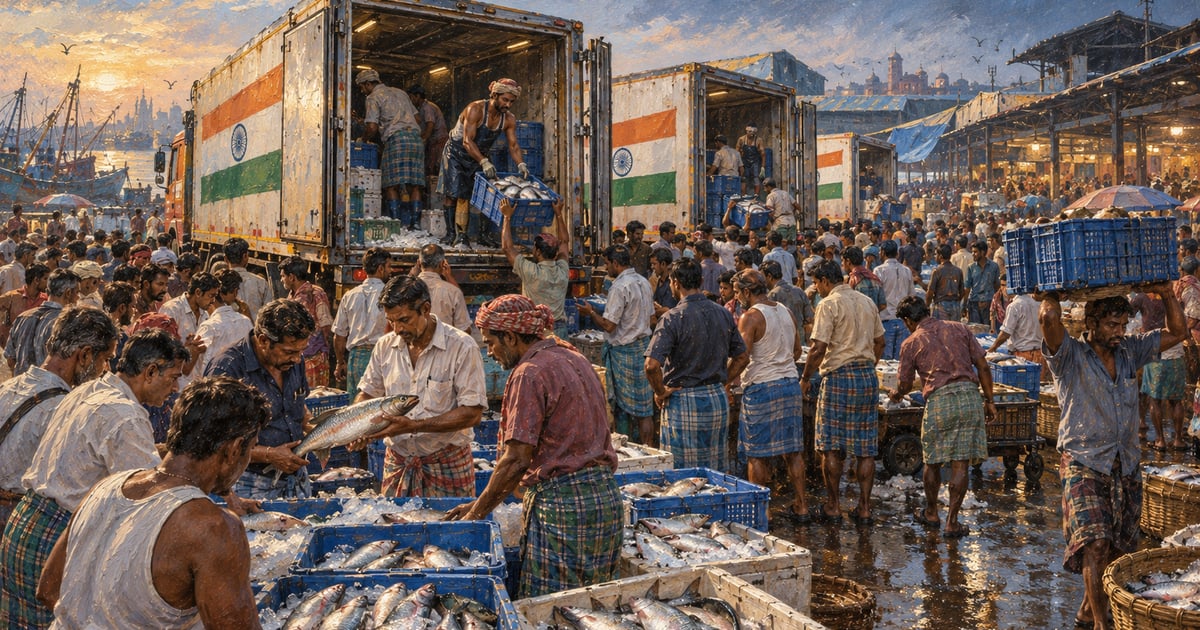
For more than a decade, the cross-border movement of hilsa (Tenualosa ilisha) between India and Bangladesh followed a predictable political choreography. Every autumn, ahead of Durga Puja, the government in Dhaka would temporarily relax its blanket ban on commercial hilsa exports, issuing special dispensations allowing a few thousand tonnes of the silver crop to cross into West Bengal. The ritual, dubbed "hilsa diplomacy", was designed as an act of goodwill, balanced against strict domestic protections to prevent local prices from spiralling beyond the reach of Bangladeshi consumers.
In the late summer of 2026, that historic trade current abruptly reversed direction.
Between July and August 2026, India exported approximately 500 tonnes (5 lakh kg) of hilsa to Bangladesh, with another 150 to 200 tonnes scheduled for delivery through September, according to figures released by wholesale trade groups and reported by The Business Standard. Data from Benapole Land Customs shows that 3,52,787 kg of Indian hilsa crossed the Petrapole–Benapole border during those two months alone, with import volumes jumping nearly eleven-fold from 29,440 kg in July to 3,23,346 kg in August.
To casual observers, this reversal appears to be an indictment of Bangladesh’s wider macroeconomic turbulence—a symbol of an economy struggling with elevated food inflation, currency adjustments, and commodity market instability. Yet the true anatomy of this trade shift is more complex. The reversal is the product of three colliding forces: severe ecological disruptions in the Padma–Meghna river basin, a widening price arbitrage between Indian marine landings and Bangladeshi retail markets, and structural imbalances within local distribution cartels.
The Anatomy of a Trade Inversion
Bangladesh is the undisputed heartland of global hilsa production, typically accounting for 70 to 80 percent of the world’s supply. The fishery supports the livelihoods of roughly 7 lakh fishermen (700,000 fishermen) and contributes more than 1 percent to the country’s gross domestic product.
Because of the fish’s cultural prominence and its sensitivity to overexploitation, Bangladesh placed a moratorium on commercial hilsa exports in July 2012. From 2019 onwards, formal exports were permitted solely during a narrow four- to six-week window before Durga Puja.
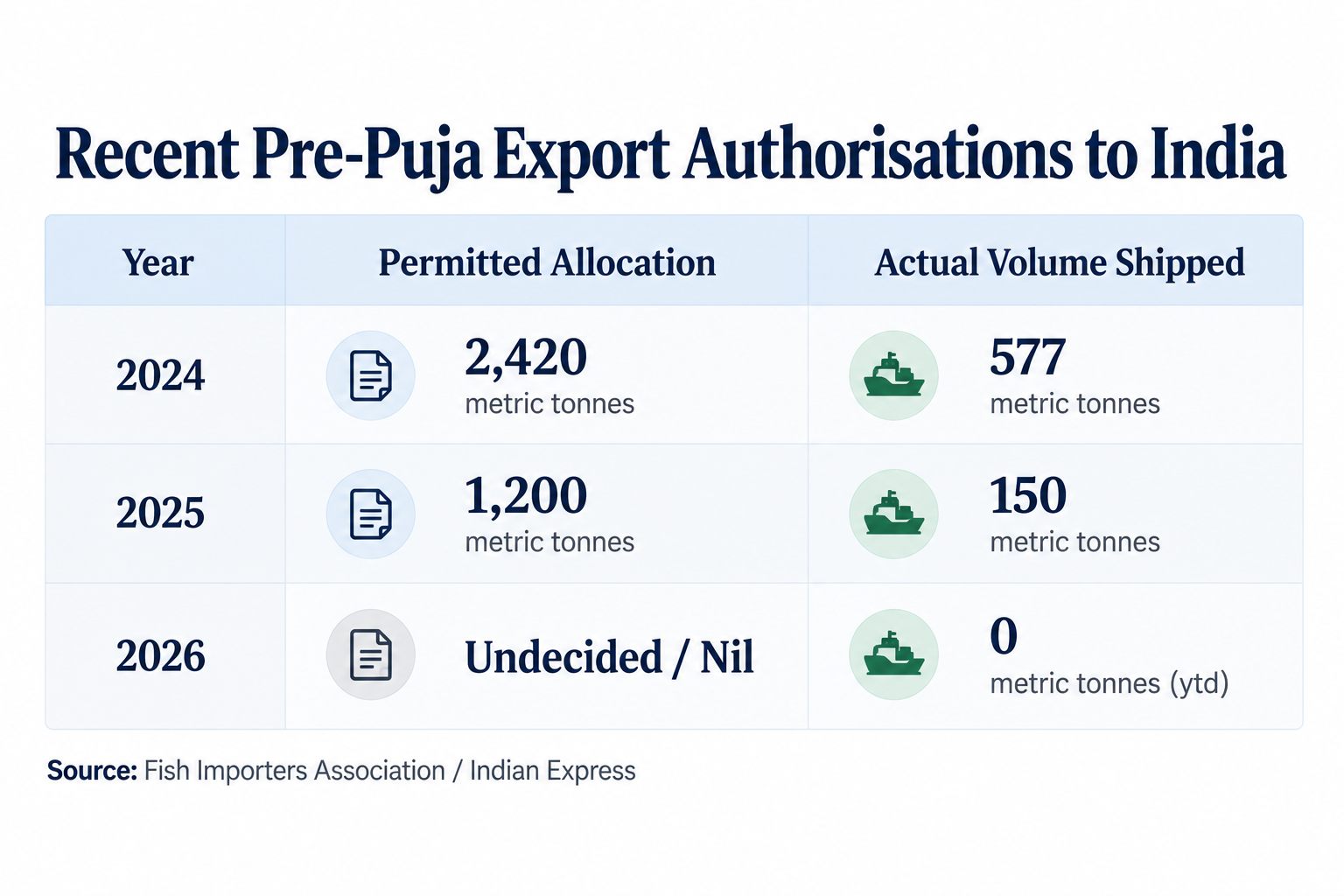
As reported by The Indian Express, the actual volumes dispatched under these quotas routinely fell far short of government allocations due to domestic shortages and bureaucratic bottlenecks. In the 2025–26 fiscal year, Bangladesh exported approximately 1,25,000 kg (125 tonnes) of hilsa, while importing 10.62 lakh kg (1,062 tonnes) from overseas. By early 2026–27, Bangladesh had exported zero hilsa, while imports from India alone surged past 5,91,000 kg (591 tonnes), according to reporting in the South Asian Herald.
The bulk of the Indian hilsa entering Bangladesh does not come from the Hooghly river in West Bengal, where catches have also remained constrained. Instead, the supply originates thousands of kilometres to the west—in Bharuch, Gujarat, along the Gulf of Khambhat and the mouth of the Narmada river.
Indian fish wholesalers, led by the Howrah Wholesale Fish Importers’ Association, identified a structural mismatch in domestic demand. In Indian markets, particularly across West Bengal, discerning consumers favour riverine hilsa, often discounting fish harvested during spawning runs when they are heavy with roe (dim-bhora ilish), which reduces flesh oiliness and alters texture. In Bangladesh, however, roe-filled hilsa commands a distinct premium, particularly in Chattogram and Sylhet, where eggs are processed and the remaining flesh is cured as salted hilsa (nona ilish).
The Price Divide: Landed Cost vs Domestic Bazaars
The immediate catalyst driving commercial shipments across the border is an extraordinary retail price disparity.
In Dhaka’s Karwan Bazar, as well as in major markets across Barishal and Khulna, a domestic Padma or Meghna hilsa weighing between 1.2 kg and 1.3 kg currently sells for Tk 3,300 to Tk 3,400 per kg (roughly ₹2,300 to ₹2,400 per kg). For a fish that once formed a regular weekend centrepiece for middle-class Bengali households, such prices have transformed hilsa into an exclusive luxury.
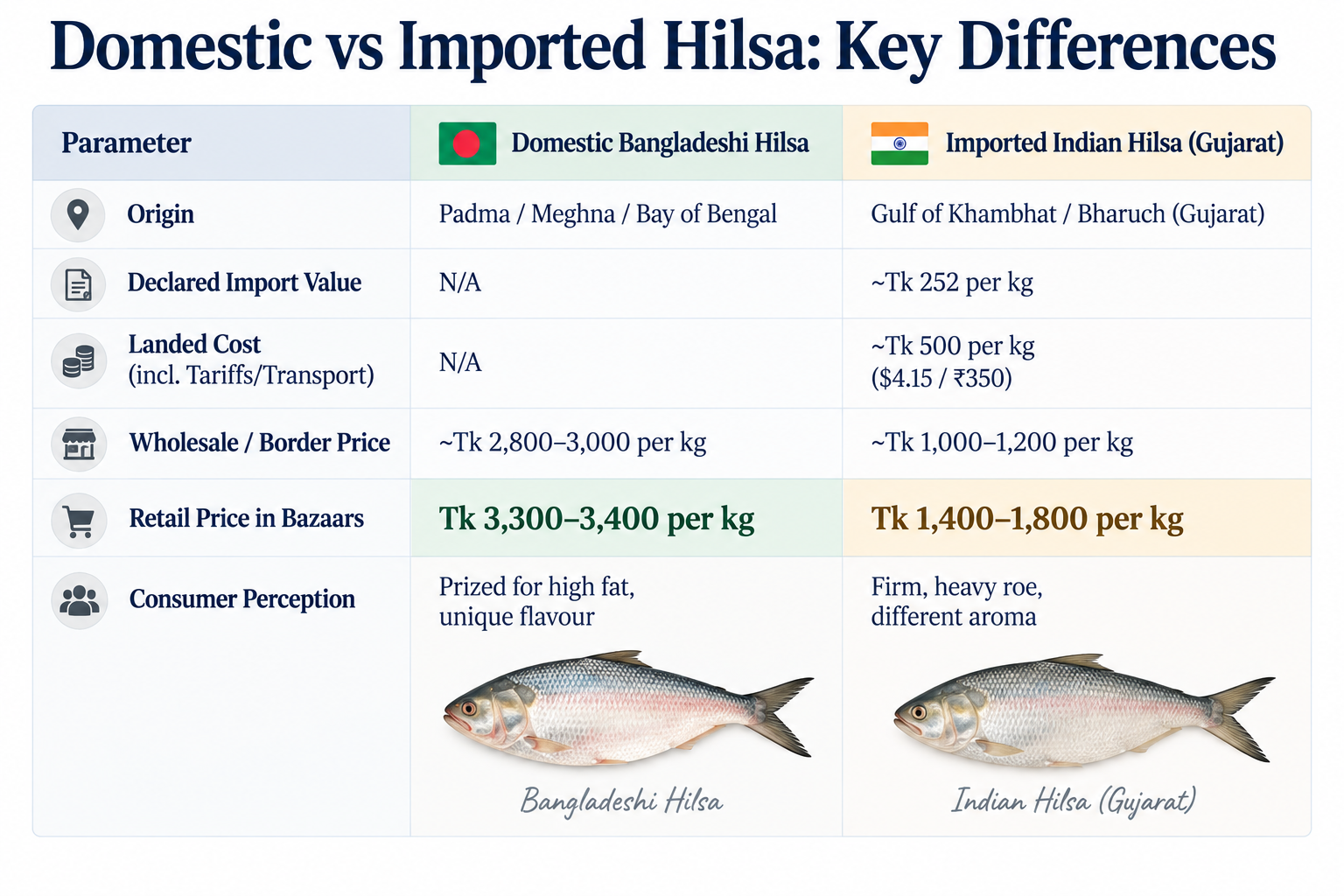
According to customs clearing disclosures reviewed by the Daily Sun, importing enterprises opened formal letters of credit (LCs) with declared values averaging Tk 252 per kg. Even after incorporating customs duties, regulatory fees, refrigerated haulage, and LC commission, the landed cost at Benapole stood at approximately Tk 500 per kg.
When transported to regional markets such as Jashore, Khulna, and Dhaka, this imported fish retails between Tk 1,400 and Tk 1,800 per kg—roughly half the price of locally caught hilsa. This steep margin has created lucrative commercial space for private importers, drawing 22 registered trading houses into the trade through Benapole by August 2026.
However, the price gap has also invited predatory market behaviour. Consumer rights monitoring bodies in southwestern Bangladesh have documented instances where imported Gujarat hilsa is relabelled by retailers as "Padma" or "Chandpur" hilsa to pocket windfall margins, misleading shoppers who only discover the differing texture and aroma after cooking.
The Underlying Crisis: Ecology, Not Just Economics
While the influx of Indian fish highlights local affordability pressures, framing this trade purely as a consequence of general economic mismanagement misses the deeper ecological crisis gripping Bangladesh's waterways.
Data compiled by marine biologists and fisheries departments shows that the country's hilsa problem is fundamentally a supply shortfall stemming from hydrological bottlenecks:
Catches Are Falling from Historical Peaks: After two decades of expansion under strict seasonal bans that pushed national output to a record 5.71 lakh tonnes (571,000 tonnes) in 2022–23, production dropped by 12.5 percent to roughly 5 lakh tonnes (500,000 tonnes) in 2023–24. Field investigations by The Daily Star revealed that in the peak landing windows of July and August, artisanal hauls fell by nearly 45 percent year-on-year.
Siltation and Migration Blocks: Hilsa is an anadromous species: it feeds in the marine waters of the Bay of Bengal and migrates upriver into freshwater river networks to spawn. Department of Fisheries surveys have mapped 17 major physical obstruction points across the Meghna–Tetulia estuary, including 14 in the Meghna river alone. While adult hilsa require at least 25 to 30 feet of water depth for unimpeded upstream migration, heavy siltation and emerging sandbars (chars) cause low-tide depths to drop to less than 9 feet in critical passages.
The Deep-Water Shift: Silt deposition, reduced freshwater discharge upstream from cross-border rivers, and industrial pollution along coastal channels have altered near-shore water salinity and temperature. Consequently, large schools of mature hilsa are remaining in deep offshore pelagic waters—often beyond depths of 40 metres.
The Technology Trap for Artisanal Fleets: Small-scale coastal fishermen operating traditional wooden trawlers lack the hydraulic winches, heavy deep-sea nets, and navigation equipment required to fish effectively at these depths. While deep-sea commercial trawlers can access these stocks, the coastal artisanal fleet—which accounts for the vast majority of local landings—returns from week-long voyages with empty holds and mounting debt.
Declining Fish Maturity: Upstream biological surveys conducted on the Padma river by fisheries researchers at Rajshahi University noted that mature hilsa are showing signs of dwarfing, with breeding fish measuring 17 to 18 cm and weighing under 150 grams, compared to the historical breeding standard of 23 cm and 300+ grams, pointing to severe environmental stress.
Macroeconomic Pressures and the Kitchen Table
The ecological disruption in the rivers has intersected directly with Bangladesh’s macroeconomic vulnerabilities.
Over the past two years, headline inflation in Bangladesh has remained elevated, with general consumer inflation recorded at 8.26 percent in August 2026 and food inflation at 7.02 percent, according to data from Trading Economics. Over the preceding twenty-four months, food inflation frequently crossed double digits, eroding household purchasing power across salaried and working-class families.
When staple food budgets are stretched, spending on high-cost animal proteins contracts. A retail price of Tk 3,400 per kg for domestic hilsa represents roughly 15 to 20 percent of the total monthly basic wage for an entry-level garment worker or junior clerical employee. Under these conditions, the willingness of local consumers to accept imported Indian hilsa at Tk 1,500 per kg is an exercise in household economic triage.
Simultaneously, the fish landing economy is burdened by the dadon system—an informal financing structure where wholesale commission agents (aratdars) lend capital to boat captains at extortionate rates to fund diesel, ice, and rations. When catches dwindle, the fixed costs of sea voyages do not disappear. Middlemen protect their margins by ratcheting up retail prices on the limited catch that reaches shore, compounding the retail price shock even as working fishermen sink into debt.
What the Shift Signals for Regional Trade
The sight of Indian trucks delivering hilsa into Bangladesh upends a deeply entrenched cultural and diplomatic trope in South Asia. Yet it underscores the pragmatic reality of bilateral supply chains:
Complementary Marine Niches: While West Bengal consumers seek out lean, freshwater Padma hilsa, the Arabian Sea produces high volumes of fatty, roe-bearing hilsa that Indian domestic markets undervalue. The formal opening of trade channels allows Gujarat's fishermen to monetise a surplus catch while offering Bangladeshi consumers an affordable alternative during peak festival periods.
The Necessity of River Rehabilitation: As noted in The Daily Star's editorial analysis, seasonal bans alone can no longer protect Bangladesh's national fish stock. Without capital-intensive capital dredging of the Meghna and Padma migration corridors, strict pollution control in industrial zones, and modernisation support for the artisanal fishing fleet, domestic production will remain constrained.
Market Integration Over Symbolism: The fact that 22 private firms imported hundreds of tonnes of Indian fish through regular commercial LCs demonstrates that food security imperatives ultimately override diplomatic posturing.
The reversal of the hilsa trade is neither an unmitigated indictment of Bangladesh's economy nor a permanent reordering of South Asian commerce. It is a stark warning of what happens when environmental degradation impairs a natural monopoly—and a demonstration of how cross-border trade flows adapt when domestic prices outrun the purchasing power of everyday consumers.