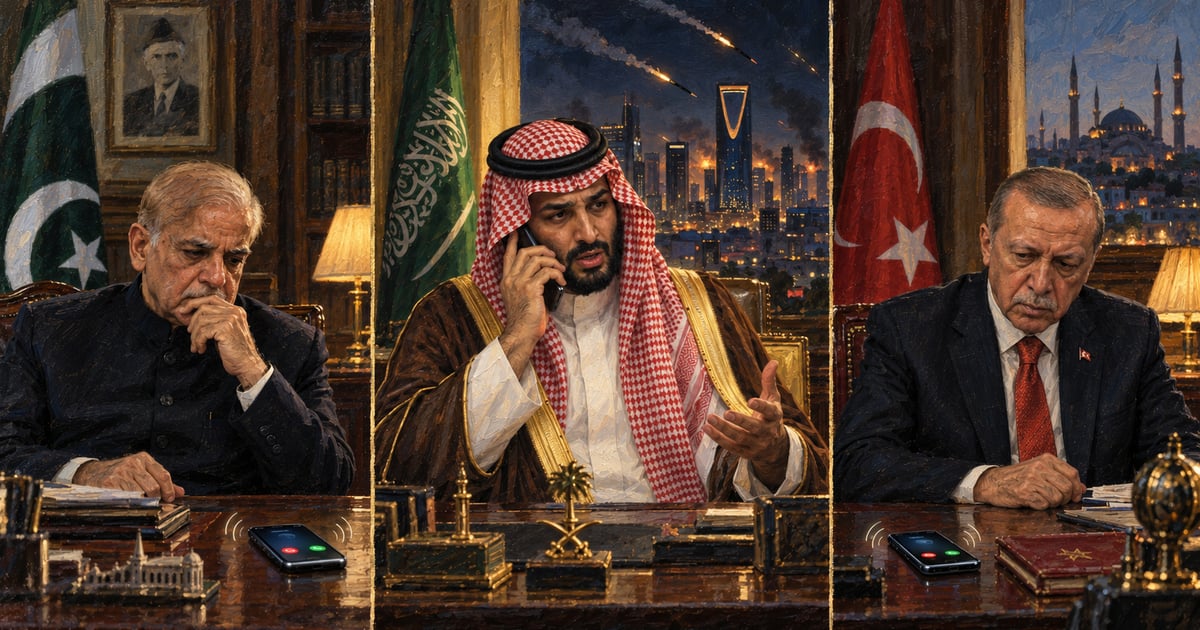
When Saudi Crown Prince Mohammed bin Salman, Turkish President Recep Tayyip Erdogan, and Pakistani Prime Minister Shehbaz Sharif gathered at Al-Safa Palace on 7 August 2026 to sign the Makkah Joint Defence Agreement, the symbolism was deliberate and commanding. By anchoring a trilateral mutual defence pact in Islam’s holiest city, the three capitals sought to establish a potent deterrent axis spanning the Persian Gulf, Anatolia, and South Asia.
Turkish Foreign Minister Hakan Fidan wasted no time framing its ambition, declaring to Anadolu Agency that the pact was "technically the same as Article 5 of the NATO treaty," enshrining the principle that an attack on one signatory would be treated as an attack on all.
Yet barely five weeks later, that grand architecture faced an acute operational crisis.
On 8 September, Yemen’s Houthi movement unleashed a coordinated swarm of ballistic missiles and loitering munitions against Saudi energy and defence infrastructure, wounding dozens. Then, on 15 September, the confrontation edged into the symbolic heart of the alliance: Saudi civil defence authorities broadcast live emergency warnings across Mecca, Jeddah, and Taif as regional air defences tracked incoming projectiles along the Red Sea corridor.
As reported by The Financial Times, phone alerts instructed residents in Mecca to take precautions, marking a rare and alarming intrusion of ballistic warfare into Islam’s foremost sanctuary.
The immediate aftermath revealed an unmistakable reality: while Saudi Arabia warned it would react "firmly", neither Islamabad nor Ankara scrambled fighter wings or dispatched expeditionary strike groups. Instead, they issued diplomatic condemnations and reaffirmed their commitments in principle.
The crisis has cast a harsh spotlight on the limits and depth of the Mecca Accord, exposing the wide gulf between political deterrence on paper and collective military action on the battlefield.
The Anatomy of the Mecca Accord: Collective Shield or Strategic Rhetoric?
To understand why the trilateral accord did not produce an instant military counter-strike against Sanaa, one must dissect the structure of the agreement itself.
The Mecca Joint Defence Agreement did not emerge in a vacuum. It was built atop the bilateral Strategic Mutual Defence Agreement (SMDA) ratified between Riyadh and Islamabad in September 2025, which saw Pakistani military contingents and Pakistan Air Force fighter squadrons—including modern JF-17 Thunder multirole aircraft—deployed to Saudi air bases such as King Abdulaziz Air Base. The accession of Turkey on 7 August transformed a bilateral security compact into a tripartite bloc representing three of the Muslim world's most formidable conventional militaries.
Key Milestones of the Trilateral Security Architecture
September 2025: Saudi Arabia and Pakistan sign the bilateral Strategic Mutual Defence Agreement (SMDA).
April 2026: Pakistan deploys combat aircraft and ground advisory personnel to King Abdulaziz Air Base under bilateral security arrangements.
7 August 2026: Saudi Arabia, Turkey, and Pakistan sign the trilateral Mecca Joint Defence Agreement at Al-Safa Palace in Mecca.
31 August 2026: First ministerial follow-up committee convenes in Istanbul, establishing a permanent secretariat in Riyadh under a three-year Pakistani chairmanship.
8–15 September 2026: Houthi ballistic missiles and drones strike Saudi installations and trigger emergency sirens across Mecca, Jeddah, and Taif, precipitating the pact's first operational crisis.
Despite the sweeping rhetoric of "an attack on one is an attack on all", the pact is an infant institution. When senior defence and foreign ministry officials met in Istanbul on 31 August 2026, they agreed on bureaucratic scaffolding—founding a joint secretariat based in Riyadh with Pakistan assuming the inaugural three-year chairmanship—and pledged collaboration on military technology.
Crucially, however, the alliance lacks:
An integrated military command structure.
Interoperable sensor-to-shooter data links between disparate air-defence grids.
Pre-delegated rules of engagement governing non-state incursions.
As Pakistani foreign ministry spokesperson Sajjad Haider Khan candidly noted following the strikes, the agreement remains an "umbrella framework" whose detailed operational mechanisms have yet to mature.
Furthermore, as strategic analyst Riaz Khokhar observed in Al Jazeera, the invocation of a NATO-style clause does not mandate automatic offensive warfare. Under NATO’s own precedents, Article 4 mandates urgent consultation, whilst Article 5 leaves the exact nature of assistance to the discretion of each sovereign capital.
When Syria downed a Turkish RF-4E reconnaissance jet in 2012, Ankara did not demand a full NATO invasion of Damascus; it requested, and received, allied Patriot surface-to-air missile batteries to reinforce its border. For the Mecca Accord, mutual defence implies defensive backstopping and deterrent positioning, not an open-ended mandate for foreign expeditionary entanglements.
Divergent Threat Perceptions: Three Capitals, Three Doctrines
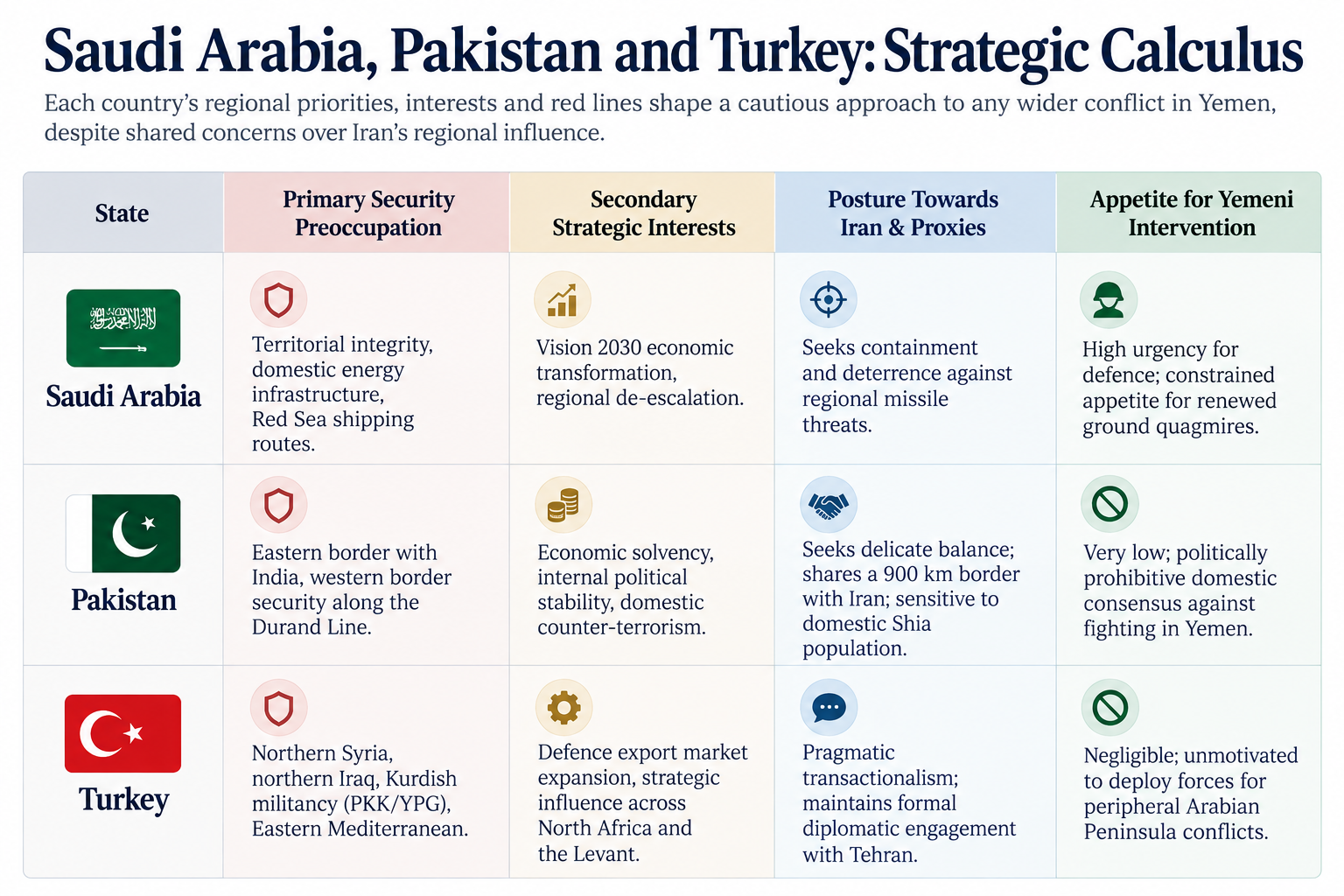
The core structural challenge confronting the Mecca Defence Alliance is that its three signatories face fundamentally different geopolitical imperatives and define their vital national interests through distinct strategic lenses.
Pakistan’s Delicate Equilibrium
For Islamabad, the prospect of entering direct hostilities against the Houthis carries grave domestic and regional perils. As reported by Middle East Eye, Pakistani Defence Minister Khawaja Asif affirmed that Pakistan would honour its treaty obligations if called upon. Yet the foreign ministry concurrently drew a bright line, confirming that offensive combat operations against the Houthis were not under consideration.
Pakistan's constraints are formidable:
The 2015 Precedent: In April 2015, the Pakistani Parliament unanimously passed a resolution mandating strict neutrality when Riyadh assembled Operation Decisive Storm in Yemen. While Islamabad reaffirmed its unwavering commitment to defend the territorial sanctity of the two Holy Mosques, it refused to deploy troops for offensive operations inside Yemen. That stance strained Saudi-Pakistani relations for years, but the underlying strategic logic remains unchanged.
The Iranian Frontier: Pakistan shares an unfortified 900-kilometre border with Iran in the restive Balochistan corridor. Following reciprocal cross-border missile strikes between the two militaries in January 2024, Islamabad has prioritised border de-escalation. Entering combat against an Iranian-supplied militia in Yemen risks unravelling that hard-won stability.
Domestic Sectarian Balance: Pakistan is home to one of the world's largest Shia Muslim populations outside Iran. Embroiling Pakistani armed forces in an overseas campaign perceived along sectarian lines would ignite severe domestic turbulence, an outcome military planners in Rawalpindi are determined to avoid.
Economic Vulnerability: Grappling with fiscal fragility and domestic inflation, Pakistan can ill afford the economic shockwaves of disrupted shipping corridors in the Persian Gulf or sharp spikes in imported energy prices.
Turkey’s Northern Horizon
Ankara’s participation in the Mecca pact reflects President Erdogan’s ambition to consolidate Turkish leadership within the wider Islamic world, unlock lucrative Gulf capital, and establish captive export markets for Turkey's booming defence manufacturing sector—led by Baykar, TAI, and Aselsan.
However, Turkish military doctrine is geared heavily towards its immediate near-abroad: neutralising Kurdish militant networks in northern Iraq and northern Syria, securing maritime entitlements in the Aegean and Eastern Mediterranean, and managing shifting balances across the South Caucasus.
Ankara maintains an intricate, competitive yet functioning relationship with Tehran. Deploying Turkish combat power to wage war on Yemeni insurgents in the southern Red Sea would yield virtually zero strategic return for Turkey's core national interests while exposing Turkish forces to asymmetrical blowback.
The Asymmetric Paradox: Deterring States vs Fighting Insurgents
A mutual defence pact is fundamentally designed to deter conventional sovereign states. The threat of tripartite retaliation by Saudi Arabia, Turkey, and Pakistan presents a formidable deterrent against overt aggression by another nation-state contemplating conventional ground invasions or cross-border aerial offensives.
Yet the security threat currently confronting Saudi Arabia does not take the form of conventional armies crossing borders. It is executed by Ansar Allah—an entrenched, ideologically driven, and highly distributed non-state actor operating from rugged mountainous redoubts in Yemen.
As asymmetric actors, the Houthis operate largely beyond the traditional logic of interstate deterrence:
Low Cost of Escalation: Firing a locally assembled Quds cruise missile or Samad drone costs a fraction of the high-end interceptor missiles (such as Patriot PAC-3 or THAAD) required to neutralise them.
Asymmetric Leverage: The Houthis possess no high-value, vulnerable state infrastructure comparable to Saudi Arabia's multi-billion-dollar Ras Tanura refining facilities, Yanbu petrochemical hubs, or Mecca’s hospitality and pilgrimage corridors.
Disregard for Conventional Superiority: A combined alliance possessing fifth-generation fighter jets, ballistic missile arsenals, and standing armies of over a million personnel offers little coercive leverage against an insurgent militia that has already survived a decade of relentless aerial bombardment.
Consequently, while the Mecca Accord provides Riyadh with diplomatic stature and enhanced technological depth, it offers no immediate silver bullet for the tactical nightmare of low-altitude drone swarms and ballistic trajectories aimed at western Saudi cities.
The Mecca Paradox: When the Symbol Becomes the Target
The deliberate branding of the agreement as the Mecca Joint Defence Agreement was intended to tap into deep historical and civilisational legitimacy. In Islamic jurisprudence and regional politics, the defence of the Two Holy Mosques (Mecca and Medina) represents an uncontested duty that unites otherwise divergent Muslim nations.
By targeting infrastructure in the Hijaz and causing air-raid sirens to sound across Mecca and Jeddah, the Houthis struck at the precise philosophical pivot of the pact.
The political dilemma for Islamabad and Ankara is acute:
If an alliance christened in Mecca fails to exhibit collective military resolve when Mecca’s own airspace is threatened, the pact risks being perceived as an empty diplomatic shell.
Conversely, if Saudi Arabia attempts to hold its allies to a maximalist interpretation of mutual defence—demanding active kinetic combat deployments against Yemen—it risks fracturing the alliance before its administrative secretariat has even established its offices in Riyadh.
The Likely Trajectory: How Will the Accord Adapt?
The current crisis will not cause the Mecca Defence Alliance to collapse; the geopolitical incentives driving trilateral alignment remain compelling for all three leaderships. However, the Houthi missile incursions will force a swift rationalisation of what the pact can practically deliver.
Over the coming months, the alliance's evolution is likely to manifest across three realistic domains:
1. Air and Missile Defence Integration, Not Ground Invasions
Rather than launching expeditionary operations in Yemen, Turkey and Pakistan are likely to augment Saudi Arabia's defensive envelope.
Pakistani Technical and Air Presence: Pakistan will expand its technical advisory presence and maintain combat air patrols over Saudi territory under the pre-existing bilateral SMDA umbrella, providing point defence for sensitive military installations.
Turkish Sensor and Counter-UAS Systems: Turkey will accelerate deliveries of specialised counter-unmanned aerial systems (C-UAS), electronic warfare suites, and low-altitude air defence radars capable of tracking terrain-hugging drones that often evade conventional high-altitude radar arrays.
2. Maritime Coalitions over Red Sea Chokepoints
With the Houthis threatening the Bab el-Mandeb strait and declaring maritime blockades, the focus of the trilateral partners will pivot towards naval containment. Pakistan and Turkey already maintain active naval presences in the western Indian Ocean and Gulf of Aden. Expanding multilateral naval patrols to secure commercial shipping lanes enables both nations to contribute meaningfully to Saudi economic security without conducting kinetic ground or air strikes on Yemeni soil.
3. Backchannel Deterrence and Diplomatic Pressures on Tehran
Rather than substituting for regional diplomacy, the Mecca Accord will function as an instrument of coercive leverage. High-ranking Pakistani and Turkish diplomatic and intelligence channels are actively engaging Iranian counterparts. By signalling to Tehran that unchecked Houthi escalations against Mecca could inexorably force foreign defensive reinforcements onto Saudi soil, Islamabad and Ankara will seek to persuade Iran to rein in its Yemeni partners.
Conclusion: Maturity Through Stress
The ballistic missile alerts echoing through the valleys of Mecca and the coastal avenues of Jeddah have ended the honeymoon period of the Mecca Joint Defence Agreement. They have proven that an alliance cannot exist solely on grand pronouncements and shared cultural symbolism.
The pact is neither an instantaneous "Islamic NATO" poised to crush foreign insurgencies nor a meaningless piece of parchment. It is a nascent, complex security alignment navigating an era of shifting global alliances and persistent proxy warfare.
If Riyadh, Ankara, and Islamabad use this crisis to realistically define their operational thresholds, harmonise their defensive technologies, and address the real threats posed by asymmetric warfare, the Mecca Accord may yet evolve into a durable component of West Asian security. But if it remains trapped between maximalist rhetoric and operational hesitation, every future missile launched towards the Hijaz will continue to expose the fragility of its foundations.