In brief
- Putin has proposed a trilateral summit with Donald Trump and Xi Jinping to negotiate an end to the war in Ukraine, aiming for a settlement favourable to Moscow that excludes Ukrainian leadership and European allies.
- The talks could be held on the sidelines of the Asia-Pacific Economic Cooperation summit in Shenzhen on 18 to 19 November, as reported by The Wall Street Journal.
- Kremlin spokesperson Dmitry Peskov said the subject of such a meeting was raised, but no formal agenda or binding agreement has been finalised.
- The proposal faces obstacles including domestic opposition in the United States, Chinese hesitation over hosting and ownership, and the problem of enforcing any agreed terms on the Ukrainian side.
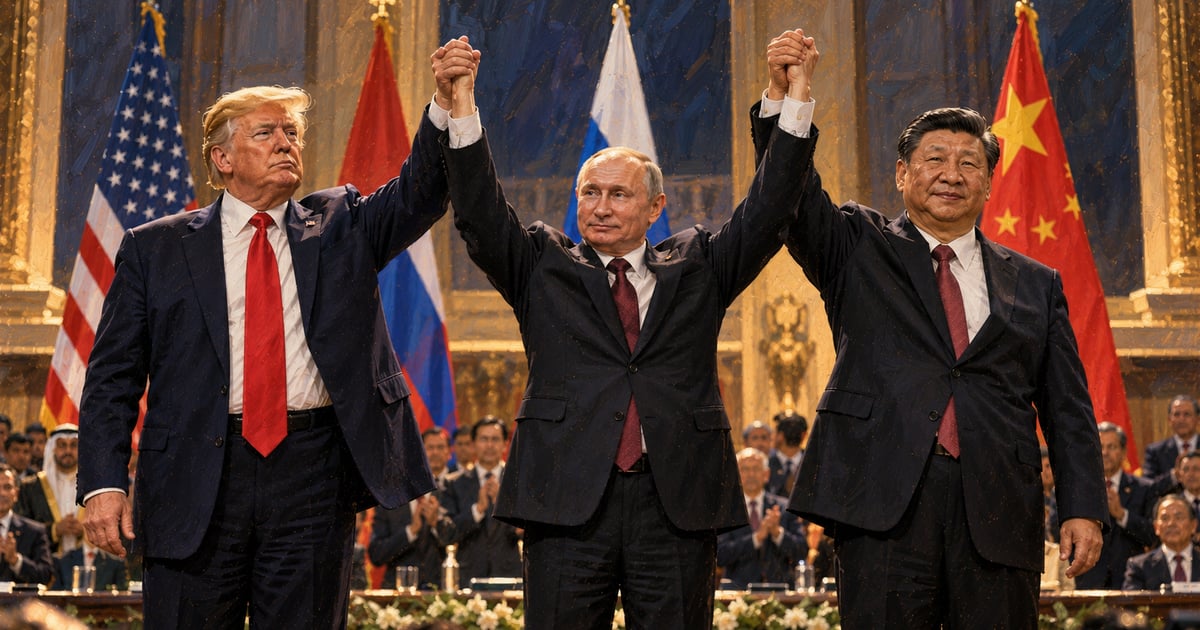
Russian President Vladimir Putin has proposed a trilateral summit with US President Donald Trump and Chinese President Xi Jinping next month to negotiate an end to the war in Ukraine, seeking a settlement favourable to Moscow that excludes both Ukrainian leadership and European allies.
The proposal, first reported by The Wall Street Journal on 19 October 2026, envisions holding the talks on the sidelines of the Asia-Pacific Economic Cooperation (APEC) summit scheduled for 18–19 November in Shenzhen, China. Kremlin spokesperson Dmitry Peskov confirmed on Monday that the concept had been raised among the parties, noting that while "the subject of such a hypothetical meeting was indeed raised," no formal agenda or binding agreement has yet been finalised.
In Washington, US Secretary of State Marco Rubio confirmed during a diplomatic visit to Uzbekistan that preliminary discussions had occurred. "There's been talks of a meeting. I don't know whether it's been finalized, but the president has been clear. He'd like the war in Ukraine and Russia to end," Rubio told reporters.
The reaction from Kyiv has been swift and unsparing. Ukrainian Foreign Minister Andrii Sybiha condemned the proposal as an attempt to legitimise Russian aggression and carve up Ukrainian sovereign territory:
"A trilateral meeting between the leaders of Ukraine, the U.S., and Russia could help end the war sooner. A trilateral meeting between the leaders of Russia, China, and the U.S. would do only the opposite: encourage Putin to continue this war."
The initiative marks Moscow’s most audacious diplomatic gambit since the start of its full-scale invasion, reviving 20th-century sphere-of-influence politics to lock in territorial gains before winter.
The Origins of the Shenzhen Proposal
The diplomatic groundwork for the trilateral format was laid on 9 October 2026 during a 90-minute telephone call between Putin and Trump. According to a former Russian intelligence official cited by The Wall Street Journal, Putin broached the idea directly with the American president while concluding a contentious bilateral transaction regarding the purchase of Russian diesel fuel and global market facilitation.
Moscow subsequently routed the proposal to Beijing through diplomatic backchannels. People familiar with the exchanges indicated that Chinese officials raised no objections to hosting the encounter on Chinese soil, provided that Washington formally consented. Publicly, Beijing has chosen deliberate ambiguity; Chinese Foreign Ministry spokesperson Mao Ning stated at a regular press briefing on Monday that she had "no information to provide at this time".
For Beijing, hosting the summit offers substantial prestige. Positioned as the neutral convener of the world’s two largest military and economic powers, China would solidify its self-styled identity as an indispensable global mediator without committing its own military or financial resources to enforcement.
Moscow’s Strategic Calculation: Engineering a "Yalta 2.0"
Moscow's desire to limit the negotiating table to three seats reflects a deliberate strategic doctrine:
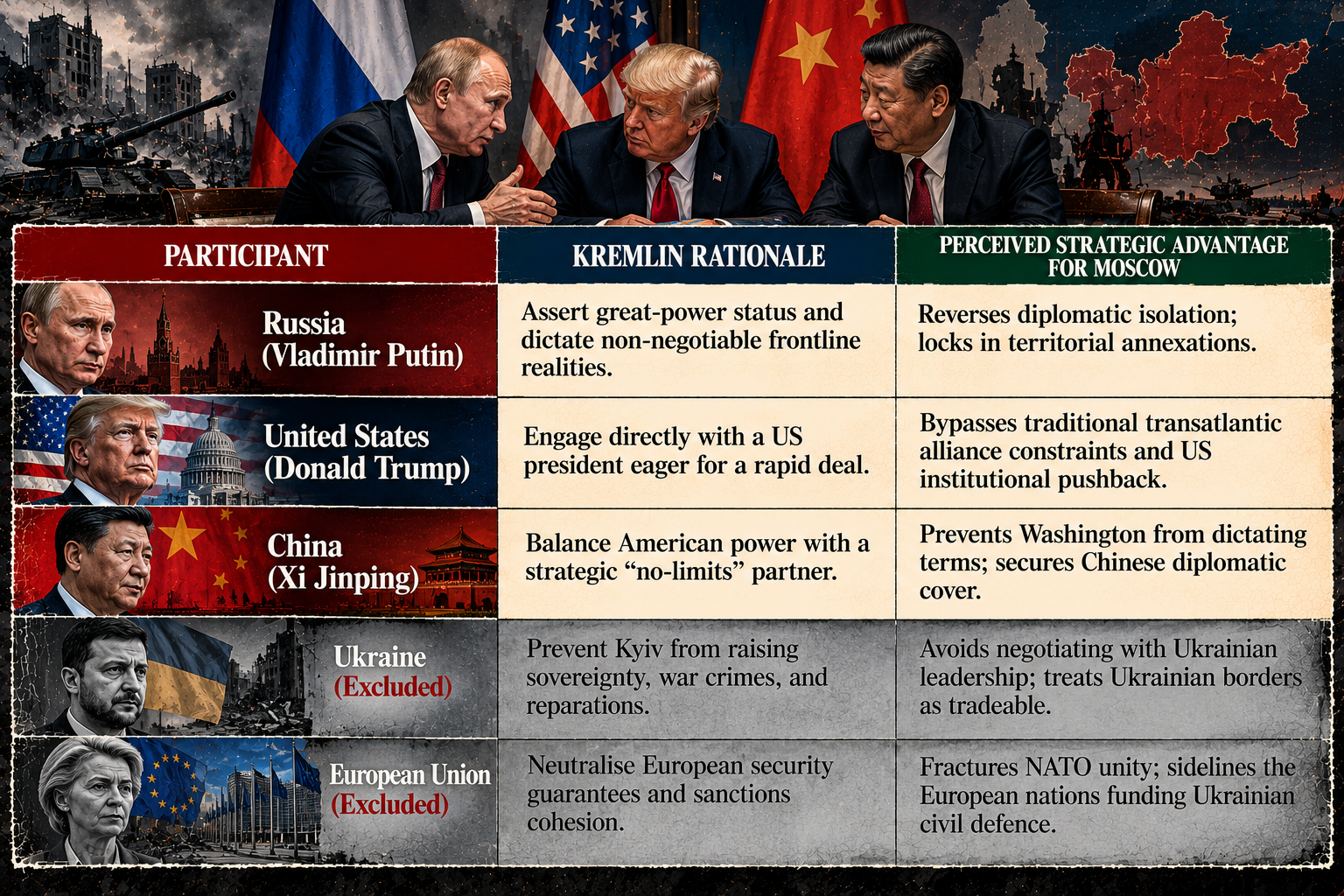
By invoking a format reminiscent of the February 1945 Yalta Conference—where Winston Churchill, Franklin D. Roosevelt, and Joseph Stalin reorganised the post-war European order—Putin is attempting to institutionalise a multipolar concert of powers. In this structure, smaller sovereign states are treated not as independent actors, but as bargaining chips within broader regional spheres of influence.
The Kremlin’s timing is calculated to exploit deepening rifts between Washington and Kyiv. Over the past month, bilateral relations between the Trump administration and President Volodymyr Zelenskyy have deteriorated sharply:
Energy Deals: Washington struck an agreement to purchase Russian diesel, prompting intense protests from Kyiv.
Sanctions Relief: The White House paused the implementation of punitive tariffs under the Graham Act, which would have imposed levies of up to 500% on Russian goods and 100% on third-party energy purchasers.
Military Assistance: Critical supplies of Patriot air defence interceptor missiles have experienced administrative delays, while operational restrictions have hit Ukrainian military use of Starlink satellite communications.
Rhetorical Clashes: Trump has publicly criticised Ukrainian strikes against Russian oil refineries—such as the 144-drone strike against Leningrad Region installations near St. Petersburg on 18 October—arguing that Ukrainian actions disrupt global energy markets.
The View from Kyiv: Resistance to a Imposed Settlement
For the Ukrainian government, the prospect of great powers negotiating the dismemberment of Ukrainian territory without its consent is an absolute red line.
President Volodymyr Zelenskyy has repeatedly stated that Kyiv is prepared to engage in direct trilateral talks with the United States and Russia on neutral ground, provided Ukraine sits as a principal party. The Kremlin has consistently rejected this configuration, insisting that Putin would meet Zelenskyy only in Moscow—a precondition designed to signal Ukrainian subordination.
Addressing reporters on Monday, Foreign Minister Sybiha argued that inviting Putin to Shenzhen would reward territorial conquest. "Inviting Putin to such a meeting would feed his appetite for self-aggrandizement and give him a stature he does not deserve," Sybiha said. "He is not a global leader; he is a war criminal. And Russia is not a global power; it is a global problem."
Kyiv has also pointed to Russia’s ongoing conduct on the battlefield to demonstrate that Moscow's diplomatic overtures are insincere. Despite Trump’s attempts to sponsor a mutual "energy truce", Russian forces carried out multi-wave missile and drone strikes against substations and generation facilities across 11 Ukrainian oblasts on 18 and 19 October, knocking out electricity to 550,000 households and cutting power and water across western Ukraine.
Brussels and the European Defence Dilemma
The European Union has reacted with guarded alarm, reasserting that any settlement negotiated behind Europe’s back would lack legitimacy and legal standing.
At a European Commission briefing on Monday, spokesperson Christian Wigand emphasised that ending the war requires neither grand trilateral choreography nor summitry:
"If Putin wanted to end this war, he could simply stop this war today, and the war could end today. Unfortunately, we recently saw in the context of the announced energy truce that Russia showed no signs of wanting to comply with it... Europe will, of course, play a key role in the future settlement and will also defend its interests."
Commission spokesperson Paula Pinho reiterated the consensus reached at last week’s European Council summit, affirming that "any solution that is found for Ukraine must respect its territorial integrity."
European leaders face a difficult reality. While European capitals fund the bulk of Ukraine’s financial stability, they remain dependent on US intelligence sharing and heavy air-defence logistics. If Washington were to sign off on a ceasefire that concedes occupied Ukrainian territory to Moscow in Shenzhen, European governments would have to choose between underwriting an enduring Ukrainian insurgency alone or accepting a Russian military footprint permanently stationed along NATO’s eastern frontier.
The Road to Shenzhen: Obstacles to an Accord
Although both Moscow and Washington acknowledge that talks about a potential meeting have taken place, the summit faces substantial operational and political hurdles before 18 November:
Domestic Political Opposition in the US: Any agreement resembling capitulation to Moscow faces fierce bipartisan resistance in the US Congress. Bipartisan legislation has already been introduced to block the Trump-Putin diesel transaction, and key Republican lawmakers continue to caution against freezing the conflict without binding security guarantees.
Chinese Hesitation Over Ownership: Beijing desires the prestige of hosting a peace summit, but it remains wary of assuming joint responsibility for enforcing a messy European partition. If talks break down in acrimony on Chinese soil, Beijing’s diplomatic standing would suffer.
The Unenforceability Problem: Even if Trump, Putin, and Xi were to agree on an outline in Shenzhen, they cannot force the Ukrainian Armed Forces to abandon their positions or halt drone operations deep within the Russian Federation without Ukrainian assent. As Peskov conceded on Monday: "Of course, a final settlement is impossible without the participation of someone in Kyiv who is prepared to take responsibility."
What to Watch Next
As diplomatic backchannels accelerate ahead of the APEC summit, three indicators will determine whether the Shenzhen meeting materialises:
Official US Schedule Confirmations: Whether the White House formalises Trump’s travel schedule and includes explicit bilateral or trilateral side sessions in Shenzhen.
Envoys on the Ground: The movements of special envoys, including Steve Witkoff and Jared Kushner, who met Ukrainian officials in Miami on Sunday, and US diplomatic teams coordinating with Beijing.
Winter Escalation Dynamics: Whether Russia intensifies attacks on Ukrainian civil infrastructure or halts strikes to provide diplomatic cover for Trump to justify entering the room.
The proposal reveals Putin's core geopolitical objective: to transform an attritional military campaign into an imperial diplomatic victory, negotiated among great powers while the nation fighting for its survival stands outside the door.