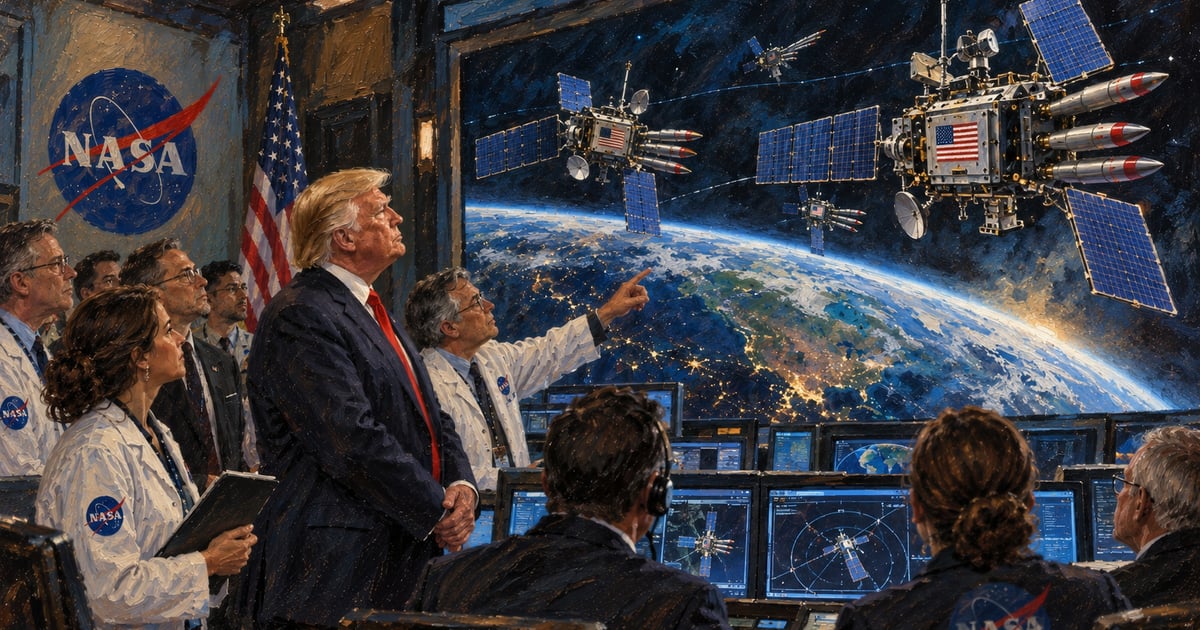
On 14 September 2026, during a keynote address at the Air & Space Forces Association’s Air, Space and Cyber Conference in National Harbor, Maryland, US Secretary of the Air Force Troy Meink ended decades of strategic ambiguity. Washington, he publicly acknowledged, has deployed operational on-orbit space control weapons in Earth's orbit to defend American and allied assets against foreign aggression.
The disclosure sent immediate shockwaves through international diplomatic corridors. Within hours, China’s Ministry of Foreign Affairs warned that Washington was "preparing for war in outer space" and turning the celestial commons into a "battlefield", while Kremlin spokesperson Dmitry Peskov reiterated Russia's demand for the "complete demilitarisation of space".
The announcement has triggered widespread public alarm, prompting two urgent questions: Has the United States violated international space law, and does this mean outer space is now being militarised?
The legal and historical answers are counter-intuitive. Washington has not technically violated the letter of the governing space treaties, and outer space was militarised decades ago. What the world is witnessing is something far more dangerous: the formal transition from passive militarisation to overt, operational weaponisation.
1. The Legal Reality: Did the US Violate the Outer Space Treaty?
The short legal answer is no. The deployment of conventional space-control weapons in Earth orbit does not violate the explicit text of the foundational charter of international space law: the 1967 Outer Space Treaty (OST) (formally the Treaty on Principles Governing the Activities of States in the Exploration and Use of Outer Space, including the Moon and Other Celestial Bodies).
To understand why, one must look at the specific wording of Article IV, the treaty’s primary arms control clause:
"States Parties to the Treaty undertake not to place in orbit around the Earth any objects carrying nuclear weapons or any other kinds of weapons of mass destruction, install such weapons on celestial bodies, or station such weapons in outer space in any other manner.
The Moon and other celestial bodies shall be used by all States Parties to the Treaty exclusively for peaceful purposes. The establishment of military bases, installations and fortifications, the testing of any type of weapons and the conduct of military manoeuvres on celestial bodies shall be forbidden."
The Article IV Asymmetry
During the Cold War negotiations between the United States and the Soviet Union in the mid-1960s, both superpowers deliberately crafted a legal distinction between Earth orbit and celestial bodies:
Celestial bodies (such as the Moon) enjoy absolute demilitarisation. No military bases, fortifications, manoeuvres, or weapon testing of any kind are permitted.
Earth orbit, by contrast, was subjected only to a partial ban. Article IV strictly outlaws nuclear warheads and other weapons of mass destruction (chemical, biological, or radiological devices). It does not prohibit conventional kinetic projectiles, robotic interceptors, high-powered microwave emitters, radio-frequency jammers, or directed-energy laser systems.
Unless the US Space Force has stationed nuclear warheads in orbit—which Washington denies and which would trigger severe global strategic alarms—its "space control" assets do not breach the explicit prohibitions of Article IV.
The Breach of "Spirit" and the UN Charter
While the deployment remains legally compliant with Article IV, critics—including legal scholars and non-aligned states—argue it undermines the broader normative architecture:
Article I of the OST mandates that the exploration and use of space shall be carried out "for the benefit and in the interests of all countries" and shall be the "province of all mankind".
Article III dictates that space activities must conform to international law, including the UN Charter. Article 2(4) of the UN Charter prohibits the threat or use of force against the territorial integrity or political independence of any state. Deploying active offensive counterspace assets ready for pre-emptive orbital interdiction places state actions precariously close to this prohibition.
2. Militarisation vs. Weaponisation: A Crucial Distinction
A frequent misunderstanding is the belief that space has historically been a pristine, purely scientific sanctuary now being militarised for the first time. In truth, space has been militarised since the very beginning of the space age.
As documented in comprehensive analyses such as the UK Parliament Research Briefing on the Militarisation of Space, military requirements drove early space exploration:
The American Corona programme in 1960 and Soviet Zenit spacecraft were dedicated orbital reconnaissance platforms.
Global Positioning System (GPS) constellations, early-warning infrared satellites (such as the US Defense Support Program and SBIRS), and secure satellite communication networks (Milstar, Skynet) were developed specifically as military force multipliers.
The announcement by the Secretary of the Air Force marks the formal crossing from militarisation (using orbital infrastructure to support military operations on Earth) to weaponisation (placing systems in orbit designed to destroy, disable, or neutralise hardware in space).
3. What Did the US Actually Deploy? Deconstructing "Space Control"
While Secretary Troy Meink refrained from detailing technical specifications, the doctrine governing these assets has been emerging in open-source military literature over the past two years.
According to the Space Force Warfighting Framework, "space control" encompasses offensive and defensive counterspace capabilities designed to secure space superiority:
Non-Kinetic Orbital Strike & Interdiction (Soft-Kill):
Radio-Frequency (RF) Jammers: Satellites carrying steerable high-gain antennas capable of overpowering uplink and downlink signals between adversary satellites and ground command stations.
Cyber and Data Link Hijacking: Payloads engineered to inject corrupt telemetry or malicious commands into adversary space constellations.
Optical Dazzlers / Low-Power Lasers: Satellite-mounted directed-energy systems designed to blind or saturate the sensitive focal-plane sensors of imaging and reconnaissance satellites without physically disintegrating the target.
Kinetic and Physical Systems (Hard-Kill):
Co-Orbital Interceptors: Maneuverable spacecraft capable of Rendezvous and Proximity Operations (RPO) that close in on adversary assets to dismantle solar arrays, sever communications links using robotic arms, or collide directly.
Dual-Use Servicing Craft: Inspection vehicles nominally built for on-orbit refuelling or space-debris removal that can swiftly be repurposed into offensive grappling mechanisms.
Renowned orbital tracker Jonathan McDowell noted that Washington has already launched several classified missions with undisclosed payloads, making radio-frequency jammers or electronic warfare suites the most probable initial operational hardware.
4. Why Now? The Geopolitical Pressures Behind the Disclosure
Washington did not make this announcement in a vacuum. It represents the culmination of a decade of escalating gray-zone provocations in orbit, primarily involving Russia and China.
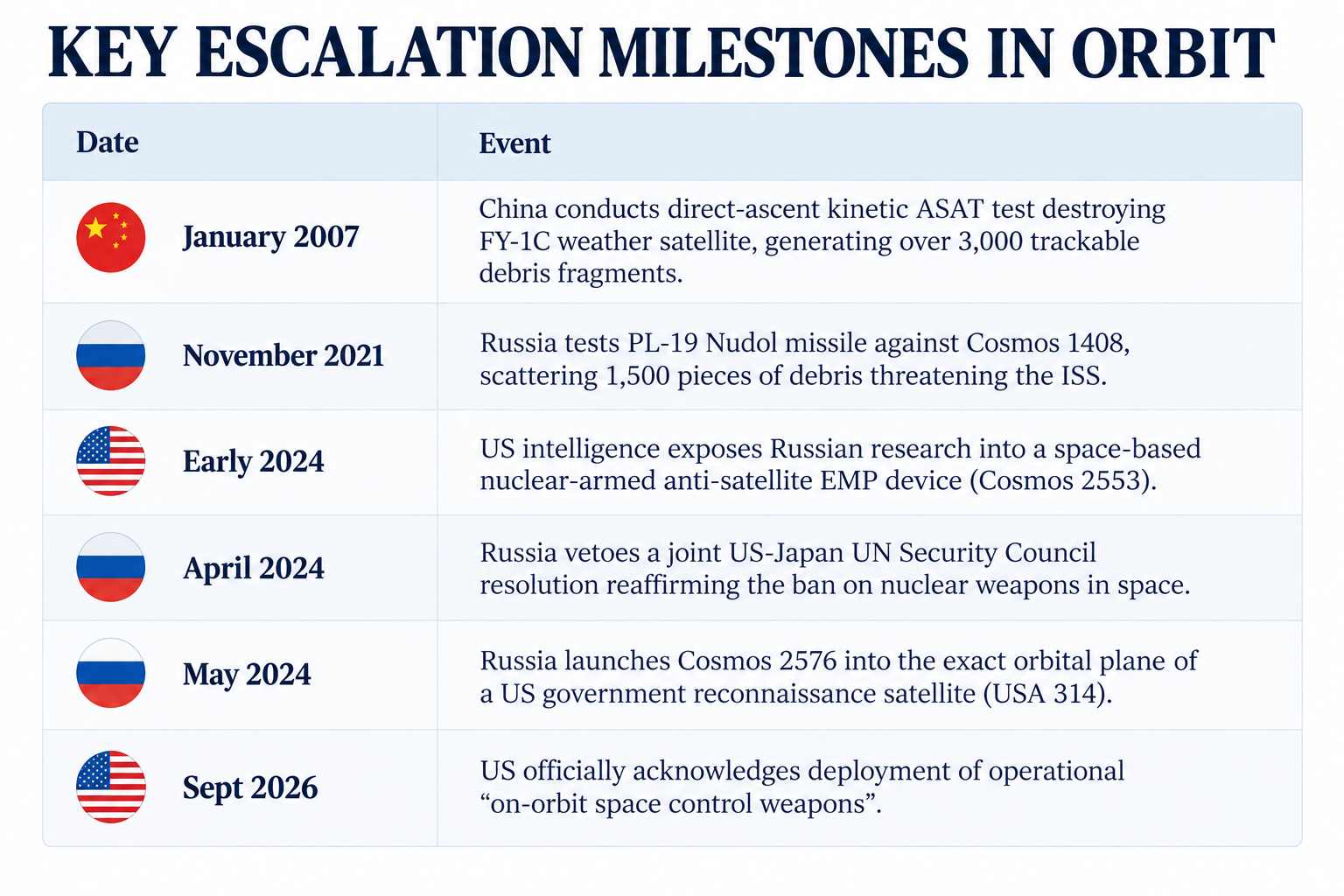
The Department of Defense has justified its operational shift by pointing to two developments:
Russian Co-Orbital Shadowing: The Russian satellite Cosmos 2576 was inserted into the identical orbital inclination and plane as a classified US reconnaissance satellite in May 2024, functioning as what Pentagon officials described as an active counterspace stalker.
Chinese Dual-Use Robotics: China’s Shijian series (most notably Shijian-17 and Shijian-21) demonstrated advanced rendezvous, grappling, and towing capabilities, successfully dragging defunct satellites into graveyard orbits. In a contested scenario, the identical mechanical arm could grapple and de-orbit an adversary’s early-warning satellite.
Confronted with what military planners viewed as asymmetric Chinese and Russian counterspace capabilities, the US Space Force chose to abandon public reticence in favour of overt, demonstrable deterrence.
5. What Comes Next? The Five Cascading Repercussions
The formal acknowledgement of deployed orbital weaponry dramatically alters space governance, military doctrine, and orbital safety. The immediate and long-term fallout will unfold across five critical domains:
1. Symmetrical Responses and Symmetrical Declarations
As Victoria Samson of the Secure World Foundation highlighted following the announcement, Washington must now expect Moscow and Beijing to discard their own rhetorical restraints.
China and Russia will accelerate the overt deployment of their own co-orbital strike platforms.
Russia's secretive inspector satellite programmes will transition into formal combat units.
The era of diplomatic ambiguity is dead; all three major powers will openly field counterspace arsenals while claiming defensive necessity under Article 51 of the UN Charter.
2. Complete Impasse in Multilateral Arms Control
For over twenty years, Moscow and Beijing have promoted the draft Treaty on the Prevention of the Placement of Weapons in Outer Space (PPWT) at the United Nations Conference on Disarmament in Geneva. Washington consistently rejected the PPWT because it contained no verification mechanisms and conveniently excluded ground-based direct-ascent anti-satellite missiles—a sector where China and Russia held distinct advantages.
Following the diplomatic skirmishes of April 2024 at the UN Security Council—where Russia vetoed a US-Japan initiative upholding the nuclear ban while demanding an unverified ban on all orbital weapons—multilateral treaties are functionally frozen. The international community cannot agree on the definition of a "space weapon", let alone inspect dual-use spacecraft.
3. Heightened Vulnerability of Dual-Use Commercial Constellations
Modern warfare relies on commercial mega-constellations. In Ukraine, SpaceX’s Starlink demonstrated that commercial low Earth orbit (LEO) communications are indispensable for battlefield command, drone piloting, and artillery targeting.
The deployment of on-orbit weapons establishes a precedent where commercial satellites operating in support of state military operations will be designated as legitimate targets for orbital jamming, dazzling, or physical interception. Commercial operators will face skyrocketing insurance premiums and demand state-backed indemnification.
4. The Catastrophic Spectre of Kessler Syndrome
The ultimate danger of kinetic warfare in orbit is the physical reality of celestial mechanics. Satellites in Low Earth Orbit travel at approximately 7.8 kilometres per second (over 28,000 km/h).
At these velocities, an impact with a 1-centimetre metal fragment carries the explosive energy of a hand grenade. If an orbital dogfight or kinetic strike occurs:
A single fragmentation event generates tens of thousands of hypervelocity shards.
Each piece becomes an unguided projectile capable of disabling other satellites.
This risks triggering Kessler syndrome—an unstoppable cascade of collisions that renders key orbital shells (particularly 400 km to 1,000 km altitudes) unusable for generations, devastating civil aviation, maritime logistics, disaster response, and weather forecasting.
5. Normalisation of Space as an Active Warfighting Domain
The psychological threshold has been breached. As astronomer Jonathan McDowell observed, the US national security establishment no longer treats conflict in space as an unthinkable contingency, but as an operational certainty to be resourced, rehearsed, and executed.
Conclusion: Living with an Armed Orbital Frontier
The United States has not broken the 1967 Outer Space Treaty. Rather, it has exploited the deliberate, conventional loophole left open by Cold War drafters sixty years ago.
By confirming that "space control weapons" are already aloft, Washington has formally inaugurated the era of orbital weaponisation. Outer space is no longer merely an observation post or a communications relay for terrestrial conflict; it is an armed, active theatre of operational combat.
In the absence of verifiable international agreements, clear rules of orbital engagement, or mutual restraint between Washington, Beijing, and Moscow, the celestial commons faces an increasingly fragile future—where a single tactical miscalculation in orbit could blind critical infrastructure on Earth or permanently lock humanity beneath a self-inflicted ceiling of hypervelocity debris.