In brief
- Agility Robotics, Inc. began trading on Nasdaq under the ticker AGLT after a 2.5 billion merger with Churchill Capital Corp XI, becoming the United States' first publicly traded pure play humanoid robotics company.
- The company highlights its Digit robot’s real world operation with over 65,000 hours logged, safety evaluations passed, and more than 100,000 totes moved at GXO’s Georgia facility.
- GXO plans to deploy Digit at two more U.S. warehouses in North Carolina and Tennessee in early 2027, alongside trials with Schaeffler, Toyota Motor Manufacturing Canada, Mercado Libre, Amazon and AGCO.
- Digit 5, unveiled on 15 September 2026, targets late 2027 for general availability and uses Nvidia IGX Thor compute, Halos safety software, FORT Robotics safety systems, and Nyobolt batteries for a nine minute recharge and over 20 hours uptime.
On 5 November 2026, Agility Robotics, Inc. rang in a milestone for industrial automation, becoming the United States’ first publicly traded pure-play humanoid robotics company. Trading on Nasdaq under the ticker AGLT (with warrants under AGLTW), the Salem, Oregon-based maker of the bipedal Digit robot completed a $2.5 billion merger with Michael Klein’s special purpose acquisition company (SPAC), Churchill Capital Corp XI, one day earlier (Agility Robotics).
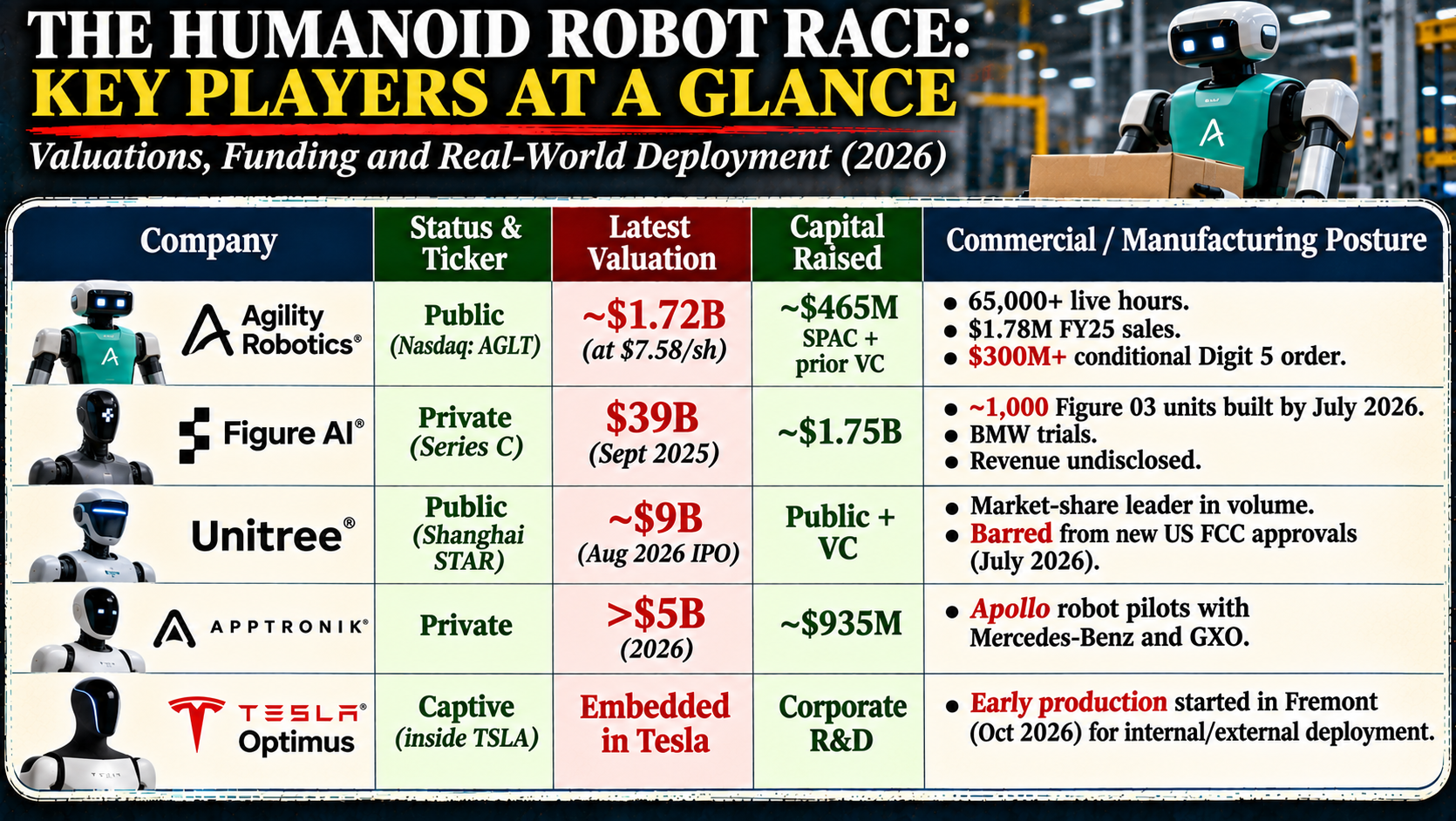
While Chinese rivals UBTech (Hong Kong, December 2023) and Unitree (Shanghai STAR Market, August 2026) beat Wall Street to public humanoid listings, US investors previously had no direct public-market vehicle for bipedal robotics—forcing retail buyers to settle for indirect exposure via Tesla or Nvidia.
Yet AGLT’s first week of trading offered an immediate reality check. After opening near the $10 SPAC reference price, shares drifted down to $7.19–$7.58 by 12–13 November, valuing Agility near $1.72 billion (MarketBeat; CNN Markets). For public investors willing to read past the bell-ringing headlines, Agility’s SEC Form S-4 registration statement explains both why the company needed public capital—and why Wall Street is pricing it cautiously.
The Deal Mechanics: How $600 Million Became $465 Million
Like many SPAC transactions, the final cash delivered at closing fell short of initial headline projections. When Agility and Churchill XI announced their combination on 24 June 2026, they projected more than $600 million in gross proceeds, anchored by roughly $420 million in Churchill’s trust account.
By the time shareholders approved the deal on 2 November (with more than 84% voting in favour), public redemptions had drained roughly $260 million from the trust. Agility still closed with approximately $465 million in gross capital before transaction expenses, assembled through three buckets (Robotics & Automation News):
~$164 million remaining in the Churchill XI trust account post-redemptions.
$201 million via a private investment in public equity (PIPE) at $10 per share, led by manufacturing giant Foxconn.
$100 million in pre-closing equity funding raised after the merger was announced.
That cash infusion was urgent: in its Form S-4, Agility’s management explicitly disclosed "substantial doubt" about its ability to continue as a going concern over the next 12 months without fresh financing (Humanoids Daily).
Inside the S-4 Ledger: Marketing vs Audited Accounting
Agility’s pitch rests on real operational credibility that few humanoid startups can match. Over nearly three years, its Digit robots have logged more than 65,000 hours of live commercial operation, passed OSHA-recognised safety field evaluations, and moved over 100,000 totes at logistics giant GXO’s facility in Georgia. In October 2026, GXO agreed to deploy Digit at two more US warehouses (in North Carolina and Tennessee) in early 2027, alongside deployments or paid trials with Schaeffler, Toyota Motor Manufacturing Canada, Mercado Libre, Amazon, and AGCO (New Market Pitch).
However, the audited financial statements inside the Form S-4 paint a far more sobering picture of commercial scale today:
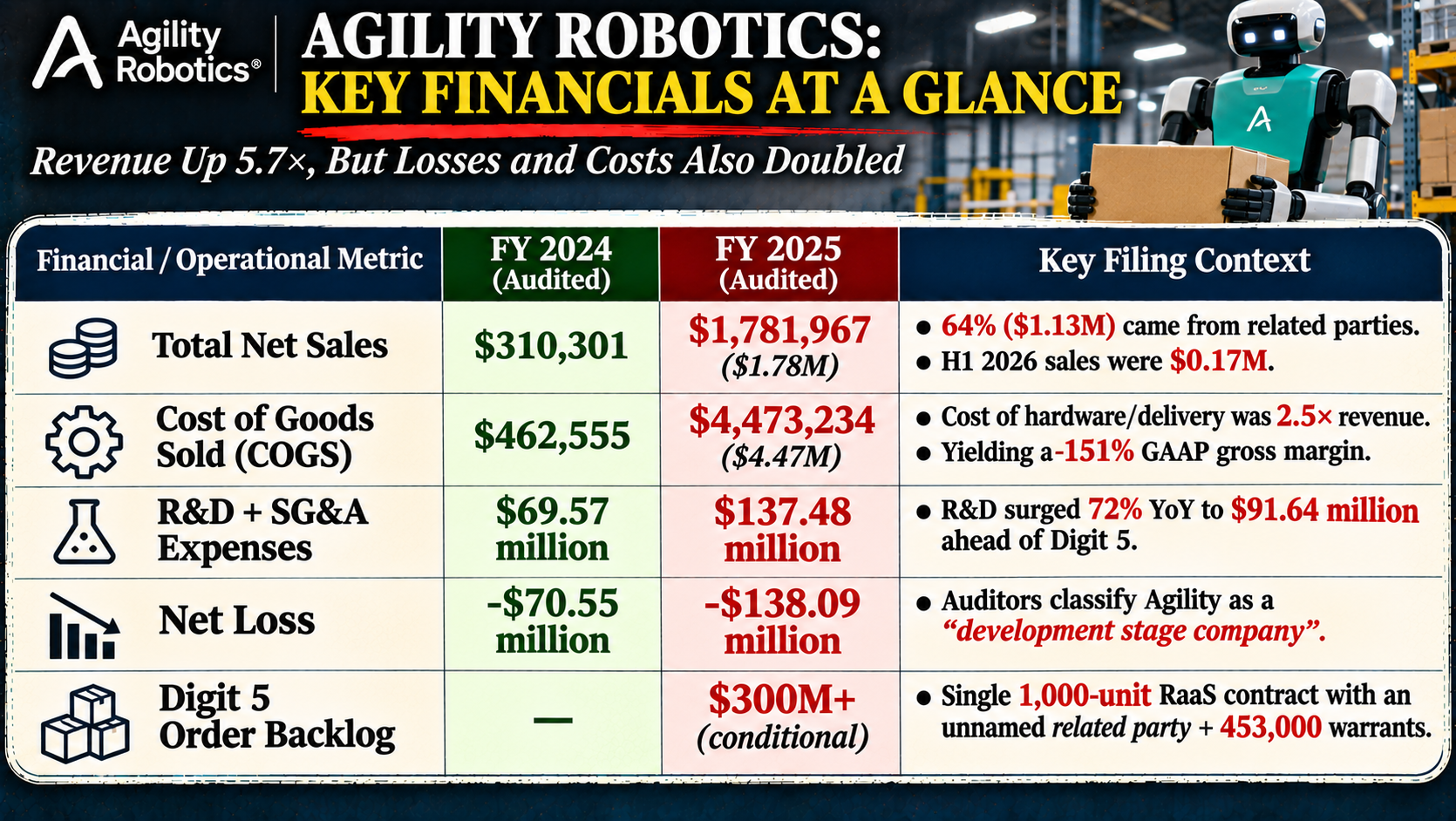
Two disclosures in the footnotes deserve close attention from any investor:
The Related-Party Order Book: Agility’s headline "$300 million+ in committed multi-year orders" for its next-generation Digit 5 robot is not a broad slate of independent Fortune 500 contracts. As of May 2026, it represented a single three-year Robotics-as-a-Service (RaaS) agreement for 1,000 Digit 5 units placed by an unnamed related party, sweetened with 453 common stock purchase warrants per robot (453,000 warrants total) that vest as machines deploy. Under US accounting rules, customer warrants can reduce the net revenue ultimately recognised on the income statement.
Unit Economics vs GAAP Reality: Management’s investor presentation cites a sub-one-year payback and ">70% unit contribution margin" over five years (modelling $8,500/month RaaS fees, or ~$535,000 cumulative revenue per robot). Those figures exclude deployment costs (~$15,000), annual delivery/support (~$15,000), and $137.5 million in annual corporate R&D and SG&A overhead.
The Digit 5 Bet and the US Trade Shield
To close the chasm between $1.78 million in sales and $300 million in conditional backlog, Agility is betting on Digit 5, unveiled on 15 September 2026 (with early access in H1 2027 and general availability targeted for late 2027).
Upgraded to lift up to 50 pounds repeatedly and work cooperatively alongside humans without safety cages, Digit 5 standardises onboard compute on Nvidia IGX Thor and Halos safety software, integrates FORT Robotics safety systems, and uses Nyobolt ultra-fast-charging batteries capable of a 9-minute recharge for more than 20 hours of daily uptime (Agility Robotics). Production will scale through RoboFab, Agility’s 70,000-square-foot Oregon plant engineered for up to 10,000 units per year.
Yet the cost curve remains steep: Chief Operating Officer Jen Hunter pegged Digit 5’s launch bill of materials at roughly $150,000 (up from ~$125,000 for Digit 4), far above management’s long-term $30,000 target. Paradoxically, Agility’s strongest competitive shield—the 28 July 2026 FCC Covered List ruling that barred new foreign-made (largely Chinese) advanced robots from US commercial markets—could complicate that cost reduction. While keeping Unitree out of US warehouses helps Agility win domestic contracts, its own risk factors warn that Chinese rare-earth retaliation and "Buy American" sourcing mandates could keep US component costs elevated.
The Bottom Line
Agility Robotics deserves credit for doing what higher-valued private rivals have avoided: opening its audited books to public scrutiny. By listing on Nasdaq as AGLT, CEO Peggy Johnson has secured $465 million in runway and given Wall Street its first pure-play benchmark for physical AI.
Still, public shareholders are buying a venture-stage hardware ramp wrapped in a public ticker. Until Digit 5 clears cooperative safety certifications in 2027, diversifies beyond related-party orders, and proves that RoboFab can drive unit costs down from $150,000 without eroding margins, AGLT will trade less on robotics hype—and strictly on execution milestones.