
In brief
- Attackers planted multi-stage malware inside Optimizely Web snippets on 16 November 2026, turning trusted domains such as CNN, BBC, Zoom, Salesforce and HSBC US into browser level traps and affecting 178 organisations.
- Security researchers tracked the compromise as OptimJack, infecting 188 Optimizely Web snippets across 178 confirmed organisations out of 1611 snippets audited, with a likely higher tally unseen due to discovery limits.
- The attack manipulated the single JavaScript file from cdn.optimizely.com, with an unknown intruder writing a one line loader into customers’ projectJS fields and into Optimizely's own snippets, while Optimizely served modified project files with its TLS certificate.
- In iOS devices, the loader delivered different exploit chains based on device version, with Coruna and DarkSword kits and fingerprinting stages, and iOS versions 13 to 17, 18.x, and 26.x targeted by separate paths.
On Monday, 16 November 2026, visitors loading websites belonging to CNN, BBC, Fox News, Zoom, Salesforce, GitLab, HSBC US, Equifax, and Ledger unknowingly executed malicious JavaScript served from a trusted vendor domain: cdn.optimizely.com (Report URI; StepSecurity).
Tracked by security researchers as OptimJack, the supply-chain compromise infected 188 Optimizely Web snippets across 178 confirmed organisations out of 1,611 snippets audited by client-side security firm Report URI—with the actual tally likely higher because researchers could only inspect discoverable snippets before clean-up began (Report URI; BleepingComputer). None of the 178 organisations needed a vulnerability in their own servers; their browsers simply trusted a single line of third-party marketing code.
(Note: A separate disruption on 16 November that affected online banking at JPMorgan Chase, Bank of America, Wells Fargo, US Bank, and Zelle was attributed by JPMorgan Chase to an internal software bug rather than a cyberattack (Al Jazeera; CNN).)
How the Optimizely Injection Worked
Optimizely Web allows marketing and product teams to run A/B tests and personalise webpages by embedding a single JavaScript file from cdn.optimizely.com/js/<project-id>.js (Report URI). Each snippet includes a customisable projectJS field designed for customer-written code that executes on every page load.
During the 16 November attack, an unknown intruder wrote a one-line loader directly into customers’ projectJS fields—and even into Optimizely’s own snippets on www.optimizely.com and login.optimizely.com (Report URI). Because Optimizely’s content delivery network served the modified project files with Optimizely’s own TLS certificate, Report URI confirmed the incident was not a CDN cache-poisoning attack (Report URI).
As of 17 November, Optimizely had not published a formal security advisory explaining how the attacker gained write access across unrelated customer accounts, leaving open whether the intrusion stemmed from a platform vulnerability, an account-signup flaw, or compromised administrative credentials (StepSecurity; Shattered).
The attacker deployed three loader variants to evade simple string-matching:
A plain
<script>tag pointing to[https://1688360](https://1688360)[.]cc/track.js.A base64-encoded loader using
atob()—observed when Smartsheet’s snippet was re-infected after an initial clean-up, indicating the attacker retained live access mid-incident.A full inline copy executed via
eval()if1688360[.]ccwas blocked (Report URI).
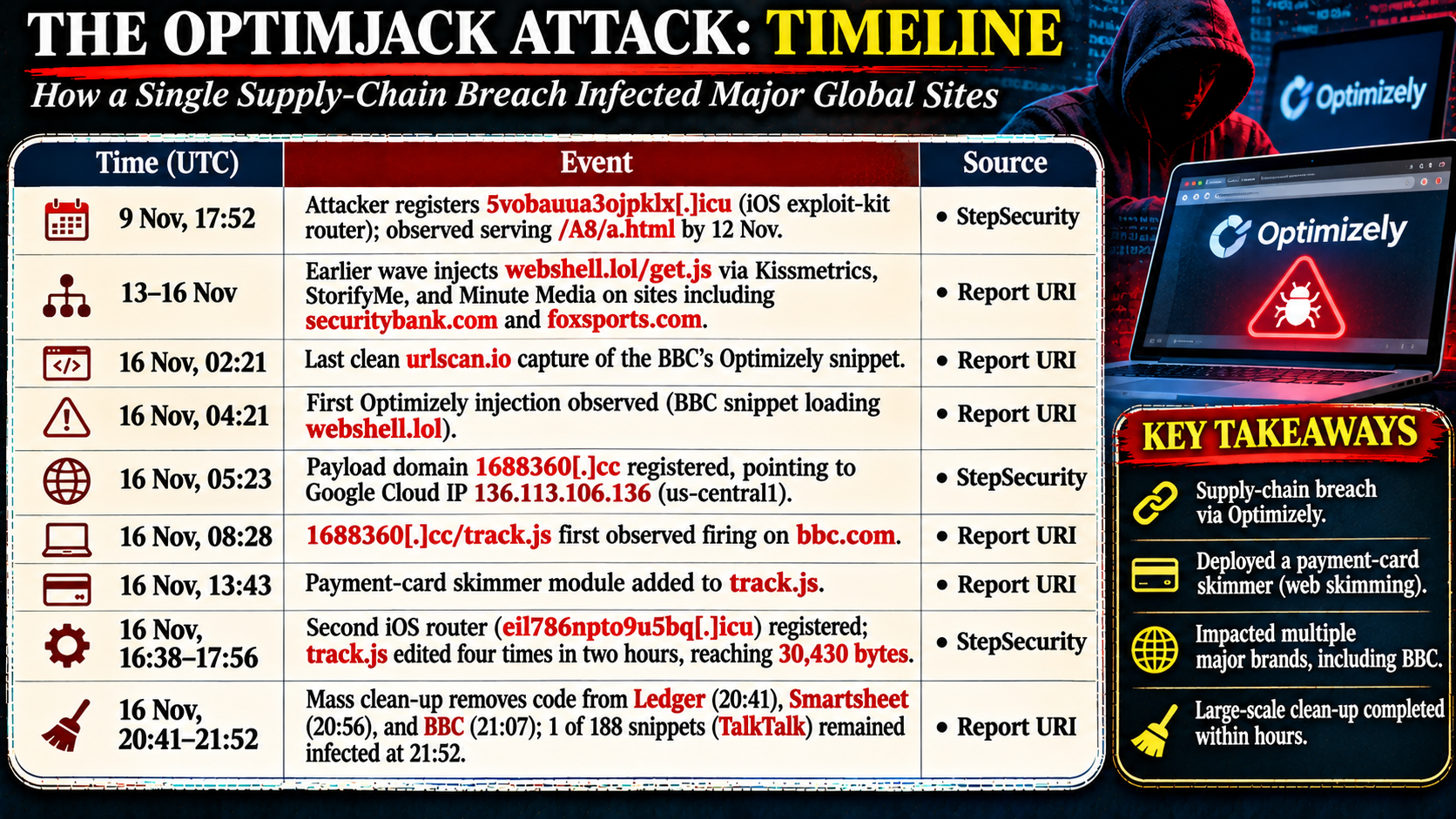
Timeline of a 17-Hour Exposure Window
Infrastructure records analysed by Report URI and StepSecurity show the operator staged domains days in advance and iterated on the live malware throughout 16 November:
The 178 Affected Organisations by Sector
Report URI’s sweep of 1,611 Optimizely snippets identified 178 compromised organisations across 20 sectors, led by financial services, enterprise software, retail, and news media:
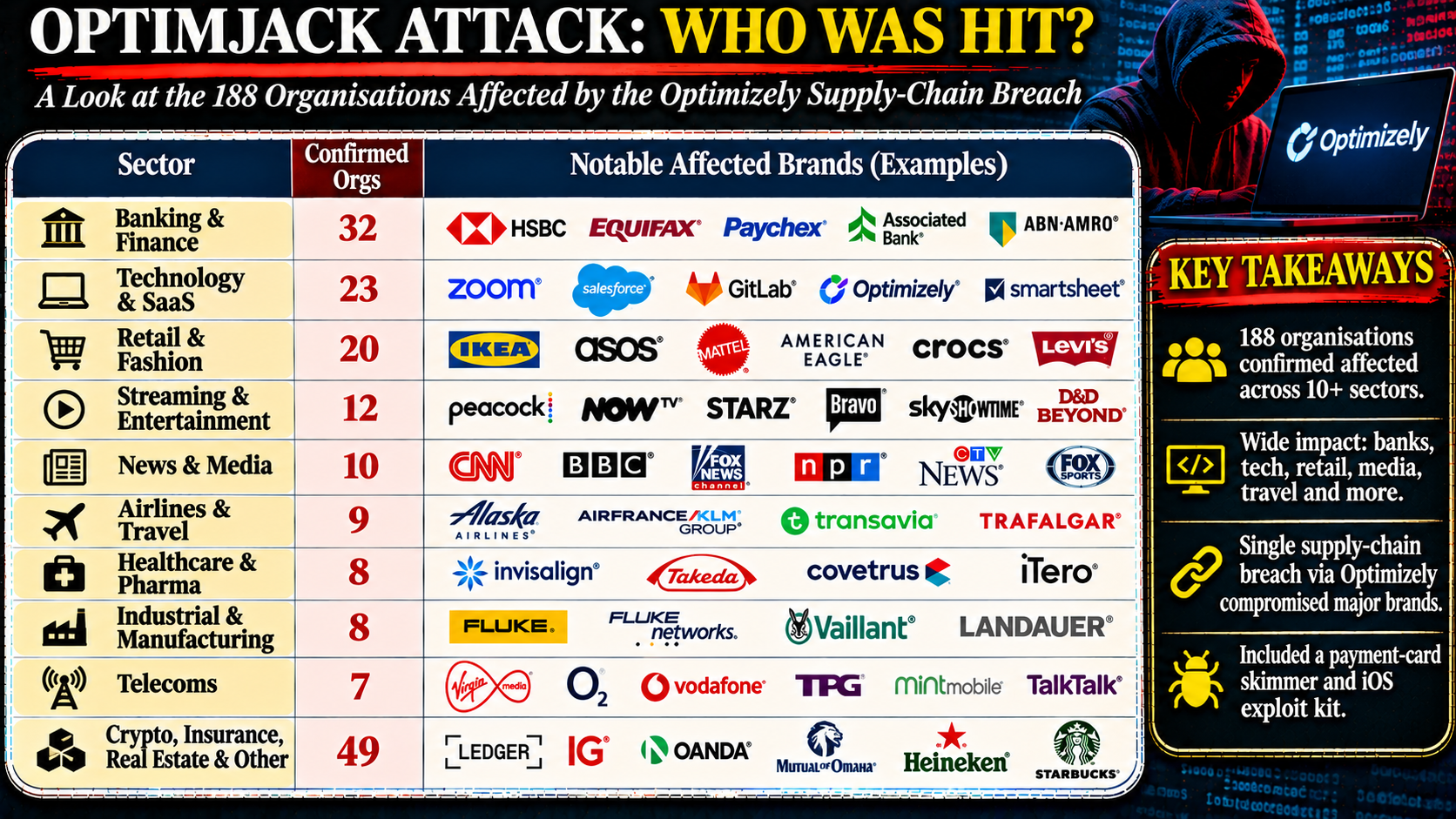
Source: Report URI sector ledger (checked 16 November 2026).
Four Payloads Inside One 30 KB Script
Once loaded, track.js executed four distinct attack chains depending on the visitor’s device and on-page actions (Report URI; StepSecurity):
Cryptocurrency address swapping: The script scanned page text, form inputs, copy/clipboard events,
fetch/XHRpayloads, andnavigator.sharefor valid wallet addresses across eight networks (BTC, ETH/EVM, TRON, SOL, TON, LTC, BCH, and DOGE), replacing checksum-valid addresses near payment keywords with attacker-controlled wallets. By evening on 16 November, on-chain trackers recorded roughly US$6,600 to US$7,040 in stolen deposits—mostly in Bitcoin (~$5,380–$5,575) and Litecoin (~$762–$763) (Report URI; StepSecurity).Payment-card skimming: Added at 13:43 UTC, this module monitored form submissions and
fetch/XHRPOSTs for Luhn-valid card numbers, expiry dates, and three- or four-digit CVVs, exfiltrating them to1688360[.]cc/card.phpvianavigator.sendBeacon. Checkouts using cross-origin hosted payment iframes (such as Stripe or Adyen) were shielded, whereas first-party payment fields were exposed (Report URI).Cookie and screenshot theft: Whenever an address swap fired, the script loaded
html2canvas.min.js, rendered a JPEG screenshot of the visible page, and posted it alongside up to 8,000 characters of non-HttpOnlydocument.cookiedata to/hit.php(StepSecurity).iOS exploit delivery: On iPhones and iPads,
track.jspulledboot.jsfrom.icurouters and fingerprinted the operating system. Devices running iOS 13–17 were routed to the Coruna exploit chain; iOS 18.x devices (below 18.7.3) received the DarkSword exploit chain; and iOS 26 devices (below 26.3) hit a fingerprinting stage (Report URI). Both Coruna and DarkSword are leaked/commercial iOS exploit kits previously linked to nation-state espionage and mass crypto-theft campaigns earlier in 2026 (The Hacker News; Wikipedia).
Why Content Security Policy Failed 85% of Affected Sites
Because the malicious loader originated from cdn.optimizely.com—a host every affected site explicitly allowlisted—traditional code reviews, repository scanners, and Subresource Integrity (SRI) hashes could not stop it (StepSecurity). Even cookie consent banners failed to help; on GitLab’s site, the consent manager itself loaded the infected Optimizely bundle (StepSecurity).
When Report URI audited Content Security Policy (CSP) headers across 256 hosts belonging to affected organisations, the breakdown exposed widespread configuration gaps (Report URI):
68 organisations had no CSP header at all.
50 organisations deployed a CSP that permitted both
track.jsexecution and data exfiltration.17 organisations blocked exfiltration via
connect-srcrestrictions, yet still allowed the script to run and swap crypto addresses inside the browser.Only 24 organisations (15% of the evaluated CSP set) blocked the payload entirely with restrictive
script-srchost allowlists.
Two common CSP settings—'strict-dynamic' and 'unsafe-eval'—proved decisive. Because Optimizely’s own documentation instructs customers to permit 'unsafe-eval', the attacker’s inline eval() fallback ran even on HSBC, whose CSP successfully blocked 1688360[.]cc/track.js and outbound exfiltration (Report URI).
What Organisations and Visitors Should Do Now
Website operators using Optimizely Web: Inspect every project’s
projectJSand custom experiment code for1688360[.]cc,.icudomains, oratob(loaders; rotate Optimizely API tokens and user credentials; audit CSP logs for blocked or attempted requests to1688360[.]ccon 16 November; move card inputs into cross-origin hosted iframes; and strip'unsafe-eval'wherever possible (Report URI; StepSecurity).Visitors on 16 November: Update iPhones and iPads immediately to iOS 18.7.3+ or iOS 26.3+, monitor bank card statements if you entered card details directly on an affected site, and verify any cryptocurrency transfer made that day against its intended destination address (Report URI).