In brief
- ISRO plans to launch Gaganyaan G1, its first uncrewed orbital test flight, in December 2026 to validate the vehicle and mission concept ahead of a crewed flight targeted for 2027.
- G1 will not carry astronauts; the HLVM3 will carry the humanoid robot Vyommitra to validate re entry, parachutes and reduced life support ahead of crewed missions.
- Vyommitra will monitor cabin parameters and relay telemetry during launch, orbital flight and re entry, while no full human rated life support is tested on these uncrewed flights.
- The ECLSS engineering model is in development and a reduced version will be demonstrated on the uncrewed Gaganyaan flights, with crewed flight planned after G1, G2 and G3.
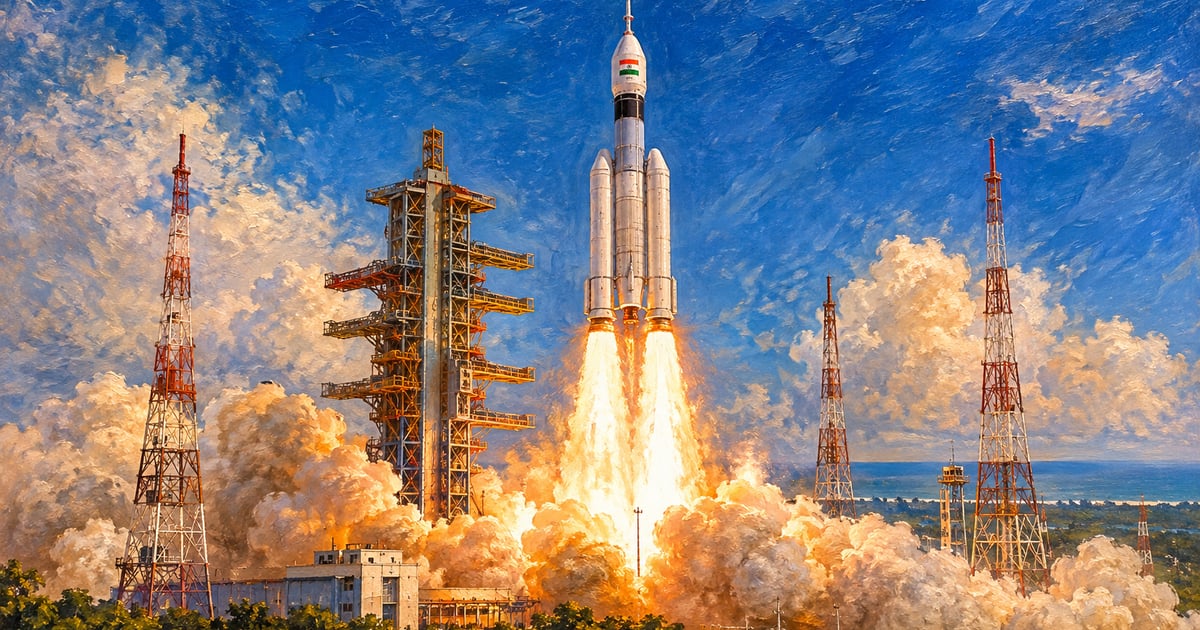
The Indian Space Research Organisation (ISRO) is preparing to launch Gaganyaan-1 (G1), its first uncrewed orbital test flight, in December 2026, according to statements by ISRO Chairman Dr V. Narayanan in late October and mid-November 2026 (Business Today, BattleIAS). As of 19 November 2026, ISRO has not announced a specific launch date or countdown window, maintaining its official target of the fourth quarter of 2026 (SatelliteTracker).
No astronauts will be aboard the December flight. G1 is an uncrewed orbital validation mission designed to prove that the Human-Rated Launch Vehicle Mark-3 (HLVM3) can place the Gaganyaan Orbital Module into a roughly 400-kilometre low Earth orbit, sustain internal systems in space, survive atmospheric re-entry, and splash down safely in Indian waters (PIB Factsheet, PIB Lok Sabha Reply). Only after G1 and two further uncrewed flights (G2 and G3) succeed does ISRO plan to launch India’s first crewed mission (H1), targeted for 2027 (PIB Factsheet, Hindustan Times).
What Will Fly Aboard G1—and What Is Still Missing
In place of human crew, the G1 Crew Module will carry Vyommitra, ISRO’s half-humanoid robot, whose integration into the spacecraft began on 28 April 2026 (Wikipedia, PIB Factsheet). Vyommitra is instrumented to monitor cabin parameters, simulate human-panel interactions, and relay telemetry through launch, orbital flight, and re-entry (Humanoid Guide). Alongside Vyommitra, researchers from the Tata Institute of Fundamental Research (TIFR) and the University of Agricultural Sciences, Dharwad, in collaboration with the Indian Institute of Space Science and Technology (IIST), have prepared fruit flies (Drosophila melanogaster) as biological payloads (Wikipedia).
Crucially, G1 will not test a full human-rated life-support suite. In a written reply to the Lok Sabha on 29 July 2026, Union Minister of State for Space Dr Jitendra Singh disclosed that while an engineering model of the indigenous Environmental Control and Life Support System (ECLSS)—which regulates cabin temperature, humidity, pressure, and carbon dioxide—has been realised, the system remains in development testing (PIB). Only a reduced version of ECLSS will be demonstrated on the uncrewed Gaganyaan flights (PIB).
The 2026 Qualification Sprints That Cleared the Way
G1 has slipped multiple times from earlier targets—including December 2024 and December 2025—as ISRO refused to freeze a launch date until parachute, propulsion, and separation hardware cleared human-rating margins (News On Air, Wikipedia). In June 2026, Dr Narayanan even cautioned that G1 could slip further depending on safety reviews (Indian Express). A concentrated run of ground and aerial trials between February and October 2026 resolved the primary hardware bottlenecks:
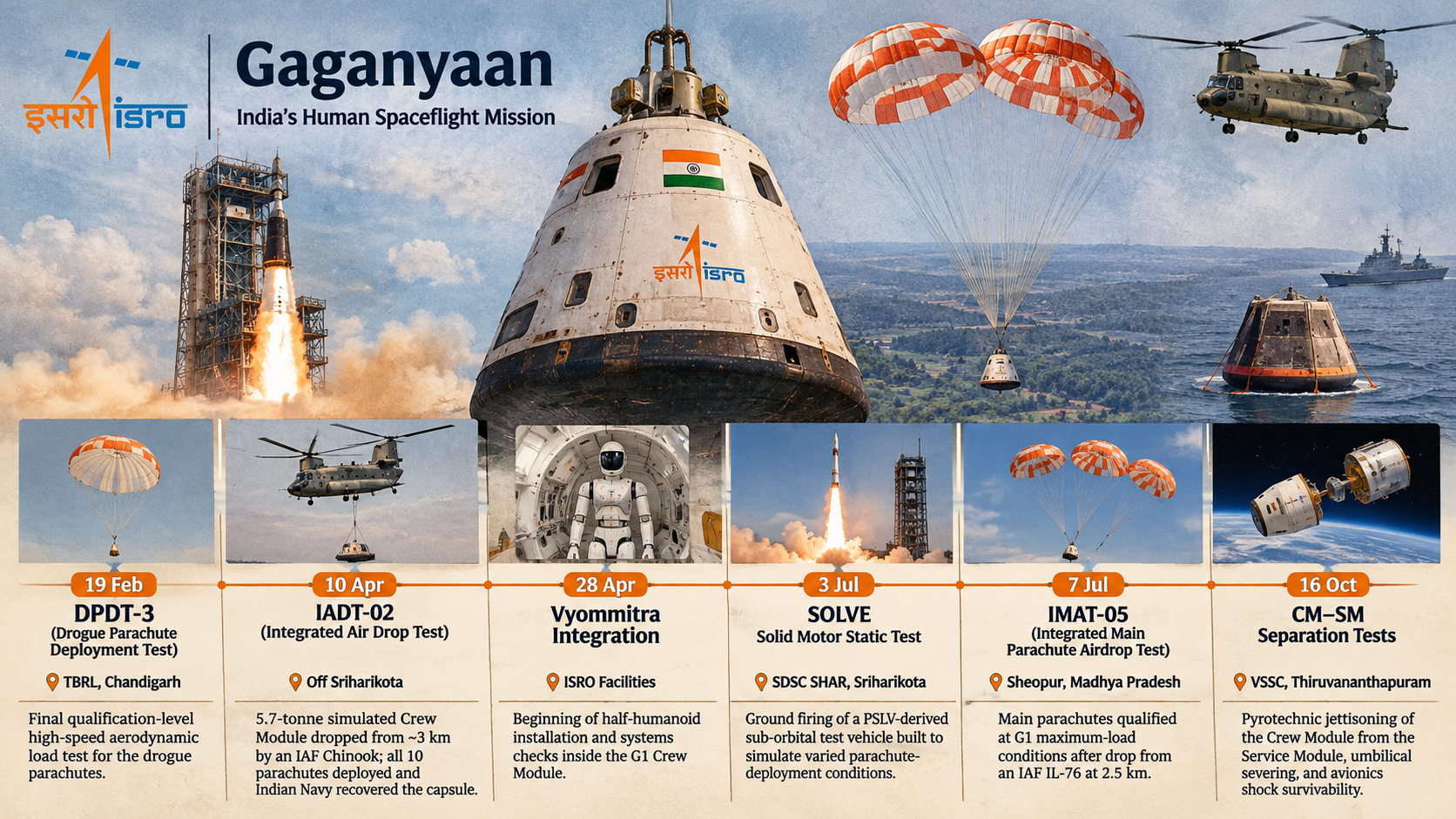
Sources: ISRO, ISRO SOLVE, ISRO IMAT, Wikipedia, and SatelliteTracker.
Launch infrastructure at Sriharikota’s Second Launch Pad has also been overhauled. ISRO has commissioned the Orbital Module Preparation Facility, augmented checkout terminals at the Second Vehicle Assembly Building, and added a Crew Access Arm, bubble lift, and zip-line escape system on the umbilical tower for eventual crewed flights (PIB). All three HLVM3 propulsion stages—the HS200 solid boosters, L110 liquid core, and C32 cryogenic upper stage—alongside five Crew Escape System solid motor types have completed ground qualification (PIB).
From G1 to BAS-01: The ₹20,193 Crore Eight-Mission Roadmap
Gaganyaan is no longer a standalone three-day capsule demonstration. In September 2024, the Union Cabinet expanded the programme’s mandate and raised its total outlay from roughly ₹10,000 crore ($1.07 billion) to ₹20,193 crore ($2.16 billion at ₹93.50 per US dollar as of 19 November 2026) (PIB Factsheet, Wise). The revised architecture covers eight missions through December 2028, bridging uncrewed qualification flights (G1–G3), initial crewed flights (H1–H2), and the launch of BAS-01, the first module of India’s planned five-module Bharatiya Antariksh Station targeted for full operationalisation by 2035 (PIB Factsheet, SatelliteTracker).
To support this cadence alongside heavier next-generation rockets, the government in January 2025 approved a Third Launch Pad at Sriharikota at an outlay of ₹3,984.86 crore ($426.19 million) (PIB).
Human Readiness and International Benchmarks
India’s four astronaut-designates—Indian Air Force test pilots Group Captains Prasanth Balakrishnan Nair, Ajit Krishnan, Angad Pratap, and Shubhanshu Shukla—have already moved beyond generic training in Russia’s Glavkosmos facilities to mission-specific simulations at ISRO’s Astronaut Training Facility in Bengaluru (PIB, Britannica).
Unlike earlier spaceflight programmes that relied solely on domestic simulators, ISRO gained live orbital data in mid-2025 when Group Captain Shukla served as primary mission pilot on Axiom Mission 4 (Ax-4), spending roughly 18 days aboard the International Space Station between 25 June and 15 July 2025 (ISRO, Britannica). Operational feedback from Ax-4 has since been folded into Gaganyaan’s crew procedures, complemented by cross-agency agreements with France’s CNES for space medicine and flight-surgeon training, the European Space Agency (ESA) for ground-network support, and the Australian Space Agency (ASA) for recovery operations (BattleIAS, PIB).
What Happens After December
If G1 lifts off in December 2026 and completes re-entry and recovery cleanly, India will clear its biggest remaining hardware hurdle—yet two substantial gates will still stand before an Indian astronaut rides an Indian rocket into orbit. First, ISRO must execute the remaining uncrewed flights (G2 and G3) and fly the TV-D2 abort test while graduating its indigenous ECLSS from a reduced demonstration unit to a fully human-rated life-support system (PIB). Second, with two consecutive PSLV third-stage anomalies in May 2025 (PSLV-C61) and January 2026 (PSLV-C62) still fresh in institutional memory, ISRO’s safety boards are unlikely to compress HLVM3’s human-rating reviews merely to hit a calendar target (Book of Exams). Succeeding on G1 will put India’s 2027 crewed goal within reach, making it the fourth nation after Russia, the United States, and China to launch humans on an indigenous spacecraft.