In brief
- Researchers from Mass General Brigham and Harvard Medical School published a study on 19 October 2026 showing an AI system can predict cancer survival from a single facial photograph, addressing oncologists' tendency to overestimate patient survival by two to five times.
- The FAHR-Face system combines two models trained on over 40 million faces: FaceAge estimates biological age with a 5.1-year mean absolute error, while FaceSurvival detects sub-visual cachexia signs and flagged patients with a 52.5% 90-day mortality rate in validation.
- External validation in Dutch medical centres showed the combined models outperformed standard clinical predictors, and the system could guide treatment de-escalation, earlier palliative support, and fairer clinical trial stratification for frail patients.
- Citing privacy and discrimination risks, the team open-sourced FaceAge but withheld FaceSurvival weights to prevent misuse by insurers, employers, or consumer apps, and launched a global study to improve diversity in phenotypic models.
In clinical oncology, the most difficult decision a physician makes is not which chemotherapy regimen or radiation dose to prescribe, but whether a patient possesses the physiological reserve to survive the treatment itself.
For decades, assessing that physical reserve has relied on subjective clinical scales, primarily the Eastern Cooperative Oncology Group (ECOG) Performance Status or the Karnofsky score. Both depend heavily on a doctor’s quick bedside visual assessment and a patient’s self-reported energy levels. Studies consistently show that oncologists, driven by therapeutic optimism, overestimate terminally ill cancer patients’ survival horizons by two to five times. This bias often results in aggressive, toxic interventions in a patient’s final weeks of life, when palliative care and symptom relief would offer superior quality of life.
On 19 October 2026, researchers from Mass General Brigham and Harvard Medical School published a landmark study in The Lancet Digital Health that could transform this assessment. Led by radiation oncologist Dr Raymond Mak and artificial intelligence researcher Dr Hugo Aerts, the team demonstrated that an artificial intelligence model—operating solely on a standard 2D digital photograph of a patient’s face—can objectively quantify biological ageing and directly predict survival probability in cancer patients.
In their clinical validation cohort, patients flagged by the system as facing the highest mortality risk experienced a 52.5% mortality rate within 90 days.
The Architecture: Building FAHR-Face
The system, designated FAHR-Face (Foundation Artificial Intelligence for Health Recognition - Face), departs fundamentally from narrow clinical algorithms. Rather than training a small convolutional neural network from scratch on medical charts, the team used a foundation-model approach:
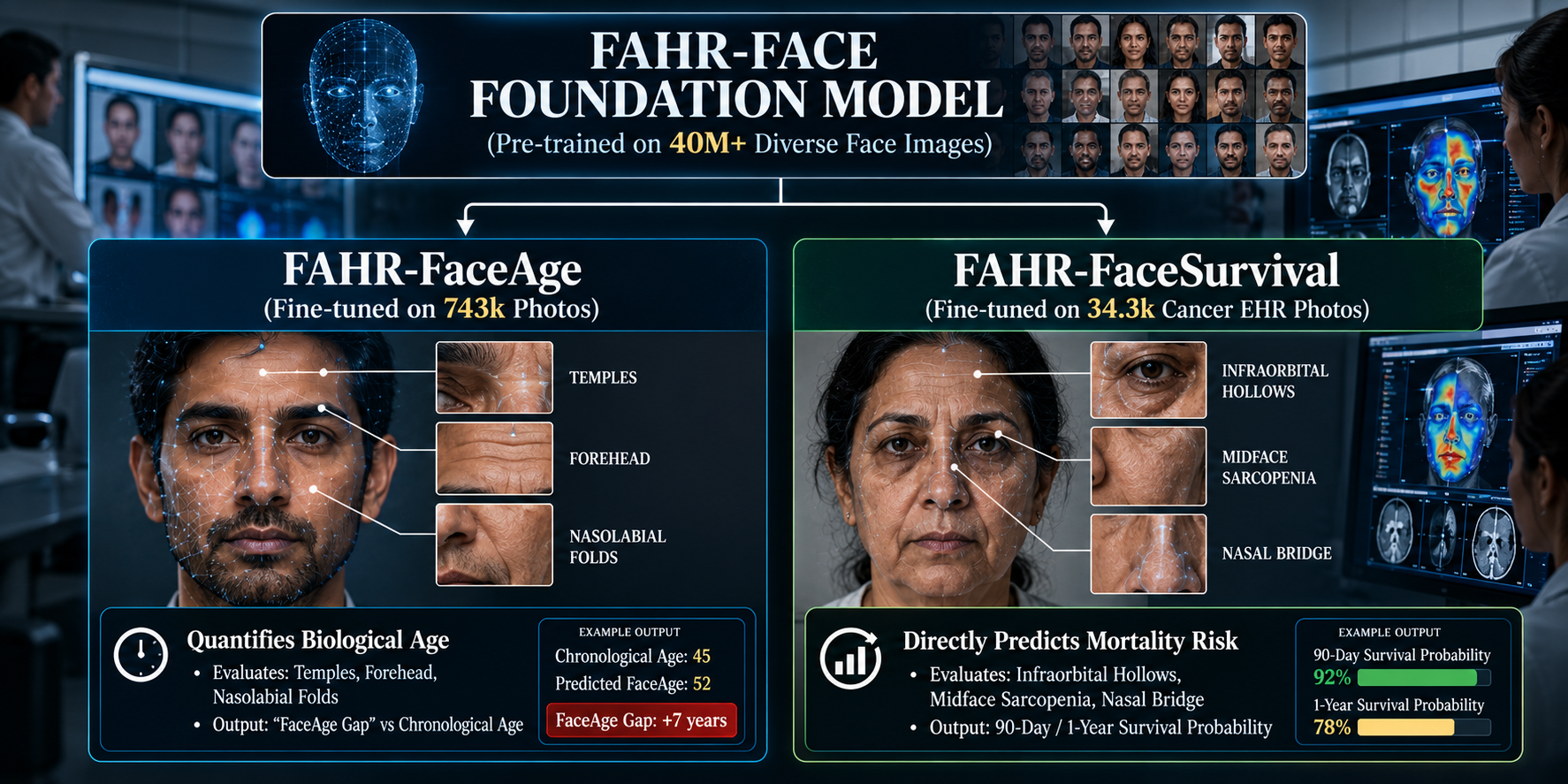
Self-Supervised Pre-Training (40 Million Faces): The base model was exposed to over 40 million diverse facial images to learn the complex mathematical geometry of human faces across ages, ethnicities, lighting environments, and head orientations.
FAHR-FaceAge (Biological Age Estimation): Fine-tuned across 743,152 curated photographs from ten public datasets spanning the entire human lifespan. It predicts biological age with a mean absolute error of just 5.1 years, establishing a robust baseline for how fast an individual’s body is ageing relative to their birth certificate.
FAHR-FaceSurvival (Oncological Risk Engine): Fine-tuned directly on 34,363 clinical facial photographs of cancer patients undergoing treatment at the Mass General Brigham Cancer Institute, linked to long-term electronic health records (EHR) and mortality outcomes.
What the AI Sees: Biological Age vs Acute Sarcopenia
A central finding of the Lancet paper is that biological ageing and cancer mortality risk are not identical phenomena. While one might assume an AI simply flags patients who look older as sicker, the model’s attention maps (gradient-weighted class activation mapping) revealed that the two sub-models scrutinise entirely different facial territories:
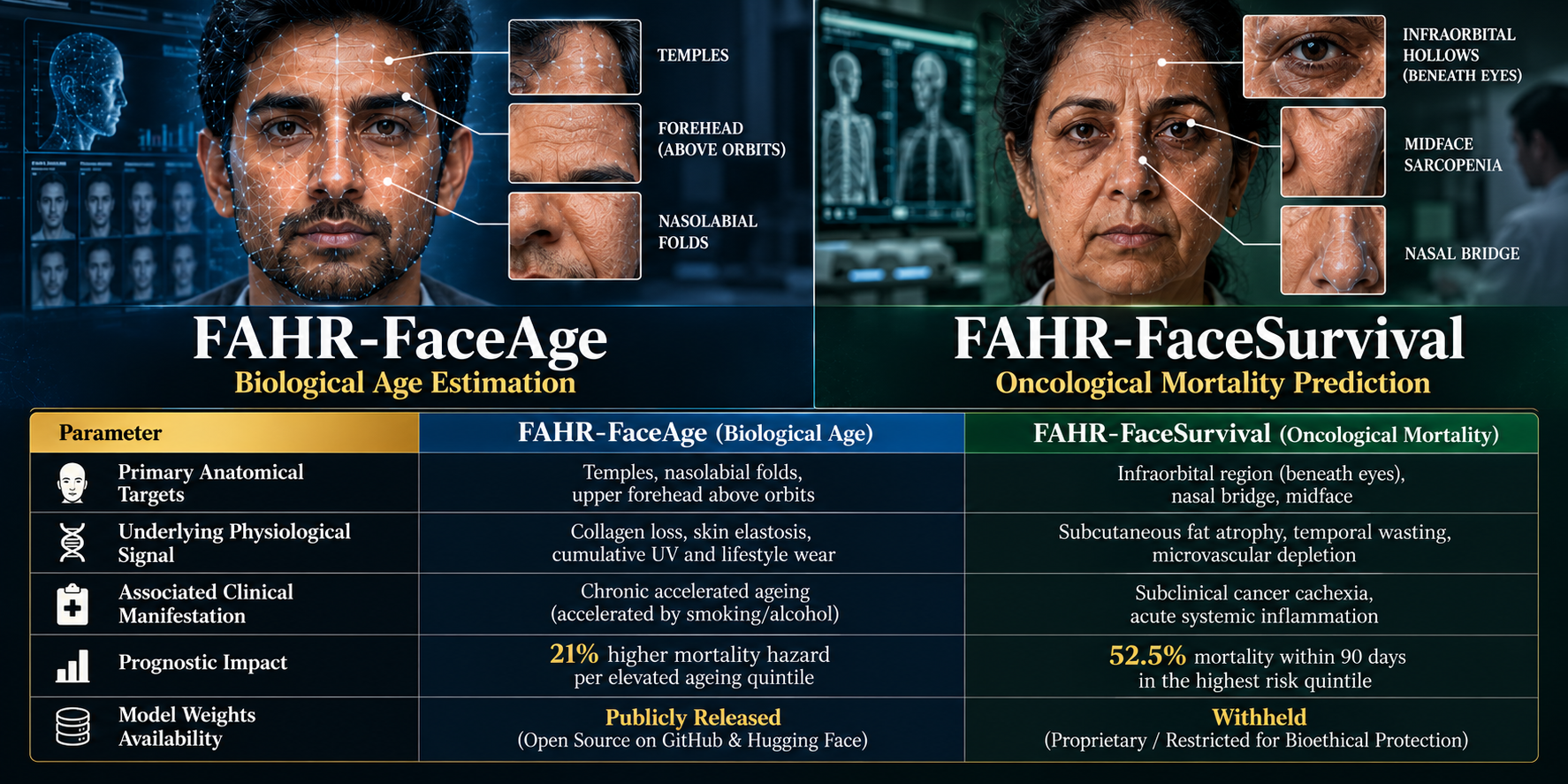
Dr Hugo Aerts, Director of the Artificial Intelligence in Medicine (AIM) program at Mass General Brigham, noted that the predictions of the two tools were only weakly correlated. When evaluated together, each model contributed independent prognostic value.
While FaceAge picks up lifetime systemic stressors—the study proved that current smokers look biologically older than former smokers, who in turn look older than non-smokers—FaceSurvival detects the subtle, sub-visual hallmarks of cancer cachexia. Cachexia is a metabolic syndrome characterised by rapid, non-lipidic muscle wasting that frequently precedes clinical recognition by weeks or months. By detecting sub-millimetre sunkenness in the infraorbital fat pads and subtle shifts in facial vascularity, the AI identifies patients whose physical reserve is failing before standard blood markers or physical scales register the decline.
Clinical Robustness and External Testing
Medical AI systems frequently fail when deployed outside their development institutions due to dataset overfitting. The Mass General Brigham team subjected FAHR-Face to extensive stress tests:
Real-World Variations: The biological age estimation held steady across confounding factors, including shifts in camera angles, hospital lighting conditions, neutral versus smiling expressions, and cosmetic makeup.
Surgical Interventions: Testing across cohorts with prior aesthetic plastic surgery revealed that general facial procedures did not distort biological health scores, with only a minor, transient shift detected following rhinoplasty (nose reconstruction).
Cross-Border Validation: The researchers validated the combined models on an independent external cohort of cancer patients from medical centres in the Netherlands (including Maastricht University). In this external validation, combining FAHR-FaceAge and FAHR-FaceSurvival with standard clinical variables (cancer stage, chronological age, and tumour histology) significantly outperformed standard predictive oncological models.
The Clinical Opportunity: Personalised De-Escalation
Dr Raymond Mak, a radiation oncologist at Mass General Brigham and corresponding author of the study, emphasised that the objective is not to deny care, but to eliminate therapeutic blind spots:
"As the population ages, physicians need better ways to estimate physical reserve and frailty before recommending intensive treatments such as radiation, surgery or systemic therapy. Our goal is to make face photograph-based health assessment more quantitative, consistent and scalable so it can support personalized treatment decisions rather than replace physician judgment."
In practical oncology, a high FAHR-FaceSurvival risk score could prompt several life-saving clinical recalibrations:
Dose Modification: De-escalating radical concurrent chemoradiation to less toxic, sequential regimens to prevent lethal treatment-related toxicities in frail patients.
Immediate Palliative and Nutritional Support: Triggering aggressive nutritional intervention, anabolic therapeutics, or dedicated palliative consults months earlier in the disease trajectory.
Clinical Trial Stratification: Ensuring that clinical oncology trials balance frailty scores across study arms, preventing experimental drugs from falsely appearing toxic due to hidden patient frailty.
The Bioethical Chokepoint: Why the Mortality Weights Were Locked
While the computer vision models represent a scientific milestone, they present unprecedented ethical and privacy dangers. Blood samples, biopsy slides, and CT scans require clinical infrastructure, informed consent, and physical custody. A facial photograph, by contrast, can be captured without consent from a smartphone, social media profile, or public closed-circuit television (CCTV) feed.
Recognising these risks, the researchers took an unusual step: they open-sourced FAHR-FaceAge, but explicitly withheld the model weights for FAHR-FaceSurvival.
The hazards of unconstrained facial mortality profiling are profound:
Predatory Underwriting: Life, health, and disability insurance providers could surreptitiously scrape applicant selfies or social media archives to price policies, deny coverage, or adjust life annuities based on unverified mortality scores.
Employment Discrimination: Prospective employers during remote video interviews could deploy ambient facial scoring to assess an executive candidate’s unstated disease burden or life expectancy.
Psychological Distress: If embedded into consumer apps, uncalibrated mortality readouts delivered to vulnerable patients without clinical context could induce severe existential distress and despair.
Confounding Pharmacological Artifacts: Systemic cancer therapies themselves alter facial morphology. High-dose corticosteroids (such as dexamethasone, universally administered during chemotherapy) induce fluid retention and "moon face" (cushingoid appearance), while targeted therapies can provoke severe facial dermatitis. If an algorithm misinterprets drug-induced facial alterations as impending mortality, it risks initiating a self-fulfilling cycle of treatment withdrawal.
To evaluate these population-level variations transparently, Mass General Brigham has launched the public, institutional review board-approved FaceAge Research Study (faceage.bwh.harvard.edu), inviting individuals globally to upload facial photographs to refine phenotypic models across diverse ethnic groups, skin tones, and non-Western clinical environments.