In brief
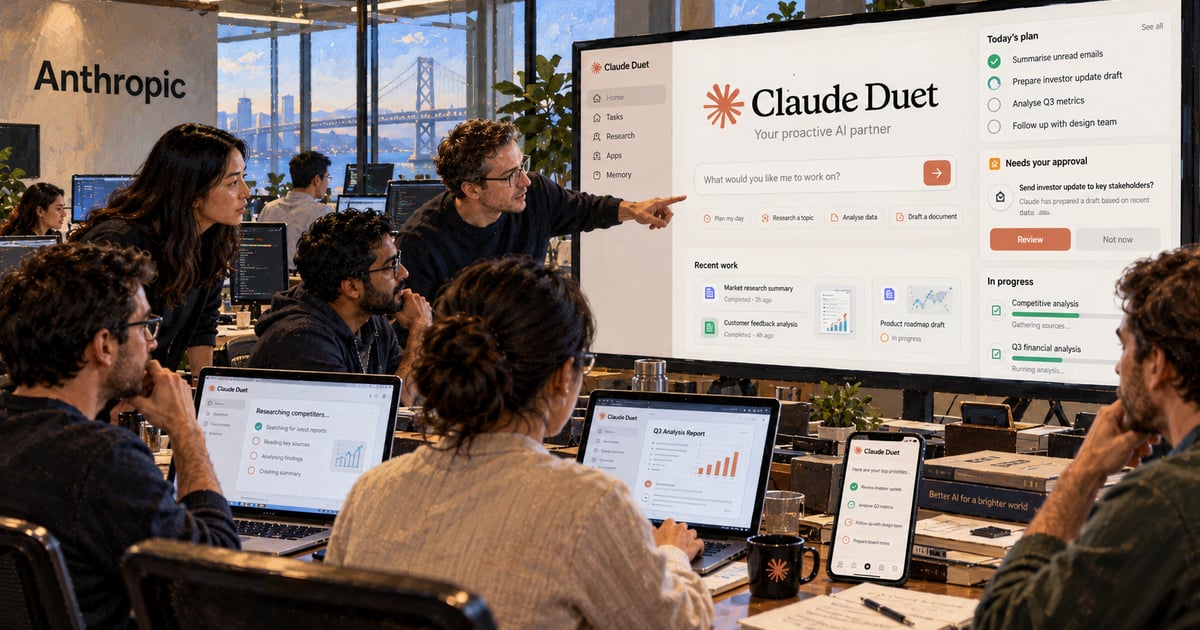
- Anthropic launched Claude Duet on 21 October 2026 as a proactive agent that works in the background instead of waiting for user instructions, using Claude Opus 5.5 to monitor connected tools and initiate conversations when needed.
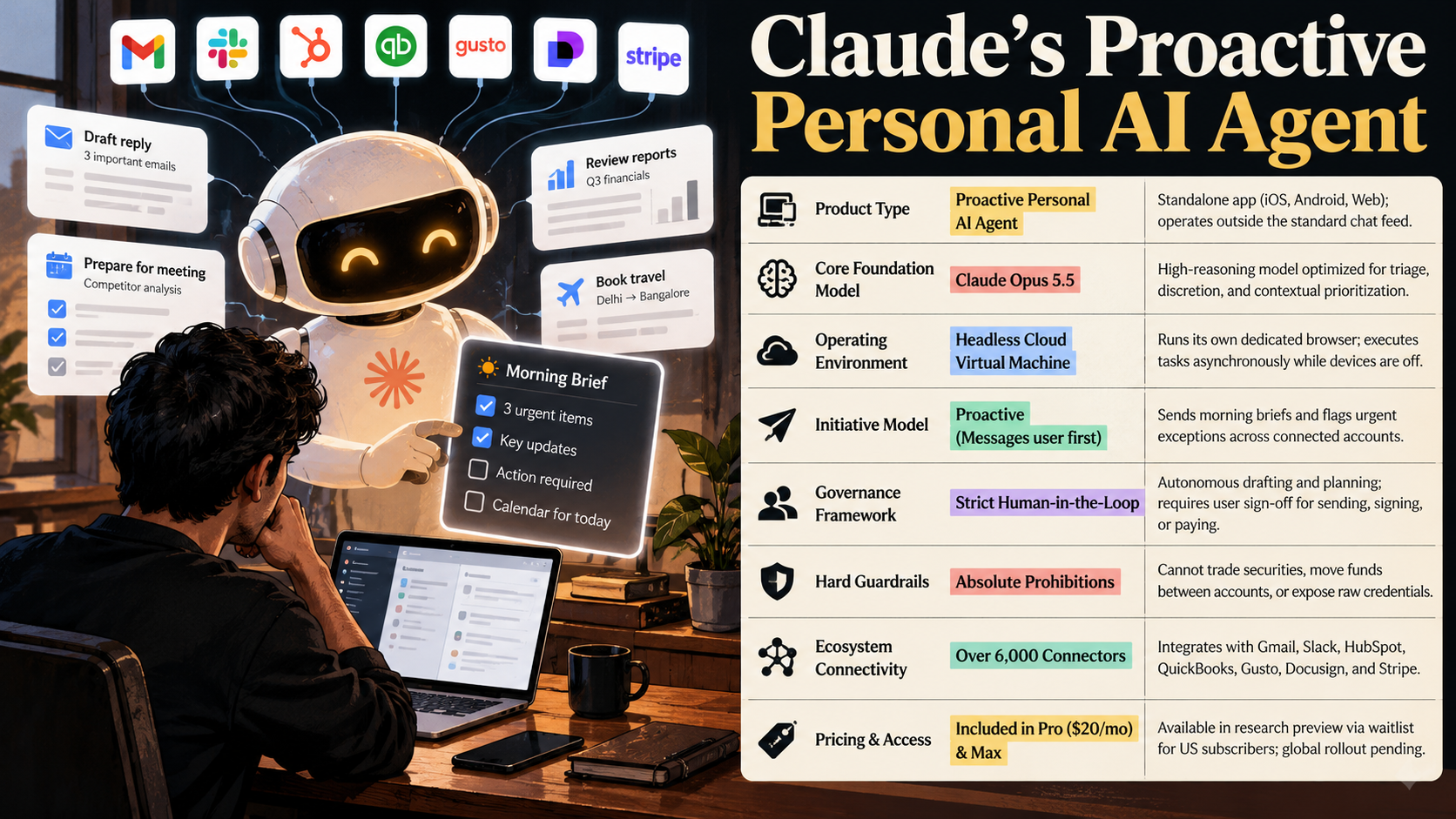
- Claude Duet is a standalone application available on iOS, Android, and the web, built around the Claude Opus 5.5 reasoning model to perform proactive triage and prepare drafts or data tasks.
- The system is designed to bring attention to important items, complete tasks handed off by the user, keep working when the user steps away, and check before acting to separate preparation from execution.
- Current limitations include miscalibrated urgency, difficulty with informal consumer tasks, and usage friction due to background polling and multi step sessions affecting plan allocations.
For the past four years, the fundamental interaction model of generative artificial intelligence has remained static: the empty text prompt.
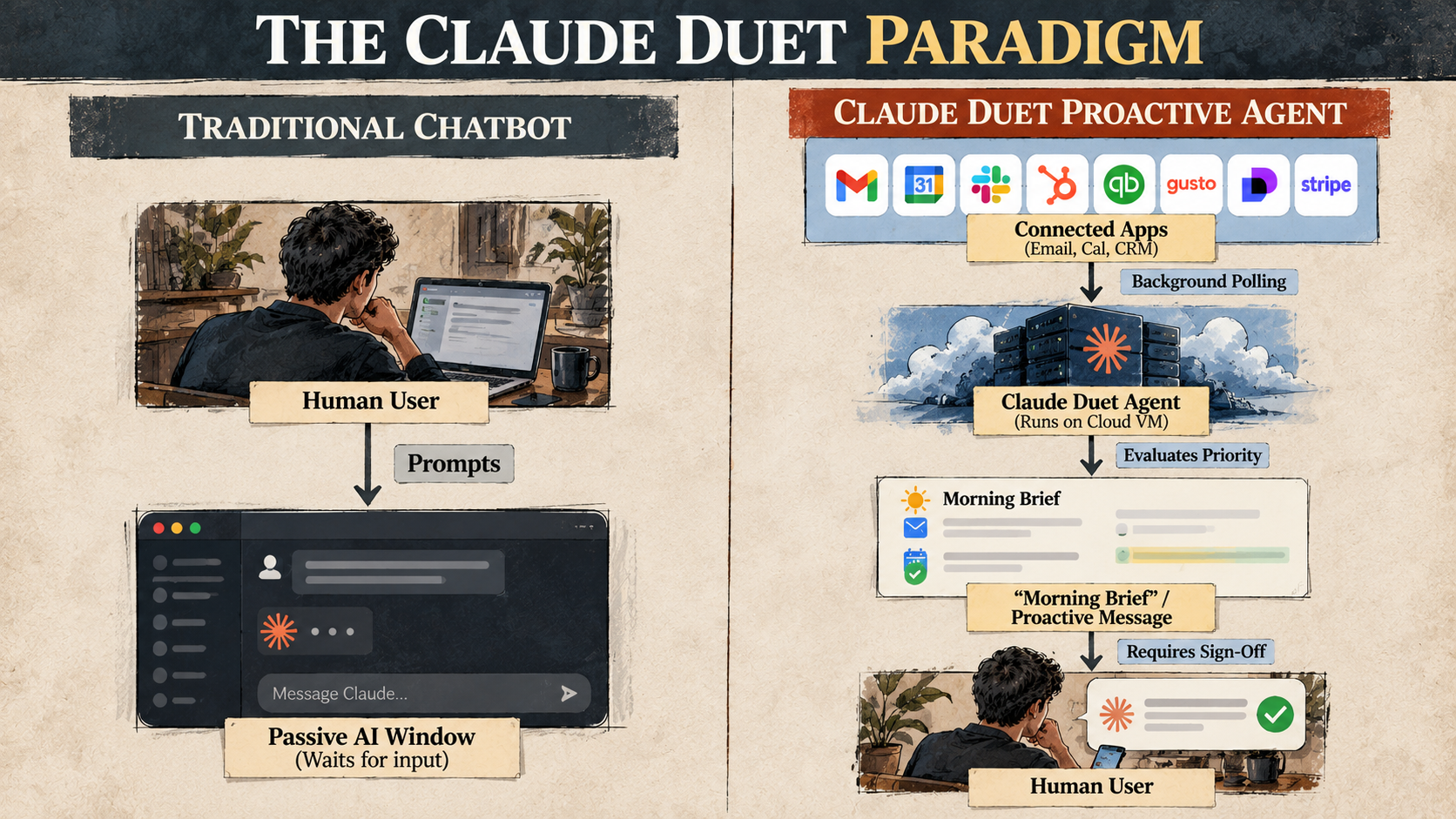
Whether interacting with ChatGPT, Google Gemini, or standard Claude, the software is entirely passive. It sits motionless on a screen, waiting for a human to type a query, upload a document, or issue an instruction. When the user closes the browser tab, the intelligence ceases to operate.
On 21 October 2026, Anthropic formally challenged that paradigm with the launch of Claude Duet, an experimental standalone application available on iOS, Android, and the web.
Built around Anthropic’s flagship Claude Opus 5.5 reasoning model, Claude Duet is what the company terms a "proactive agent." Instead of waiting for instructions, Duet works continuously in the background, monitoring connected workplace software, preparing drafts, catching scheduling conflicts, and initiating conversations when an issue genuinely warrants human attention.
1. The Core Shift: From Reactive Chat to Proactive Triage
Anthropic defines Claude Duet’s functional philosophy through four distinct operational verbs:
Brings you what needs your attention: It reviews your connected tools and filters out noise, presenting only decisions that genuinely require human judgment.
Completes tasks you hand off: It undertakes multi-step digital labour—from drafting complex correspondence to generating financial models.
Keeps working when you step away: Because it operates on an independent cloud virtual machine, initiating a research task or data synthesis does not require leaving your laptop open.
Checks before it acts: It maintains a strict boundary between analytical preparation and real-world execution.
The Morning Brief and Daily Cadence
In practice, a user’s interaction with Claude Duet begins not with a blank prompt, but with a curated morning briefing.
Before the working day commences, Duet reviews calendar invites, cross-references recent email threads, audits open invoices in QuickBooks or Stripe, and checks direct messages in Slack. It synthesises these disparate inputs into a concise agenda, flagging anomalies:
Calendar Mismatches: Identifying that a client presentation is scheduled 15 minutes before an international flight departure, offering to draft a rescheduling request.
Silent Deals: Detecting that a high-value sales prospect in HubSpot has not replied to a proposal in seven days, presenting a pre-drafted follow-up note ready for review.
Administrative Hazards: Noting that monthly payroll in Gusto has unapproved reimbursement requests 24 hours before the processing deadline.
2. Architecture: Headless Cloud VMs and Periodic Polling
To function autonomously, Claude Duet cannot rely on client-side browser extensions or device processing. It runs in a secure, sandboxed cloud container:
Asynchronous Virtual Machines
When a user delegates a complex assignment—such as "Audit our Q3 ad spend across Shopify and Stripe and build a comparative margin dashboard"—Duet does not tie up the user's phone or computer. The agent spins up a headless browser within its cloud sandbox, navigates the relevant SaaS platforms via secure API connectors, extracts the data, writes the analytical code, and renders the artifact. When the project is ready, it issues a push notification.
The Periodic Polling Trade-Off
A persistent challenge for always-on agents is compute consumption. If an AI model inspects millions of user inboxes every second, subscription costs and API rate limits would quickly become unsustainable.
Anthropic solved this through cadenced background polling. Duet inspects connected accounts at calculated intervals—typically every two to four hours, with higher frequency during designated working hours—to preserve the user’s shared plan limits. Background checks count against the subscriber's standard Claude Pro or Max usage quotas, making intelligent triage essential.
3. The Security and Discretion Perimeter
Granting an autonomous system read-and-write access to private corporate infrastructure introduces severe attack vectors, particularly indirect prompt injection (where a malicious actor sends an email containing hidden instructions designed to hijack the agent).
Anthropic integrated several layers of defense into Duet’s runtime:
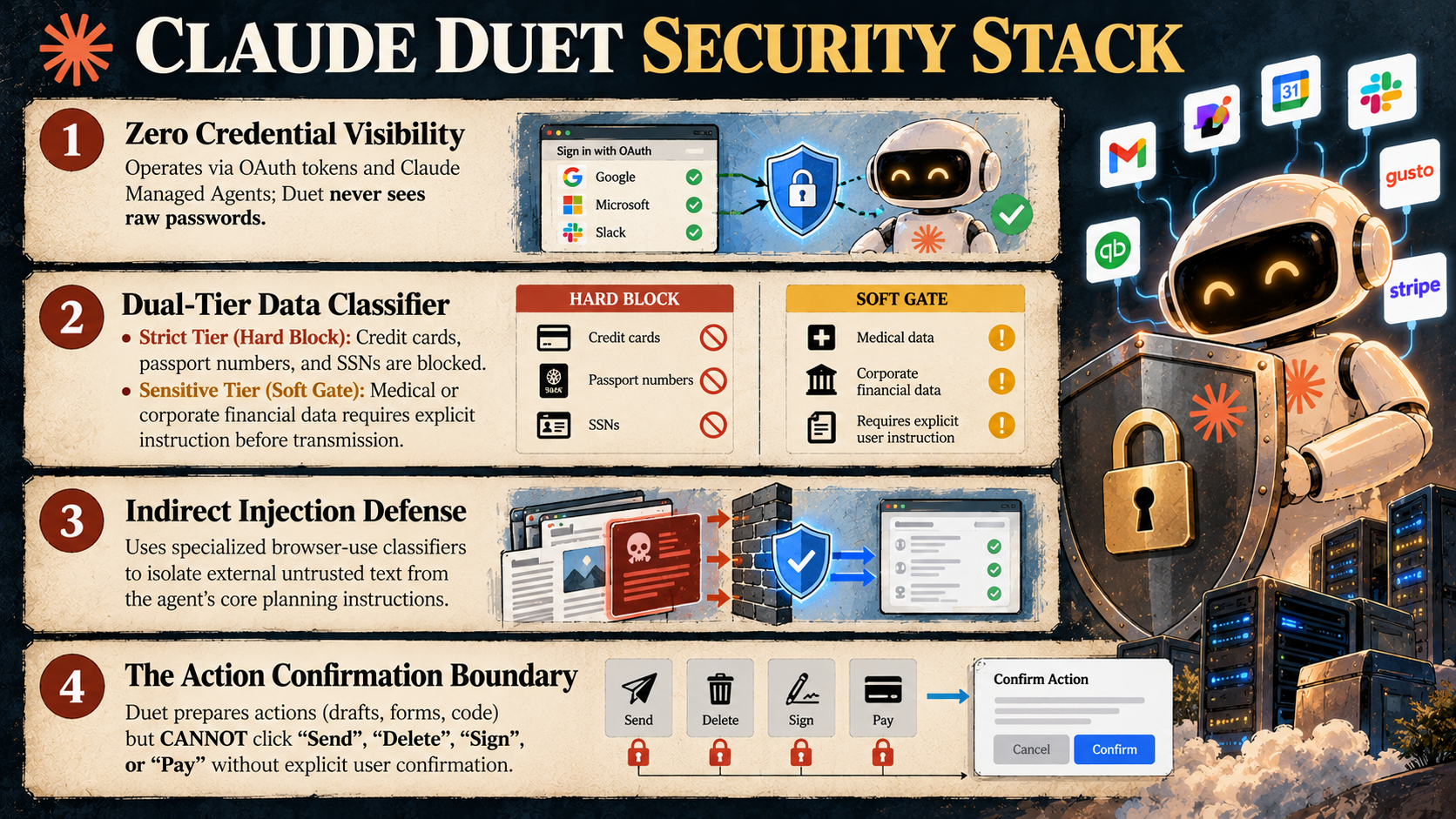
Furthermore, Anthropic established hard architectural boundaries: certain operations are completely prohibited, even if the user explicitly orders the agent to perform them. Duet is strictly barred from trading financial securities, transferring funds between banking institutions, or permanently purging primary databases.
For commercial purchasing, Duet partners with Stripe Link. When instructed to procure office equipment or software licences, Duet compiles the cart, confirms the total with the user, and completes checkout using a single-use virtual card, ensuring that actual corporate credit card credentials remain unexposed.
4. The Competitive Landscape: The Battle for the Personal Agent
Claude Duet’s debut marks Anthropic’s formal entry into the high-stakes "Agentic AI" race, where the primary battleground has shifted from raw model benchmarks to integrated personal utility:
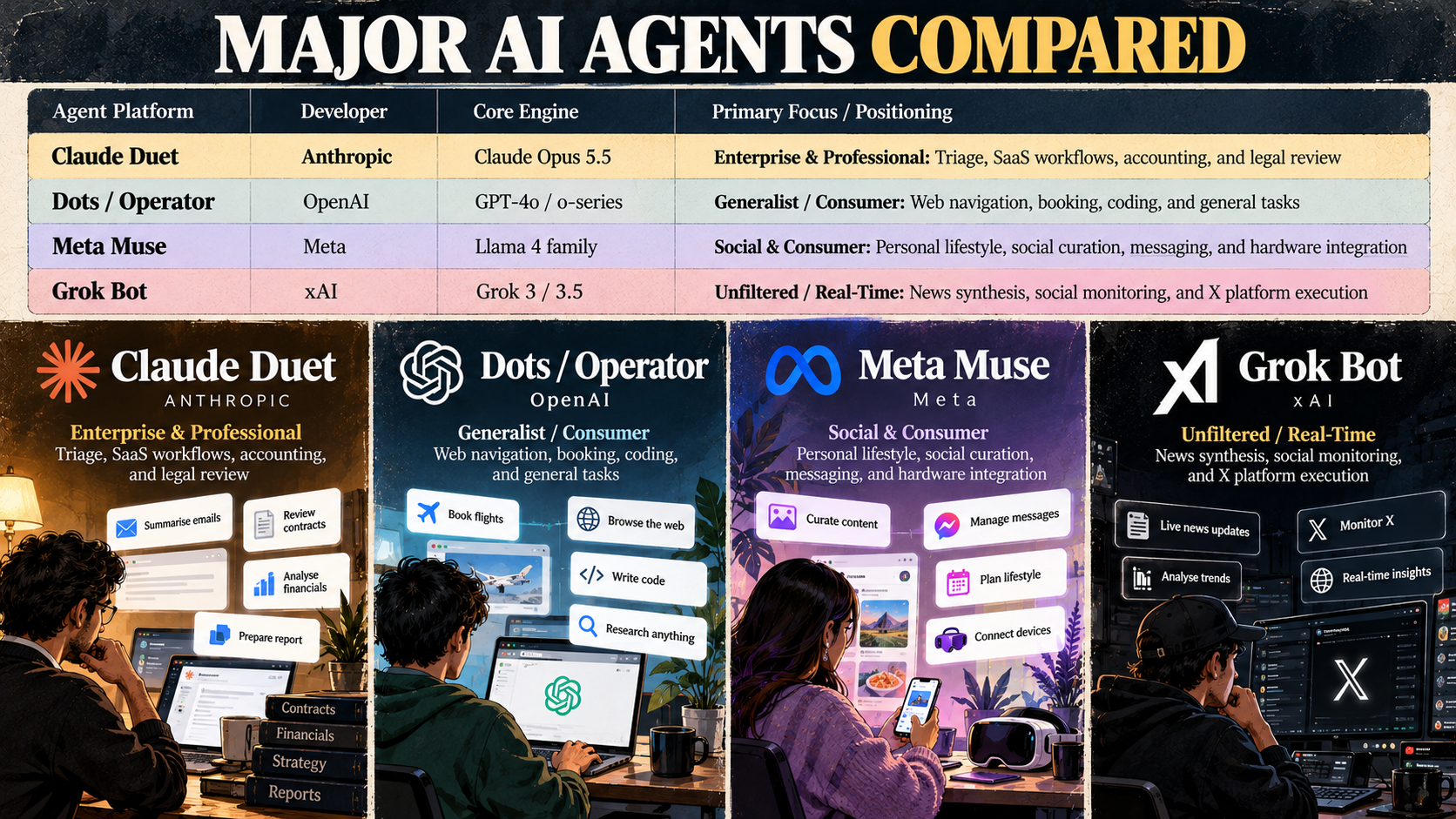
While Meta and OpenAI are leaning heavily into consumer lifestyle tasks and generalist web browsing, Anthropic is explicitly aiming Duet at small business owners, startup founders, and corporate professionals overwhelmed by software fragmentation. By connecting natively into business infrastructure (QuickBooks, Gusto, Docusign, HubSpot), Duet seeks to replace the administrative drag of navigating dozens of disconnected SaaS browser tabs.
5. Current Limitations: The Early Realities of Proactivity
Because Claude Duet is in an early research preview, Anthropic and early enterprise testers have noted several operational friction points:
Contextual Urgency Miscalibration: Determining what is truly "urgent" is a subjective human judgment. In early builds, Duet occasionally flags low-priority newsletter receipts while categorising important, subtly worded client emails as routine.
Personal Errand Weakness: The agent is heavily optimized for structured business workflows. It currently struggles with informal consumer errands, such as finding the cheapest local dry cleaner or navigating fragmented concert ticket platforms.
Usage Limit Friction: Because background polling and deep multi-step virtual machine sessions consume standard Pro and Max plan allocations, heavy users can exhaust their message allowances faster than they would in standard text chat.
Shared Inbox Incapacity: Duet is architected around individual personal identity. It cannot currently manage a shared team inbox (such as
[email protected]or[email protected]) without causing permission conflicts.