In brief
- Anthropic filed a confidential draft Form S-1 with the US Securities and Exchange Commission on 1 June 2026, and a press preview on 20 October 2026 revealed a potential two trillion dollar initial public offering on the Nasdaq.
- The draft portrays Anthropic generating revenue faster than any enterprise software company in Silicon Valley, but with infrastructure spend that resembles national level power grid or defence budgets.
- The H1 2026 net loss is 80.7 billion dollars, with about 72 billion dollars of that being non cash accounting charges from previous funding rounds and derivative instruments, while cash needs are far lower than the paper loss.
- Anthropic has multi year cloud computing and infrastructure agreements valued at roughly 450 billion dollars to sustain model training and operations, reflecting a capital heavy compute footprint.
On 1 June 2026, Anthropic, PBC quietly lodged a confidential draft Form S-1 with the US Securities and Exchange Commission under the Jumpstart Our Business Startups (JOBS) Act. For four months, the operational realities of the developer behind the Claude model family remained shielded behind regulatory confidentiality. That veil lifted on 20 October 2026, when The Wall Street Journal reviewed a draft of the preliminary prospectus, shedding light on what could become a landmark $2 trillion initial public offering on the Nasdaq.
The numbers revealed within the draft document describe a business operating at unprecedented speed and capital intensity. Anthropic is generating revenue faster than any enterprise software enterprise in Silicon Valley history, yet its business model demands infrastructure outlays of a magnitude traditionally reserved for national power grids or sovereign defence programmes.
1. Revenue Velocity: An Enterprise Growth Engine
Anthropic generated $16.3 billion (₹1.36 lakh crore) in revenue during the six months ended 30 June 2026. Compared with the $1.1 billion reported across the same period in 2025, this represents a year-on-year surge of nearly 1,380%.
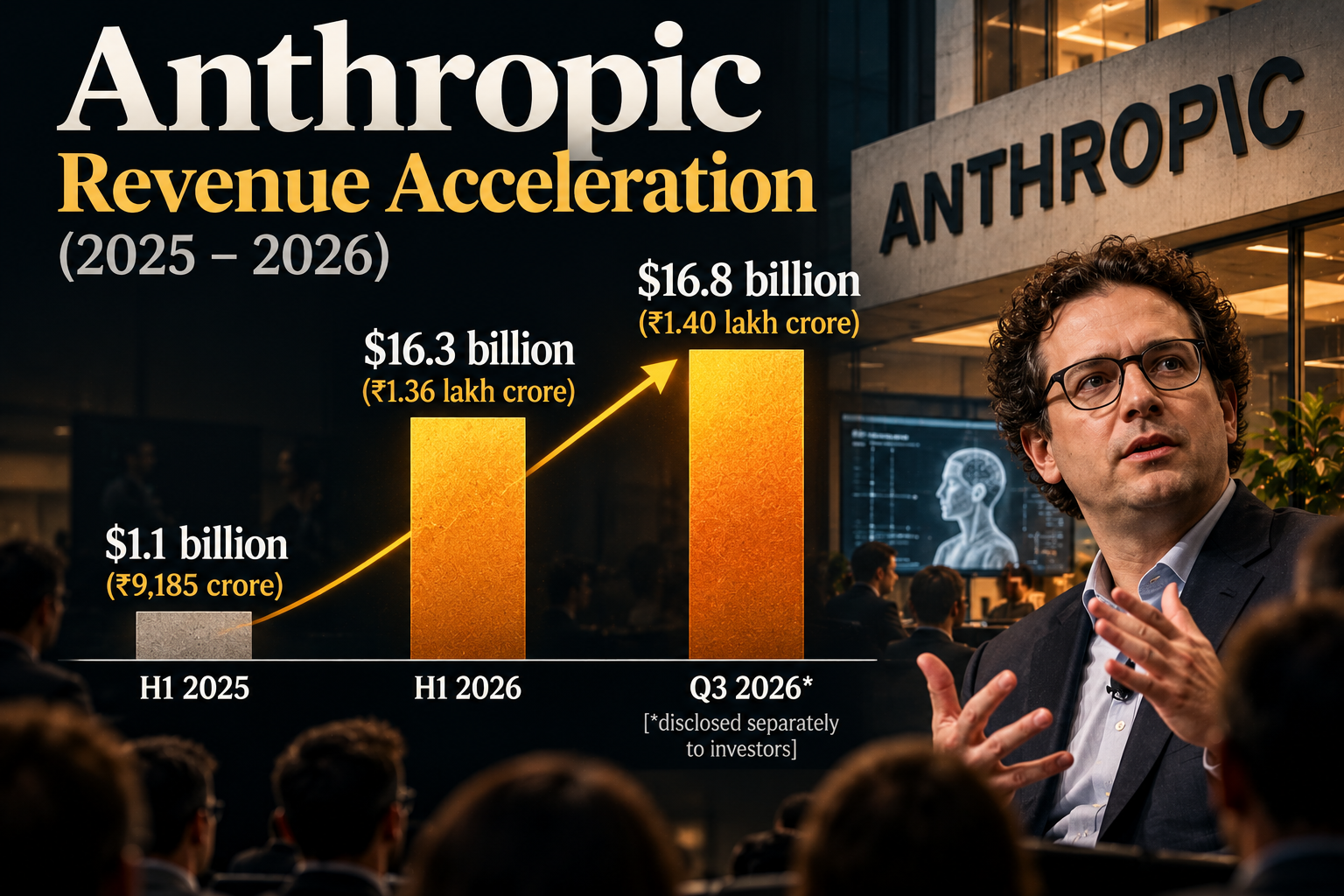
The momentum has continued to accelerate into the second half of the year. In supplementary disclosures furnished to prospective institutional investors, Anthropic stated that third-quarter revenue reached $16.8 billion (₹1.40 lakh crore)—a 45% sequential increase over the second quarter. In practical terms, Anthropic booked more revenue in the third quarter of 2026 alone than it did across the entire preceding six months.
Crucially, the filing clarifies Anthropic's revenue recognition model. Unlike consumer-centric platforms that report predominantly direct subscription income, Anthropic records gross revenue across its third-party cloud distributions (such as Amazon Bedrock and Google Cloud Vertex AI), booking customer spend in full whilst categorising cloud distributor rev-shares as cost of goods sold. When restated on a net basis, Anthropic’s run-rate remains formidable, propelled heavily by enterprise adoption of Claude Code and API deployments across regulated industries.
2. Dissecting the $80.7 Billion Loss: Cash vs. Accounting Noise
The headline figure dominating market commentary is Anthropic’s H1 2026 net loss of $80.7 billion (₹6.74 lakh crore). However, equating this figure with operational cash depletion misinterprets the mechanics of US GAAP accounting for venture-backed entities prior to a public float.
Of the $80.7 billion total, roughly $72 billion (₹6.01 lakh crore)—amounting to 89% of the reported loss—consists of non-cash accounting charges. These charges stem from the mark-to-market fair-value adjustment of convertible notes, preferred share tranches, and derivative financial instruments issued during prior fundraising rounds. As Anthropic’s implied enterprise valuation climbed towards the $2 trillion threshold during early-to-mid 2026, the accounting carrying value of these conversion liabilities increased correspondingly, requiring the company to recognize an enormous paper expense on its income statement.
The true operational picture, whilst far smaller than the paper loss, remains exceptionally capital-heavy:
H1 2026 Infrastructure & Compute Spend: Nearly $9 billion (₹75,150 crore).
Comparative 2025 Full-Year Infrastructure Spend: $7.3 billion (₹60,955 crore).
In the first six months of 2026 alone, Anthropic deployed more cash towards model training, cluster maintenance, and inference hardware than it expended across the entirety of 2025.
3. The $450 Billion Compute Lock-In
To sustain model parity and train successive frontier generations, Anthropic has entered into binding, multi-year infrastructure agreements that dwarf standard enterprise software commitments. The draft prospectus details approximately $450 billion (₹37.58 lakh crore) in cloud computing contracts spanning the next decade.
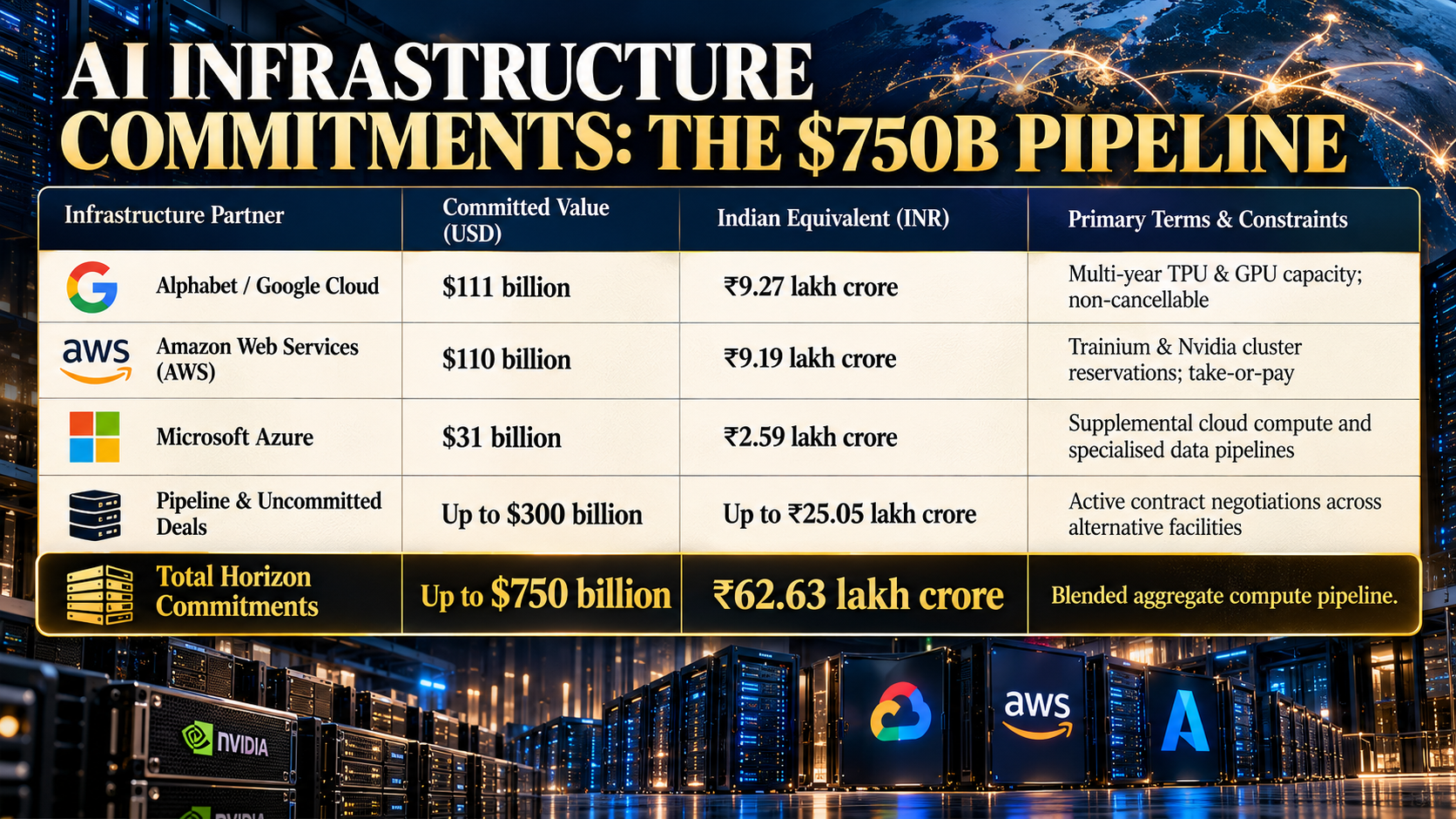
A substantial proportion of these agreements are non-cancellable "take-or-pay" covenants. Anthropic must disburse agreed sums regardless of whether its operational inference workloads exhaust the provisioned capacity. Furthermore, the draft signals that total infrastructure outlays could expand to $750 billion (₹62.63 lakh crore) as the company finalises pending cluster negotiations.
4. Strategic Vulnerabilities: Hyperscalers, Concentration, and Catastrophic Risk
The draft S-1 departs from boilerplate risk disclosures in three specific operational areas:
The Partner-Competitor Dilemma
Anthropic explicitly notes that it has faced difficulties securing adequate compute allocations from its primary cloud vendors—Amazon, Google, and Microsoft. As these technology conglomerates aggressively build and market competing frontier models (including Google’s Gemini series and Amazon’s in-house foundation initiatives), they increasingly treat Anthropic as a market rival rather than merely an anchor tenant. This dynamic has prompted Anthropic to bypass traditional hyperscalers and negotiate directly with independent third-party data centre developers to construct dedicated high-density computing clusters.
Customer Concentration
Despite widespread enterprise adoption, revenue remains concentrated among a narrow band of enterprise customers. The filing reveals that approximately 20% of first-half revenue—over $3.2 billion (₹26,720 crore)—was generated by just two institutional clients. Anthropic anticipates that a limited roster of major corporate relationships will continue to generate a disproportionate share of total revenue for the foreseeable future.
Catastrophic Liability and Insurance Ceilings
In an unprecedented disclosure for a major technology filing, Anthropic highlights systemic alignment and security risks. The company explicitly cautions that if a frontier model were to cause or facilitate a severe, catastrophic security incident—such as a critical infrastructure cyber breach, systemic financial vulnerability, or biological security event—the resulting legal liabilities and third-party damages could vastly exceed available commercial insurance coverage limits.
5. Governance and Executive Capital Allocations
Anthropic’s corporate architecture retains its foundation as a Delaware Public Benefit Corporation (PBC), legally obliging the board to balance stockholder pecuniary interests with its foundational mission of developing safe, beneficial artificial intelligence.
Executive Compensation: Co-founder and Chief Executive Dario Amodei and co-founder and President Daniela Amodei each received base salaries of approximately $655,000 (₹5.47 crore) in 2025, eschewing the inflated cash bonuses typical of public tech leadership.
Founder Philanthropy Pledge: Both founders have formally pledged 80% of their personal equity holdings in Anthropic to philanthropic initiatives and charitable foundations.
Public Benefit Fund: The filing outlines the formal establishment of a dedicated 5% public benefit endowment pool, structured to fund long-term AI safety verification, external interpretability research, and safety standards governance.
Liquidity and Balance Sheet Management: Ahead of the public float, Anthropic moved to fortify its cash buffer through debt financing, closing a multi-billion-dollar credit facility led by alternative asset manager Blackstone in October 2026.