In brief
- Markets in East Asia have seen significant volatility as investors confront AI spending doubts, with a sell-off led by Korea and Taiwan's semiconductor giants and heavy equipment makers in Tokyo.
- The AI spending doubt refers to a mismatch between capital expenditure on AI data centres by US hyperscalers and the lack of corresponding software revenue growth from business clients, raising concerns about cash flow to justify the investment.
- Despite a market correction, demand for computing power remains historically high and leading foundries report full capacity utilisation for advanced manufacturing nodes, indicating the decline is in uncritical capital allocation rather than AI demand.
- The immediate trigger was not an operational failure or earnings miss but a structural crisis of confidence over AI spending, affecting sentiment and causing sharp declines in key indices such as Kospi, Taiex, and Nikkei 225.
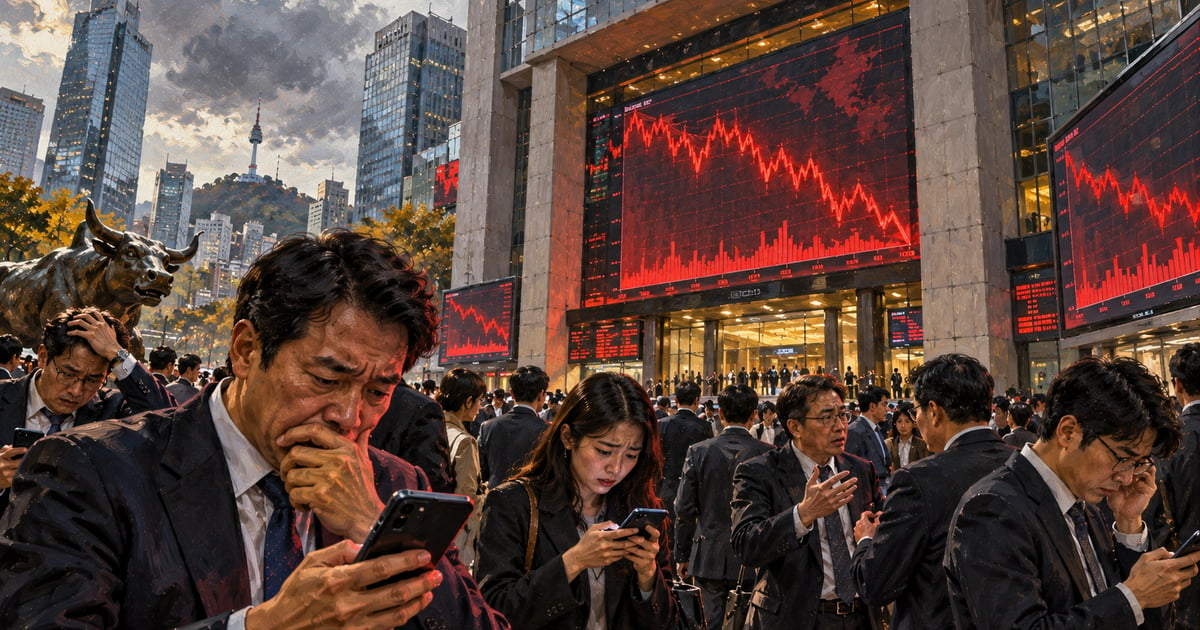
Over the past few weeks, equity markets across East Asia have experienced significant volatility.
South Korea’s benchmark Kospi index dropped by 8% in a single trading session, dragging it down more than 35% from its peak earlier in the year. The sell-off was led by its two domestic semiconductor giants: Samsung Electronics and SK Hynix, which saw their share prices tumble between 9% and 12%. In Taipei, the Taiex slid by nearly 3% as Taiwan Semiconductor Manufacturing Company (TSMC) slipped, while Tokyo’s Nikkei 225 tumbled as testing and manufacturing equipment makers such as Tokyo Electron and Advantest retreated.
The immediate trigger for the rout was not an operational failure or an earnings miss. In fact, Samsung had recently forecast a sharp jump in operating profit. Instead, markets were hit by a structural crisis of confidence known across trading desks as AI spending doubt.
Global investors are increasingly questioning whether the hundreds of billions of dollars being poured into artificial intelligence data centres by US technology giants will generate sufficient, timely financial returns—and Asian hardware suppliers are bearing the initial impact of that scepticism.
What Is the "AI Spending Doubt"?
At its core, AI spending doubt is the recognition of an unsustainable mismatch between capital expenditure (capex) and end-user revenue.
Over the past two years, the four major US "hyperscalers"—Microsoft, Alphabet, Meta, and Amazon—have dramatically increased their infrastructure budgets. Collectively, these firms are spending well over $200 billion (approximately ₹16.6 lakh crore) annually to acquire specialised graphics processing units (GPUs), build high-density data centres, secure electrical substations, and lay high-speed optical networking.
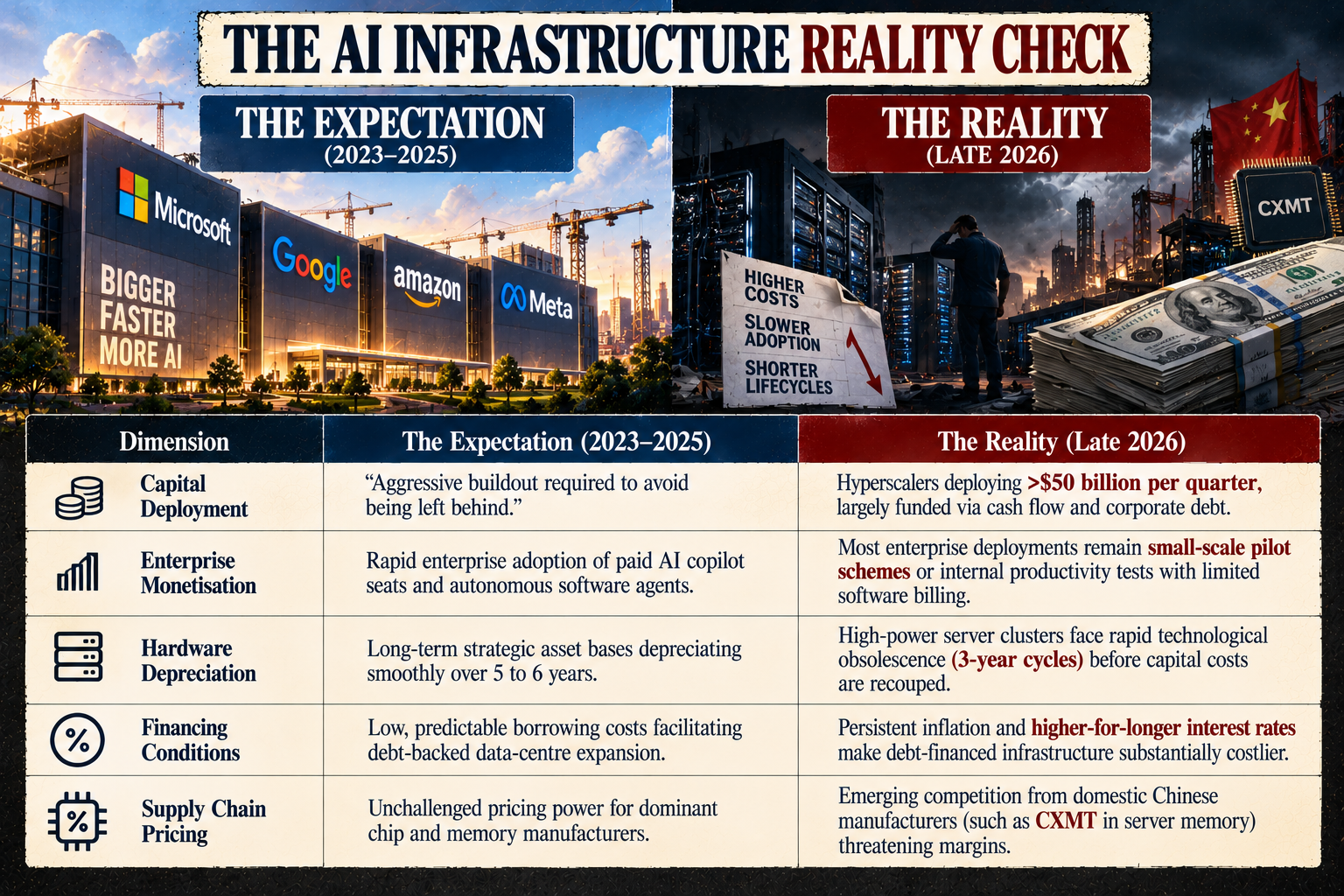
The central doubt among fund managers is straightforward: Where is the cash flow coming from to justify this level of infrastructure investment?
While chip designers and foundries have recorded surging revenues by selling hardware to cloud providers, the cloud providers themselves have yet to see a corresponding surge in recurring software revenue from business clients.
The Catalyst: High-Level Warnings and Financing Realities
This scepticism moved from an academic debate to an aggressive market sell-off following a series of events in mid-October 2026:
Broadcom CEO’s "Casino" Rebuke: Speaking at an industry event in Singapore, Broadcom Chief Executive Hock Tan delivered an unusually candid assessment of market sentiment, warning that investors had developed extreme, unrealistic expectations. Tan remarked that many investors had "no clue what they are investing in" and likened the trading environment to a "casino." Crucially, Tan identified infrastructure financing—rather than silicon manufacturing—as the primary bottleneck facing the sector.
The Collapse of Data-Centre IPOs: Market confidence was further shaken when data-centre operator Firmus Grid Ltd—a venture backed by Nvidia—was forced to abandon its planned initial public offering. The withdrawal highlighted that private equity and institutional debt markets are becoming hesitant to fund speculative, multi-billion-dollar computing facilities without long-term customer purchase contracts in place.
Macroeconomic Friction: Hotter-than-expected inflation data in the United States revived concerns that central banks will keep benchmark interest rates elevated for longer. Because modern gigawatt-scale data centres are funded using heavy corporate debt and private infrastructure funds, higher capital costs directly diminish the net present value of future AI revenue.
Chinese Competitive Pressure: Reports from the South China Morning Post revealed that Chinese memory manufacturer ChangXin Memory Technologies (CXMT) is preparing to release an advanced server-memory architecture by the end of 2026. The prospect of state-backed Chinese supply entering the server DRAM market raised fears that memory chip pricing power could erode sooner than anticipated.
Why People Are Doubting AI Spending: The Four Core Fault Lines
Institutional investors have identified four primary structural problems with the current pace of AI capital allocation:
1. The Monetisation Lag
Building an AI model requires massive upfront capital; deploying it profitably requires customers willing to pay sustainable subscription or usage fees. While consumers frequently use generative AI tools, few pay more than nominal monthly fees. In the corporate sector, chief information officers (CIOs) report that while they are running internal experiments, widespread deployment of enterprise-wide paid software licences remains constrained by concerns over data security, output hallucination, and uncertain productivity gains.
2. The Depreciation Trap
Unlike traditional cloud computing servers—which rely on general-purpose CPUs that can be depreciated over five or six years—AI accelerator servers run at extreme thermal loads and evolve rapidly. A cluster of advanced GPUs purchased today may be rendered economically uncompetitive in three years by newer, more power-efficient architectures. If cloud providers are forced to accelerate their depreciation schedules, the paper profits of Big Tech could face substantial markdowns unless software revenues rise rapidly to offset them.
3. Power and Physical Grid Bottlenecks
Data centres do not run on code alone; they require vast amounts of electricity. In North America and Europe, utilities have informed hyperscalers that connecting new 500-megawatt to 1-gigawatt data centres will require transmission upgrades taking anywhere from three to seven years. As a result, tech companies are having to fund expensive microgrid installations, off-grid power generation, and nuclear restarts. These auxiliary capital requirements add billions to project costs without increasing computing throughput.
4. The Shift Back to "Cyclical" Valuation
Between 2023 and early 2026, semiconductor manufacturers were valued by markets as structural growth stocks—companies that would generate expanding margins indefinitely. However, as Mingyu Kim, an equity analyst at KB Securities, noted following the Seoul market sell-off:
"Concerns over the sustainability of AI investment beyond the next 12 months have prompted the market to revert to valuing semiconductor stocks as commodity-driven cyclicals."
When investors treat a sector as cyclical, price-to-earnings (P/E) multiples contract sharply, triggering fast institutional exits.
Why Did Asian Stock Markets Suffer the Worst Blow?
While the debate over AI spending began on Wall Street, the most severe market declines occurred in Asia. The explanation lies in the structure of the global technology supply chain.
Silicon Valley designs algorithms and platforms, but Asia manufactures the physical hardware.
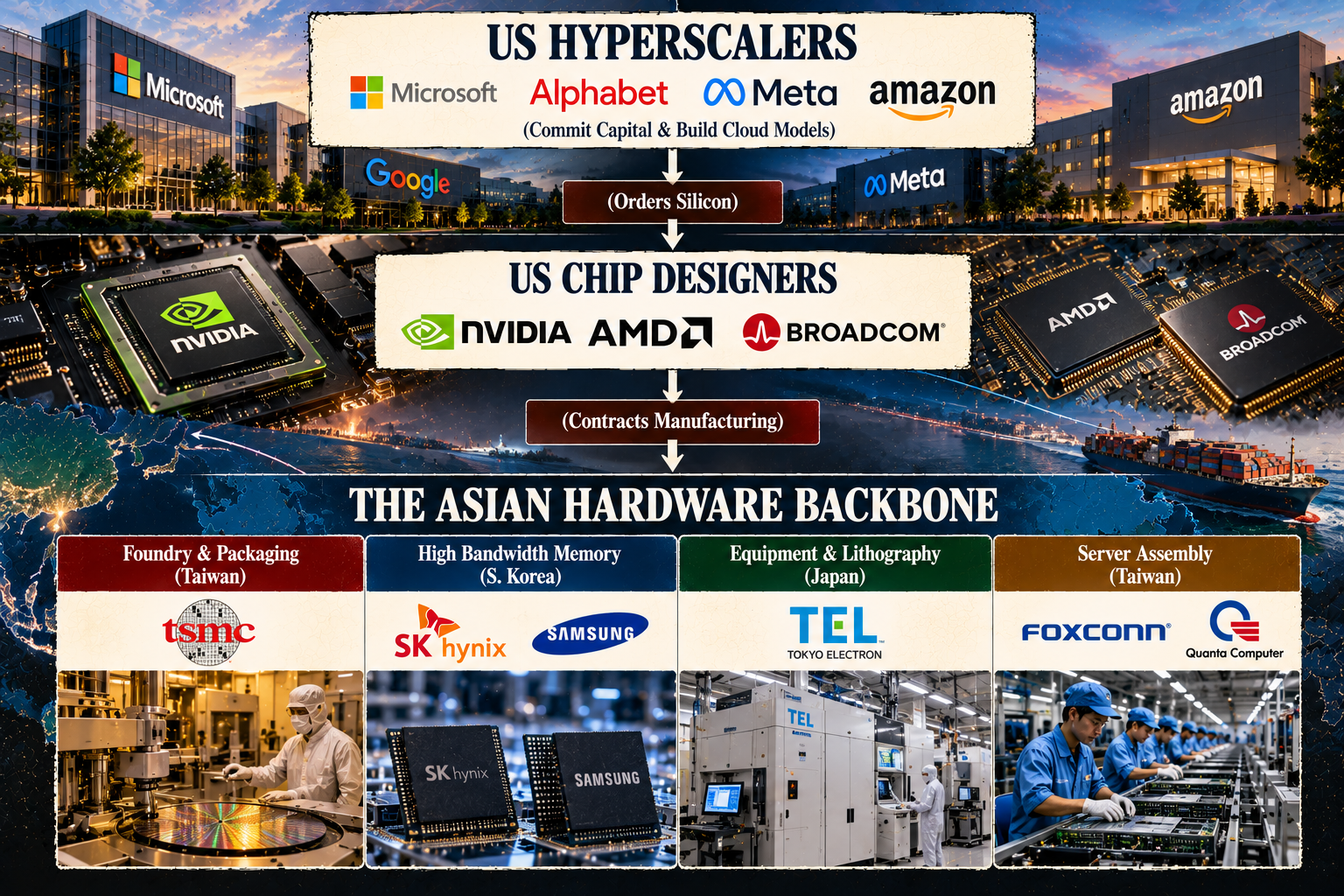
Because of this industrial concentration, Asian equity benchmarks have extraordinarily high exposure to the semiconductor trade:
Index Concentration: Samsung Electronics and SK Hynix together account for nearly 30% of South Korea's Kospi index. TSMC accounts for more than 30% of Taiwan's Taiex. When global funds decide to trim their exposure to the semiconductor cycle, they execute broad index sales that pull down the entire national market.
The Bullwhip Effect: In supply chain economics, small changes in consumer demand produce larger swings for wholesale suppliers, and massive fluctuations for raw component manufacturers. If a US cloud giant decides to trim its 2027 capex forecast by just 10%, the immediate order cancellations for advanced DRAM, HBM stacks, and silicon wafers can drop by 30% to 40%.
Foreign Capital Flight: In South Korea alone, foreign institutional investors dumped more than 12 trillion won (approximately $9 billion / ₹75,000 crore) in equities in October as sovereign wealth funds and global asset managers reduced portfolio risk in the face of currency fluctuations and rising interest rates.
What Comes Next?
The recent market correction does not indicate that artificial intelligence is a passing fad or that data-centre construction will cease. The demand for computing power remains historically high, and leading foundries continue to report full capacity utilization for their most advanced manufacturing nodes.
What has ended, however, is the period of uncritical capital allocation.
Going forward, institutional investors are no longer treating multi-billion-dollar capex announcements as automatic evidence of future revenue. To stabilise equity valuations, Big Tech companies will have to prove during upcoming quarterly earnings reports that enterprise customers are turning pilot projects into profitable, recurring software revenues—and that the physical data centres being built can pay for themselves before the hardware becomes obsolete.