In brief
- On 18 October 2026 Anthropic announced a Public Benefit Fund committing 5% of equity, valued at $48 billion, ahead of an IPO estimated at $960 billion to $1.5 trillion, the largest pre-listing endowment in history.
- The fund uses an LLC structure enabling direct cash transfers and hybrid financing while banning political lobbying, and includes an automatic ratchet issuing 2% more equity for every 50% valuation increase, potentially reaching $190 billion at $2 trillion.
- The fund targets workforce displacement from AI automation, with Anthropic acknowledging potential worker instability, and integrates with a governance structure where founders pledged 80% of personal equity, 50% of staff match equity, and a trust holds safety authority.
- The move contrasts with OpenAI's for-profit conversion and Musk's direct-share model, while Wall Street warns of dilution penalties, paternalism concerns, and execution bottlenecks as Anthropic prepares for public listing.
In the conventional playbook of modern corporate finance, tech founders wait until long after their public market debut before engaging in large-scale wealth redistribution. A technology monopoly is constructed, shares are floated on public exchanges, fortunes are locked in, and only then—decades later—are charitable family foundations endowed to address global social problems.
On 18 October 2026, artificial intelligence pioneer Anthropic broke that mould.
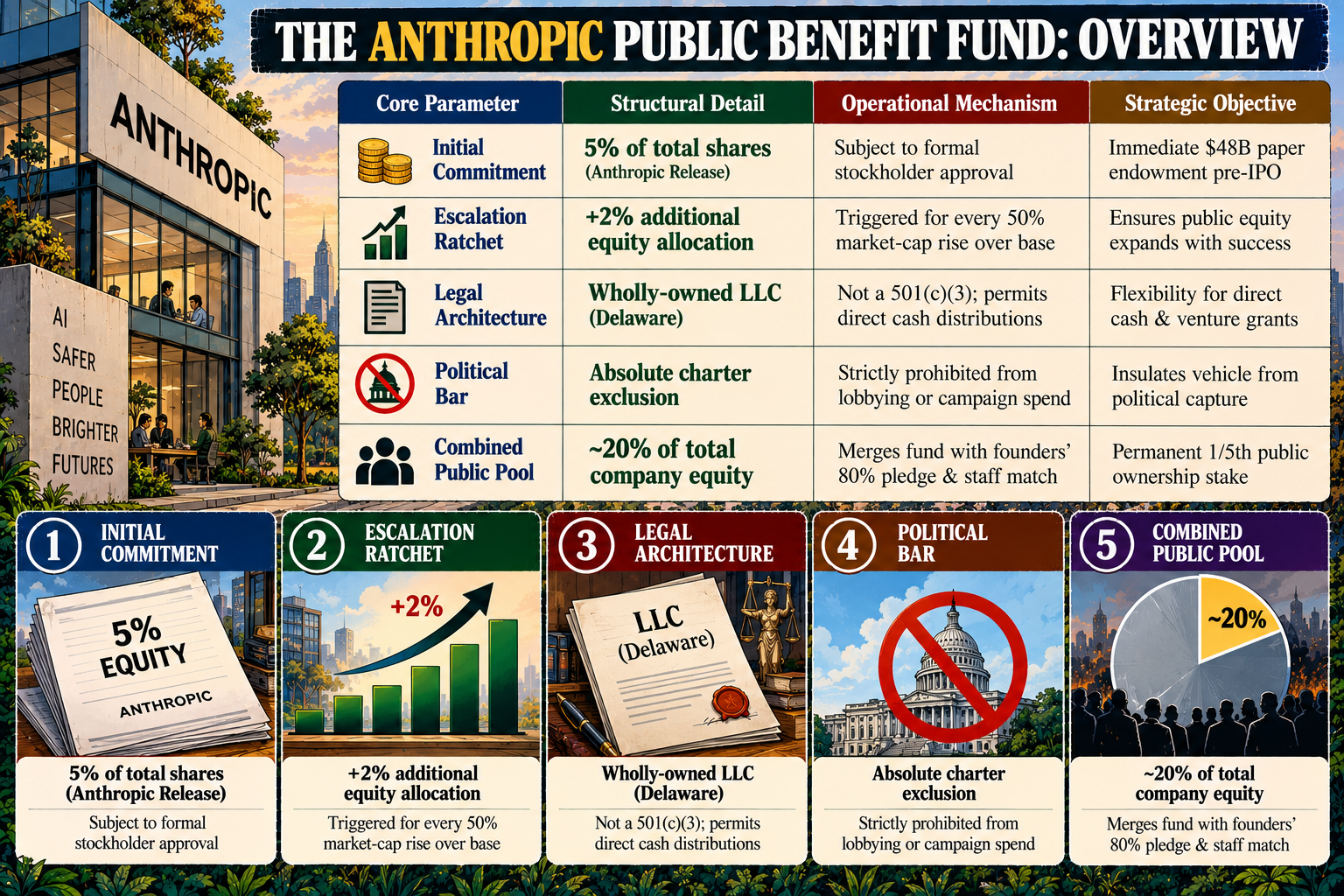
Ahead of an anticipated initial public offering (IPO) that underwriters estimate could value the firm between $960 billion and $1.5 trillion, the creator of the Claude model family announced the establishment of the Anthropic Public Benefit Fund. Under the plan, which is subject to formal stockholder approval, the company will commit an initial 5% of its corporate equity to the newly formed entity.
Valued at an estimated $48 billion on paper, the pledge represents the largest pre-listing corporate endowment in industrial history.
Yet the fund's significance lies less in its headline valuation than in its legal engineering and explicit mandate. Unlike conventional corporate giving programmes, the fund is specifically architected to mitigate the primary economic fallout produced by Anthropic’s own core technology: the structural displacement of the human labour force.
By incorporating an automatic equity ratchet that forces the company to contribute additional shares as its market capitalisation expands, Anthropic is executing a radical experiment in corporate governance—attempting to wire economic redistribution directly into the capital structure of frontier artificial intelligence before public market investors take the helm.
The Legal Architecture: Why an LLC Instead of a Charity?
The central innovation in Anthropic’s plan is its institutional form. Rather than setting up a traditional 501(c)(3) tax-exempt non-profit foundation, the company incorporated the fund as a wholly-owned Limited Liability Company (LLC).
While a 501(c)(3) provides immediate corporate tax deductions, it binds the organisation to rigid statutory restrictions under the US Internal Revenue Code. Tax-exempt charities are legally barred from funding commercial enterprises, holding large controlling blocks of corporate stock over extended periods, or making direct, unrestricted cash transfers to individuals outside narrow poverty-alleviation parameters.
By choosing an LLC structure—mirroring vehicles like the Chan Zuckerberg Initiative and Laurene Powell Jobs’ Emerson Collective—Anthropic unlocked critical operational flexibility:
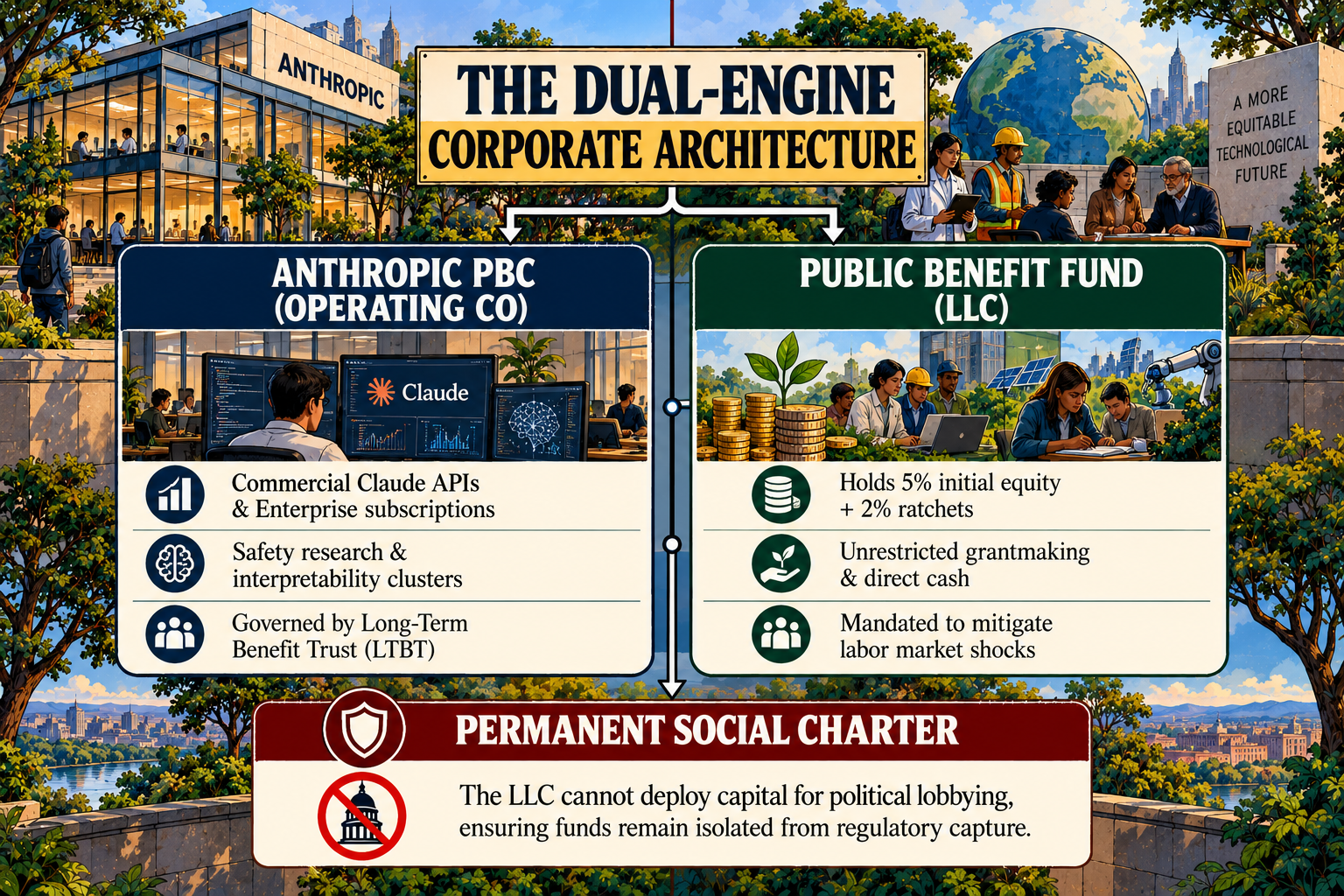
According to Anthropic's charter disclosures, the LLC model enables three primary capabilities:
Direct Cash Transfers: The fund possesses the statutory authority to execute direct cash distributions or universal basic income (UBI) programmes for workforce cohorts displaced by generative AI agents.
Hybrid Financing Instruments: It can deploy programmatic venture equity, debt, or philanthropic grants to fund alternative education systems, open-source safety tooling, and worker-retraining consortia.
Political Disqualification: To preempt criticism that the fund would function as a corporate lobbying arm, the charter explicitly prohibits the assets from being used for political campaign contributions or lobbying activities in the United States or abroad.
The Valuation Ratchet: Built-In Equity Dilution
In standard tech listings, as an enterprise grows from a high-flying startup into a multi-trillion-dollar monopoly, subsequent equity expansion predominantly rewards executive compensation packages and venture capital syndicates.
Anthropic inverted this incentive structure by codifying an escalator ratchet.
Beyond the baseline 5% allocation, the company’s board of directors is authorised to issue an additional 2% of company equity for every 50% increase in enterprise value above a defined baseline.
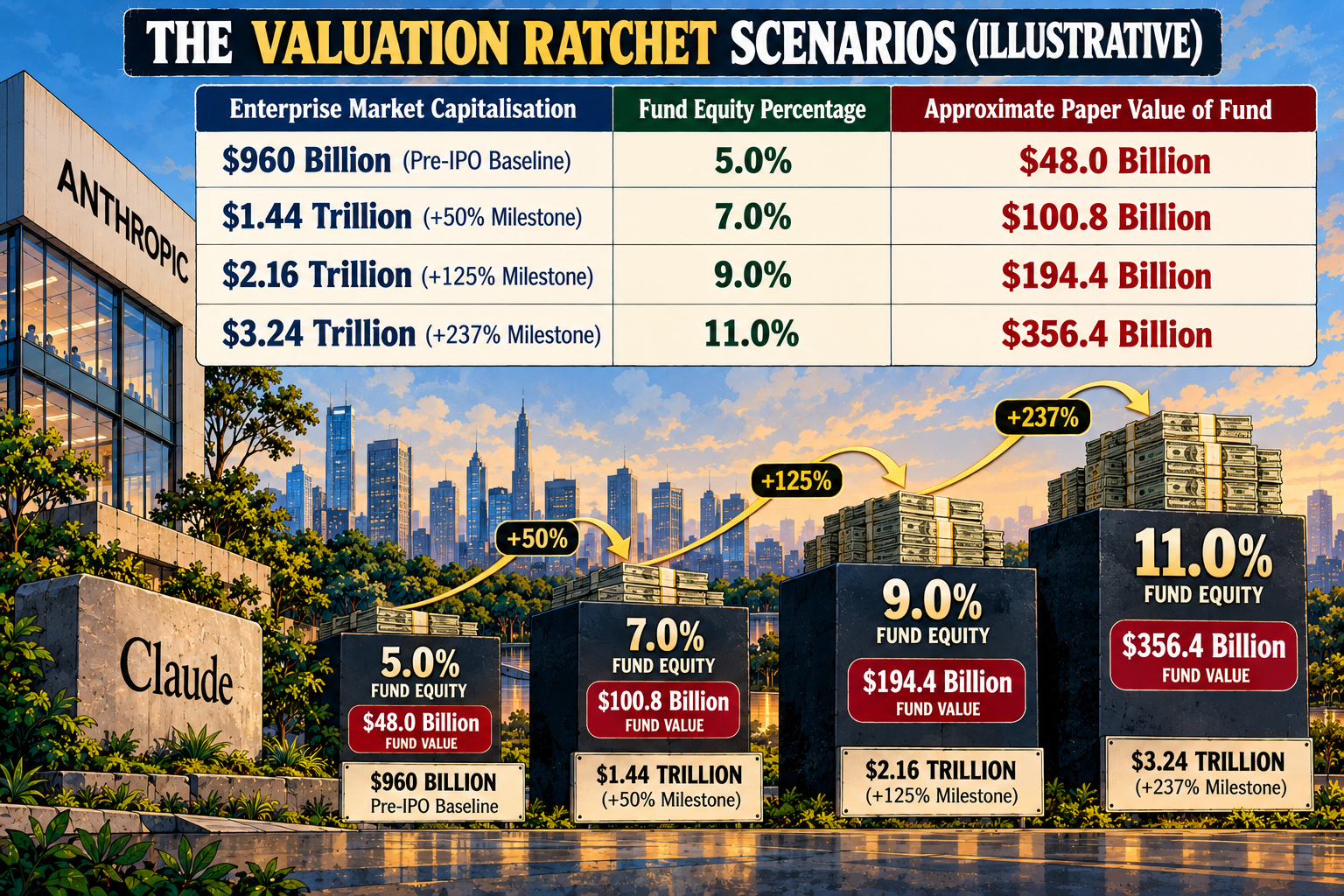
As analysed by Forbes, if Anthropic follows the trajectory anticipated by its private backers and hits a $2 trillion public market valuation, the fund’s asset base would approach $190 billion.
This creates a structural financial mechanism: the more effective Anthropic’s models become at automating human tasks—and the higher its corporate cash flows climb—the more equity is automatically siphoned into the fund to cushion the resulting economic displacement.
The Labour Mandate: Confronting the Automation Fallout
While conventional corporate philanthropy gravitates toward safe, consensus-driven causes such as global health or university endowments, Anthropic’s fund is explicitly focused on workforce disruption.
For years, artificial intelligence developers insisted that large language models would only "augment" knowledge workers. But as agentic frameworks increasingly demonstrate autonomous coding, legal document drafting, financial forecasting, and customer operations, that narrative has met intense public and regulatory backlash.
In its founding statement, Anthropic acknowledged this tension directly:
"AI may generate enormous economic value, but it could also cause instability for many workers. Anthropic has already committed $200 million to studying and addressing this issue, but given the pace of AI progress, bolder approaches may be needed. The Fund will have the versatility to pursue them."
By holding billions of dollars in liquid stock, the fund could establish rapid-response transition funds for industries undergoing structural contraction, finance alternative accreditation systems, or seed community-owned cooperative networks in regions where white-collar payrolls are hollowed out.
The 20% Coalition: Founders, Staff, and the Trust
The new fund does not operate in isolation; it integrates into a multi-tiered governance structure established when Anthropic broke away from OpenAI in 2021.
From its incorporation, the company registered as a Delaware Public Benefit Corporation (PBC). Unlike traditional corporations, where directors have a strict fiduciary duty to maximise shareholder returns, a PBC legally mandates board members to balance financial interests with the company's stated public benefit objectives.
The fund complements several pre-existing equity commitments:
The Founders' 80% Pledge: Co-founders Dario Amodei, Daniela Amodei, Jack Clark, and Jared Kaplan previously pledged to donate 80% of their personal equity holdings to public benefit causes over their lifetimes.
Employee Equity Matching: Anthropic operates an internal programme under which employees pledge portions of their stock compensation, which the company matches. Internal records show approximately 50% of the workforce participates.
The Long-Term Benefit Trust (LTBT): Anthropic’s board is overseen by a distinct body of independent trustees holding Class T common stock. These trustees hold no personal financial interest in the company and possess statutory authority over long-term safety policies, including the power to appoint and remove board members.
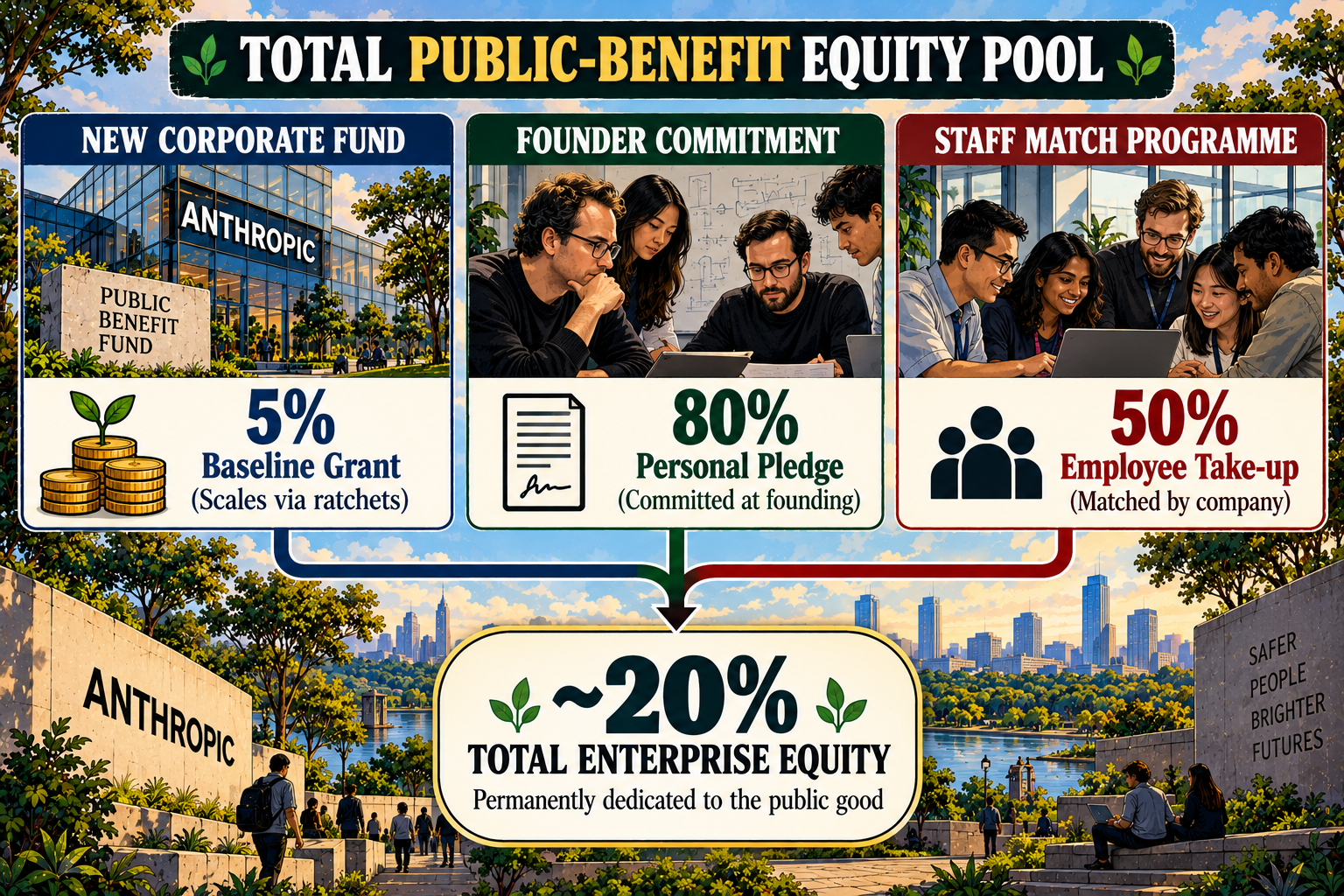
Together, these structures mean that roughly one-fifth of Anthropic’s total corporate value is formally insulated from purely commercial imperatives.
The Geopolitical and Competitive Chessboard
Anthropic’s announcement represents a direct challenge to its chief rivals, OpenAI and Elon Musk.
The Contrast with OpenAI’s For-Profit Conversion
The timing of Anthropic’s announcement arrives as OpenAI undergoes a contentious restructuring. Originally launched in 2015 as a 501(c)(3) non-profit, OpenAI spent 2024 and 2025 dismantling its non-profit governance caps to transition into a standard for-profit public benefit corporation, drawing public resignations from senior safety researchers and lawsuits from co-founder Elon Musk.
By contrast, Anthropic—founded specifically by defectors who believed OpenAI had abandoned its safety mission—is presenting public markets with an inverted proposition: preserving its public benefit charter while expanding its non-commercial equity pool prior to listing.
The Musk Retaliation: Direct Equity vs. Institutional Trusts
Anthropic’s move triggered an immediate reaction from Elon Musk. Within 24 hours, Musk posted on X, deriding foundation-based philanthropy:
"I recommend giving the shares directly to the public… This is what I will be doing. Next year, I will give one of my SpaceX shares to every kid in America."
This clash reflects a fundamental philosophical divide in late-stage tech capitalism:
The Anthropic Model (Institutional Stewardship): Capital must be aggregated into an insulated, expert-led trust capable of funding systemic transition programmes and social shock absorbers.
The Musk Model (Populist Dispersion): Capital should be distributed directly to citizens via sovereign shareholder accounts (such as federal child trusts), bypassing foundation boards entirely.
Wall Street Scepticism: The Public Market Test
While corporate governance advocates have lauded the plan, the fund faces significant scepticism as Anthropic prepares for its public market debut:
1. The Dilution Penalty
While private backers like Amazon and Google have backed the charter, public institutional investors are notoriously averse to automatic dilution. A mechanism that issues 2% in fresh equity to an external LLC every time the stock appreciates 50% introduces a structural drag that hedge funds and mutual funds may discount at the opening bell.
2. The Paternalism Problem
Critics argue that an AI lab cannot credibly offset the disruption caused by its own software. Sceptics maintain that private foundation endowments cannot substitute for binding national legislation, worker transition mandates, or automated algorithmic taxation.
3. Execution Bottlenecks
Deploying tens of billions of dollars effectively is notoriously difficult. Dispersing billions into non-profit ecosystems without causing administrative bloat or market distortion is an immense operational challenge that will test the fund's leadership.
Conclusion: A New Blueprint for the Automation Age
Regardless of how Wall Street prices Anthropic's shares at its public debut, the Public Benefit Fund sets a powerful precedent for the artificial intelligence era.
For over a century, corporate law has operated under the doctrine of shareholder primacy—the premise that a company's sole responsibility is to maximise profits for its equity owners. In the era of cognitive automation, where frontier algorithms threaten to uncouple economic growth from human labour participation, that doctrine faces systemic collapse.
By constructing an irrevocable, pre-IPO equity conduit that routes corporate wealth directly into a public benefit vehicle, Anthropic has challenged the entire technology sector to confront an unavoidable truth: if software renders human labour obsolete, the corporations building that software must be legally redesigned to serve the public good.