In brief
- Nepali Prime Minister Balendra Shah visited India for 25 hours in November 2026, securing a ₹15,000 crore development package but failing to resolve disputes over air routes, borders and Gorkha recruitment.
- India and Nepal signed eight MoUs covering space, policing, governance, health and agriculture, and launched rail, bridge, pipeline and hydroelectric projects including a 669 MW Lower Arun scheme.
- India rejected Nepal’s request for high altitude western air routes, dismissed the 2018 Eminent Persons Group report, avoided public mention of the Kalapani border dispute and did not discuss Agnipath Gorkha recruitment.
- Shah pivoted from populist nationalism to transactional diplomacy, prioritising economic delivery over confrontation, choosing India as his first bilateral destination and reorienting ties toward technology, youth and infrastructure.
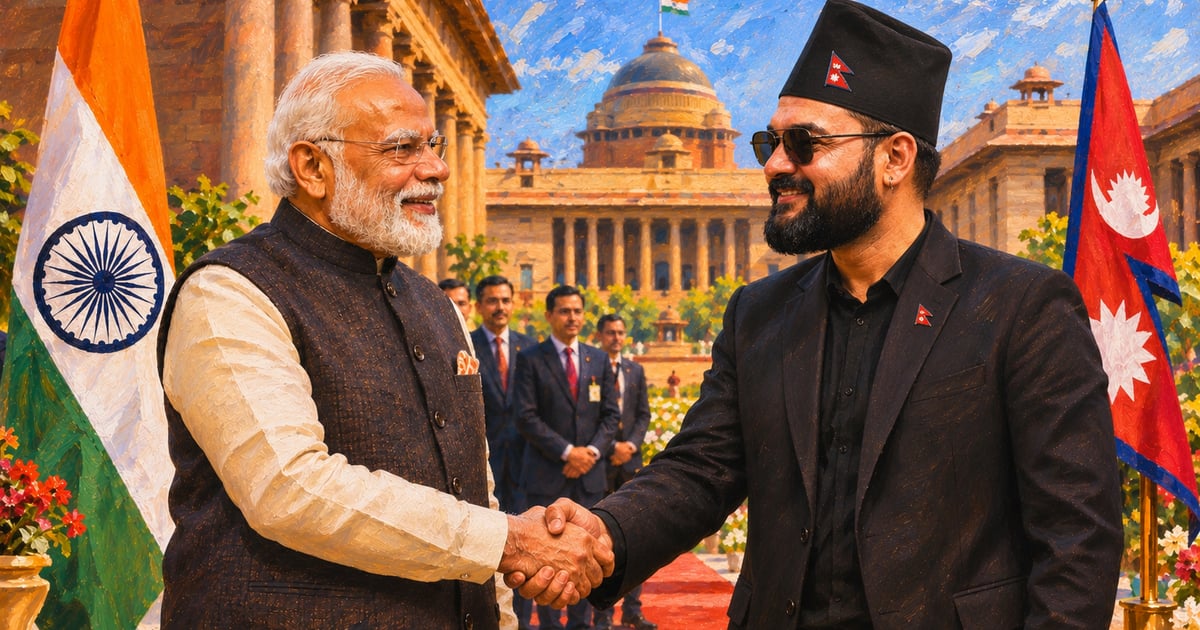
After nearly eight months of diplomatic suspense, Nepali Prime Minister Balendra ("Balen") Shah spent barely 25 hours on Indian soil between 22 and 23 November 2026 (The Wire, MEA). Stepping out at Rashtrapati Bhavan in his trademark all-black Nepali attire and dark sunglasses, the 36-year-old former rapper and Kathmandu mayor—now the world’s youngest national leader—dispensed with the usual ceremonial trappings of a Kathmandu prime ministerial visit, skipping both a formal airport send-off at home and an embassy civic reception in New Delhi (The Hindu, The Wire).
Beneath the compressed schedule, the visit produced India’s largest single financial commitment to Nepal to date: a ₹15,000 crore (NPR 24,000 crore; roughly $1.6 billion) development package, eight Memoranda of Understanding (MoUs), a new maritime transit gateway at Kandla, and an offshore campus of an Indian Institute of Technology (IIT) (MEA, The Wire). Yet the ledger of what New Delhi withheld—high-altitude western air routes, any revival of the 2018 Eminent Persons Group (EPG) report, and public movement on the Kalapani border dispute—was just as revealing as what it gave.
The Road to New Delhi: Why the Visit Carried High Drama
Shah’s trip was watched closely in both capitals because of how he arrived in power. Following the Gen-Z uprising of September 2025 that forced then-Prime Minister K.P. Sharma Oli to resign, Shah’s Rastriya Swatantra Party (RSP) swept the elections, sweeping aside the Nepali Congress and Maoist establishment that had dominated Kathmandu since 2008 (The Hindu, The Wire).
Indian policymakers had good reason to be cautious. As Kathmandu’s mayor in June 2023, Shah placed a map of "Greater Nepal" in his office in response to the undivided subcontinent mural in India’s new Parliament building (The Wire). Once sworn in as Prime Minister in March 2026, he visited New York for the United Nations General Assembly in September before finally accepting Prime Minister Narendra Modi’s invitation to New Delhi in late November—triggering complaints from Nepal’s opposition parties that they had not been consulted on the agenda (The Wire, The Statesman).
What Was Signed: The Eight MoUs and Connectivity Launches
At Hyderabad House on 23 November, India and Nepal adopted a ten-pillar Joint Vision Statement—"Viksit Bharat and Samunnat Nepal"—and exchanged eight formal MoUs (MEA, The Wire):
Space & Communications: An MoU between the Indian Space Research Organisation (ISRO) and Nepal’s Ministry of Information and Communication to establish a Satellite Communication (SATCOM) network utilising the South Asia Satellite (MEA).
Policing & Forensics: Two security-sector agreements—one linking Gandhinagar’s National Forensic Sciences University with the Nepal Police Crime Investigation Department, and another pairing Rashtriya Raksha University with Nepal’s National Police Academy (MEA).
Governance & Urbanisation: An MoU between India’s National Centre for Good Governance and the Nepal Administrative Staff College for civil-servant training, plus an agreement on technical cooperation in sustainable urban development (MEA).
Health & Agriculture: Three MoUs covering health and medicine, Ayurveda and traditional systems of medicine, and livestock and fisheries development (MEA).
Alongside the paperwork, the two prime ministers virtually inaugurated and launched major physical links: the Sarayu-Kamala Express rail service between Ayodhya and Janakpur; a cross-border motorable bridge between Dharchula (Uttarakhand) and Darchula (Nepal); Phase II of the Motihari–Amlekhgunj petroleum pipeline; and foundation stones for the 669 MW Lower Arun hydroelectric project, a Jhapa petroleum terminal, and the Banbasa Integrated Check Post (ICP) (MEA). Both sides also finalised the Field Location Survey for the proposed Raxaul–Kathmandu electrified broad-gauge railway (MEA).
What Nepal Got: Grants, Rupee Credit, Port Access, and an IIT
For Kathmandu, the tangible gains fall into four buckets:
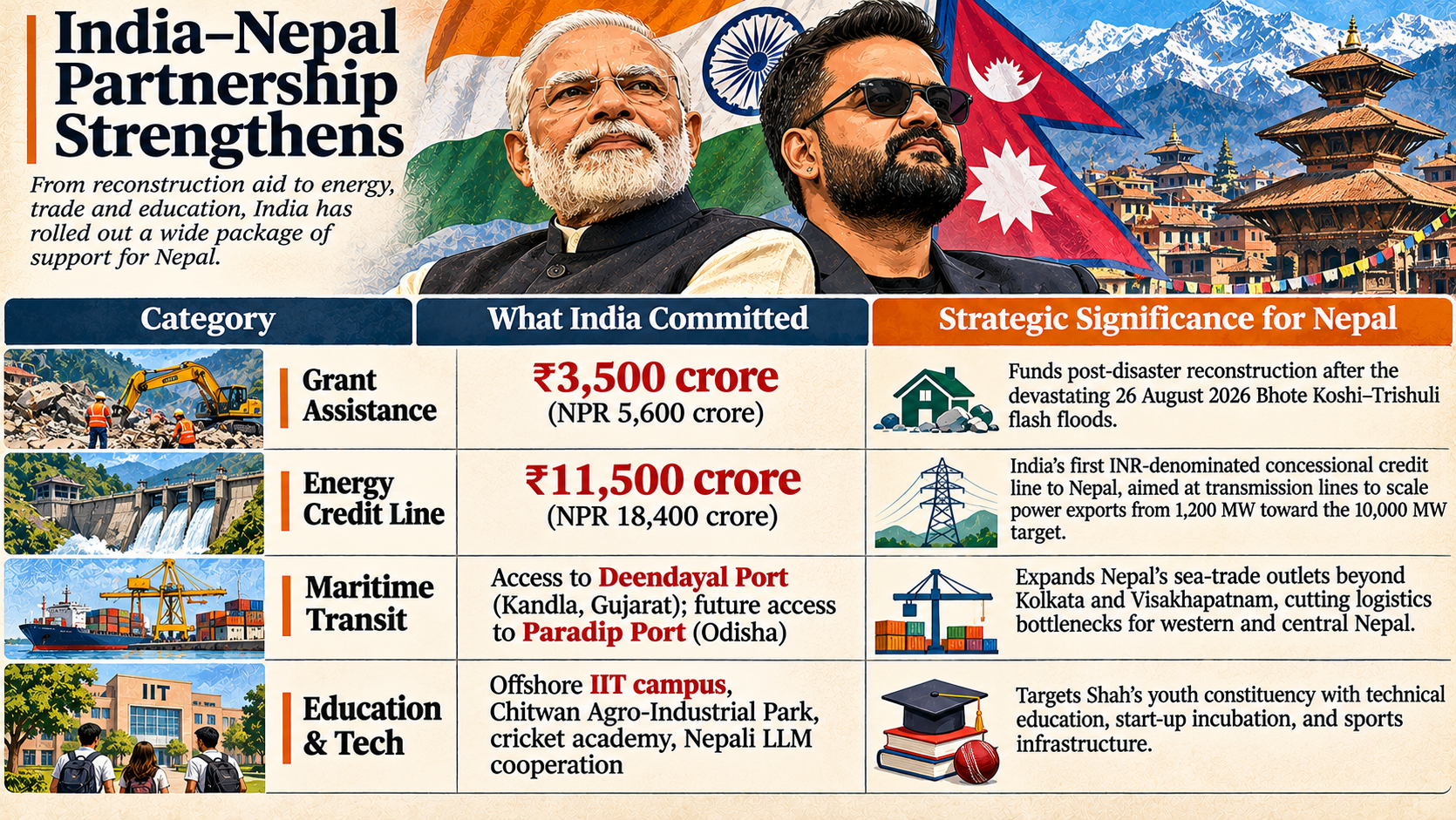
Yet the financial arithmetic shows careful Indian calibration. Nepali Foreign Minister Shishir Khanal revealed upon returning to Kathmandu that Nepal had requested NPR 10,000 crore in grants and NPR 10,000 crore in loans (The Wire). New Delhi delivered 44% less in outright grants than Kathmandu asked for, while nearly doubling the credit component—and denominating it in Indian rupees rather than US dollars, unlike the $750 million post-2015 earthquake facility (of which roughly $550 million has been utilised) (The Wire).
What Is Missing: Air Routes, EPG, Lipulekh, and Agnipath
Despite the warm choreography, four long-standing Nepali priorities hit a wall:
1. Western Air Entry Routes: Nepal’s aviation sector had pinned high hopes on securing a high-altitude western entry point near Mahendranagar to make international flights into Bhairahawa’s Gautam Buddha International Airport and Pokhara International Airport commercially viable (OnlineKhabar, The Wire). Currently, most international arrivals must enter via Simara, south of Kathmandu, forcing western-bound aircraft to fly costly detours (The Wire). India agreed only to make the existing unidirectional B345 Kathmandu–Bhairahawa–Lucknow route bidirectional, leaving wider airspace proposals—stalled over military airspace and altitude differences—to future technical talks (MEA, Ratopati).
2. The 2018 EPG Report: Constituted in 2016 to overhaul bilateral ties, the Eminent Persons Group submitted a joint report in 2018 that India has never formally accepted. Asked about it after the talks, Indian Foreign Secretary Vikram Misri bluntly dismissed the document as "in the past" and "not relevant" (The Wire). On reviewing the 1950 Treaty of Peace and Friendship, the Joint Vision document offered only a familiar pledge to review bilateral legal frameworks "on the basis of mutual consent", with no timeline or mechanism (The Wire).
3. Kalapani, Lipulekh, and Limpiyadhura: Unlike Pushpa Kamal Dahal’s June 2023 visit—when both Modi and Dahal addressed boundary resolution in their joint press remarks—neither Modi nor Shah mentioned the territorial dispute publicly (The Wire). The joint press release merely noted progress on repairing boundary pillars and directed Foreign Secretaries to work on outstanding boundary matters, while Misri confirmed that India–China trade through the Lipulekh Pass was not raised at all (MEA, The Wire).
4. Agnipath and Gorkha Recruitment: Misri confirmed that the impasse over recruiting Nepali Gorkhas into the Indian Army—halted since India introduced the four-year Agnipath scheme in 2022—did not come up during the talks (The Wire). Meanwhile, decades-old hurdles on the Pancheshwar Multipurpose Project remain unresolved beyond another directive to finalise its Detailed Project Report (MEA, The Wire).
What It Shows About Changes in Balen Shah’s Policy
Shah’s conduct in New Delhi marks a clear pivot from populist nationalism to transactional statecraft. As Kathmandu’s mayor, he built political capital through high-visibility cultural defiance, including the 2023 "Greater Nepal" map episode (The Wire). As Prime Minister, facing an economy battered by the August 2026 floods and a young electorate demanding jobs rather than slogans, he made three calculated adjustments:
First, he chose economic delivery over rhetorical confrontation. By keeping Kalapani and Lipulekh out of his public speeches and framing shared Himalayan rivers around climate resilience and flood mitigation, Shah avoided turning his maiden bilateral trip into a public standoff (The Wire).
Second, he prioritised India before Beijing. Taking nearly eight months to visit New Delhi—and making India his first bilateral destination ahead of any trip to China—signalled that Kathmandu’s new post-uprising leadership recognises India’s irreplaceable role as its primary power buyer, transit corridor, and disaster-relief partner (The Hindu, NDTV).
Third, he shifted the bilateral agenda toward tech and youth. With Finance Minister Swarnim Wagley engaging Indian industry via the Confederation of Indian Industry and Shah securing an offshore IIT campus, start-up hubs, satellite links, and cricket academies, Kathmandu’s new leadership is trying to re-anchor India–Nepal ties around human capital and infrastructure rather than legacy political grievances (The Hindu, The Wire).
Whether that pragmatism survives domestic scrutiny in Kathmandu—especially if the High-Level Monitoring Group fails to deliver tangible progress on western air routes before Modi’s reciprocal visit—will test how much political room Shah’s new realism truly has.