In brief
- Ousted Prime Minister Sheikh Hasina announced 16 December as her return date from Indian exile, requesting a Biman Bangladesh Airlines flight; Prime Minister Tarique Rahman's government rejected the request, stating she must face extradition as a convicted fugitive.
- Bangladesh's International Crimes Tribunal sentenced Hasina to death in absentia in November 2025 for crimes against humanity during the 2024 uprising that killed up to 1,400 people; she missed the appeal deadline, so return means immediate arrest and possible execution.
- Despite BNP's 209-seat parliamentary majority from the February 2026 election, street violence has surged with 565 arrests by mid-November, bomb attacks on Grameen Bank outlets, and interim leader Muhammad Yunus warning of an insurgency.
- Bangladesh secured a three-year LDC graduation deferral to November 2029 but faces a banking crisis with non-performing loans at Tk 6,27,400 crore and is seeking $14.5 billion in international loans including a new $4.5 billion IMF facility.
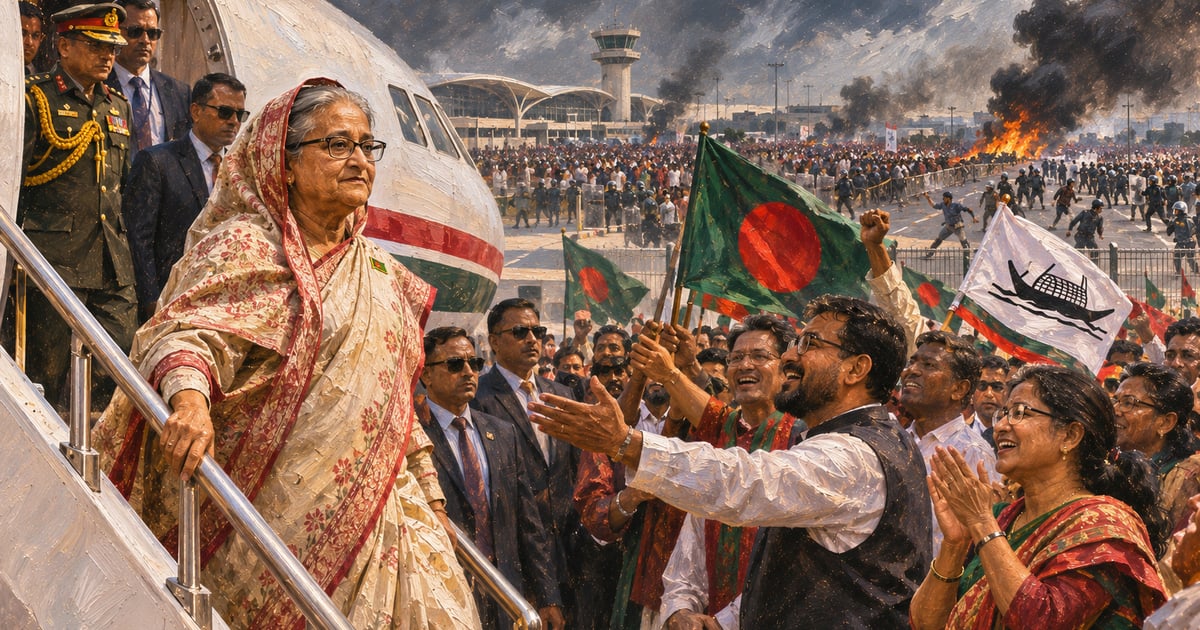
On 24 November 2026—the exact day Bangladesh was originally scheduled to graduate from the United Nations Least Developed Country (LDC) list before crisis-hit Dhaka secured a three-year deferral—ousted Prime Minister Sheikh Hasina named 16 December as her target date to return from exile in India (Prothom Alo, Al Jazeera). Speaking to Reuters, her spokesperson Syed Mozammel Ali said the 79-year-old former leader had asked Prime Minister Tarique Rahman’s government to arrange her flight from New Delhi aboard national carrier Biman Bangladesh Airlines, mirroring the Bangladesh aircraft that flew her into exile on 5 August 2024 (Al Jazeera, The Daily Star).
Dhaka’s rejection was immediate. Prime Minister Rahman’s press secretary, Abu Abdullah M. Saleh, told the Associated Press that Hasina has been convicted by a tribunal and can return only through formal extradition (Al Jazeera). Other officials warned she would "arrive as prisoner in handcuffs", while International Crimes Tribunal (ICT) Chief Prosecutor Aminul Islam said it was unreasonable for a convicted fugitive to expect state transport (Anadolu Agency, Al Jazeera).
The timing is not accidental. December 16 is Victory Day, marking Bangladesh’s 1971 Liberation War triumph led by Hasina’s father, Sheikh Mujibur Rahman (Al Jazeera). By announcing a homecoming date for the first time in 27 months, Hasina is testing an elected government that holds a sweeping parliamentary majority on paper yet presides over surging street violence, a crippled banking system, and an urgent hunt for $14.5 billion in international loans (Anadolu Agency).
The Legal Trap: An Unappealed Death Sentence and a Banned Party
Even if Hasina wanted to board a commercial flight without Dhaka’s cooperation, the legal reality awaiting her at Hazrat Shahjalal International Airport is severe. On 17 November 2025, a three-member bench of Bangladesh’s International Crimes Tribunal led by Justice Mohd Golam Mortuza Majumder sentenced Hasina and former Home Minister Asaduzzaman Khan Kamal to death in absentia (HRW, Newsonair). In a 453-page verdict anchored in Article 7 of the Rome Statute after the interim government amended the tribunal law in November 2024, the court found Hasina guilty of crimes against humanity for ordering live ammunition and drone strikes against protesters during the July–August 2024 uprising, in which the United Nations estimates up to 1,400 people were killed (HRW, Al Jazeera). Former Inspector General of Police Chowdhury Abdullah Al-Mamun, who turned state witness, received a five-year sentence (Newsonair).
Separate from the main verdict, the tribunal convicted Hasina of contempt of court on 2 July 2025—handing down a six-month prison sentence in absentia over a leaked audio clip in which she allegedly claimed a "licence to kill" (Wikipedia). Crucially, Bangladesh’s judiciary has already ruled that Hasina missed the statutory deadline to appeal her death sentence, meaning there is no automatic legal stay against execution upon arrest unless she seeks—and receives—presidential clemency, a step she has refused to consider while dismissing the tribunal as politically rigged (Al Jazeera).
Human rights monitors and legal scholars have flagged real procedural flaws in the in absentia trial, including concerns raised in Opinio Juris over judicial gatekeeping and selective accountability (Opinio Juris). Those legal critiques give Hasina’s camp international talking points, and they complicate any extradition decision in New Delhi, yet they do not alter the immediate domestic fact: inside Bangladesh, returning on 16 December means immediate detention.
Post-Election Politics: A Landslide Mandate Under Street Siege
Hasina’s return threat also exposes the fragility of Bangladesh’s post-uprising political settlement. After Nobel laureate Muhammad Yunus’s 18-month interim administration dissolved the Awami League’s political activities and jailed thousands of its cadres, Bangladesh held its 13th general election on 12 February 2026 (Ratopati, Wikipedia).
The election produced a decisive parliamentary mandate on paper. On a 59.44% turnout, Tarique Rahman’s Bangladesh Nationalist Party (BNP) won 209 of 300 directly elected seats (212 with allies, later rising to 210 for the BNP itself after April by-elections) with 49.97% of the vote (Wikipedia, IPU). Jamaat-e-Islami emerged as the main opposition with 68 seats (31.77% of the vote), while the National Citizen Party (NCP)—the political vehicle of the 2024 student uprising led by Nahid Islam—secured just 6 seats (3.05%) (Wikipedia, IPU). Rahman took office on 17 February 2026 (The Daily Star).
Nine months later, that two-thirds majority has not translated into street calm. Since Hasina sought a new passport and travel documents earlier in November 2026, violence has escalated sharply (The Daily Star). Bomb blasts and arson across Dhaka led to 565 arrests by mid-month, while Rahman branded the Awami League a "terrorist organization" (Ratopati). On 23 November, Yunus warned that nearly 100 Grameen Bank outlets nationwide—alongside his ancestral home—had been targeted with petrol bombs since the start of November (New Indian Express, Ratopati). State news agency BSS has characterised the wave of attacks as an "insurgency" aimed at destabilising the government (BSS).
The Economic Crisis Beneath the Unrest
Hasina’s timing is doubly dangerous for Rahman because economic discontent is eroding the goodwill that greeted his February victory. Bangladesh’s economy presents a sharp split: its external accounts have stabilised on paper, yet its domestic banking, fiscal, and industrial engines are seizing up.
On the external side, remittances from roughly 10 million Bangladeshi overseas workers—sending home around $7.5 billion every quarter, matching the scale of an entire International Monetary Fund (IMF) programme—helped lift gross foreign-exchange reserves to $34.55 billion ($29.84 billion under the IMF’s BPM6 definition) by the end of May 2026, while delivering a record $6.61 billion balance-of-payments surplus in FY 2025–26 (TIME, Bangladesh Bank, MCCI).
Inside the country, however, five structural pressures have converged:
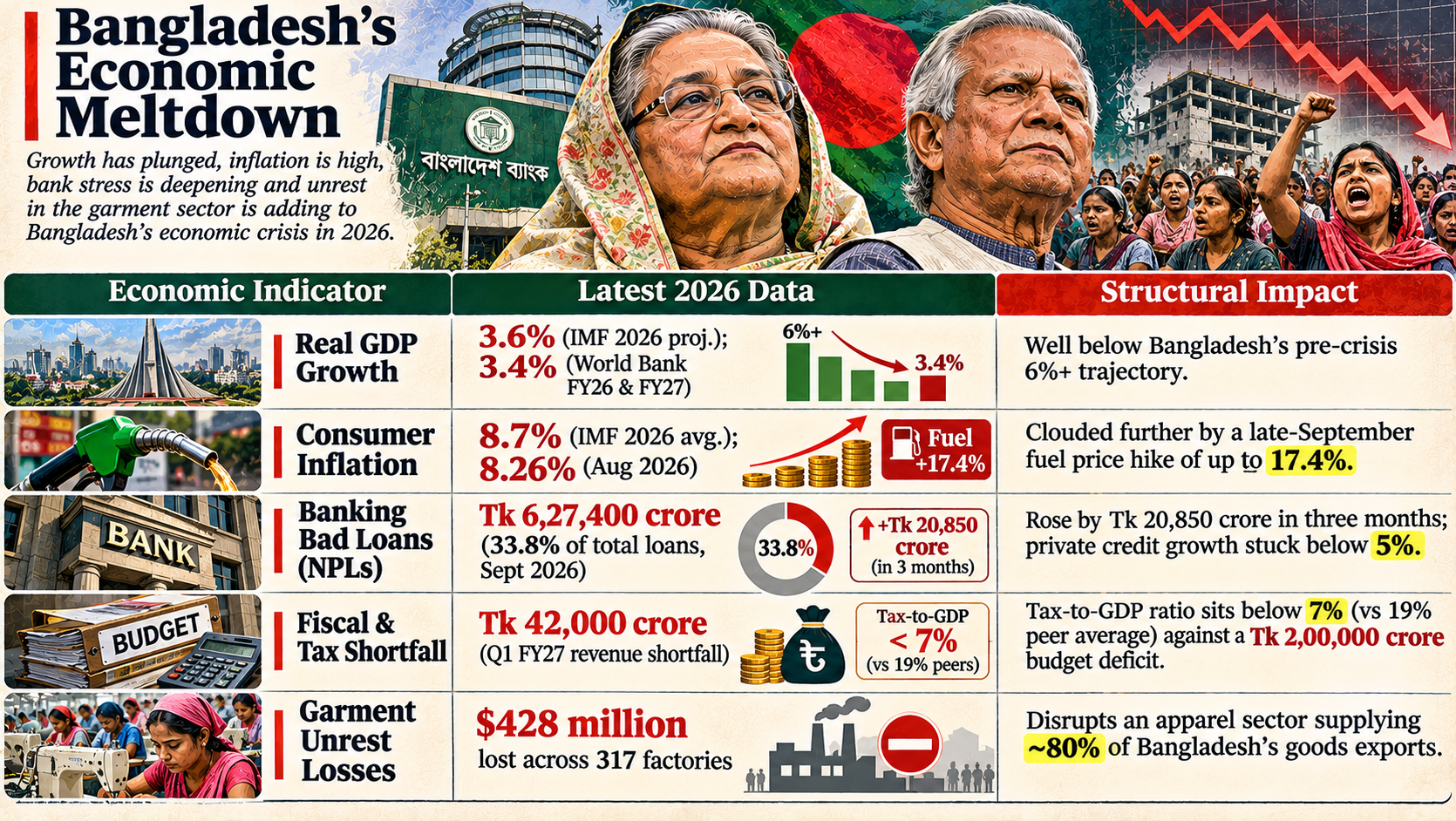
The banking crisis is particularly acute. Years of politically directed lending left non-performing loans at Tk 6,27,400 crore by September 2026—meaning more than one in every three taka lent by the banking system is in default (The Daily Star). Corporate borrowers absorb 70% to 80% of private bank credit, starving small businesses, while Bangladesh Bank’s November decision to let loan defaulters with court stay orders tap a Tk 60,000 crore ($4.9 billion) stimulus has drawn sharp scrutiny (The Daily Star, The Daily Star).
Meanwhile, energy and trade pressures have forced Dhaka onto the defensive. Disruptions to electricity supply from Adani Power’s 1,496–1,600 MW Godda plant in Jharkhand—compounded by overdue power arrears and domestic gas shortages—have sparked blackouts and opposition protests (The Wire, TBS). Recognising that it could not absorb the loss of duty-free export privileges, Bangladesh secured a three-year postponement of its UN LDC graduation on 29 October 2026, pushing the cliff edge from 24 November 2026 to November 2029 (Prothom Alo).
Having exited its previous $5.5 billion IMF programme in May 2026 after drawing $3.8 billion, Finance Minister Amir Khosru Mahmud Chowdhury’s team is now seeking $14.5 billion in international loans, including a fresh $4.5 billion IMF facility, while asking lenders for "flexible" terms (ThePrint, Anadolu Agency).
What Lies Ahead: Four Scenarios After 16 December
With less than three weeks until Victory Day, Bangladesh faces four interlocking tests:
1. No State Flight, Higher Street Attrition. Dhaka will not send a Biman aircraft to Delhi, and Hasina is unlikely to land voluntarily without immunity from immediate arrest and a ticking execution clock. Instead, 16 December functions as a mobilisation deadline. If Awami League supporters stage coordinated blockades or clashes across Dhaka and industrial corridors, Rahman’s government will face a stark choice between heavy-handed security crackdowns—which alienate Western donors—or losing control of commercial arteries.
2. A Prolonged Freeze With New Delhi. Bangladesh’s Law Minister Md Asaduzzaman has branded Hasina a "convicted criminal" and pressed India for her extradition (The Hindu). While India’s High Commissioner Pranay Verma said in October that extradition is possible via a "well-structured" legal process, New Delhi has made no move to hand her over, likely constrained by domestic Indian politics and the political-offence exceptions common in extradition treaties (The Hindu). Expect testy diplomacy, border-trade friction, and continued Bangladeshi scrutiny of Indian power contracts.
3. Collision With the IMF Over Reform Speed. The IMF has explicitly urged tight monetary policy, deeper banking restructuring, and revenue reform to lift Bangladesh’s sub-7% tax-to-GDP ratio (The Daily Star, Anadolu Agency). Yet with inflation near 8.7%, youth unemployment above 10% among educated graduates, and Q1 revenue already Tk 42,000 crore behind target, Rahman’s cabinet faces intense political pressure to subsidise fuel and expand credit rather than tighten belts (The Daily Star, The Shillong Times). Any delay in signing the $4.5 billion IMF deal will squeeze private-sector import financing.
4. Garment Buyer Flight Risk. Ready-made garments generate roughly 80% of Bangladesh’s goods exports, and July–October FY27 merchandise exports had begun recovering (+5.9% year-on-year to $17.1 billion) (FocusEconomics). However, with 317 factories already reporting $428 million in unrest-related losses and EU denim exports dipping 5.48% in January–September, a violent December would push global apparel brands to shift spring 2027 orders toward Vietnam, Cambodia, and India (The Daily Star, Fibre2Fashion).
Bangladesh’s 2029 LDC deferral bought Rahman’s government three extra years of tariff breathing room. Whether Dhaka can use that window to clean up a Tk 6.27 lakh crore bad-loan pile—or gets dragged back into street confrontation over Sheikh Hasina’s 16 December gamble—will decide if the country’s fragile post-uprising democracy holds.