In brief
- Xi Jinping greeted Donald Trump on the airport tarmac while leaving Vladimir Putin to a senior aide, showing different on camera treatment for the two leaders at the Shenzhen APEC summit.
- Claims that Beijing orchestrated a wholesale humiliation of Putin and banished him to a separate table at the gala dinner are disputed, and Moscow still gained diplomatic ground in Shenzhen.
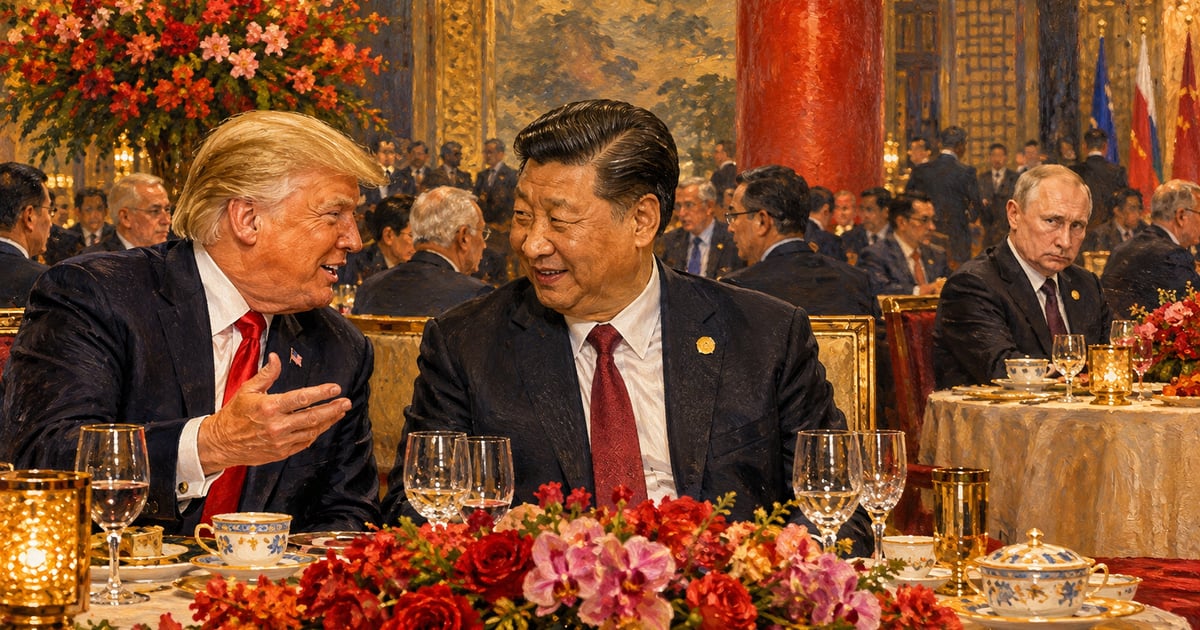
- Credible reports conflict on the exact seating at the Shenzhen banquet, with Xi and Trump at a large head table and Peng Liyuan seated between Xi and Putin, suggesting priority of Xi, Trump conversation.
- Xi spent two hours in bilateral talks with Putin on Wednesday afternoon, describing China, Russia ties as a source of stability and urging both nations to advance the democratization of international relations, while criticising Western sanctions in public remarks.
Chinese President Xi Jinping did treat Donald Trump and Vladimir Putin differently on camera during the Asia-Pacific Economic Cooperation (APEC) summit in Shenzhen on 18–19 November 2026—most visibly at the airport, where Xi personally welcomed the US President on the tarmac while leaving the Russian leader to a senior aide (TIME, CFPublic). Yet the broader claim circulating online—that Beijing orchestrated a wholesale humiliation of Putin and banished him to a separate table at the gala dinner—overstates disputed seating reports and ignores how much diplomatic ground Moscow still gained in Shenzhen.
The Tarmac Contrast: Verified Asymmetry, Specific Context
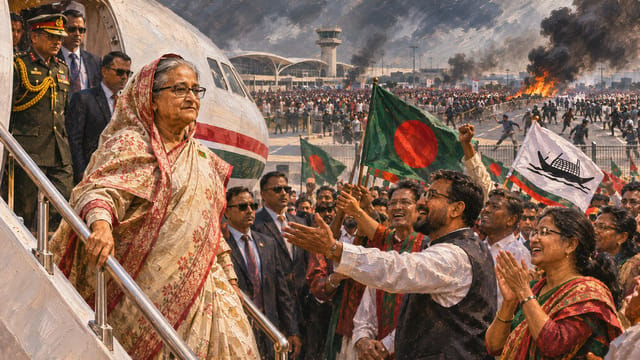
The sharpest protocol divide occurred before any talks began. When Air Force One landed at Shenzhen Bao’an International Airport on Wednesday afternoon, 18 November, Xi waited on the tarmac to greet Trump with a handshake that turned into a brief hug as five People’s Liberation Army J-10C fighter jets flew overhead (TIME, The Standard). According to TIME, it was the first time a paramount Chinese leader had personally greeted a foreign counterpart at an airport since Mao Zedong welcomed Soviet Premier Nikita Khrushchev in Beijing in 1959 (TIME).
Putin, who arrived in the early hours of Wednesday morning, received no such reception. He was met instead by Cai Qi, Xi’s chief of staff and a member of the Politburo Standing Committee (TIME, United24 Media). British and Ukrainian commentators seized on both the downgrade and images of Cai towering over Putin, portraying Russia’s president as a diminished junior partner (Express).
What viral commentary largely omitted is diplomatic reciprocity. Xi’s tarmac appearance for Trump directly repaid the personal airport welcome Trump had extended to Xi at Joint Base Andrews during the Chinese leader’s Washington visit in September 2026 (TIME, CFPublic). Sending Cai Qi—the fifth-ranked official in the Chinese Communist Party—to meet Putin in the middle of the night was a noticeable step down in personal pomp, but it did not break standard Chinese protocol for multilateral arrivals.
The Gala Dinner Dispute: Separate Table or Separated by Protocol?
Claims about Wednesday evening’s APEC welcome banquet at the Shenzhen International Exchange Centre are harder to settle because credible reports conflict on the exact seating:
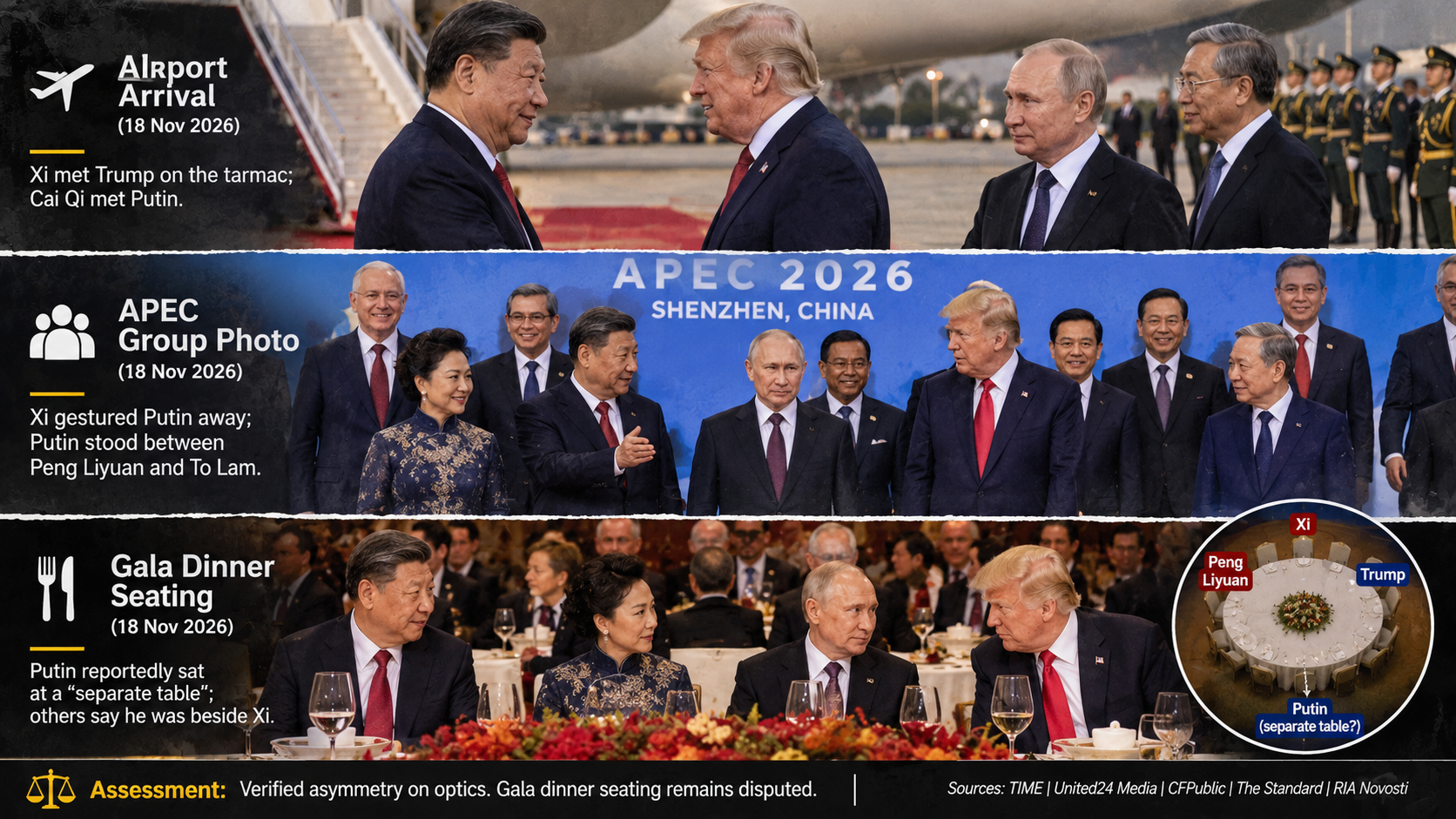
The overlap between United24 Media and The Standard points to the most plausible explanation: at a large head table, Xi and Trump sat together—allowing Trump to tell Fox News that the two "spoke the whole evening"—while China’s First Lady, Peng Liyuan, sat between Xi and Putin (United24 Media, The Standard, TIME). Whether that arrangement placed Putin at a distinct wing of the banquet layout or merely one seat removed from Xi, it clearly prioritised direct Xi–Trump conversation over three-way table parity.
Why Beijing’s Choreography Was Not an Anti-Russia Break
Even if Xi reserved his warmest public choreography for Trump, the private schedule in Shenzhen shows Beijing was not abandoning Moscow. On Wednesday afternoon—between the airport arrivals and the banquet—Xi spent two hours in bilateral talks with Putin, their roughly 50th meeting (CFPublic, TIME). Xi described China–Russia ties as "a source of stability" in a "turbulent" world and urged both nations to advance "the democratization of international relations", while both leaders criticised Western sanctions in public remarks (The Hindu, CFPublic).
Beijing’s restraint towards Washington and indulgence towards Moscow reflect cold leverage. China buys Russian oil and supplies dual-use components while facing US export controls on advanced semiconductors and tariff friction; flattering Trump in public helps Beijing stabilise US ties without conceding its strategic partnership with Moscow (Chatham House, TIME).
What Putin Actually Gained on 19 November
Judging the summit solely by airport greetings misses the outcome of Thursday’s unprecedented 80-to-90-minute trilateral meeting at Kylin Villa (The Hindu, TIME). Seated with Xi in the centre—unlike the 1945 Yalta photograph, where Franklin D. Roosevelt occupied the middle—Putin was given an equal chair alongside the leaders of the world’s two largest economies (Chatham House, The Guardian).
As Chatham House Director Bronwen Maddox argued, Russia arrived in Shenzhen with 40% of its economic production diverted to the war in Ukraine and its Kerch bridge to Crimea newly damaged, yet the trilateral allowed Putin to appear as one of three global arbiters (Chatham House). Worse for Kyiv and European capitals, Trump used the trilateral not to press Moscow on Ukraine, but to attack the International Criminal Court—the very body that has issued an arrest warrant for Putin (TIME).
The Shenzhen optics did not depict a humiliated Kremlin ostracised by Beijing. They depicted a hierarchy managed by Xi Jinping—one in which, as International Crisis Group senior researcher Ali Wyne observed, both the US and Russian presidents were visibly "trying to curry favor with the Chinese President" (TIME).