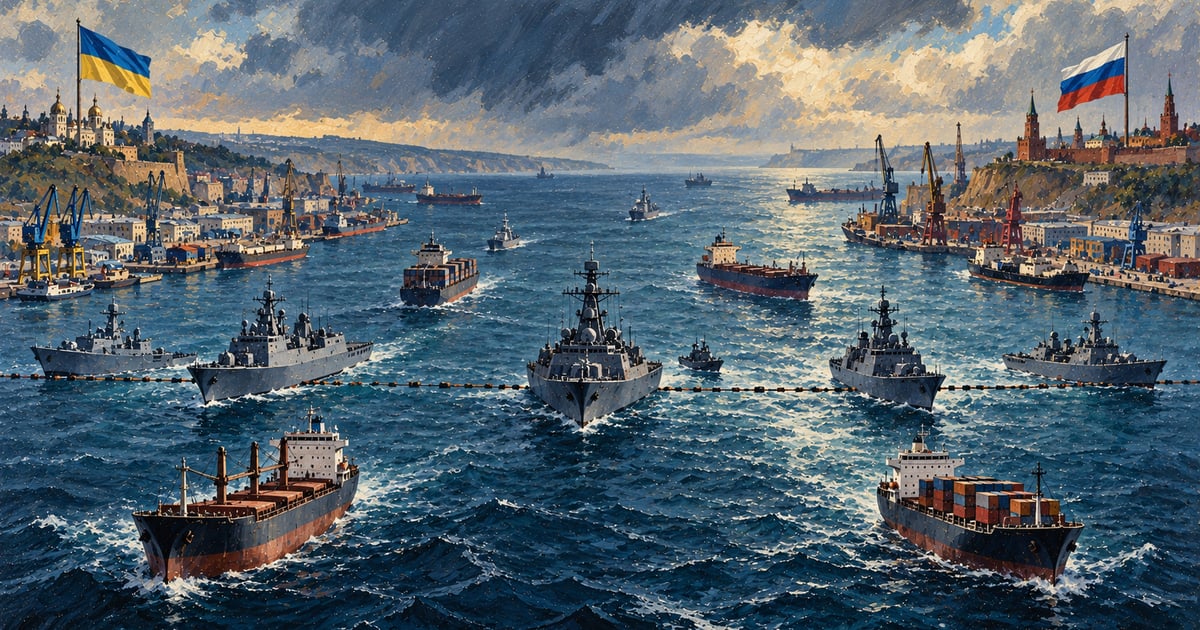
Whenever geopolitical tensions flare in the Middle East, financial headlines fixate upon a single 39-kilometre-wide stretch of water: the Strait of Hormuz. Because roughly one-fifth of the world’s petroleum liquids and liquefied natural gas transits this narrow passage connecting the Persian Gulf to the open ocean, any threat of closure triggers immediate market panic, speculative spikes in crude futures, and emergency diplomatic interventions.
Yet 1,500 miles to the northwest lies another maritime bottleneck whose strategic leverage over human survival is arguably far more acute, even if it commands fewer international headlines. The Black Sea basin—funnelled through the serpentine waterways of the Bosphorus and Dardanelles—serves as the undisputed primary caloric corridor of the Eastern Hemisphere.
Between them, Russia and Ukraine export roughly 29% to 32% of global traded wheat, 13% to 15% of traded maize, and over 60% of international sunflower oil and meal. While modern industrial economies possess strategic petroleum reserves, commercial inventories, and alternative power grids capable of buffering an oil shock, the human body enjoys no such substitution elasticity. When the maritime arteries of the Black Sea seize, the consequence is not merely expensive freight; it is acute caloric deprivation and social destabilisation across the developing world.
Recent months have exposed just how fragile this agricultural conduit has become. What was once viewed as a temporary disruption following the 2022 invasion of Ukraine has metastasised into an attritional, reciprocal maritime campaign. Terminal strikes, drone attacks in shallow coastal seas, and soaring naval insurance premiums have effectively turned the Black Sea into a contested economic battlespace. As bulk grain shipments through the Turkish Straits drop precipitously, the comparison with the Persian Gulf is no longer rhetorical hyperbole. The Black Sea has become the Strait of Hormuz of global food security.
Comparing the Chokepoints: Hormuz vs the Black Sea
To understand why the Black Sea threatens international stability, one must first dismantle the comparison with Hormuz. The parallel is functional rather than strictly geographical.
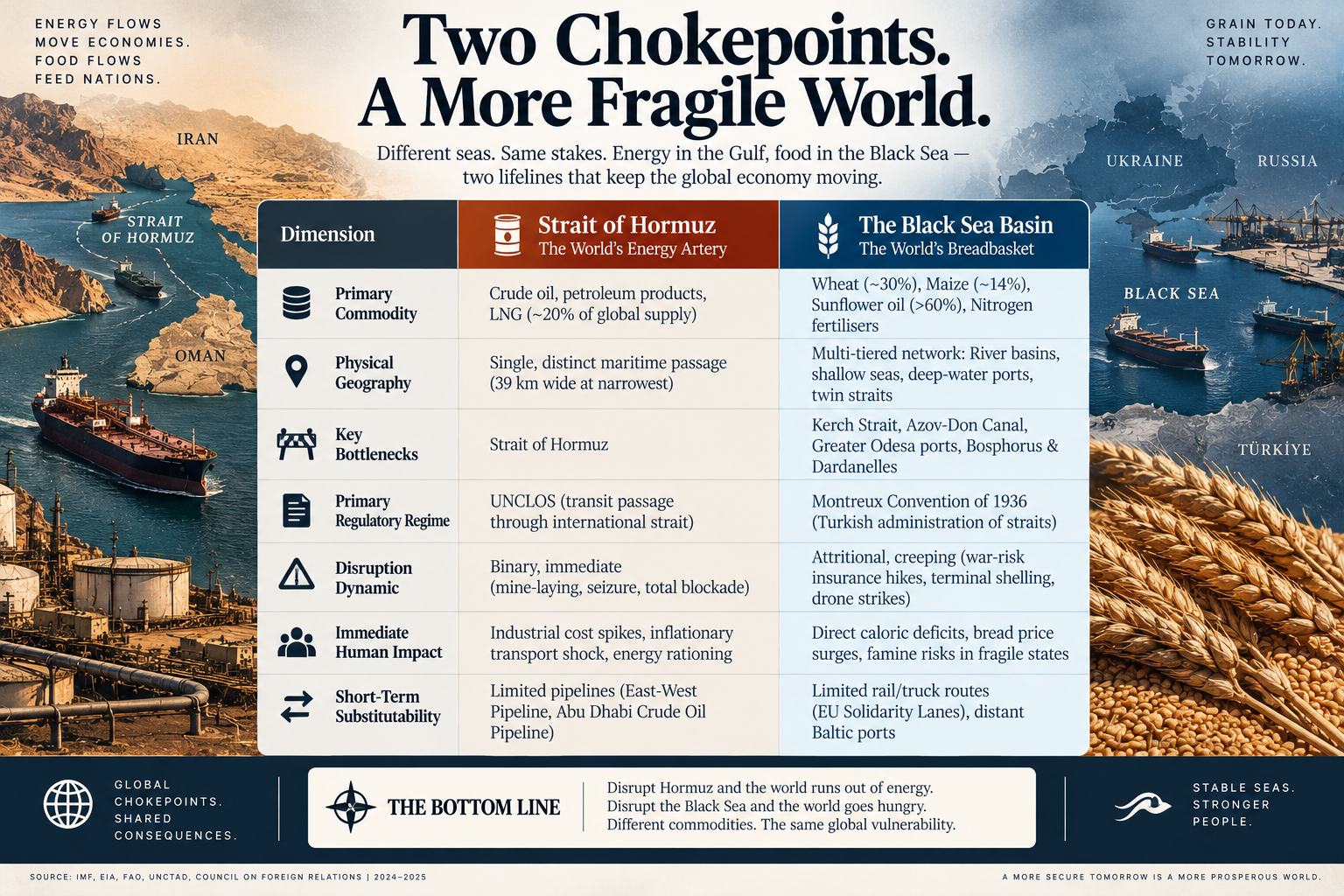
As noted by international commodity specialists at the IDMA Istanbul Global Grain and Milling Forum, treating agricultural trade as an isolated commercial sector ignores how intimately physical trade routes mirror energy corridors. The Bosphorus facilitates over 30% of global wheat exports and more than 60% of the world's sunflower oil trade. But unlike Hormuz—where a hostile navy or non-state actor can threaten a single body of water—the Black Sea operates as a complex, multi-tiered pipeline of inland rivers, shallow feeder seas, rail networks, and deep-water ocean terminals.
Disruption does not require the sinking of a supertanker or the closing of the Turkish Straits by Ankara. It begins at the farm gate and river docks, travels across coastal feeder channels, and manifests as prohibitive insurance costs and damaged berthing infrastructure long before vessels ever sight the Bosphorus.
Anatomy of the Black Sea Food Corridor
The Black Sea agricultural machinery depends on two distinct geographic wings: the north-western arc anchored by Ukraine and the eastern arc anchored by the Russian Federation.
1. The North-Western Arc: Ukraine’s Export Infrastructure
Before 2022, Ukraine’s deep-water ports in the Greater Odesa region—Odesa, Chornomorsk, and Pivdennyi (formerly Yuzhny)—handled upwards of 90% of the nation’s grain and vegetable-oil exports. After the collapse of the United Nations- and Turkish-brokered Black Sea Grain Initiative in July 2023, Kyiv established a unilateral maritime corridor hugging the territorial waters of NATO members Romania, Bulgaria, and Turkey.
While this route proved remarkably resilient throughout 2024 and 2025, it remains under persistent military threat. High-precision ballistic missile strikes and Shahed drone barrages on port superstructure, grain silos, and electrical substations have repeatedly throttled throughput. When commercial bulkers or port berths are hit, commercial charterers retreat, and cargo insurance rates surge beyond economic viability.
2. The Eastern Arc: Russia's Azov and Caucasian Terminals
Russia, the world’s foremost wheat exporter, relies on a bifurcated maritime logistics model. Approximately 25% of Russian grain exports originate along the shallow-water waterways of the southern agricultural heartland—the Don River basin and the Sea of Azov. Here, smaller river-sea vessels (typically between 3,000 and 5,000 deadweight tonnes) load grain at shallow river ports such as Rostov-on-Don and Azov.
These vessels navigate the Azov-Don Shipping Canal, enter the Sea of Azov, and transit south through the narrow Kerch Strait beneath the Crimean Bridge. In the waters south of the Kerch Strait or directly at deep-water Caucasian ports like Novorossiysk and Taman, the cargo is either transshipped onto deep-sea ocean bulkers (Panamax and Handymax vessels) or sails directly across the Black Sea to regional buyers. Novorossiysk alone represents the juggernaut of Russian agricultural export power, equipped with deep-water berths capable of loading large vessels swiftly for long-haul voyages to Asia and Africa.
3. The Ultimate Chokepoint: The Turkish Straits
All commercial traffic departing the Black Sea must pass through the Turkish Straits—the Bosphorus and the Dardanelles. At its narrowest point in central Istanbul, the Bosphorus is a mere 700 metres wide, featuring treacherous currents, sharp navigational turns, and dense urban traffic.
Governed by the 1936 Montreux Convention, the straits remain open to merchant vessels of all flags during peacetime, with Turkey exercising strict safety and environmental pilotage oversight. Even without a formal wartime blockade, any congestion, security alert, or physical backlog in the Black Sea reverberates immediately at the Bosphorus anchorage, where queues of waiting bulkers tie up global maritime capacity.
The 2026 Crisis: Reciprocal Escalation and Choked Waters
For the first four years following the 2022 invasion, the maritime conflict in the Black Sea was characterised by asymmetric naval defence: Ukraine used uncrewed surface vessels (USVs) and anti-ship cruise missiles to push Russia’s Black Sea Fleet out of Sevastopol and away from the western shipping lanes. By mid-2026, however, the conflict entered a volatile new phase: reciprocal targeting of economic and agricultural logistics.
The tipping point arrived in July 2026. Following intensive Ukrainian drone and missile strikes targeting Russian logistics vessels, fuel barges, and naval assets operating in the Sea of Azov and Kerch waters, Russian authorities took the unprecedented step of halting commercial vessel processing through the Azov-Don Shipping Canal and closing the Kerch Strait to outbound commercial traffic.
While deep-water operations at Novorossiysk initially absorbed diverted volumes, subsequent Ukrainian strikes on oil and bulk facilities in Novorossiysk forced temporary terminal suspensions. According to reports compiled by Al Majalla and industry reporting from The Moscow Times, Russian grain exporters faced massive internal logistics gridlocks as grain accumulated across Rostov and Krasnodar silos during the peak summer harvest.
Concurrently, Russian forces escalated strikes against Ukraine’s export hubs. A wave of missile strikes across Odesa, Chornomorsk, and Pivdennyi damaged four major export terminals and destroyed critical grain loaders, prompting leading exporters such as Kernel to suspend operations at specific berths. In late July 2026, a missile strike on a commercial maize carrier off Odesa killed ten crew members, destroying the illusion that commercial mariners could operate with impunity. The Ukrainian Agrarian Council reported that these strikes reduced Ukraine’s monthly maritime export capacity by roughly 33%, dropping from 6 million tonnes to barely 4 million tonnes.
The macroeconomic impact was immediate. According to an empirical assessment by Joseph Glauber, former chief economist of the USDA, published by the International Food Policy Research Institute (IFPRI), total grain shipments exiting through the Bosphorus Strait in late July 2026 fell by over 40% compared to the same period in 2025.
Global wheat prices, which had trended downward throughout 2024 and 2025, surged by nearly 25% from January 2026 levels, reflecting what grain traders describe as a compounding "chokepoint war premium."
Why Land and Alternative Routes Cannot Fill the Breach
When maritime choke points close, logistics planners inevitably turn to overland substitution. In the case of the Black Sea, however, alternative export routes are constrained by severe physical, technical, and political bottlenecks.
The Limits of Ukraine's European Bypass
Following the initial naval blockade in 2022, the European Commission established the "EU-Ukraine Solidarity Lanes", utilising barge traffic on the Danube River (via ports like Izmail and Reni to Romania’s deep-water port of Constanța) as well as cross-border road and rail freight through Poland, Slovakia, and Hungary.
While the Danube route successfully moved millions of tonnes, it cannot scale to replace the loss of deep-water Black Sea terminals:
Barge Draught and Congestion: The Sulina and Bystre channels of the Danube Delta suffer from periodic low-water levels during summer droughts, restricting barge loading depths and creating multi-week queues.
The Railway Gauge Chokepoint: Ukrainian railways operate on broad gauge (1,520 mm), inherited from the Soviet era, whereas Central and Western Europe use standard gauge (1,435 mm). Every wagon of grain arriving at the Polish or Romanian border must either be lifted to swap bogies or transshipped into European railcars via specialised grain elevators. This introduces friction, demurrage fees, and massive throughput ceilings.
Political Resistance: In 2023 and 2024, farmers across Poland, Hungary, and Romania staged extensive border blockades, protesting that influxes of cheaper Ukrainian grain depressed local market prices and overwhelmed domestic transport infrastructure. These political sensitivities ensure that overland transport through the EU remains an expensive relief valve, not an alternative pipeline.
The Friction of Russian Diversion
Russia faces its own structural barriers when attempting to bypass the Black Sea. While Moscow boasts alternative ports on the Baltic Sea (such as Ust-Luga and St. Petersburg), the Caspian Sea (Astrakhan), and the Pacific Far East (Vladivostok):
Geographic Misalignment: The primary wheat-growing regions of southern Russia—Rostov, Krasnodar, and Stavropol—are located adjacent to the Black and Azov seas. Hauling grain thousands of kilometres north to Baltic terminals via rail adds prohibitive domestic freight tariffs and overwhelms rolling stock.
Terminal Capacity: Russian Baltic terminals were historically engineered for fertilisers, coal, and petroleum; dedicated deep-water grain-loading silos remain inadequate to handle the tens of millions of tonnes typically exported via the Black Sea.
Market Proximity: Baltic exports must circumnavigate northern Europe, dramatically lengthening transit voyages to primary buyers in the Mediterranean, North Africa, and the Middle East, while Caspian routes can only serve smaller regional buyers such as Iran.
The Compounding Shock: The Fertiliser and Energy Nexus
The destabilisation of the Black Sea does not occur in a vacuum. It interacts directly with concurrent disruptions across the globe's premier energy corridor: the Strait of Hormuz.
The global food system is fundamentally a mechanism for transforming hydrocarbons into edible calories. Natural gas represents the indispensable chemical feedstock and fuel for the Haber-Bosch process, which synthesises atmospheric nitrogen into ammonia—the foundation of all nitrogenous fertilisers (urea, ammonium nitrate, and diammonium phosphate).
When naval hostilities and vessel seizures in the Persian Gulf restrict energy flows through the Strait of Hormuz, global LNG and natural gas prices spike. In the first five months of 2026, international fertiliser benchmark prices jumped by approximately 35%, driven by elevated feedstock costs and shipping diversions around the Cape of Good Hope.
This dynamic creates a vicious, compounding feedback loop:
The Production Squeeze: Russia is the world's largest exporter of nitrogen fertilisers and a primary supplier of phosphates and potash. The historical export pipeline for Russian ammonia—the 2,400-kilometre Togliatti-Odesa pipeline terminating at Pivdennyi—has remained shut since early 2022. As Black Sea terminals and merchant vessels come under fire, Russian fertiliser exports face heightened freight and insurance surcharges.
The Yield Lag: When high fertiliser prices coincide with high diesel and freight costs, farmers throughout Latin America, Africa, and South Asia cut back on fertiliser application rates. The International Food Policy Research Institute (IFPRI) estimates that major global wheat-producing nations will see production drop by more than 10% in the 2026/27 marketing year, due to a combination of persistent droughts in the US Southern Plains and prohibitive input prices.
The Maritime Trap: At the exact moment when global carry-over stocks among major grain exporters have dropped to critical levels (falling to under 27 days of consumption), the primary maritime exit channel required to balance the market is choked by conflict.
Human and Regional Consequences: Who Bears the Cost?
An oil shock delivers an inflationary impulse felt at petrol stations, corporate balance sheets, and central bank interest rate meetings. A grain shock, by contrast, strikes directly at household survival in countries where food represents upwards of 50% to 70% of total disposable income.
1. The Bread Subsidy Vulnerability: Egypt and North Africa
Egypt is the world's largest wheat importer, purchasing roughly 12 to 13 million tonnes annually. Between July 2025 and January 2026, Egyptian official import data showed that Russia and Ukraine together supplied 84.5% of the country's imported wheat (5.28 million tonnes from Russia, 2.16 million from Ukraine).
For Cairo, Black Sea security is directly tied to regime stability. The Egyptian state guarantees the baladi subsidised flatbread programme for more than 70 million citizens. When Black Sea FOB prices and marine war-risk insurance premiums climb, the Egyptian Ministry of Finance must either absorb enormous fiscal deficits—in an economy already constrained by external debt and currency devaluation—or scale back subsidies, risking civil unrest.
Similar acute vulnerabilities afflict Lebanon, Libya, Tunisia, Jordan, and Yemen, where domestic grain production is negligible and state finances are depleted.
2. The Humanitarian Frontline: The Horn of Africa and the Sahel
In August 2026, senior United Nations officials delivered an urgent briefing to the UN Security Council on the Arab News-reported "triple chokepoint crisis". UN Secretary-General António Guterres and World Food Programme (WFP) Deputy Executive Director Carl Skau warned that conflict-driven hunger had climbed to historic highs, with over 266 million people facing acute food insecurity worldwide.
In war-ravaged Sudan, basic food prices leaped by nearly 40% between February and August 2026 as shipping lines rerouted cargoes and local supply chains collapsed. In Somalia, which imports more than 90% of its staple grains and where nearly 2 million children suffer from acute malnutrition, higher Black Sea prices directly reduce the purchasing power of humanitarian aid agencies. As the WFP faced 20% higher shipping costs and 35% higher fuel costs for its relief operations, procurement budgets purchased fewer metric tonnes of food, pushing vulnerable populations closer to famine.
3. Edible Oil Cascades: The Asian Impact
While wheat commands primary attention, the Black Sea basin is equally decisive for global fats and edible oils. Russia and Ukraine account for 63% of international sunflower oil trade (roughly 10 million tonnes combined).
Major Asian economies, particularly India, represent primary destination markets for Black Sea sunflower oil. When strikes hit processing plants and crush facilities in Odesa or ports in the Sea of Azov, Indian edible oil refiners are forced to substitute sunflower oil with palm oil from Indonesia and Malaysia or soybean oil from South America. This cross-commodity substitution rapidly transmits inflation across the entire global vegetable oil complex, driving up consumer prices from Delhi to Jakarta.
The Legal and Diplomatic Void
Why has the Black Sea proven so difficult to stabilise compared to other international waterways? The answer lies in the erosion of maritime governance and international law.
The Montreux Convention's Limitations
Signed in 1936, the Montreux Convention gives Turkey absolute sovereignty over the Bosphorus and Dardanelles. While Montreux guarantees complete freedom of commercial navigation during peacetime, Article 19 authorises Ankara to close the straits to warships belonging to belligerent powers during a war in which Turkey is neutral.
Turkey’s invocation of Article 19 shortly after Russia’s 2022 invasion succeeded in freezing the naval balance inside the Black Sea by preventing non-riparian NATO warships from entering, while barring additional Russian naval vessels from deploying from the Baltic or Mediterranean. However, Montreux provides Turkey with no mandate to police merchant shipping in the international waters of the Black Sea itself, nor does it prevent riparian states from laying sea mines, deploying uncrewed drones, or launching standoff missiles against commercial port facilities.
The Death of the Black Sea Grain Initiative
The UN-brokered Black Sea Grain Initiative (BSGI), active between July 2022 and July 2023, operated via a Joint Coordination Centre in Istanbul with Russian, Ukrainian, Turkish, and UN inspectors. It allowed the export of more than 32 million tonnes of foodstuffs. When Russia withdrew in July 2023, citing western banking sanctions that impeded its own agricultural exports, the formal mechanism for verified commercial safe passage disintegrated.
Ukraine’s subsequent unilateral corridor proved that commercial transit could be maintained through deterrence and naval strikes rather than diplomatic consensus. But deterrence is an inherently unstable basis for commerce. Once Ukraine expanded its operations to hit Russian logistics in Azov and Novorossiysk, and Russia retaliated with systematic strikes against Ukrainian loading berths, the Black Sea crossed the threshold into full-spectrum economic warfare.
Without an internationally recognised neutral guarantor willing to escort merchant vessels or underwrite war-risk liabilities, the maritime corridor remains hostage to military escalation.
Strategic Outlook: The Dispersed Chokepoint of the 21st Century
The comparison between the Black Sea and the Strait of Hormuz ultimately forces a re-examination of what constitutes a strategic chokepoint in the modern era.
For nearly a century, maritime security has been defined by physical geography: narrow canals and straits like Suez, Panama, Malacca, and Hormuz. A chokepoint was understood as a place where geography forced ships into a single channel where a single obstruction could sever global supply.
The Black Sea demonstrates that in an era of precision-guided munitions, long-range uncrewed surface drones, and commercial satellite tracking, a strategic chokepoint is no longer defined by narrow cliffs or shallow banks alone. It can exist across an entire maritime basin. By expanding the definition of military targets to include grain storage silos, rail marshalling yards, shallow-water canals, and merchant bulkers, belligerent states have transformed an entire sea into an active economic kill zone.
An interruption in the Strait of Hormuz will always trigger faster stock-market reactions, louder cable-news alerts, and immediate shifts in crude oil benchmarks. But as silos overflow with unexportable grain in Rostov and Odesa, while families in Cairo, Beirut, and Port Sudan watch the price of their staple bread double, the reality is inescapable. The Black Sea is the less talked about, more dangerous chokepoint of our era—and its disruption threatens to starve a fragile world.