In March 2015, a coalition of Arab states led by the Kingdom of Saudi Arabia launched an aerial campaign intended to swiftly crush an insurgency in neighbouring Yemen. Named Operation Decisive Storm, the intervention was designed to reverse a coup by the Houthi movement—officially known as Ansar Allah (Supporters of God)—and reinstate Yemen’s internationally recognised president, Abdrabbuh Mansur Hadi. Saudi planners anticipated a decisive campaign lasting several weeks.
Instead, the intervention initiated over seven years of devastating conflict that transformed an impoverished local militia into an entrenched regional power armed with long-range ballistic missiles and autonomous attack drones. The war triggered what the United Nations repeatedly termed the world’s worst humanitarian crisis, claiming more than 3.77 lakh lives (377,000 lives) through violence, hunger, and disease, according to assessments by the United Nations Development Programme (UNDP).
Today, cross-border airstrikes and missile exchanges have ceased under a durable informal truce first brokered by the United Nations in 2022. Yet the underlying crisis remains unresolved. Understanding how Saudi Arabia became ensnared in Yemen requires looking past conventional talking points of a sectarian proxy war, examining a century of disputed borders, religious competition, and state breakdown.
The Historical Roots: Borders, Sects, and Inverted Alliances
The modern tension between Riyadh and northern Yemen rests on two structural pillars: a contested 1,400-kilometre border and divergent theological traditions.
Northern Yemen is the historical homeland of Zaydism, a branch of Shia Islam established in the region in the late ninth century. Unlike the Twelver Shia tradition dominant in Iran, Iraq, and Lebanon, Zaydi jurisprudence (Fiqh) is doctrinally close to Sunni Islam, historically rejecting hereditary succession in favour of an elective Imamate led by descendants of the Prophet Muhammad (Sayyids). For more than a millennium, the Zaydi Imamate ruled the rugged northern highlands of Yemen.
The Border Demarcation of 1934
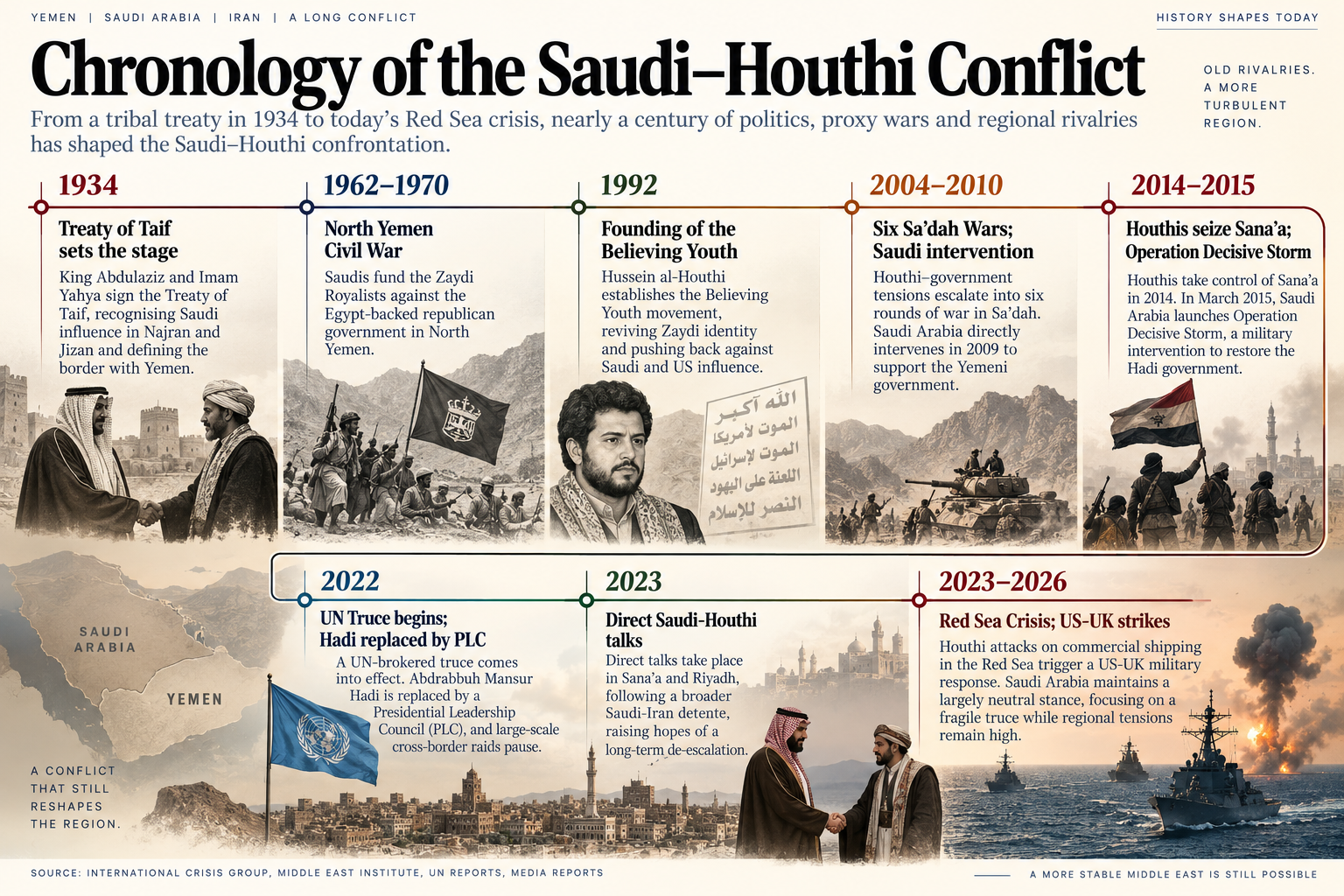
As King Abdulaziz Al Saud consolidated the modern Kingdom of Saudi Arabia in the early twentieth century, Saudi expansion collided with the expansionist ambitions of the Zaydi ruler, Imam Yahya Hamid al-Din of the Mutawakkilite Kingdom of Yemen. Following a brief border conflict in 1934, the two rulers signed the Treaty of Taif. Under the accord, Yemen ceded administration of the border provinces of Asir, Jizan, and Najran to Saudi Arabia.
Although renewed periodically, the loss of these fertile agricultural and mountainous territories rankled Yemeni nationalists for decades. It was not until the Treaty of Jeddah in June 2000 that former Yemeni President Ali Abdullah Saleh formally settled the international border line—a concession that many northern tribesmen and Zaydi traditionalists regarded as an illegitimate betrayal.
Following the republican victory and the abolition of the 1,000-year-old Zaydi Imamate, the republican government in Sana'a pursued centralisation. In subsequent decades, northern Yemen—particularly the governorate of Sa'dah—suffered economic marginalisation and infrastructural neglect.
The Incubation of Ansar Allah: The Sa'dah Wars (1990–2010)
During the 1980s and 1990s, the demographic balance in northern Yemen shifted. Backed by wealthy Gulf donors and Saudi religious endowments, Salafi and Wahhabi proselytisation expanded across Yemen. The establishment of the Dar al-Hadith Islamic institute in Dammaj, in the heart of Sa'dah, by Salafi scholar Muqbil bin Hadi al-Wadi'i, represented an existential challenge to the traditional Zaydi clerical aristocracy.
The Believing Youth
In 1992, Zaydi clerics and intellectuals founded al-Shabab al-Mumin (The Believing Youth) to revitalise Zaydi religious heritage, open summer clubs, and educate youth against imported theological doctrines. Among its charismatic leaders was Hussein Badreddin al-Houthi, a former parliamentarian whose father, Badr al-Din al-Houthi, was an esteemed Zaydi scholar.
Hussein al-Houthi gradually radicalised the movement. Influenced by the 1979 Iranian Revolution and staunchly opposed to Western foreign policy in the Middle East, he linked local grievances to broader anti-imperialism. Following the 2003 US-led invasion of Iraq, Hussein al-Houthi introduced the Sarkha (the slogan):
"God is Great, Death to America, Death to Israel, A Curse Upon the Jews, Victory to Islam."
When Houthi supporters chanted the slogan in the Grand Mosque of Sana'a in the presence of President Ali Abdullah Saleh, the central government interpreted it as a direct challenge to state authority and an embarrassment to its counterterrorism partnership with Washington.
The Six Sa'dah Wars (2004–2010)
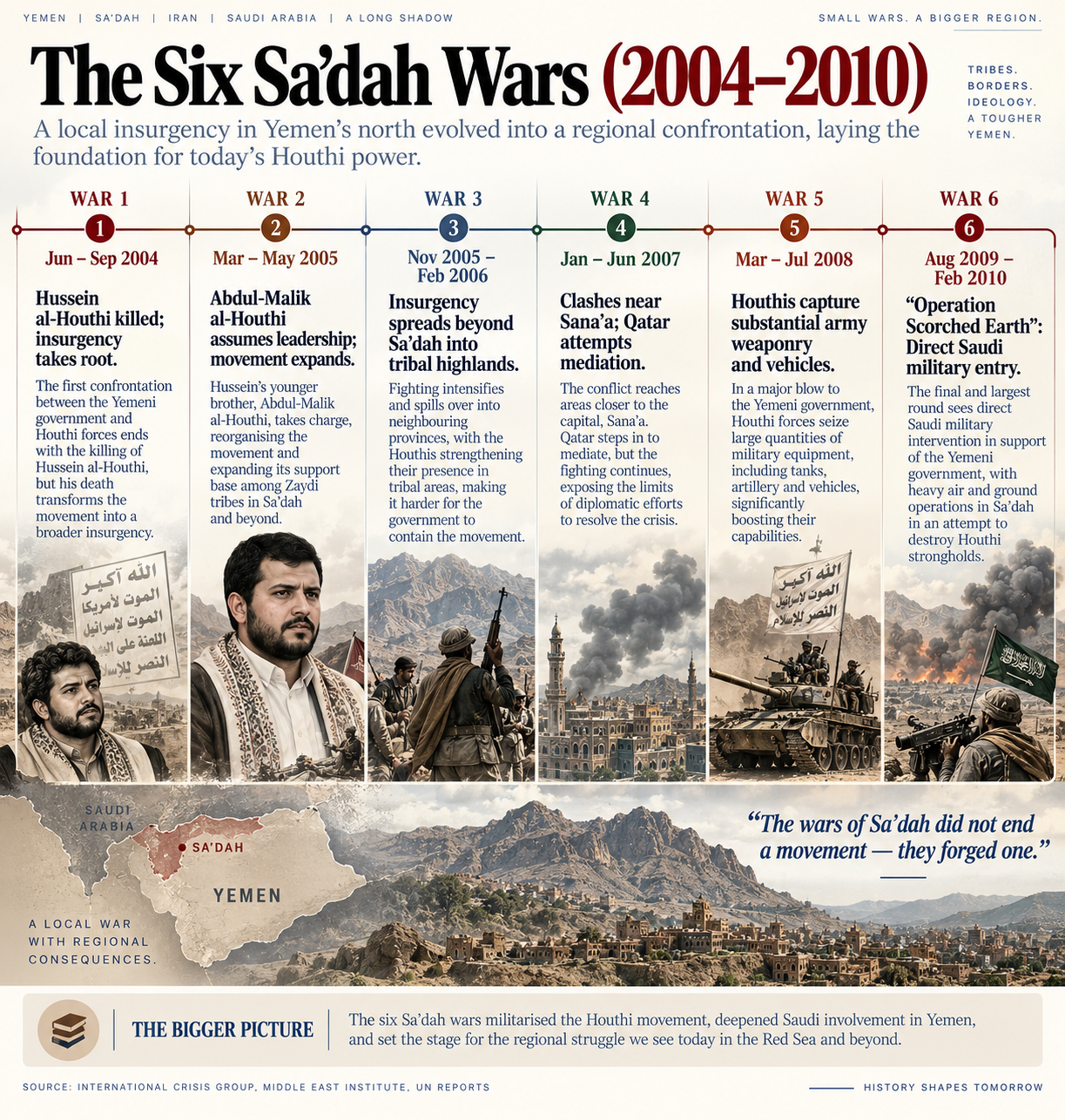
In June 2004, state security forces attempted to arrest Hussein al-Houthi, igniting the first Sa'dah war. Hussein was killed by government troops in September 2004, but his death transformed him into a martyr. Leadership passed to his younger brother, Abdul-Malik al-Houthi, who reorganised the fighters into a disciplined insurgent force named Ansar Allah.
Between 2004 and 2010, the Yemeni army fought six distinct military campaigns against the Houthis in northern Yemen. Far from crushing the movement, each conflict enhanced Houthi military capabilities, hardened their command structures, and expanded their territorial control across Sa'dah and neighbouring Amran.
By January 2015, Houthi militants surrounded the presidential palace and placed Hadi under house arrest. Hadi resigned, escaped in disguise to the southern port city of Aden, and rescinded his resignation. As Houthi and pro-Saleh forces advanced south towards Aden with combat aircraft and armour, Hadi fled to Riyadh, requesting direct military intervention from the Gulf states.
Operation Decisive Storm and the Internationalised War (2015–2022)
On 26 March 2015, Saudi Arabia declared the beginning of Operation Decisive Storm. Overseen by the kingdom's newly appointed 29-year-old Minister of Defence, Prince Mohammed bin Salman, the intervention assembled a coalition of nine Arab countries, including the United Arab Emirates, Bahrain, Kuwait, Egypt, and Sudan.
The United States and the United Kingdom provided substantial operational backing, including mid-air refuelling for coalition strike aircraft, intelligence sharing, logistics coordination, and billions of dollars in precision-guided munitions.
The coalition quickly secured Yemen's southern coast, expelling Houthi forces from Aden in the summer of 2015. However, the advance halted when coalition-backed infantry attempted to push into the steep, fortified topography of the northern highlands.
Strategic Divergence within the Coalition
As the war dragged on, fractures opened between the coalition’s two primary pillars:
Saudi Arabia prioritised securing its southern border, preserving the central government of President Hadi, and containing the Muslim Brotherhood-affiliated Islah party.
The United Arab Emirates focused on maritime choke points and southern independence movements, funding and arming the secessionist Southern Transitional Council (STC) and coastal militias led by Tariq Saleh (the late president's nephew).
The contradictions exploded into open fighting in August 2019, when STC forces clashed with Hadi’s troops in Aden, fracturing the anti-Houthi front.
The Collapse of the Houthi-Saleh Axis
In northern Yemen, the alliance of convenience between Saleh and the Houthis disintegrated amid mutual distrust. In late November 2017, street battles erupted in Sana'a between Houthi fighters and Saleh loyalists. On 2 December 2017, Saleh publicly declared his readiness to "turn a new page" with the Saudi coalition.
Two days later, Houthi forces ambushed Saleh's convoy outside Sana'a and killed him. Saleh's death eliminated any moderate domestic check on the Houthi movement, leaving Ansar Allah in absolute political, fiscal, and security control of northern Yemen.
The Missile and Drone Escalation
Unable to defeat the coalition conventionally, the Houthis adopted asymmetric warfare, launching hundreds of ballistic missiles and explosive-laden drones across the border into Saudi Arabia.
According to annual reports from the UN Panel of Experts on Yemen, Iran's IRGC-Quds Force provided critical technical advice, guidance systems, and dual-use components smuggled through maritime routes, upgrading Soviet-era Scud variants into extended-range Burkan missiles and assembling Qasef and Samad loitering munitions.
The cross-border strikes moved from border military outposts to civilian infrastructure and economic targets inside the kingdom:
Regular strikes targeted Abha International Airport and Jizan oil storage facilities.
In September 2019, precision missile and drone attacks struck Saudi Aramco processing plants at Abqaiq and Khurais, temporarily cutting Saudi oil production by 5.7 million barrels per day—roughly half of the kingdom's output. While the Houthis claimed responsibility, international investigators concluded the sophisticated strikes originated from Iranian territory.
In March 2022, a Houthi missile barrage struck an Aramco fuel depot in Jeddah during the Formula 1 Grand Prix trials, sending plumes of black smoke over the circuit.
Coalition air strikes hit hospitals, schools, markets, and funeral halls, while the coalition's naval and aerial blockade severely restricted food, fuel, and medical imports entering the primary port of Hodeidah and Sana'a International Airport.
The 2022 Truce and Riyadh's Strategic Pivot
By early 2022, the strategic calculus in Riyadh had transformed fundamentally.
Crown Prince Mohammed bin Salman had launched Vision 2030, an ambitious economic programme requiring hundreds of billions of dollars in foreign direct investment to build giga-projects such as NEOM and luxury tourism resorts along the Red Sea coast. Persistent Houthi drone and missile strikes threatened the kingdom's reputation as a secure international investment destination.
Recognising that military victory was unachievable, Riyadh chose to disengage.
On 2 April 2022, United Nations Special Envoy for Yemen Hans Grundberg negotiated a historic nationwide two-month truce. The agreement provided for:
A cessation of all offensive military operations inside Yemen and across international borders.
The resumption of commercial commercial flights through Sana'a airport to Amman and Cairo.
Fuel vessels docking at the port of Hodeidah.
Talks to reopen blocked roads around the besieged city of Taiz.
Days later, in Riyadh, President Hadi formally transferred his powers to an eight-member Presidential Leadership Council (PLC) headed by former interior minister Rashad al-Alimi, removing Hadi from the political scene.
Although the formal UN truce expired in October 2022 after disagreements over paying public sector salaries in Houthi-held areas, its core parameters held. Major Saudi airstrikes and cross-border missile barrages halted entirely.
Bilateral Negotiations in Sana'a and Riyadh
Crucially, Saudi Arabia bypassed its Yemeni allies in the PLC and opened direct bilateral talks with the Houthis, mediated by the Sultanate of Oman.
In April 2023, the Saudi Ambassador to Yemen, Mohammed Al-Jaber, travelled to Sana'a to hold direct discussions with Houthi political leaders. In September 2023, an official Houthi delegation visited Riyadh for five days of talks—the first public visit of its kind since the war began.
By December 2023, UN Special Envoy Hans Grundberg announced that the parties had committed to an agreed set of principles towards a comprehensive Yemen Peace Roadmap, including:
Paying public sector salaries and pensions nationwide from state oil revenues.
Fully reopening Sana'a airport and Red Sea ports.
Establishing an orderly withdrawal of foreign troops.
Launching an inclusive UN-supervised political process.
Regional Disruption: The Red Sea Crisis (2023–2026)
The nascent peace process was upended by regional events. Following the outbreak of the Israel–Hamas conflict in October 2023, the Houthis entered the regional arena as an active member of Iran’s self-described "Axis of Resistance".
Framing their campaign as solidarity with Palestinians in Gaza, the Houthis launched medium-range ballistic missiles and drones towards Eilat in southern Israel and initiated attacks on commercial shipping passing through the Bab al-Mandab Strait.
Between November 2023 and 2026, Houthi forces boarded vessels, deployed unmanned surface vessels (USVs), and fired anti-ship ballistic missiles at international container ships and tankers, forcing global shipping lines to reroute around Africa's Cape of Good Hope.
The Western Coalition and Saudi Neutrality
In response, the United States launched Operation Prosperity Guardian in December 2023, and together with the United Kingdom, commenced repeated precision strikes against Houthi radars, missile depots, and command installations across western Yemen.
Crucially, Saudi Arabia refused to join the US-led naval coalition or take part in military strikes. Riyadh:
Explicitly declined to permit American or British strike aircraft to operate from Saudi airbases for missions over Yemen.
Urged Washington to exercise restraint and avoid provoking the Houthis into resuming cross-border attacks.
Refrained from joining retaliatory strikes, even when Houthi drones crossed Saudi airspace toward Israel.
Riyadh understood that joining Western military action would dismantle two years of painstaking bilateral negotiations, reignite missile strikes on Saudi infrastructure, and end any chance of an orderly exit from Yemen.
Economic Brinkmanship
Even as armed hostilities remained dormant, economic warfare intensified. In early 2024, the government-aligned Central Bank of Yemen in Aden (CBY-Aden) ordered all commercial banks to relocate their headquarters from Sana'a to Aden and revoked the operating licences of banks complying with Houthi regulations.
The Houthis retaliated by issuing new coins and threatening to cut commercial flights. Fearing that renewed economic collapse would trigger a military response against Saudi oil installations, Riyadh intervened diplomatically in July 2024, pressing CBY-Aden to cancel its punitive measures and restore joint flight schedules through Sana'a airport.
The Reality on the Ground: A Partitioned Yemen
More than a decade after the fall of Sana'a, Yemen is characterized by de facto fragmentation rather than unified governance.
The Houthi movement has transitioned from an insurgent group into an entrenched regional authority. It collects taxes, runs courts, commands a standing army equipped with advanced ballistic weapons, and enforces ideological conformity through school curricula.
Conversely, the anti-Houthi coalition remains divided. The Presidential Leadership Council is an uneasy conglomerate of rivals—southern secessionists, northern republicans, Salafi commanders, and coastal fighters—united only by their opposition to Sana'a.
Conclusion: Strategic Realities of an Unfinished War
The Saudi–Houthi conflict offers profound lessons in the limits of military intervention.
For Saudi Arabia, the 2015 intervention proved to be a costly miscalculation. Eight years of air supremacy failed to dislodge a motivated, terrain-savvy adversary. Instead, the war brought Iranian advisors to the Saudi border, exposed the vulnerability of the kingdom's industrial infrastructure, and caused extensive international reputational damage.
Riyadh’s current policy is governed by pragmatic containment. Rather than attempting to govern or defeat northern Yemen, Saudi Arabia seeks to secure its border, buy internal calm through financial assistance, and decouple its domestic modernization plans from the unresolved grievances of its southern neighbour.
For the Houthis, the conflict has been an unexpected political victory. They survived the full air power of a regional coalition, outmanoeuvred their internal rivals, and established themselves as a formidable military presence capable of disrupting international maritime trade.
Yet their domestic victory remains precarious. The Houthis govern an impoverished, war-ravaged population that lacks basic public services, electricity, and clean water. With state salaries unpaid, foreign aid dwindling, and the formal UN peace roadmap held hostage by regional tensions in the Red Sea, the absence of war has not brought peace. The guns along the Saudi border may be quiet, but Yemen remains trapped in an unstable partition, awaiting a political settlement that remains as elusive as ever.