In brief
- China’s Ministry of Commerce announced sweeping export restrictions on Tunnel Boring Machines and will require licences starting 18 November 2026. The move targets export of complete machines, cutterheads, hydraulic drive units, or spare assemblies from Chinese ports.
- The policy marks a silent economic blockade that has stalled major Indian infrastructure projects for almost two years, including the Mumbai to Ahmedabad high speed rail corridor and Himalayan border tunnels in Ladakh and Arunachal Pradesh.
- India is pushing to break a foreign monopoly by developing indigenous heavy tunnelling capability under Make in India and Atmanirbhar Bharat, with BEML built TBMs in trials and testing planned before full deployment.
- In the interim India will expand manufacturing via European partners in Chennai to provide a critical buffer while the domestic capabilities mature.
In modern industrial warfare, geopolitical leverage is rarely exerted through conventional military hardware alone. Instead, it is increasingly prosecuted through critical, unglamorous industrial chokepoints: rare earth magnets, semiconductor photoresists, titanium forgings, and specialized tooling.
On 19 October 2026, Beijing activated its latest strategic lever.
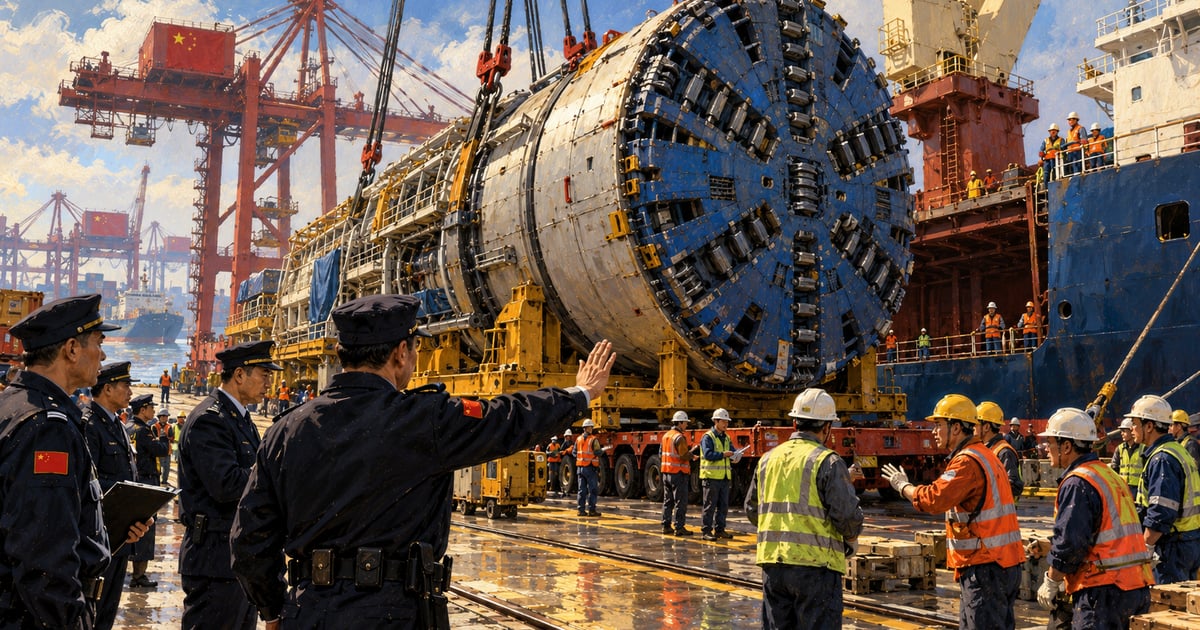
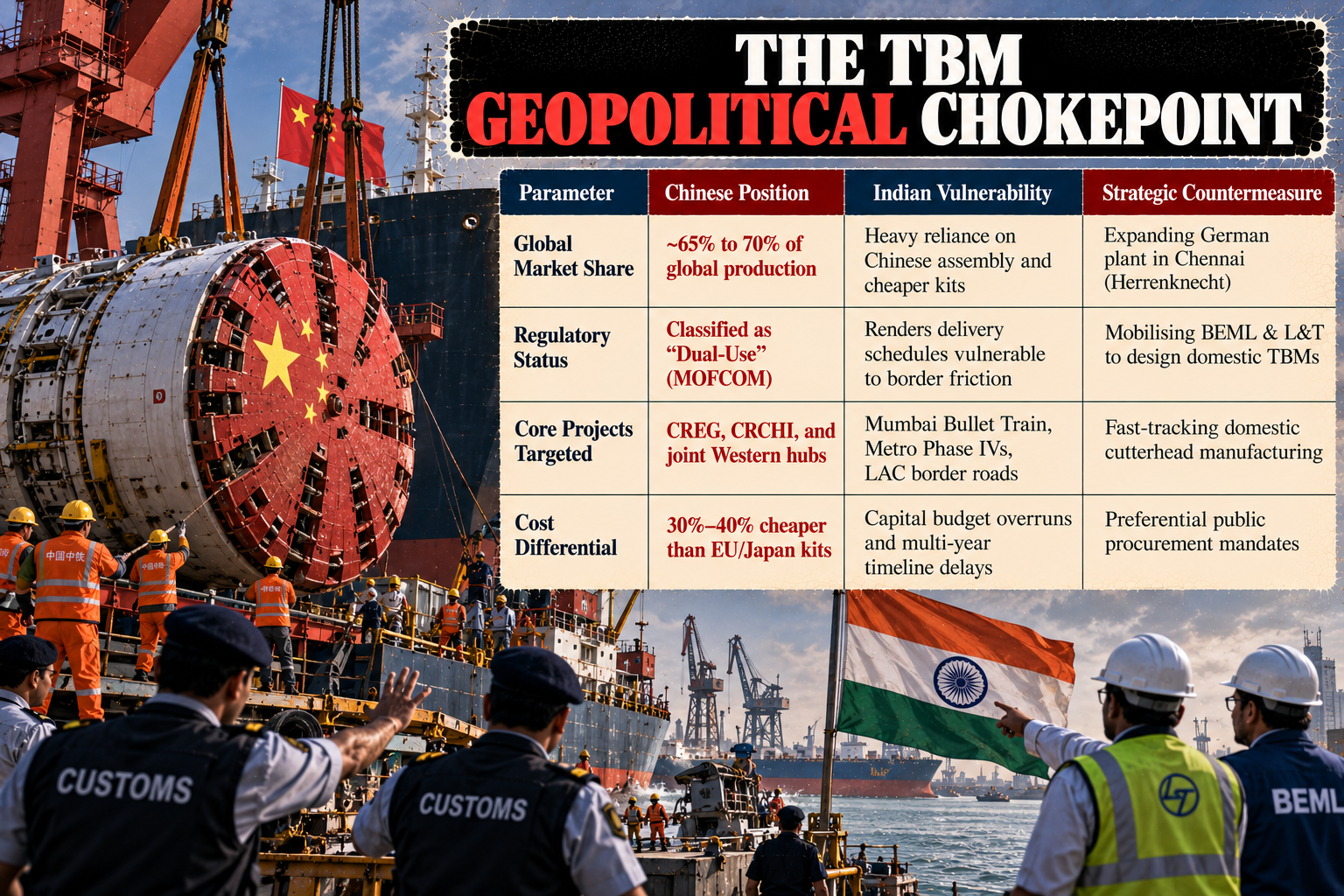
China’s Ministry of Commerce (MOFCOM) announced sweeping export restrictions on Tunnel Boring Machines (TBMs), classifying these subterranean mega-structures as controlled "dual-use" equipment under its national security statutes. Starting 18 November 2026, any shipment of complete machines, cutterheads, hydraulic drive units, or spare assemblies from Chinese ports will require formal, case-by-case government licences.
For India, the announcement was not a theoretical policy shift; it was the formal codification of a silent economic blockade that has been quietly stalling major infrastructure projects for nearly two years.
From the high-speed rail corridor connecting Mumbai and Ahmedabad to critical, all-weather military logistics tunnels being carved beneath Himalayan mountain passes in Ladakh and Arunachal Pradesh, India’s infrastructure ambitions have run directly into a Chinese supply-chain wall. In response, New Delhi has initiated a high-stakes campaign under the Make in India and Atmanirbhar Bharat frameworks: breaking a crushing foreign monopoly by constructing its own indigenous heavy tunnelling capability.
What Is a TBM and Why Can't India Just Build Tunnels Without Them?
A Tunnel Boring Machine is not merely a large drill; it is a fully automated, subterranean factory.
Weighing between 1,000 and 3,500 tonnes and stretching the length of a passenger train (frequently exceeding 100 metres), a modern shield TBM performs five complex engineering tasks simultaneously:
Excavation: A massive circular cutterhead fitted with tungsten carbide disc cutters rotates against the rock or soil face under thousands of tonnes of hydraulic pressure.
Ground Support: Pressurised chambers (Earth Pressure Balance or bentonite slurry systems) balance ground and water pressures, preventing urban streets or mountain slopes above from collapsing.
Muck Extraction: Crushed rock and soil are siphoned out of the excavation chamber via screw conveyors or slurry pipes to the surface.
Ring Erection: A robotic hydraulic erector arm lifts pre-cast concrete segments and bolts them into a watertight, structural circular ring.
Propulsion: Hydraulic thrust cylinders push off against the newly installed concrete ring to propel the machine forward into the earth.
In densely populated urban centres like Mumbai, Kolkata, Chennai, and Delhi, conventional "drill-and-blast" methods are impossible without destabilising surface buildings and urban utilities.
More crucially, in the fragile, seismically volatile geology of the Himalayas, drill-and-blast methods trigger catastrophic landslides, fracture water aquifers, and progress at a crawl of one or two metres per day. A modern TBM, by contrast, can safely advance 15 to 25 metres a day, creating a finished, reinforced tunnel in a single continuous pass.
Without TBMs, India’s modern infrastructure push cannot function.
The Bullet Train Hostage: The Standoff in Guangzhou
The vulnerability of India’s dependence on Chinese manufacturing was laid bare during the construction of the flagship 508-km Mumbai–Ahmedabad High-Speed Rail Corridor.
A signature engineering component of the bullet train project is a 21-kilometre underground rail tunnel between Bandra Kurla Complex and Shilphata in Maharashtra, which includes a 7-kilometre undersea section beneath Thane Creek—the first undersea rail tunnel in India.
Excavating this corridor required the deployment of the largest TBM ever used on Indian soil: a colossal 13.56-metre-diameter Mixshield machine, designated S-1392.
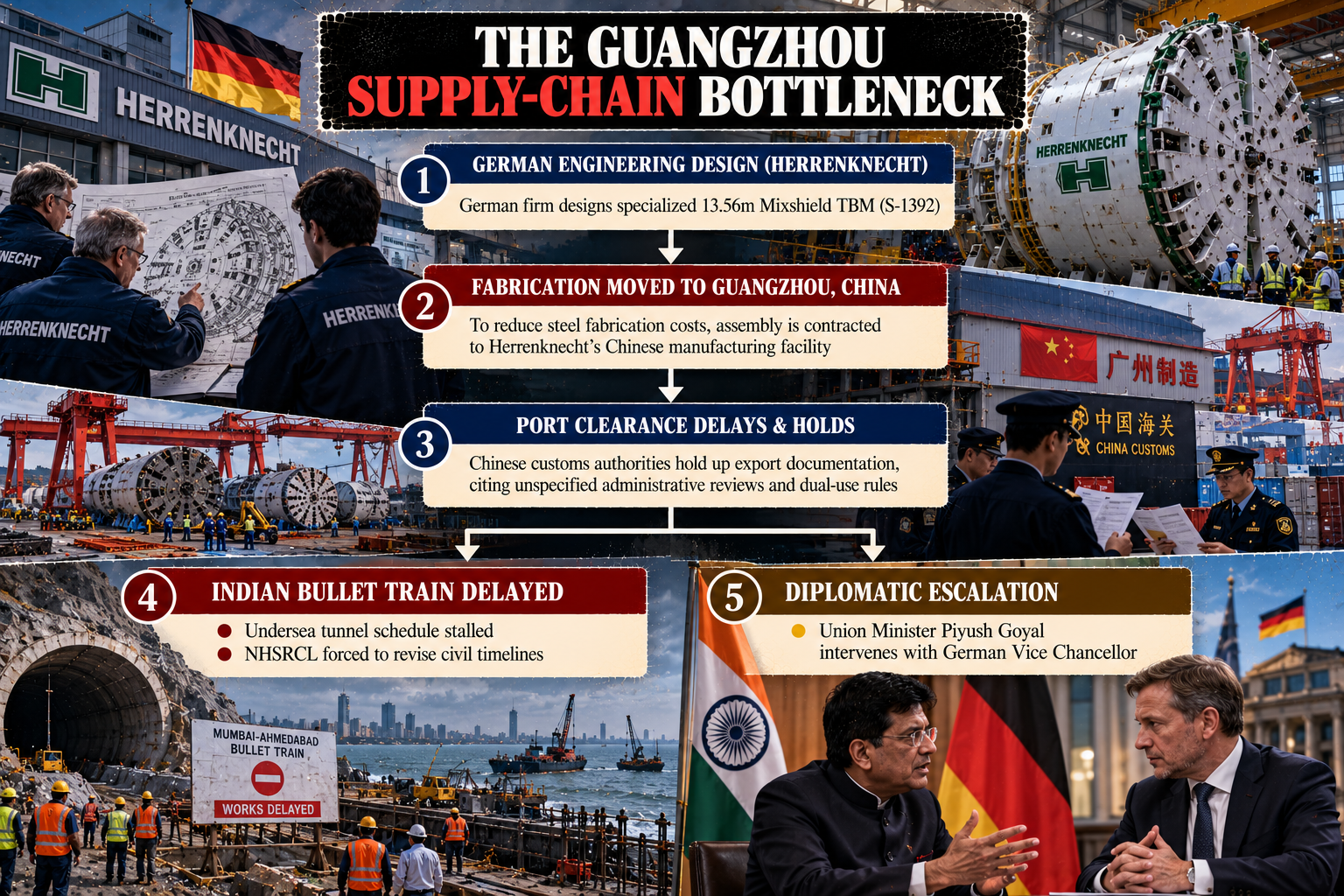
Although the National High Speed Rail Corporation Limited (NHSRCL) contracted the machinery from world-renowned German engineering specialist Herrenknecht AG, global manufacturing dynamics intervened. Like many Western engineering conglomerates, Herrenknecht had established large-scale assembly yards in Guangzhou, China, to take advantage of low structural steel costs and skilled assembly labour.
Beginning in 2024, Chinese customs authorities placed bureaucratic holds on the export of these machines to India. Shipments languished at Chinese docks for months under opaque customs procedures.
The crisis escalated to the highest diplomatic levels. During a metro ride in New Delhi in late 2024, Union Commerce Minister Piyush Goyal personally raised the issue with Germany’s Vice Chancellor Robert Habeck, pointing out that Chinese authorities were deliberately obstructing German-branded machines destined for Indian infrastructure.
While the bullet train TBM was eventually cleared and delivered in early 2026 following intense diplomatic maneuvering, the message from Beijing was unmistakable: India's transport revolution was operating at the pleasure of Chinese port officials.
The Strategic Dimension: Why China Classified TBMs as "Dual-Use"
Beijing's decision to formally classify TBMs under dual-use export controls on 19 October 2026 was not driven by trade protectionism alone; it was guided by military doctrine along the Line of Actual Control (LAC).
Following the deadly 2020 Galwan Valley clashes, India launched an unprecedented border infrastructure blitz. Under the Ministry of Defence and the Border Roads Organisation (BRO), India began cutting all-weather road and rail axes through the Himalayas:
The Zojila Tunnel (14.15 km) linking Srinagar to Leh;
The Shinku La Tunnel (4.1 km) providing all-weather access to Ladakh via Himachal Pradesh;
The Sela Tunnel and planned corridors beneath the Sela Pass toward Tawang in Arunachal Pradesh;
The 125-km Rishikesh–Karnaprayag Rail Link, designed to transport heavy military formations directly to the Uttarakhand border.
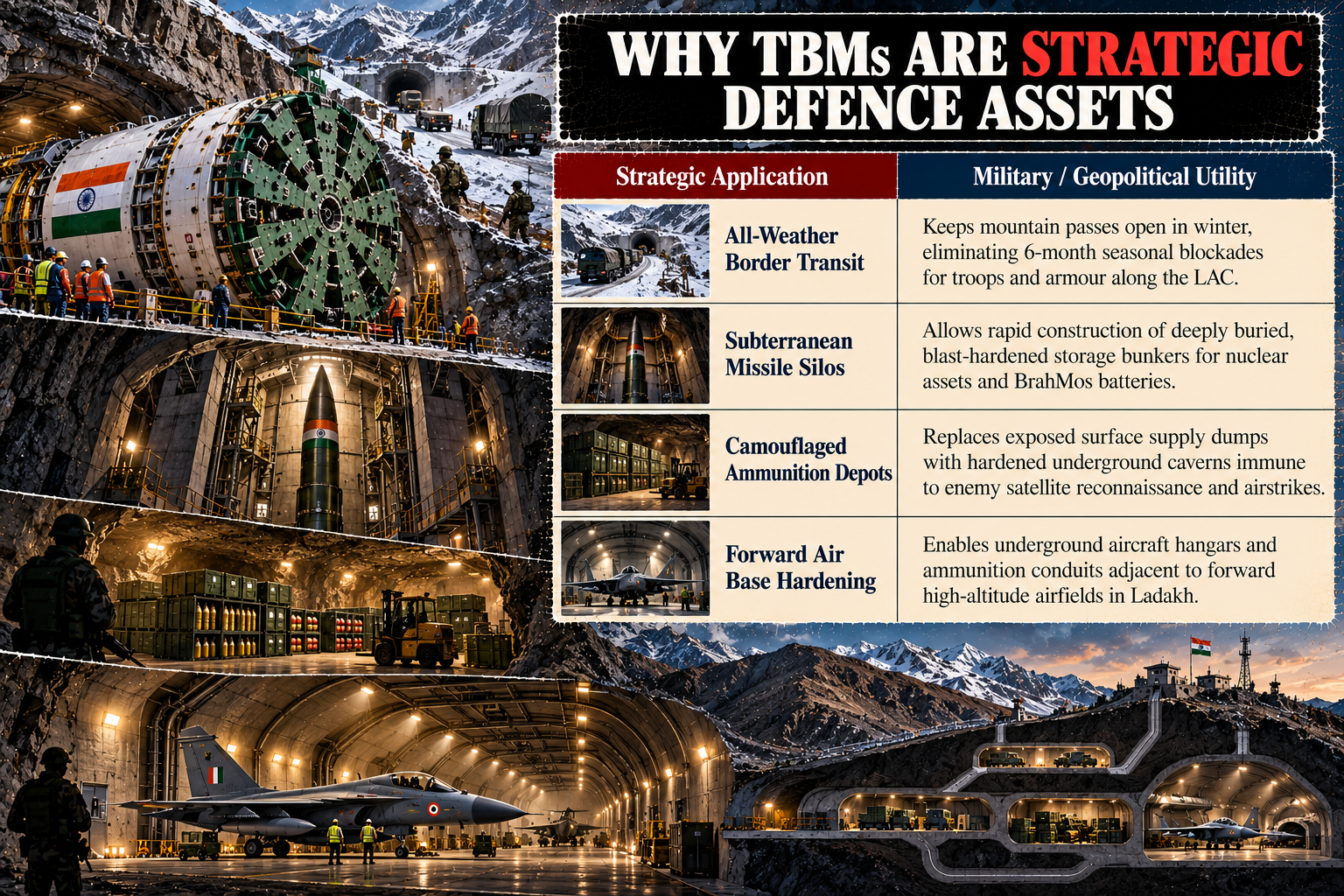
For China, which spent thirty years mastering mechanized subterranean engineering through state giants like China Railway Construction Heavy Industry (CRCHI) and China Railway Engineering Equipment Group (CREG), weaponising TBM exports is an asymmetric tactic.
By choking the supply of machines, replacement cutterhead disc rings, and hydraulic pumps, Beijing aims to slow India’s military mobility along the frontier, preserving the infrastructure advantage China established across Tibet over the past two decades.
India’s Two-Track Counter-Offensive
Confronted with the reality that Chinese supply chains can be severed at any moment, New Delhi has launched a two-track counter-offensive to establish subterranean sovereignty.
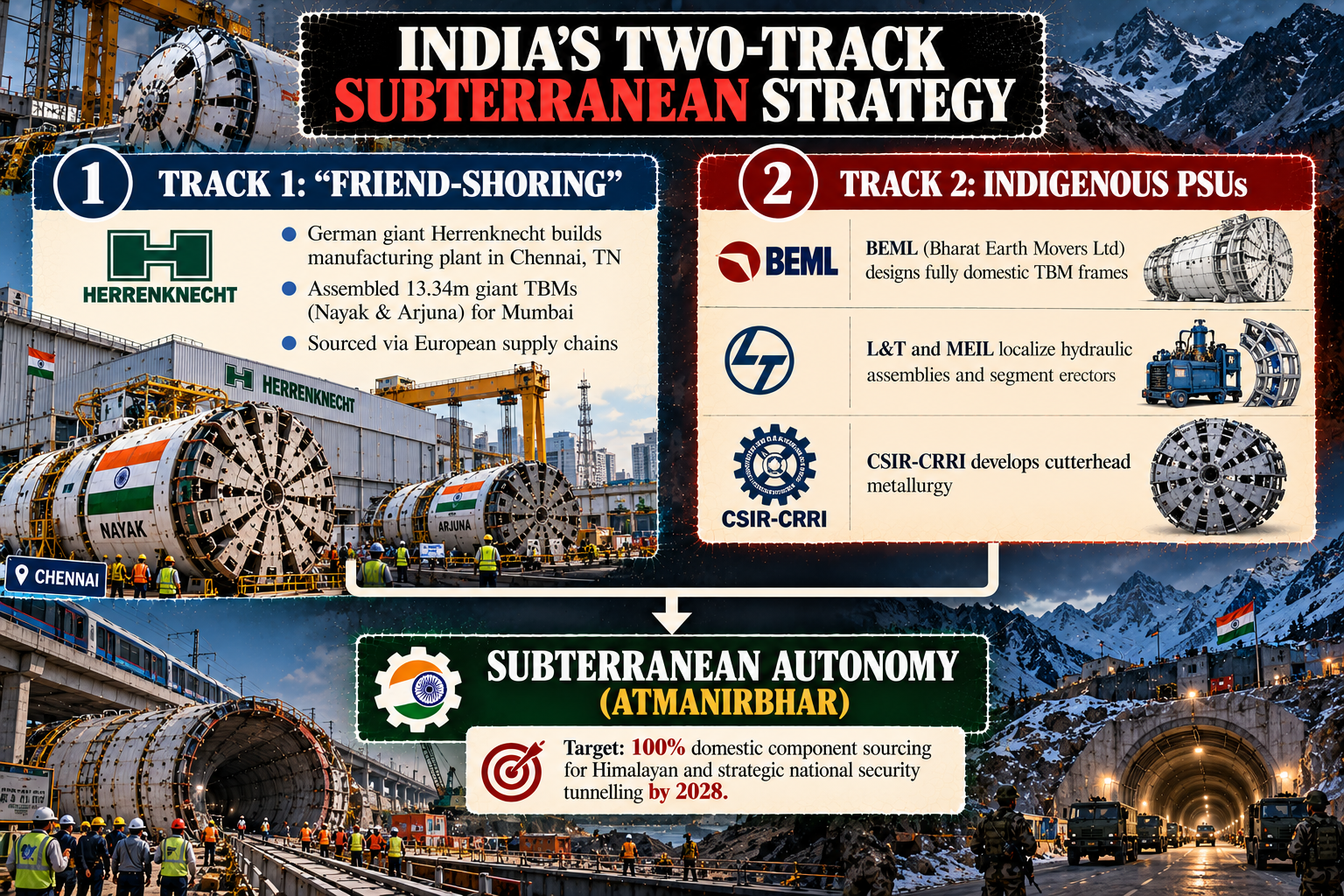
Track 1: "Friend-Shoring" Manufacturing with Germany (Herrenknecht Chennai)
The most immediate operational solution has been partnering with European manufacturers to build domestic assembly plants on Indian soil.
Recognising the regulatory risk in China, Germany’s Herrenknecht AG established and expanded a massive TBM manufacturing and refurbishment facility at Alinjivakkam near Chennai, Tamil Nadu. The Chennai plant has transitioned from a basic assembly depot into a full-scale fabrication hub:
It manufactured all ten TBMs required for Phase II of the Chennai Metro Rail Project.
In 2025 and 2026, the facility delivered two giant 13.34-metre hard-rock Single Shield TBMs—christened Nayak and Arjuna—procured by Megha Engineering & Infrastructures Limited (MEIL) for the Mumbai Metropolitan Region Development Authority’s (MMRDA) Thane–Borivali Twin Tunnel Project.
By shifting precision engineering away from Guangzhou to Tamil Nadu, India has created a secure, non-Chinese procurement corridor for major urban metro lines.
Track 2: The Indigenous Engineering Push (BEML, L&T, and CSIR)
While friend-shoring insulates urban metro projects, strategic defence tunnels along the LAC require complete, sovereign domestic capability. Foreign joint-venture equipment often remains subject to home-nation export review boards or end-user monitoring.
Under the guidance of the Ministry of Heavy Industries and the Ministry of Road Transport and Highways (MoRTH), India has mobilised its public and private heavy engineering leaders:
BEML (Bharat Earth Movers Limited): The state-run defence PSU—which already manufactures heavy mining dumpers, metro rakes, and military recovery vehicles—has floated Expressions of Interest (EoI) to manufacture complete, indigenous Tunnel Boring Machines. BEML is leveraging its heavy fabrication yards in Kolar Gold Fields and Bengaluru to develop domestic drive systems.
Larsen & Toubro (L&T): India’s premier infrastructure conglomerate has set up dedicated TBM refurbishment and component-fabrication workshops in Kanchipuram and Hazira, localising the production of hydraulic jacking frames and trailing-gear utility wagons.
CSIR-CRRI and IIT Consortia: Developing indigenous disc-cutter metallurgy. A major vulnerability in Himalayan tunnelling is the abrasive nature of quartz-heavy metamorphic rock, which wears down cutterhead discs every few hundred metres. Indian material science laboratories are testing domestically forged ultra-hard tungsten-carbide alloys to eliminate reliance on imported cutter tools.
The Engineering Frontier: Why Building a TBM Is Not Easy
Building a domestic TBM is one of the steepest engineering climbs in heavy machinery manufacturing. Unlike standard excavators or bulldozers, TBMs cannot be mass-produced on a generic assembly line; every single machine must be bespoke-engineered for the specific geological strata it will encounter.
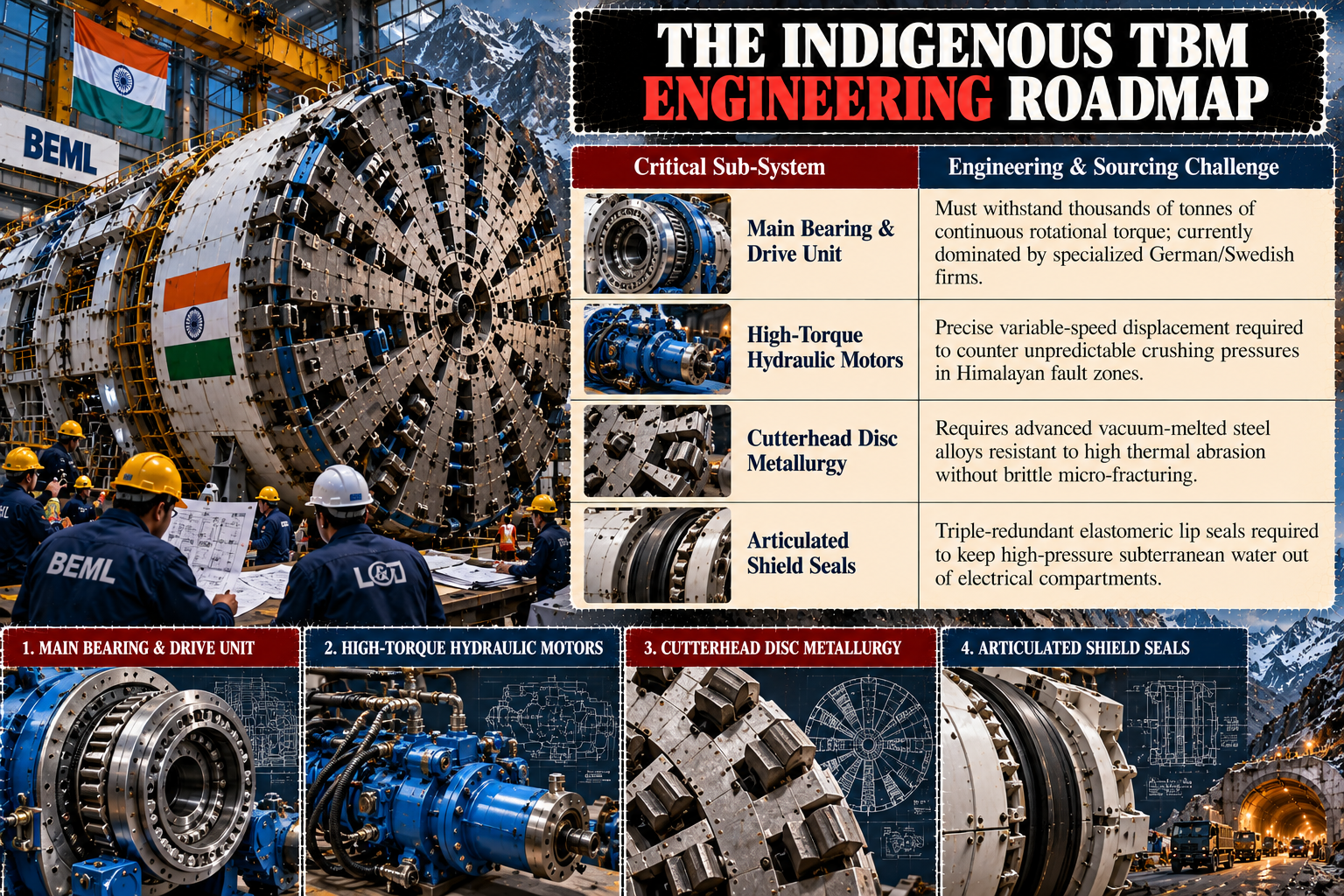
The Himalayan mountains present conditions unlike any European or Chinese terrain: shearing tectonic fault lines, extreme water ingress, squeezing rock that crushes machine shields, and pockets of explosive methane gas.
Developing a domestic TBM industry requires India to master not only heavy metal fabrication, but advanced high-pressure hydraulics, closed-loop telemetry control systems, and specialized metallurgy.
Conclusion: Carving Out Sovereign Ground
China’s decision to impose export controls on Tunnel Boring Machines follows an established playbook: identifying a niche, highly concentrated industrial technology, achieving global cost dominance, and then restricting supply when geopolitical tensions rise.
For India, the shock has arrived at an opportune moment.
With over ₹15 lakh crore ($180 billion) in urban transit, high-speed rail, hydroelectric reservoirs, and strategic border corridors slated for construction over the next decade, India is the world's largest consumer of tunnelling technology outside China. Continuing to rely on an adversary for the fundamental machines required to build sovereign infrastructure was an intolerable strategic vulnerability.
The transition will not be effortless. Fully domestic, BEML-built TBMs will take years of testing and certification before they can drill beneath Himalayan peaks. In the interim, expanded manufacturing via European partners in Chennai provides a vital buffer.
By pushing India to construct its own heavy boring machines, Beijing may soon discover that its export blockade accomplished what decades of domestic industrial policy could not: awakening India’s heavy engineering giants and ensuring that the machines carving the country's subterranean future bear the stamp of Made in India.