
In brief
- SEBI reversed its derivatives settlement reform on 15 October 2026, decoupling expiring F&O contracts from the cash market closing auction and reverting to 30-minute VWAP from 7 December 2026, ending a 73-day experiment that caused severe market dislocations.
- The auction-based settlement failed because India's derivatives turnover of ₹25-35 lakh crore daily dwarfs cash equity turnover by over twentyfold, making the single auction print a target for manipulative capital that triggered 150-300 point index swings on expiry days.
- Three structural flaws emerged: gamma squeezes trapped option sellers unable to hedge after 3:15 pm, split cash market timelines broke ETF tracking and arbitrage, and retail brokers faced margin crises when post-auction moves assigned supposedly out-of-the-money options.
- The revised rules restore 30-minute VWAP with real-time indicative broadcasts, set a 3:30 pm expiry cut-off for expiring index derivatives, and isolate a 10-minute cash auction from 3:30 pm; SEBI will monitor for at least a year.
On 15 October 2026, SEBI performed one of the swiftest regulatory reversals in Indian market history. Through circular HO/47/11/11(3)2025-MRD-POD2/I/23843/2026, the capital markets regulator dismantled the core pillar of its high-profile trading reform: the requirement that expiring futures and options (F&O) contracts settle against the single clearing price discovered in the cash-market Closing Auction Session (CAS).
Effective 7 December 2026, the final settlement price of expiring index and single-stock derivatives will decouple from CAS and revert to the historical 30-minute Volume-Weighted Average Price (VWAP) of continuous cash trading between 3:00 pm and 3:30 pm.
The rollback marks the end of a turbulent 73-day experiment that began on 3 August 2026. While closing call auctions are standard practice in New York, London, and Tokyo, transplanting the mechanism into India—where derivative turnover dwarfs cash-market equity turnover by more than twentyfold—unleashed severe market dislocations. To understand why SEBI stepped back, one must look past the headline timing changes and examine the microstructural flaws that made auction-based derivative settlement unworkable.
The Theoretical Promise vs The Indian Reality
Under the framework introduced in January 2026 (HO/47/11/11(3)2025-MRD-POD2/I/2765/2026), SEBI sought to eliminate "banging the close." Under the traditional VWAP system, well-funded market operators could theoretically influence the final settlement price by executing aggressive, directional trades in the final five minutes of continuous trading.
SEBI reasoned that an auction would solve this. In a call auction:
Buy and sell orders are pooled without continuous matching over a set window.
An algorithm calculates an indicative equilibrium price where the maximum volume of shares clears.
A single, multilateral price match executes at the close.
In mature Western exchanges, closing auctions work effectively because the cash market is deep, institutional asset managers dominate trading, and equity derivatives represent a manageable multiple of underlying cash liquidity.
In India, the structural reality is inverted:

When daily derivatives notional turnover regularly exceeds ₹25 lakh crore to ₹35 lakh crore ($300 billion to $420 billion), tethering the entire derivative settlement apparatus to a single discrete auction print in the cash market turned that auction into a target for manipulative capital.
The Anatomy of the Failure: What Broke After August 3
Between 3 August and mid-October 2026, the interaction between CAS and derivatives expiry days produced three severe operational breakdowns.
1. The Gamma Squeeze and "Zero-to-Hero" Whipsaws
The primary structural defect occurred in expiry-day options. As an option nears its expiry cut-off, its gamma—the rate of change of its delta with respect to the underlying price—approaches infinity for strikes near the money. A minuscule price change in the underlying index causes an out-of-the-money (OTM) contract with almost zero value to suddenly shoot deep into-the-money (ITM).
Under the 30-minute VWAP regime, gamma spikes were naturally dampened. Because VWAP aggregates every trade between 3:00 pm and 3:30 pm weighted by volume, an operator attempting to move the settlement price of the Nifty 50 had to sustain aggressive buying across 50 heavyweight stocks across thousands of separate trades for half an hour. The capital cost was astronomical, and counter-trend arbitrageurs would continuously absorb the flow.
Under CAS, the entire 30-minute average was replaced by a single equilibrium print. An institutional desk or proprietary syndicate looking to move the Nifty settlement price did not need to buy shares for 30 minutes. They only had to submit an overwhelming market or limit order in two or three index heavyweights—such as HDFC Bank, Reliance Industries, or ICICI Bank—during the auction order-entry window.
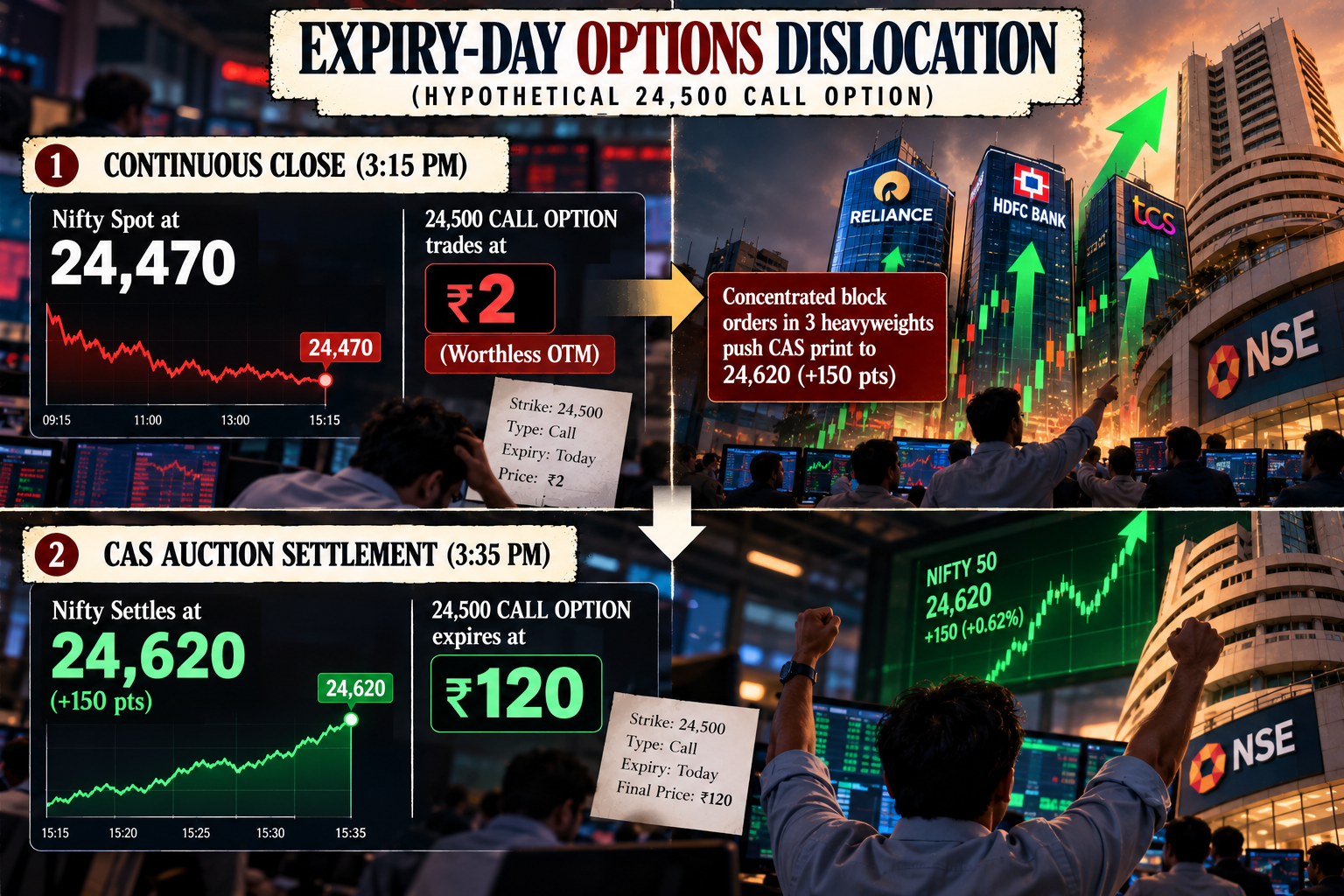
Because continuous trading in underlying equities had halted at 3:15 pm, market makers could not delta-hedge. If an institutional trader pushed the auction price upward, option writers (typically retail algorithmic traders, high-net-worth individuals, and systematic trading firms) could not buy underlying cash shares in real time to hedge their surging short delta. They were trapped in an opaque auction book. When the auction matched at 3:35 pm, indices swung by 150 to 300 points post-close, triggering catastrophic unhedgeable losses for option sellers.
2. The Split Cash Market and Basis Arbitrage Failure
Under the 3 August framework, continuous trading for F&O-eligible equities ended at 3:15 pm, followed by their 20-minute auction. Non-F&O equities, however, continued trading continuously until 3:30 pm.
This bifurcated timeline broke the cash-futures basis:
ETF Tracking Disasters: Exchange-traded funds tracking broader indices (such as the Nifty Midcap 150 or Nifty 500) hold a mix of F&O-eligible and non-F&O shares. Between 3:15 pm and 3:30 pm, fund managers and market makers faced live continuous prices for half their portfolio and frozen auction orders for the other half, blowing out tracking error.
Arbitrage Paralysis: Arbitrageurs running cash-versus-futures spreads rely on simultaneous execution in both legs. With cash trading frozen at 3:15 pm and index futures trading until 3:40 pm, the futures market traded completely unanchored from continuous cash pricing for 25 minutes every afternoon.
3. The Retail Brokerage Margin Crisis
Retail brokers such as Zerodha and Groww manage hundreds of thousands of leveraged intraday intraday square-off positions daily (MIS and Cover Orders). Broker risk-management engines are programmed to automatically liquidate outstanding intraday client positions starting at 3:15 pm to ensure clients do not carry leverage overnight.
Under the split CAS system:
Cash risk engines had to fire at 3:15 pm for F&O stocks.
Continuous cash engines had to fire until 3:30 pm for non-F&O stocks.
Derivatives risk engines had to remain active until 3:40 pm.
When the closing auction produced extreme post-market index moves at 3:35 pm, thousands of retail option positions that appeared safely out-of-the-money when brokers ran their 3:15 pm margin assessments were unexpectedly assigned in-the-money at 3:35 pm. Clients who had nominal margin buffers suddenly faced massive negative cash balances. The brokers themselves bore the clearing corporation default risk, creating an untenable operational headache for intermediary compliance desks.
The October 15 Overhaul: The Architecture of the Rollback
Faced with mounting evidence of structural instability and over 20,000 public submissions on its 12 September consultation paper, SEBI issued circular HO/47/11/11(3)2025-MRD-POD2/I/23843/2026 on 15 October 2026.
The regulator did not abolish the Closing Auction Session entirely. Instead, it executed a precise surgical decoupling: it preserved the auction for cash equities whilst completely removing derivatives settlement from its purview.
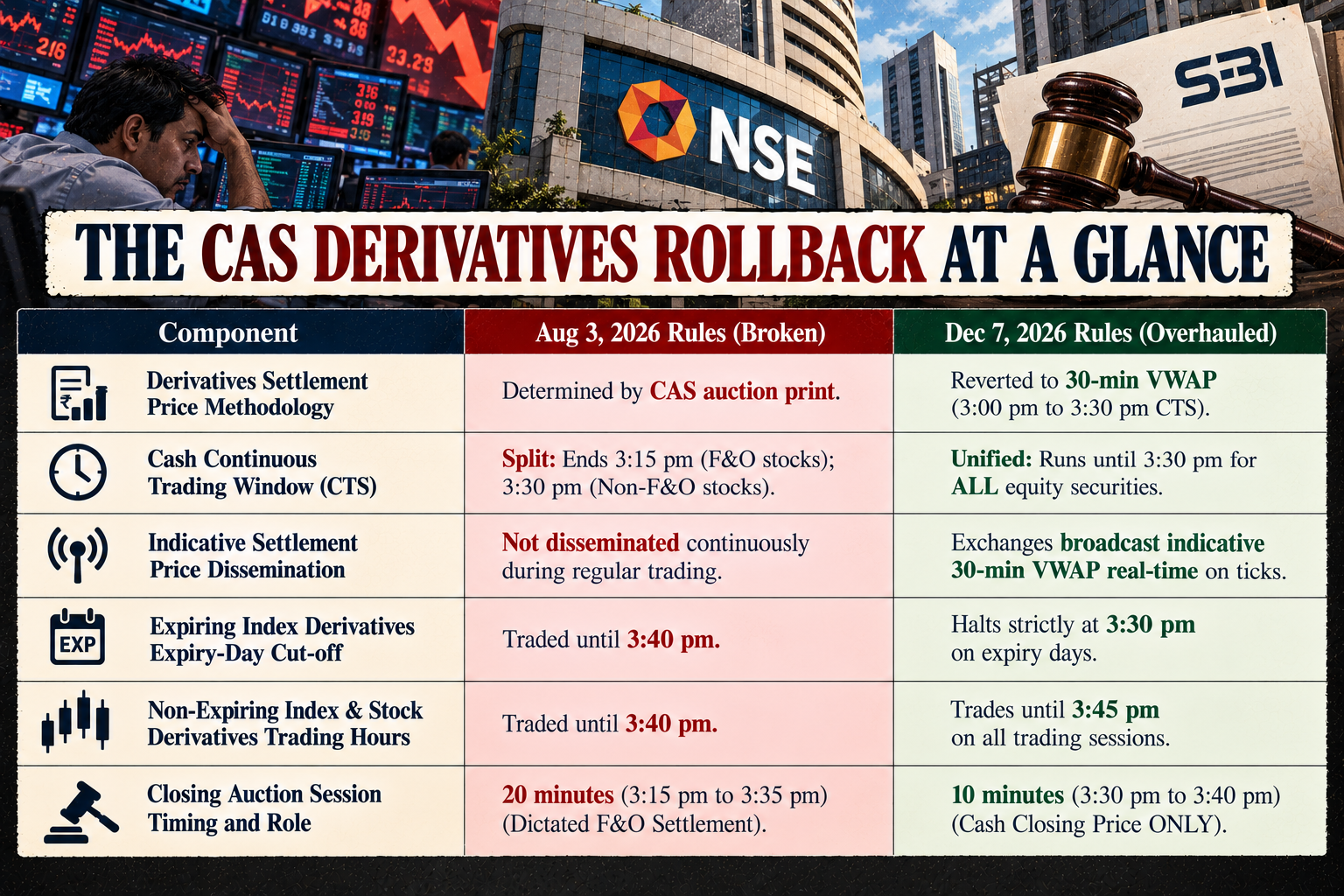
The New Mechanics: How Derivatives Will Settle from 7 December 2026
The revised framework introduces a four-stage process that restores predictability while maintaining safeguards against price manipulation:
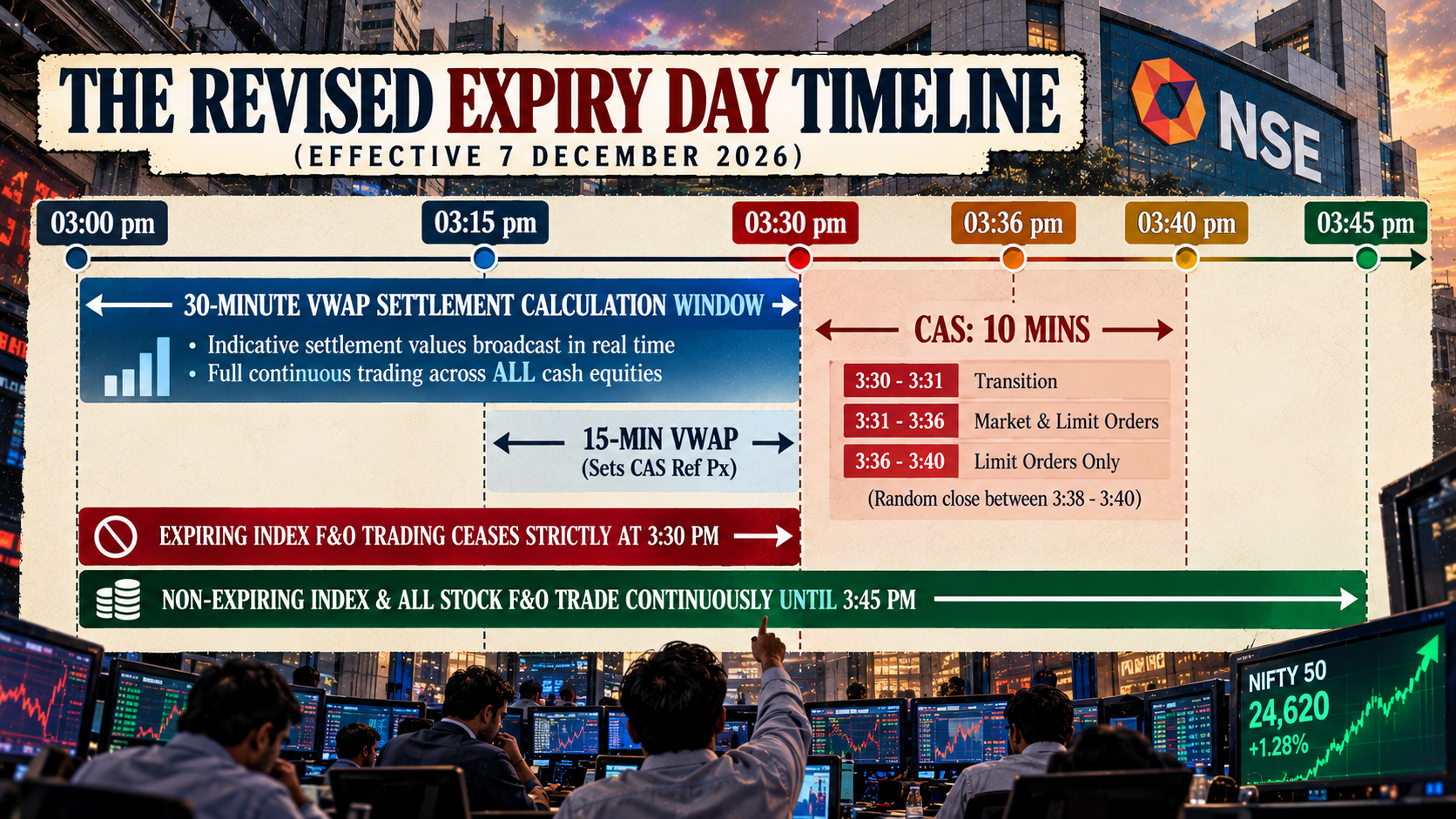
1. The Restored 30-Minute VWAP Anchor (3:00 pm to 3:30 pm)
From 7 December 2026, the final settlement price of expiring index options and futures will once again be calculated using the volume-weighted average prices of constituent securities during the final 30 minutes of continuous cash trading.
2. Real-Time Indicative Settlement Broadcasts
To address historical complaints that the 30-minute VWAP was an opaque "black box", SEBI added a critical transparency mandate: during the entire 3:00 pm to 3:30 pm window, stock exchanges must calculate and broadcast the indicative value of the underlying index and stock VWAPs in real time. Traders and algorithms can observe the exact evolving settlement price tick-by-tick, eliminating the post-close settlement surprises that plagued the August–October period.
3. Strict 3:30 PM Expiry Cut-Off
To prevent late-session basis contamination, trading in expiring index derivatives contracts will cease promptly at 3:30 pm on expiry days.
Non-expiring contracts (next-week and far-month expiries) and all single-stock derivative contracts will continue trading until 3:45 pm. This allows market participants to roll forward positions or hedge overnight exposure even while the cash market transitions into its separate closing auction.
4. The Isolated 10-Minute Cash CAS (3:30 pm to 3:40 pm)
Having stripped out derivatives settlement, SEBI retained CAS strictly for determining the official closing price of cash shares (used by mutual funds for NAV calculation and passive index tracking). The session was overhauled to prevent order spoofing:
3:30 pm to 3:31 pm: Order transition and reference price setting (anchored to the last 15-minute VWAP of continuous trading from 3:15 pm to 3:30 pm).
3:31 pm to 3:36 pm: Both market and limit orders are accepted.
3:36 pm to 3:40 pm: Strict limit-order phase. Market orders are blocked, and existing market orders cannot be cancelled or modified.
3:38 pm to 3:40 pm: System-driven random close to eliminate predatory front-running algorithms.
Institutional Aftermath: Why the Rollback Stabilises the Market
The regulatory retreat represents a victory for market microstructural stability over textbook financial theory. While global exchange models champion single-price closing auctions, market structures must reflect the realities of domestic order flows.
Global investment bank Jefferies noted that the decoupling removes systemic overhang across retail brokerages, where order velocity had dropped following the August rollout. By eliminating unexpected settlement gap-risk, the revised rules restore confidence for systematic option sellers who provide the bulk of day-to-day liquidity in Indian index options.
As SEBI Whole-Time Member K.V.R. Murty confirmed, the regulator plans to "wait and watch for at least a year" under this revised framework. By isolating the Closing Auction Session to cash equities and restoring 30-minute VWAP for derivatives, SEBI has preserved modern price discovery for long-term institutional investors while safeguarding the retail derivatives ecosystem from catastrophic structural whipsaws.