
In brief
- India's government is creating a state-controlled hardware monitoring device for foreign satellite operators like Starlink to ensure sovereign interception and prevent foreign kill switches, citing Ukraine war lessons.
- Inter-satellite laser links let data bypass Indian ground stations, so the Department of Telecommunications mandates zero cross-border leakage and localised gateways with physical verification.
- The Centre for Development of Telematics will develop a hardware monitor for gateway and enterprise tiers, enforcing the same physical interception standards as domestic networks under the Telecommunications Act 2023.
- Domestic telcos Jio and Airtel demand security parity with their trusted-source compliance, while SpaceX faces latency, proprietary protocol, and cost challenges from the mandatory hardware module.
For four years, the commercial entry of Elon Musk’s SpaceX into the world’s most populous digital market has been characterised by an unyielding regulatory stalemate. On paper, the promise of satellite broadband is transformative: deploying thousands of low-Earth orbit (LEO) satellites to beam high-speed internet into the remotest reaches of the Himalayas, the Thar Desert, the Northeast frontiers, and island territories where terrestrial optical fibre cannot feasibly reach.
Yet behind the scenes in New Delhi, commercial enthusiasm has run headlong into uncompromising national security doctrine.
On 20 October 2026, The Economic Times revealed that the Indian government—through an inter-ministerial coordination involving the Department of Telecommunications (DoT), the Ministry of Home Affairs (MHA), and the National Security Council Secretariat (NSCS)—is formulating an unprecedented technical mandate: the creation of a dedicated, state-controlled hardware monitoring device to serve as a physical security checkpoint for foreign satellite communications.
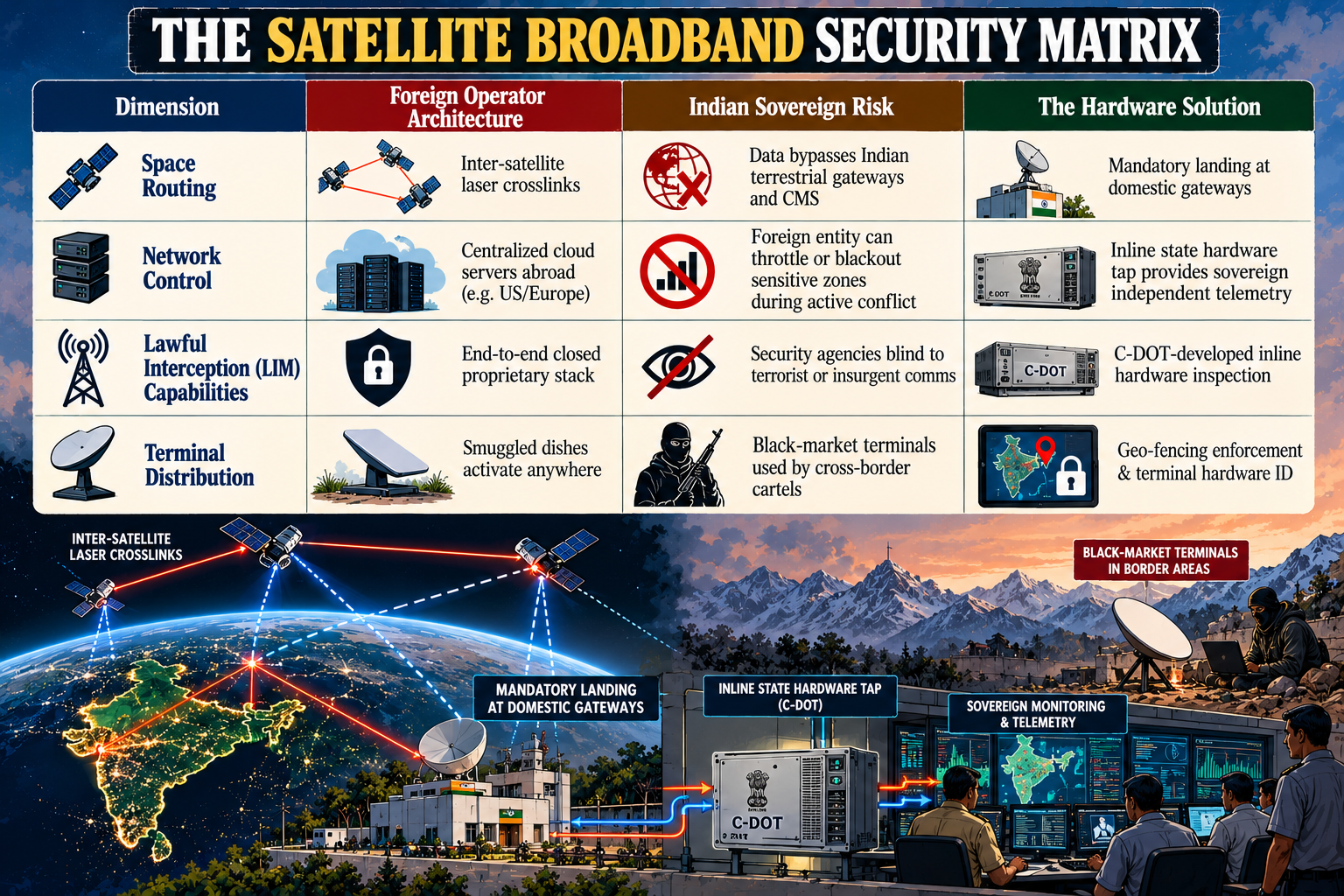
Under the proposed framework, reported by India Today and Outlook Business, foreign mega-constellations operating in India—most notably Starlink—will be barred from routing raw consumer and enterprise data directly between user terminals and orbital satellites without intermediate domestic oversight.
Instead, every byte of satellite traffic will be compelled to pass through an indigenous hardware tap, ensuring that sovereign law enforcement agencies retain unhindered lawful interception capabilities, prevent illicit cross-border routing, and eliminate the risk of a foreign corporation pulling a digital "kill switch" during a national security crisis.
The Lessons of Ukraine: Why Software Pledges Are Not Enough
To understand New Delhi's insistence on a physical hardware device, one must examine how geopolitical perceptions of commercial satellite constellations were radically altered by the war in Ukraine.
When the conflict erupted in 2022, Starlink was hailed as an asymmetric operational asset, keeping Ukrainian command networks alive after Russian cyber strikes disabled terrestrial infrastructure. However, as the war progressed, the profound strategic hazards of relying on a privately held foreign enterprise became glaringly apparent:
In late 2022, Elon Musk unilaterally denied a Ukrainian military request to activate Starlink connectivity over Russian-occupied Crimea to facilitate a naval drone strike, citing fears of nuclear escalation.
Ukrainian officials subsequently complained of unexpected operational restrictions, bandwidth caps, and geographic geofencing shifts that directly disrupted tactical operations.
More recently, unmonitored Starlink terminals began appearing on black markets and in the hands of adversary forces, demonstrating the extreme difficulty of regulating small, portable phased-array dishes.
For Indian defence and intelligence planners, these incidents shattered the premise that commercial service-level agreements (SLAs) or corporate software assurances could guarantee communications sovereignty.
India faces a complex, two-front security environment along disputed borders with Pakistan and China. In sensitive, conflict-prone zones such as the Line of Actual Control (LAC) in Ladakh and Arunachal Pradesh, or counter-insurgency sectors in Jammu & Kashmir, communications infrastructure must operate under absolute sovereign jurisdiction.
If a foreign satellite provider possesses the technical capability to switch off connectivity, throttle data speeds, or alter geofencing boundaries based on foreign diplomatic pressure or executive whim, it constitutes an intolerable national security liability.
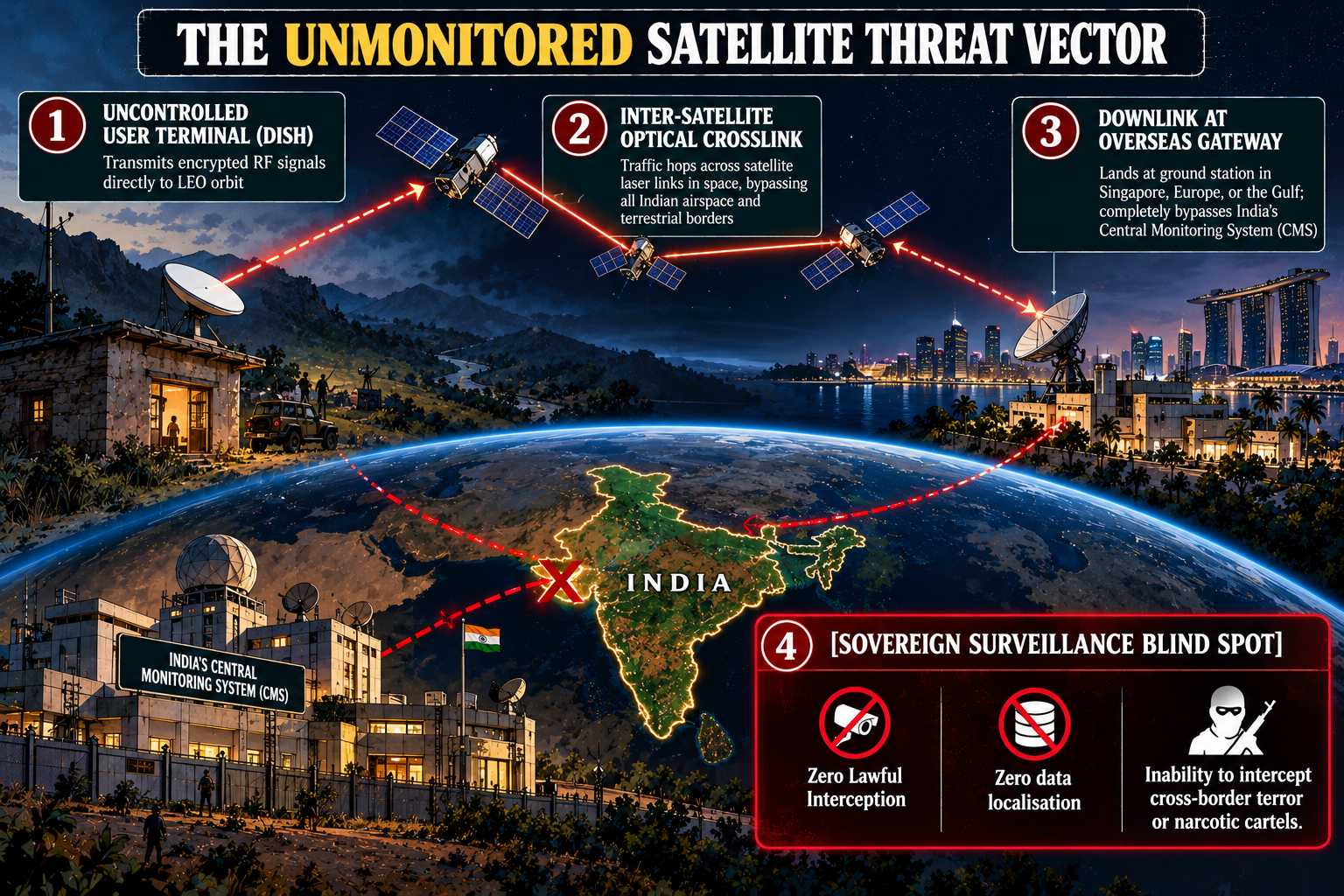
The risk is not theoretical. Indian security agencies have already intercepted and seized smuggled, unauthorised Starlink terminals within Indian territory, used by transnational narcotics cartels and regional insurgent groups seeking to evade terrestrial telecom interception.
The Technical Trap: Inter-Satellite Lasers and Data Leakage
The primary technological hurdle confronting Indian regulators is the rapid evolution of inter-satellite laser links (ISLs).
Early satellite internet constellations operated on a "bent-pipe" architecture: a user terminal beamed a signal to a satellite overhead, which immediately bounced it directly back down to a local ground gateway connected to the domestic internet backbone. Under this model, sovereign interception was relatively simple: as long as the ground gateway resided inside India, local security agencies could monitor traffic at the landing station.
Modern LEO constellations—most notably Starlink Gen 2—operate as dynamic, space-based mesh networks. Utilizing high-speed optical laser transceivers, satellites can route packets between one another in the vacuum of space at the speed of light.
This means a user in the Kashmir Valley or the Andaman Islands could transmit sensitive data to a satellite overhead, which could then laser-hop the data across five satellites in orbit and downlink it to an earth station in the United Arab Emirates or Germany—without the packet ever touching an Indian terrestrial server or gateway.
To counter this, Department of Telecommunications (DoT) regulations strictly mandate that:
Zero Cross-Border Data Leakage: All data originating from or terminating within Indian territory must land at a physically verified domestic earth station.
Localised Gateways: Operators must construct and maintain secure gateway stations within India under 24/7 security agency inspection. While SpaceX claims it has built or contracted up to 20 gateway antenna sites across India, the government requires absolute physical verification that laser crosslinks cannot be used as an orbital bypass during emergency internet shutdowns or counter-terror operations.
The Proposed Solution: C-DOT and the Sovereign Hardware Tap
Rather than relying on proprietary software logs provided by foreign operators, the Centre's proposed policy introduces a physical checkpoint: an inline hardware monitoring unit.
According to government officials familiar with the discussions, the Centre plans to commission the development of the device through premier state-run telecommunications research bodies—principally the Centre for Development of Telematics (C-DOT)—in collaboration with vetted domestic defence electronics and private engineering firms.
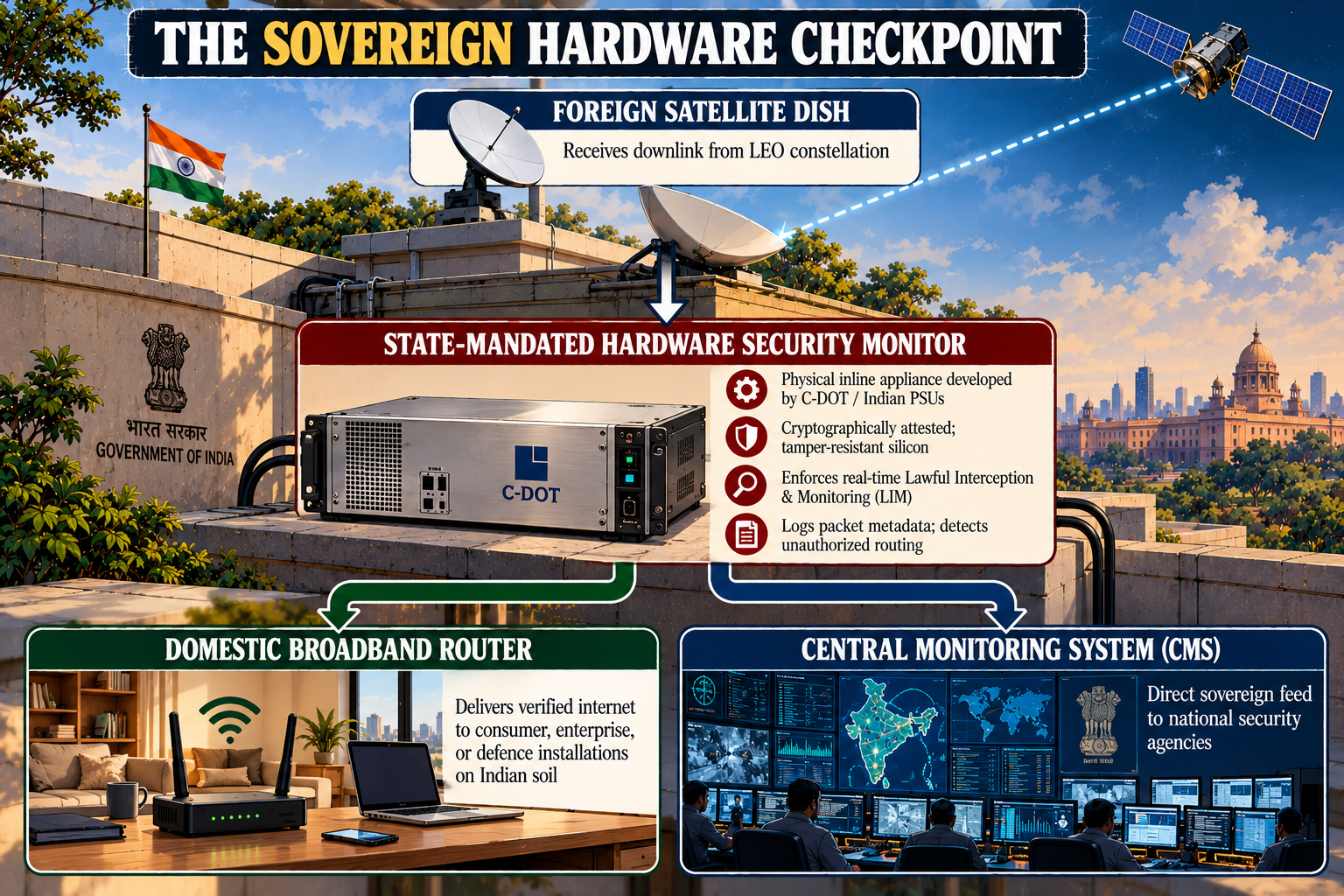
The device is envisioned to function across two deployment tiers:
The Gateway Tier: Deployed at all satellite ground earth stations across India, sitting directly between the satellite antenna downlinks and the domestic internet exchange point (IXP). Every data packet entering the national grid is monitored for metadata integrity and routing compliance.
The Enterprise & Subscriber Tier: For high-security military, government, or infrastructure installations, a hardened, tamper-proof hardware box could sit directly between the user’s satellite modem and internal local area network (LAN), ensuring that cryptographic keys and traffic cannot be surreptitiously redirected.
Under India’s Telecommunications Act, 2023 and statutory Global Mobile Personal Communication by Satellite (GMPCS) licence terms, all telecommunications licensees are legally mandated to facilitate real-time interception for designated intelligence bodies. The hardware monitor ensures that foreign satellite operators are held to the exact same physical standard as domestic fibre and cellular networks.
The Domestic Battleground: Jio, Airtel, and the Parity Demand
The push for a rigid hardware checkpoint is also driven by intense commercial warfare within India’s ₹3 lakh crore ($36 billion) telecommunications industry.
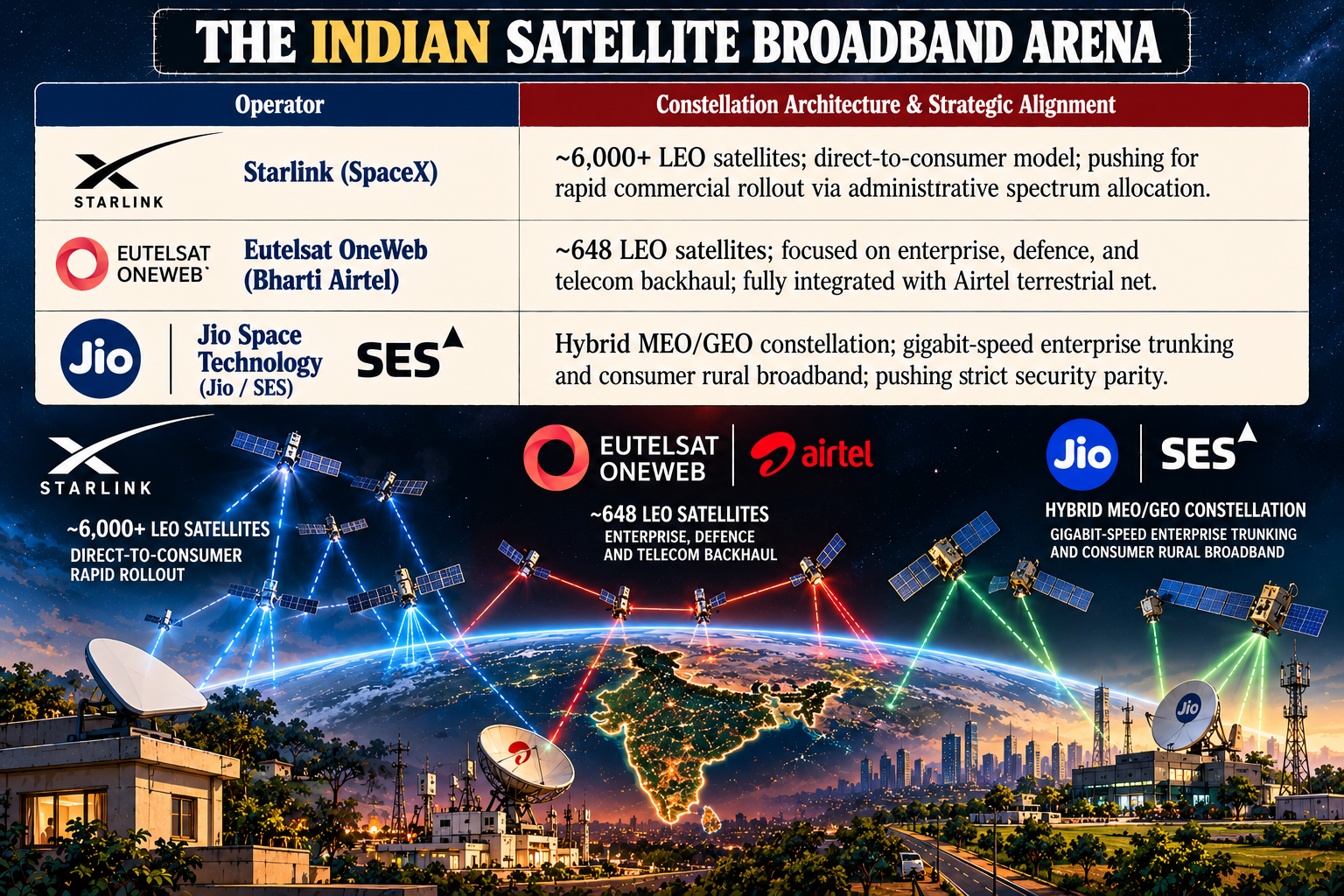
The race to capture India's nascent satellite broadband market is dominated by three main contenders:
Starlink (SpaceX): Elon Musk’s pure-play LEO constellation with over 6,000 satellites in orbit, commanding unmatched launch economies via reusable Falcon 9 rockets.
Eutelsat OneWeb: Backed heavily by billionaire Sunil Bharti Mittal’s Bharti Airtel alongside the British and French governments, possessing a fully deployed constellation of over 600 LEO satellites.
Jio Space Technology: A joint venture between Mukesh Ambani’s Reliance Jio and Luxembourg-based satellite titan SES, leveraging high-throughput medium-Earth orbit (MEO) and geostationary (GEO) assets.
For months, Reliance Jio and Bharti Airtel waged a fierce public campaign over spectrum allocation. While Musk successfully lobbied the Indian government to adhere to global standards by administratively allocating satellite spectrum—rather than auctioning it like terrestrial airwaves—domestic telcos pivoted to regulatory and security parity.
The domestic giants have insisted to the DoT that foreign satellite operators must not be granted an "easy pass." Domestic telcos have spent tens of thousands of crores complying with stringent National Security Directives on the Telecommunication Sector (NSDTS)—which require all networking gear to be vetted by the National Cyber Security Coordinator (NCSC) and sourced exclusively from "Trusted Sources" (effectively blacklisting Chinese equipment).
By insisting on an unyielding hardware security layer, domestic operators are ensuring that Starlink cannot leverage an unregulated, low-cost operating model to undercut established terrestrial networks.
The Friction Ahead: Will SpaceX Accept an Indian "Black Box"?
While New Delhi views the hardware monitor as a non-negotiable prerequisite for sovereign digital security, the mandate creates severe technical and commercial friction for SpaceX.
SpaceX’s competitive advantage relies on an end-to-end, vertically integrated proprietary architecture. Starlink terminals, modems, and software protocols are designed to be closed, seamless, and mass-producible at scale. Inserting a third-party, state-designed hardware device into that pipeline introduces significant engineering complications:
Latency and Throughput Bottlenecks: Hardware-level packet inspection can add latency and reduce processing speeds, eroding the low-latency performance that differentiates LEO constellations from older geostationary satellites.
Proprietary Protocol Resistance: SpaceX uses customized, encrypted communication protocols between its terminals and satellites. For an Indian hardware tap to monitor traffic effectively, SpaceX would have to share deep architectural specifications or provide decryption hooks—something tech corporations are historically reluctant to yield.
Hardware Unit Economics: Starlink already faces pricing challenges in India. With dish hardware costs previously displayed near ₹34,000 and monthly subscriptions estimated around ₹8,600, mandating an additional, specialized Indian security hardware module could further inflate deployment costs, pushing the service beyond the reach of rural consumers.
Conclusion: The Terms of Entry for the New Space Age
The Indian government's deliberations over a hardware security checkpoint mark a decisive moment in global technology governance.
For decades, the expansion of commercial telecommunications was driven by the ethos of frictionless, borderless connectivity. But in an era defined by great-power rivalry, electronic warfare, and sovereign cybersecurity threats, the borders of nation-states are being forcefully reasserted in orbit.
India has made it abundantly clear: it wants satellite broadband. It recognizes that low-Earth orbit connectivity is essential to bridge the digital divide for millions of citizens living in isolated terrains. But New Delhi will not sacrifice its national security or communications sovereignty to achieve it.
If Elon Musk and SpaceX wish to capture the vast, untapped frontier of the Indian market, they will have to accept a fundamental geopolitical reality: in the skies above India, sovereign security takes precedence over technological speed.