When Cyprus's president flew to New Delhi last week to sign a defence roadmap and discuss drone procurement, most coverage treated it as a routine bilateral visit. It isn't. Look at every country India has armed in the past two years, every port India has bought, every corridor India is building — and a pattern emerges that is too deliberate to be a coincidence.
Every single one of them sits on Turkey's doorstep.
This is not diplomacy. It is architecture.
What Triggered It
Turkey sent a warship and military cargo planes to Pakistan after the Pahalgam terror attack. During the India-Pakistan flare-up in May 2025, Pakistan used Turkish-made Axisguard Songar drones to target Indian installations. New Delhi formally called upon Ankara to be mindful of India's sensitivities. Turkey ignored the call.
India's response wasn't a statement. It was a strategy.
The countries India has since moved on — Greece, Cyprus, Israel, Armenia — each share a specific, deep-rooted grievance with Turkey. India has positioned itself as the arms supplier, the port investor, and the strategic partner for all of them simultaneously. Strategists call this extra-regional strategic depth: building leverage against an adversary not by confronting them directly, but by tightening relationships with every country that the adversary considers its neighbourhood.
Turkey chose a side during Operation Sindoor. India is now making sure that choice comes with a cost.
The Pieces on the Board
Armenia is the most pointed move. India has sold Armenia the Swathi weapon-locating radar, Pinaka rocket launchers, Akash surface-to-air missiles, anti-drone systems, and the Advanced Towed Artillery Gun System. It appointed its first-ever defence attaché in Yerevan in 2023. Armenia has become the largest importer of Indian weapons.
Armenia borders Turkey to the west and Azerbaijan — Turkey's closest regional proxy — to the east. If another conflict erupts between Armenia and Azerbaijan, it would likely feature Indian and Turkish military hardware on opposing sides. India has inserted itself into Turkey's most sensitive regional fault line without deploying a single soldier.
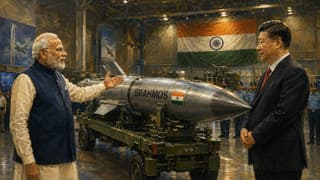
Greece is Turkey's oldest rival, and Indian defence companies have deepened cooperation with Hellenic Aerospace Industry and Hellenic Defence Systems. The Akash air defence system, which performed well against Turkish-origin drones during Operation Sindoor, has sharpened Athens's interest considerably. India is also promoting the BrahMos supersonic cruise missile — the anti-ship variant, capable of Mach 2.8 over 300 kilometres — for deployment across the Eastern Aegean islands and Crete. A BrahMos deployment in the Aegean would directly alter the military balance that Turkey depends on in its disputes with Greece.
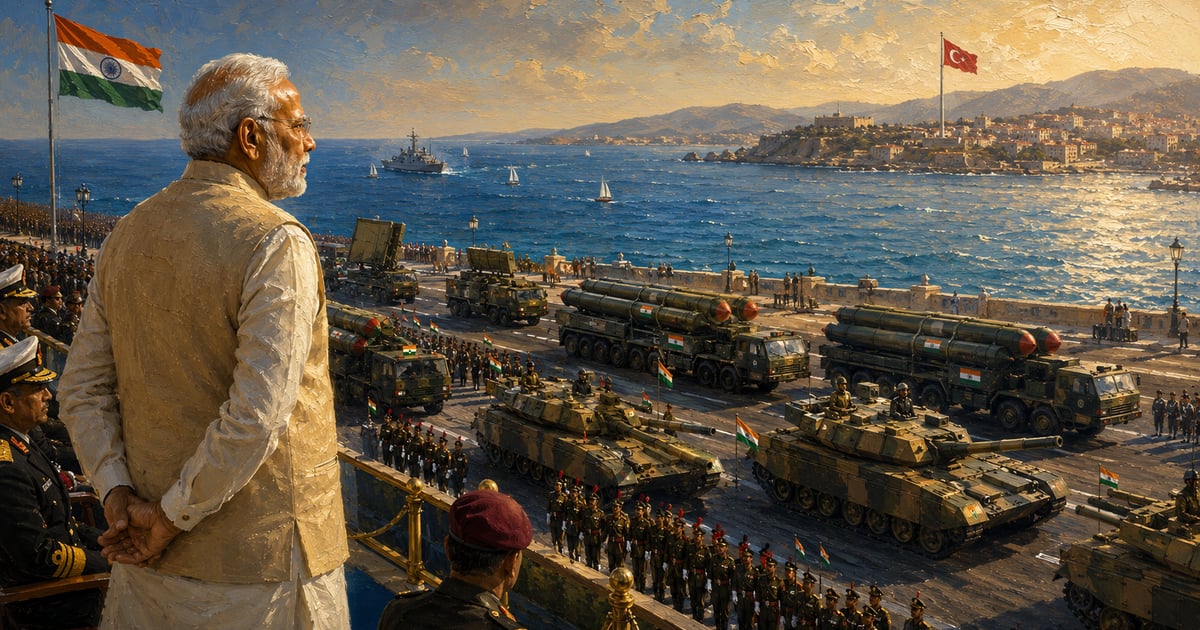
Cyprus is where the symbolism is sharpest. The northern third of Cyprus has been under Turkish military occupation since 1974. Modi's visit to Nicosia in June 2025 — the first by an Indian prime minister in 23 years — produced a Joint Declaration on India-Cyprus Partnership and a five-year action plan. The Indian Navy frigate INS Trikand docked in Limassol for maritime exercises shortly after. Cyprus, sitting on €1.2 billion in EU defence funding, has expressed a strong interest in Indian drones used in Operation Sindoor. A Cypriot official put it plainly: "We know very well India's capabilities. India tested them in a real situation."
Israel closes the loop geographically. Adani's $1.2 billion acquisition of Haifa Port is not simply a commercial investment — it is a strategic anchor for India's presence in the Mediterranean. Turkey's "Blue Homeland" maritime doctrine seeks dominance over the Eastern Mediterranean. India now owns its most strategically significant port.
The Corridor Is the Real Weapon
The military partnerships sit on top of something even more consequential: India is physically acquiring the infrastructure of a trade route that bypasses Turkey entirely.
The corridor taking shape runs from Indian-owned Mundra at the origin, through Haifa in Israel, to Marseille in France (MoU signed February 2026), to Alexandroupoli in Greece (under negotiation, reported $2 billion investment), to Trieste in Italy. This is the India-Middle East-Europe Corridor — IMEC — and it aims to cut transit times between India and Europe by 40 per cent compared to the Suez Canal route.
Every port India acquires along that corridor is simultaneously a commercial asset and a strategic insurance policy. The Red Sea crisis showed what happens when a single chokepoint gets disrupted. India is building redundancy — and collecting leverage — at each node.
Turkey controls the Bosphorus. India is building a route that doesn't need it.
The Hexagon Taking Shape
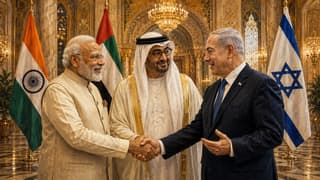
Israeli Prime Minister Netanyahu has floated what he called a "hexagonal alliance" linking countries that share common adversaries — almost certainly referring to Israel, Greece, Cyprus, India, and Armenia. In late 2025, Israel, Greece, and Cyprus signed a joint declaration creating a 2,500-strong rapid-reaction military force.
India's role in this emerging grouping is not formal membership. It is something more useful: the indispensable enabler. The arms supplier, the port investor, the economic anchor. The country that all the others need but that hasn't formally committed to anything that would constrain its flexibility.
This is very deliberate. India is gaining the benefits of an alliance without the obligations of one.
The Counter-Arguments Are Real
This strategy has genuine friction points, and they deserve honest attention.
Technology transfer is a constraint. SkyStriker is jointly developed with Israel — any Cyprus export requires Israeli approval, a veto India cannot control. BrahMos exports to Greece require Russian clearance as a co-production partner, an increasingly uncomfortable dependency. India is selling weapons it doesn't fully own the export rights to.
Port acquisitions face headwinds. The Greek government previously blocked the privatisation of Alexandroupoli on geopolitical grounds. EU scrutiny of foreign port ownership has intensified since China's Piraeus acquisition became a cautionary tale. India is seen as a safer partner than China or Russia — but "safer" is not the same as "approved."
There is also the question of overextension. India is simultaneously managing the China border, the Pakistan relationship, a careful balancing act with Russia, and now a Mediterranean theatre. Committing to all of Turkey's adversaries simultaneously risks turning a manageable irritant into a durable enmity without the bandwidth to handle the consequences.
And Turkey holds cards. Bilateral India-Turkey trade runs at $8–10 billion annually. Turkey controls the Bosphorus. As a NATO member hosting Patriot batteries and AWACS deployments, Ankara cannot simply be isolated — not without consequences for the Western alliance architecture that India also wants access to.
Why This Is Different
India has done versions of this before. In the 1970s, it built strategic depth against Pakistan through the Bangladesh liberation and the Indo-Soviet Treaty. In the 1990s, the Look East policy countered Chinese encirclement in Southeast Asia. But the theatre this time is the Mediterranean — a region India has never operated in — and the instruments are commercial port ownership combined with arms exports, not formal alliances or troop deployments.
The closest parallel is China's String of Pearls strategy in the Indian Ocean: acquiring port stakes in Sri Lanka, Pakistan, Bangladesh, and Myanmar to encircle India commercially and, eventually, militarily. India is now running the same playbook in reverse, in Turkey's backyard, with European legitimacy as the wrapper.
India's defence exports have grown 34-fold in a decade to ₹23,622 crore in FY2024-25, with a target of ₹50,000 crore annually by 2029. Greece, Cyprus, and Armenia together are the gateway to a European defence market that spends over $350 billion a year — a market that Operation Sindoor just made India credible in.
For seven decades, India practised strategic autonomy by staying out of other regions' conflicts. What is unfolding now is something categorically different. India is entering another region's conflicts — not with troops, but with weapons, ports, corridors, and sequenced strategic partnerships. The restraint doctrine is giving way to a presence doctrine.
Turkey made a choice during Operation Sindoor. India is quietly, commercially, and with considerable patience, making sure that choice has consequences — not in a press release, but on a map.