In brief
- Global fund managers market India's stock market as a hedge against AI because US indices are concentrated in semiconductor and hyperscaler stocks, but the label signals India's exclusion from AI leadership.
- The Nifty 50 relies on domestic consumption from banks, construction, telecom and consumer goods, with earnings growing 12-15% in a 7% economy, yet India lacks semiconductor fabs, foundation models and hyperscalers.
- India's $250 billion IT services sector, 13% of Nifty 50, faces 3-3.5% annual revenue deflation as AI compresses labour arbitrage, threatening 5.4 million jobs that drive urban banking, real estate and discretionary spending.
- Short-term, India offers defensive utility with strong balance sheets and steady earnings, but long-term the hedge label confirms India captures no AI productivity gains, risking confusion of safety with progress.
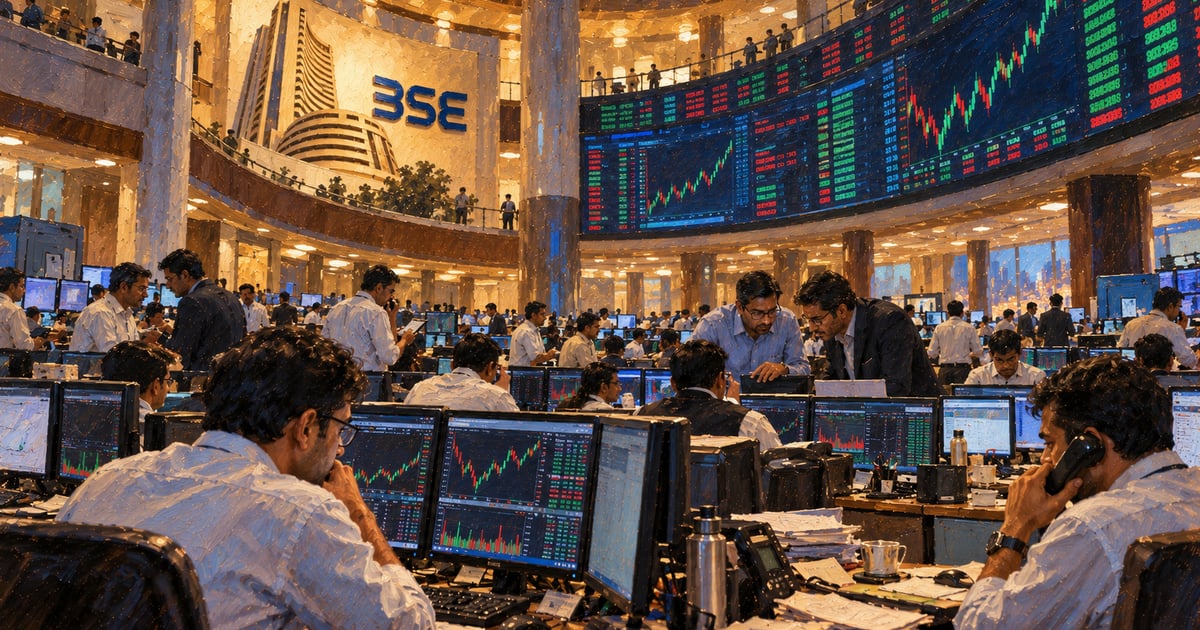
When global fund managers began marketing the Indian stock market as the world’s most attractive "hedge against AI", institutional desks in Mumbai and London received the pitch with quiet self-satisfaction.
With US indices distorted by unprecedented concentration in mega-cap semiconductor and hyperscaler stocks, global asset allocators at Aberdeen Group, Principal Asset Management, Eastspring Investments, and Jefferies turned to Dalal Street. Their rationale was simple: if the hundreds of billions of dollars poured into graphics processing units (GPUs) and foundation models fail to produce commensurate enterprise returns, global equities will face severe multiple contraction. India, having virtually no exposure to the AI trade, offers a buoyant, uncorrelated shelter.
The pitch is mathematically coherent, but it asks to be translated. In the polite vernacular of asset management, calling a $4 trillion national equity market a "hedge against technology" is a classic backhanded compliment. It celebrates the sturdy cash flows of India’s domestic consumption while delivering a devastating structural verdict: India is not an architect of the defining technological shift of the twenty-first century.
Worse, the premise of the hedge is economically flawed. By confusing the absence of listed AI hardware with immunity from AI disruption, global allocators overlook the transmission mechanism connecting software automation directly to India’s domestic consumption flywheel.
The Mechanics of the "AI Hedge" Pitch
To understand why global asset managers began viewing the National Stock Exchange (NSE) as an antidote to Silicon Valley vertigo, one need only look at the constituent sheets of the world’s leading indices.
By early 2026, the ten largest technology companies in the S&P 500 accounted for more than a third of the entire index's market capitalisation. The MSCI World Index had transformed into an asymmetric bet on generative AI infrastructure. If enterprise software budgets froze, or if hyperscaler capital expenditures triggered an ROI hangover, standard global portfolios had nowhere to hide.
India’s benchmark Nifty 50 tells the opposite story:
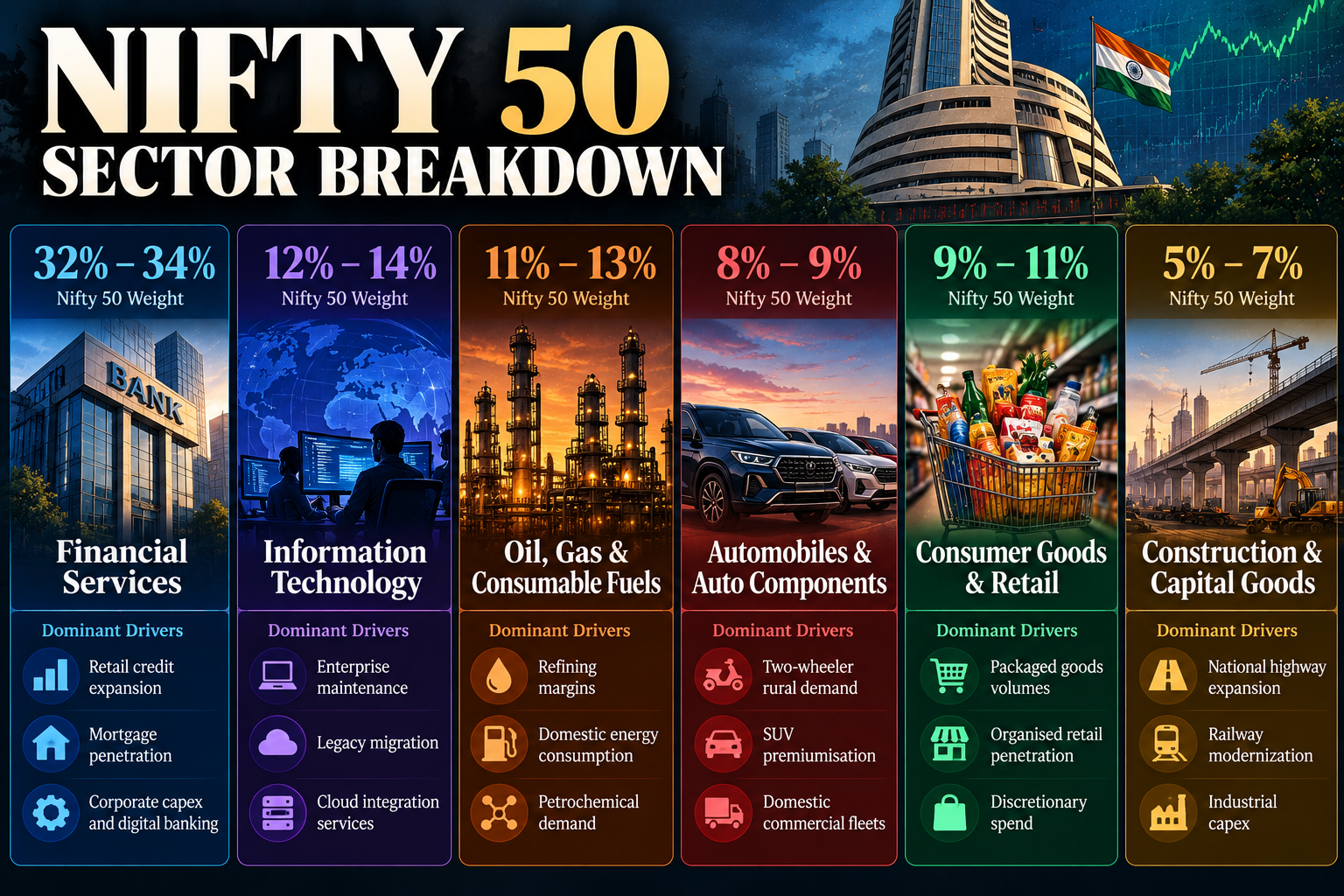
The Nifty 50 is an index of real-world plumbing. When an investor buys Dalal Street, they are buying HDFC Bank and ICICI Bank financing home purchases, Larsen & Toubro constructing ports and metro lines, Bharti Airtel collecting mobile tariffs, Mahindra & Mahindra selling tractors, and ITC selling packaged food.
These earnings do not rely on transformer architectures, GPU clusters, or venture-funded inference subsidies. During periods when institutional investors fear an AI bubble, India’s domestic earnings growth—running at 12% to 15% in an economy expanding above 7%—functions as an asset-allocation shock absorber. In that narrow, portfolio-construction sense, the praise is genuine: India has built a domestic macro engine that does not need permission from Silicon Valley to generate corporate profits.
The Indictment: Institutional Doublespeak for Being Left Behind
The compliment turns sour the moment one steps outside the trading desk. In global capital markets, calling an economy a "hedge" against an innovation is institutional shorthand for declaring it irrelevant to that innovation.
Consider the composition of Asian equity peers. Taiwan is not an AI hedge; through TSMC, it manufactures the physical bedrock of global computation. South Korea is not an AI hedge; SK Hynix and Samsung Electronics dominate high-bandwidth memory (HBM), capturing direct gross margin from every server rack deployed in North America. Even China, despite sweeping US export restrictions, boasts listed foundation-model developers, domestic chip design champions such as Cambricon, and hyperscalers like Alibaba and Tencent developing proprietary silicon and large language models.
India possesses no equivalent on its public exchanges:
No Frontier Hardware: India has no semiconductor fabrication plants producing sub-7-nanometre silicon, no advanced packaging facilities for AI accelerators, and no public equipment manufacturers.
No Hyperscale Foundation Models: There is no Indian equivalent of OpenAI, Anthropic, or Google DeepMind trading on the domestic bourses or funded at sovereign scale.
The Capex Chasm: In March 2024, the Union Cabinet approved the IndiaAI Mission with an outlay of ₹10,372 crore (about $1.25 billion over five years), aiming to subsidise 10,000 GPUs for domestic research. While strategically necessary, that figure is dwarfed by private industry abroad: a single US hyperscaler spends that much on AI infrastructure every two to three weeks.
When Amazon and Microsoft announced a combined $52 billion (approximately ₹4.3 lakh crore) investment pipeline in India, the capital was earmarked primarily for building physical hyperscale data centres—the digital equivalent of laying railway tracks for foreign trains. India supplies the land, cooling water, and renewable electricity, but the high-margin cognitive intellectual property remains firmly anchored offshore.
To celebrate India’s stock market as a hedge against this reality is akin to praising a village for avoiding a transport strike because its residents still travel on foot. It is safe, but it is not a sign of industrial leadership.
The $250-Billion Paradox: IT Services and AI Deflation
The praise is further undermined by the one technology sector India does have in its indices: IT services.
Representing roughly 13% of the Nifty 50, firms such as Tata Consultancy Services (TCS), Infosys, HCLTech, and Wipro built a $250 billion export engine on labour arbitrage and linear headcount growth. For three decades, the business model was straightforward: charge global corporations an hourly rate for software engineering, testing, maintenance, and enterprise resource integration, and deliver the work using Indian engineering talent.
Generative and agentic AI do not augment this model; they compress it. Software development, synthetic code testing, and legacy application maintenance are the exact tasks that modern coding agents execute at a fraction of the cost.
Industry research indicates that enterprise clients are actively demanding productivity givebacks during contract renewals. Rather than billing 100 engineers on a multi-year time-and-materials contract, clients now require projects to be delivered with 30 engineers equipped with automated workflows, demanding that the 30% to 50% productivity gain be passed on as lower pricing.
Analysts estimate this shift introduces an annual revenue deflation of 3% to 3.5% across traditional Indian IT services portfolios. While IT majors are hastily retraining staff and embedding AI into internal platforms, the transition threatens their fundamental revenue equation. They are trading high-volume, billable human hours for software licences and platform fees where they own little underlying IP.
An index carrying a 13% weight in companies vulnerable to labour-deflation headwinds is not an unalloyed hedge against AI; it is an unhedged casualty of AI efficiency.
The Domestic Spillover Fallacy: Can Dalal Street Truly Decouple?
The central flaw in the "India as an AI hedge" narrative is the assumption that India’s domestic banking, automotive, and consumer sectors operate in a vacuum sealed off from technological disruption.
India’s modern urban middle class was largely financed by the technology services boom. The IT and business process management (BPM) sectors directly employ over 54 lakh professionals (5.4 million people), predominantly in urban centres such as Bengaluru, Hyderabad, Pune, Chennai, and the National Capital Region.
These 54 lakh workers do not merely write code; they drive the high-margin discretionary economy:
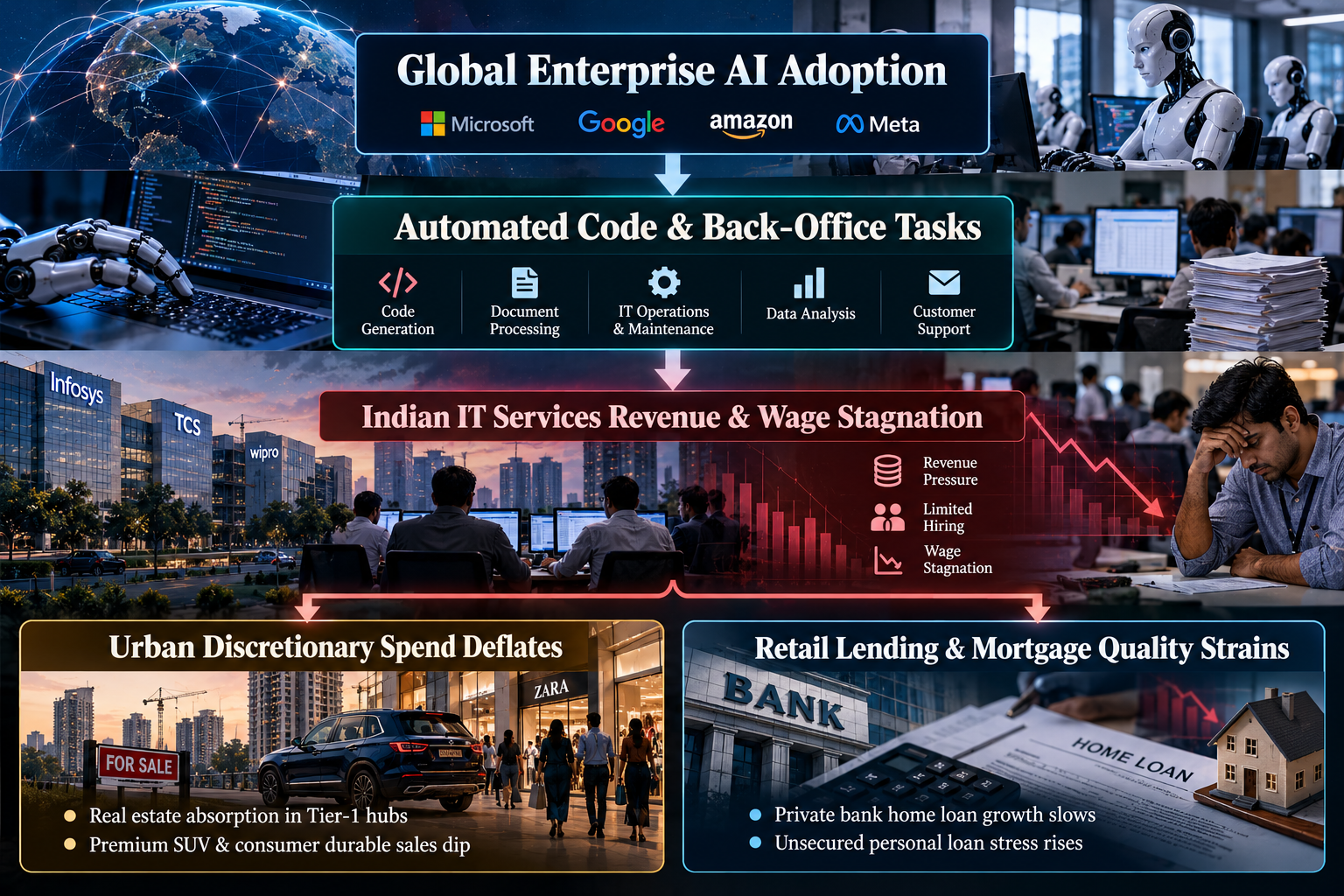
If IT sector hiring slows from net annual additions of hundreds of thousands to single-digit replacement numbers, and entry-level wages remain stagnant, the ripple effects will travel directly into the books of private banks and retail conglomerates:
Mortgage and Unsecured Credit: Private banks that derive significant growth from home loans and credit cards extended to tech employees will experience softening asset growth and rising credit costs.
Urban Real Estate: Residential and commercial real estate absorption in Bengaluru and Hyderabad relies on technology sector payrolls.
Consumer Discretionary: Sales of premium passenger vehicles, consumer durables, and organised retail thrive on white-collar disposable income.
When global fund managers buy Indian banks and auto stocks to escape AI volatility in the US, they are merely buying the second-order derivatives of that same technological shockwave.
Cyclical Shelter vs Secular Trap
In financial history, asset classes often play conflicting roles across different time horizons. During the late-1990s dot-com bubble, defensive old-economy equities—packaged goods, utilities, and tobacco—were lauded as safe havens against overvalued internet infrastructure. When the bubble burst in 2000, those stocks preserved capital. But across the subsequent two decades, the real wealth belonged to those who built, scaled, and owned the internet platform economy.
India’s current positioning on Dalal Street is caught in the same tension:
In the short to medium term (Cyclical Praise): The market offers genuine defensive utility. Indian companies possess sound corporate balance sheets, low debt, strong return on equity (ROE), and steady domestic earnings. For an asset allocator looking to survive a potential drawdown in semiconductor stocks, Dalal Street is an effective capital-preservation tool.
In the long term (Structural Indictment): Being a hedge against the dominant technology of an era means being excluded from its productivity gains. If AI redefines enterprise productivity, industrial automation, and scientific discovery, value will accrue to the owners of compute, foundation models, and specialised IP—not to downstream services companies or retail banks.
Verdict: The Cost of the Compliment
The claim that the Indian stock market is a hedge against AI should be treated with scepticism by Indian policymakers and investors alike.
It is genuine praise for India’s macroeconomic sovereignty: the country has constructed a domestic financial system resilient enough to attract global capital on its own terms, without relying on foreign commodity cycles or Silicon Valley sentiment.
Yet beneath the flattering language of portfolio diversification lies a clear warning. Global capital views India as an AI hedge for the exact reason it cannot view it as an AI leader: the public markets do not contain the intellectual property of the future.
Accepting that title too complacently risks confusing safety with progress. Being the world's most resilient non-participant in a technological revolution is a respectable way to manage portfolio risk, but it is no way to build national wealth.