
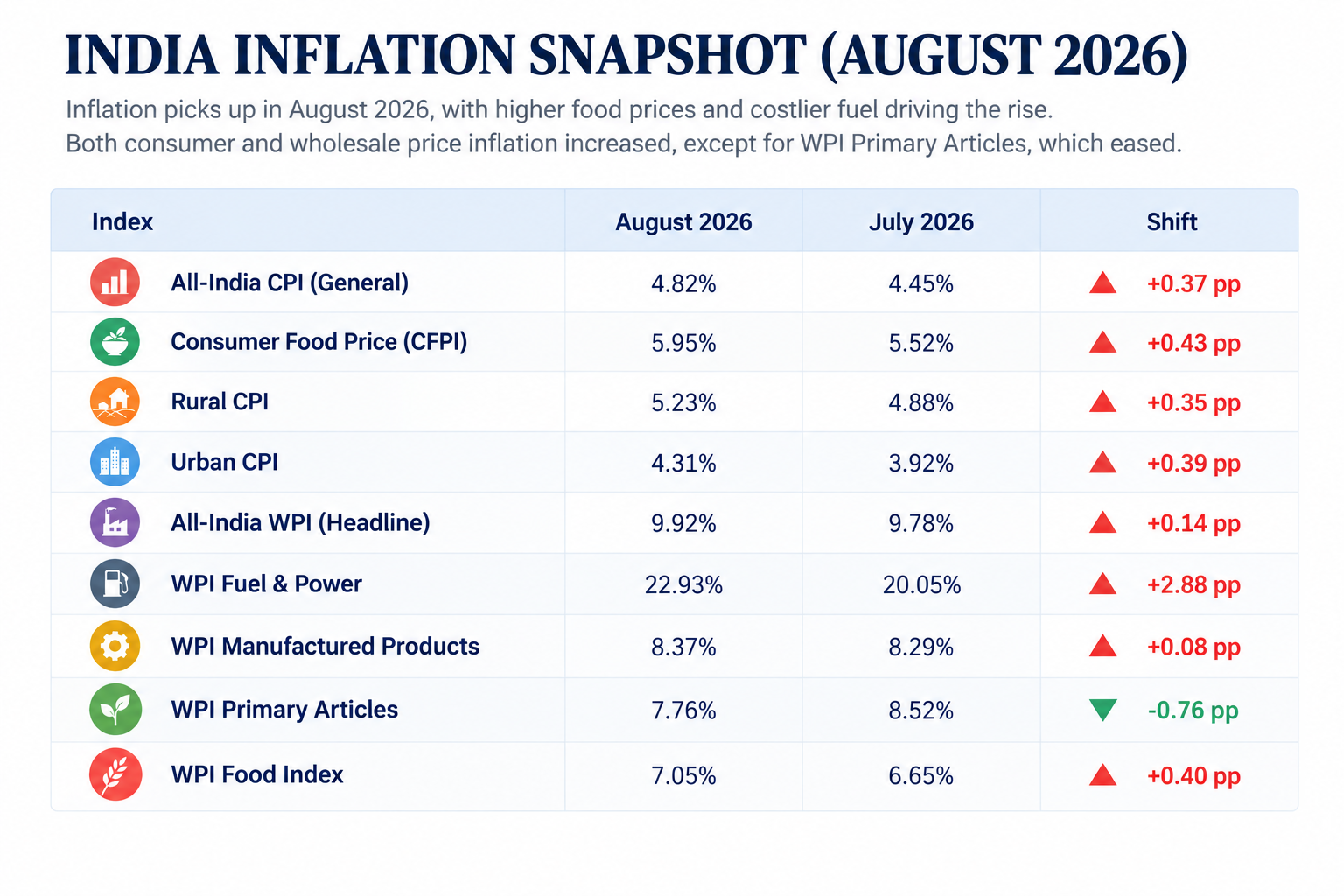
India's macroeconomic landscape in mid-September 2026 presents a striking divergence. On 14 September 2026, the Ministry of Statistics and Programme Implementation (MoSPI) and the Ministry of Commerce and Industry released their respective price indices for August 2026. The prints establish that retail consumer price inflation (CPI) has hardened to 4.82%, while wholesale price inflation (WPI) has climbed to 9.92%—a multi-month high that places wholesale price increases near double digits.
This 5.10 percentage point gap between what producers pay and what consumers experience reveals acute pipeline cost pressures. While the headline retail print remains within the Reserve Bank of India’s (RBI) statutory 2.0% to 6.0% tolerance band, it sits uncomfortably above the central bank’s 4.0% median target. With wholesale energy and basic materials climbing rapidly, the Indian economy faces an intricate balance between preserving corporate profit margins, shielding household purchasing power, and sustaining real gross domestic product (GDP) expansion projected at 6.4% to 6.5% for FY27 (2026–27).
The August 2026 Inflation Prints: What the Data Shows
Both primary indices experienced acceleration during August 2026, though their underlying composition and magnitudes differ substantially.
1. Consumer Price Index (CPI): Sticky Food and Rural Friction
According to the official MoSPI Consumer Price Index Press Release for August 2026, headline retail inflation rose by 37 basis points to 4.82% YoY, with the general index reaching 108.74.
The primary catalyst was food prices. The Consumer Food Price Index (CFPI) reached 5.95% YoY in August, up from 5.52% in July. The headline food figure, however, masks deep volatility among specific kitchen staples:
The Onion Surge: Onion inflation surged to 48.27% YoY in August, more than doubling from 22.54% recorded in July, reflecting seasonal supply gaps and distribution bottlenecks.
The Tomato Plunge: In contrast, tomato prices witnessed deepening deflation, collapsing from -4.60% YoY in July to -31.09% YoY in August as fresh market arrivals flooded mandis.
A critical structural dynamic is the persistent rural-urban wedge. Rural retail inflation stood at 5.23% in August, compared to 4.31% in urban centres—a divergence of 0.92 percentage points. Because food accounts for a substantially larger weight in rural household budgets, rural consumers continue to bear a disproportionate burden of erratic vegetable, pulse, and edible oil price movements.
State-level dispersion was similarly pronounced. The highest headline inflation rates were recorded in Telangana (6.27%), Tamil Nadu (5.92%), and Madhya Pradesh (5.55%), whereas several northern and eastern states registered prints below the national average.
2. Wholesale Price Index (WPI): Fuel and Industrial Pressures
As detailed in the Ministry of Commerce and Industry WPI Press Release for August 2026, wholesale inflation climbed to 9.92% YoY in August 2026, up from 9.78% in July, pushing the All Commodities index to 110.8.
The dominant driver of wholesale price momentum was the Fuel and Power group, which expanded by 22.93% YoY (up from 20.05% in July). Upstream increases in global crude petroleum and domestic mineral oils drove transportation and energy costs across industrial supply chains.
Concurrently:
Manufactured Products (the largest weight in the WPI basket at 64.23%) rose 8.37% YoY, led by the manufacture of basic metals, fabricated metal products, and chemicals.
Primary Articles moderated slightly to 7.76% YoY from 8.52% in July, as non-food crop prices stabilised.
WPI Food Index rose to 7.05% YoY from 6.65% in July, reflecting higher prices for manufactured food products such as processed oils and grain mill items.
Decoding the 5-Percentage-Point CPI–WPI Gap
Why is wholesale inflation running at more than double the rate of consumer inflation? The explanation lies in structural basket differences and pricing transmission mechanisms.
Basket Weighting Asymmetries: The CPI basket places roughly 45% of its weight on food and beverages, with services (housing, health, education, transport) forming the bulk of the remainder. WPI, conversely, contains zero services weighting; it is dominated by manufactured goods (64.23%), fuel and power (13.15%), and primary articles (22.62%). When global crude, basic metals, and bulk commodities rally, WPI surges immediately.
Fuel Price Buffers: Retail prices of auto fuels (petrol and diesel) in India are partially insulated by state-owned oil marketing companies and government excise adjustments. In contrast, WPI reflects raw import parity pricing of crude and mineral oils, absorbing the full brunt of international energy price swings.
Transmission Lag and Margin Compression: Upstream wholesale price hikes do not transfer to retail shelves instantly. When consumer demand is price-sensitive—as is currently true across semi-urban and rural retail markets—manufacturers and retailers often absorb input cost increases by accepting compressed operating margins rather than risking volume declines.
If WPI sustains near double-digit levels through the autumn, corporate profit margins will face severe compression unless firms begin passing these costs downstream, which would place upward pressure on retail core inflation in late 2026.
Monetary Policy: Why the RBI’s MPC Remains Cautious
At its August 2026 bi-monthly meeting, the RBI’s Monetary Policy Committee voted unanimously to maintain the benchmark policy repo rate at 5.25%, as recorded in the Reserve Bank of India MPC Press Release.
The MPC's policy calculus is governed by three primary considerations:
The 4.0% Anchor: While 4.82% is comfortably below the statutory upper tolerance threshold of 6.0%, central bank communications have repeatedly underlined that the policy anchor is 4.0%, not 6.0%. Loosening policy while headline CPI is trending upward toward 5.0% risks de-anchoring inflationary expectations.
Pipeline Cost Hazards: With wholesale prices climbing at 9.92%, the MPC cannot dismiss the risk that core CPI (excluding volatile food and fuel components) could rebound if manufacturers exhaust their capacity to absorb input costs.
External Real Rate Differentials: With global central banks navigating their own gradual easing cycles, maintaining the policy rate at 5.25% preserves a modest real interest rate buffer (approximately 43 basis points against current CPI), preventing destabilising capital outflows and anchoring the Indian rupee.
Unless food price spikes subside sharply following winter harvest arrivals, the MPC is expected to hold rates steady through the final quarter of calendar year 2026.
What Lies Ahead for the Indian Economy?
Despite price frictions, India continues to be the fastest-growing major economy. However, sustaining this momentum requires managing several domestic and external factors.
1. Growth Trajectory and Real GDP Projections
Multilateral institutions maintain a positive outlook for the Indian economy. According to reporting on the IMF Growth Projections for FY27 via The Economic Times, India’s GDP is forecast to expand by 6.4% to 6.5% in FY27.
Growth is underpinned by:
Sustained public infrastructure investment, with central government capital expenditure exceeding ₹11 lakh crore (approximately $132 billion).
Steady urban discretionary spending in aviation, hospitality, and consumer durables.
Continued expansion in high-value services exports, particularly Global Capability Centres (GCCs) and IT consulting.
However, the World Bank India Development Update highlights that broadening growth beyond urban infrastructure and services will require an unambiguous recovery in private corporate capital expenditure and rural mass consumption.
2. The Consumption Dichotomy: Rural Lag versus Urban Resilience
The divergence between rural inflation (5.23%) and urban inflation (4.31%) mirrors broader consumption patterns:
Urban Demand: Premiumisation remains evident. Automobile manufacturers report robust order books for mid-to-high-end sport utility vehicles, while premium housing across Tier-1 metros continues to see strong absorption.
Rural Demand: Real wage growth in rural areas has remained subdued relative to food price pressures. Because rural consumers spend a higher percentage of their disposable income on nutrition and daily essentials, sticky inflation directly curtails expenditure on entry-level fast-moving consumer goods (FMCG) and two-wheelers.
The performance of the Kharif harvest arrivals in October and November 2026 will serve as the bellwether for whether rural purchasing power can rebound ahead of the festival season.
3. External Sector and Fiscal Consolidation
India’s external fundamentals remain comparatively secure:
Current Account Deficit (CAD): Projected at a manageable 1.5% to 2.0% of GDP for FY27, buffered by strong software receipts and inbound remittances averaging over ₹8.5 lakh crore (around $102 billion) annually.
Foreign Exchange Reserves: Ample reserve buffers provide the RBI with sufficient liquidity to smooth excessive foreign exchange volatility without resorting to aggressive rate interventions.
Fiscal Consolidation: The Union Government remains committed to narrowing the fiscal deficit toward 4.5% of GDP in FY27, restricting the scope for inflationary deficit financing while keeping the borrowing programme orderly.
Conclusion
India’s August 2026 inflation numbers underline that the battle against price instability is not complete. While headline retail inflation at 4.82% demonstrates commendable resilience relative to global peers, the resurgence of wholesale inflation to 9.92% serves as an early warning of latent supply-side frictions. With the RBI maintaining a steady hand at 5.25% and economic growth poised around 6.5%, India remains structurally robust—provided agricultural supply chains normalise and input cost surges do not derail the broader consumption recovery.