
The death of a 28-year-old laboratory technician in eastern Siberia has triggered an acute intersection of institutional panic, public anxiety, and geopolitical surveillance. On 1 October 2026, Darya Shipilova succumbed to acute pulmonary distress at the district hospital in Shelekhov, a satellite town of Irkutsk. She was not an ordinary hospital patient; she was an employee of the Irkutsk Anti-Plague Research Institute of Siberia and the Far East, a premier federal facility tasked with studying some of the planet’s most lethal infectious agents.
Within forty-eight hours of her death, approximately 197 individuals were placed under medical isolation, hospitals across Irkutsk abruptly shut their doors to visitors under three-week quarantine orders, and mask mandates returned to local industrial plants. In the West, news of a lab-linked fatality from "pneumonia of unknown aetiology" prompted immediate invocations of late 2019: whispers of a containment breach, an official cover-up, and the terrifying prospect of a "COVID-19 redux".
Yet an examination of the microbiological facts, biosafety protocols, and international treaty obligations demonstrates that while the Irkutsk incident reveals systemic vulnerabilities in laboratory transparency, it does not represent the dawn of a novel, uncontrollable global pandemic.
Anatomy of an Incident: Official Denials versus Whistleblower Reports
The timeline of the Irkutsk incident illustrates a stark divergence between municipal reality and state messaging.
According to regional reporting collated by the independent Russian outlet Lyudi Baikala and corroborated by Meduza, Shipilova was hospitalised on 29 September after developing fulminant respiratory symptoms. Her condition deteriorated precipitously, requiring mechanical ventilation before she died two days later.
Medical staff reported that Shipilova made an explicit deathbed disclosure: on 25 September, while working inside the institute, she had accidentally dropped and broken a glass test tube containing live cultures of Yersinia pestis, the causative bacterium of plague.
Federal authorities moved swiftly to control the narrative. Russia’s consumer rights and public health watchdog, Rospotrebnadzor, released a terse statement acknowledging the death of an institute worker, but diagnosed the cause solely as "pneumonia of unknown aetiology". The agency asserted that expanded biological screening found no microorganisms associated with her occupational duties and insisted that no workplace accidents involving pathogenic cultures had occurred.
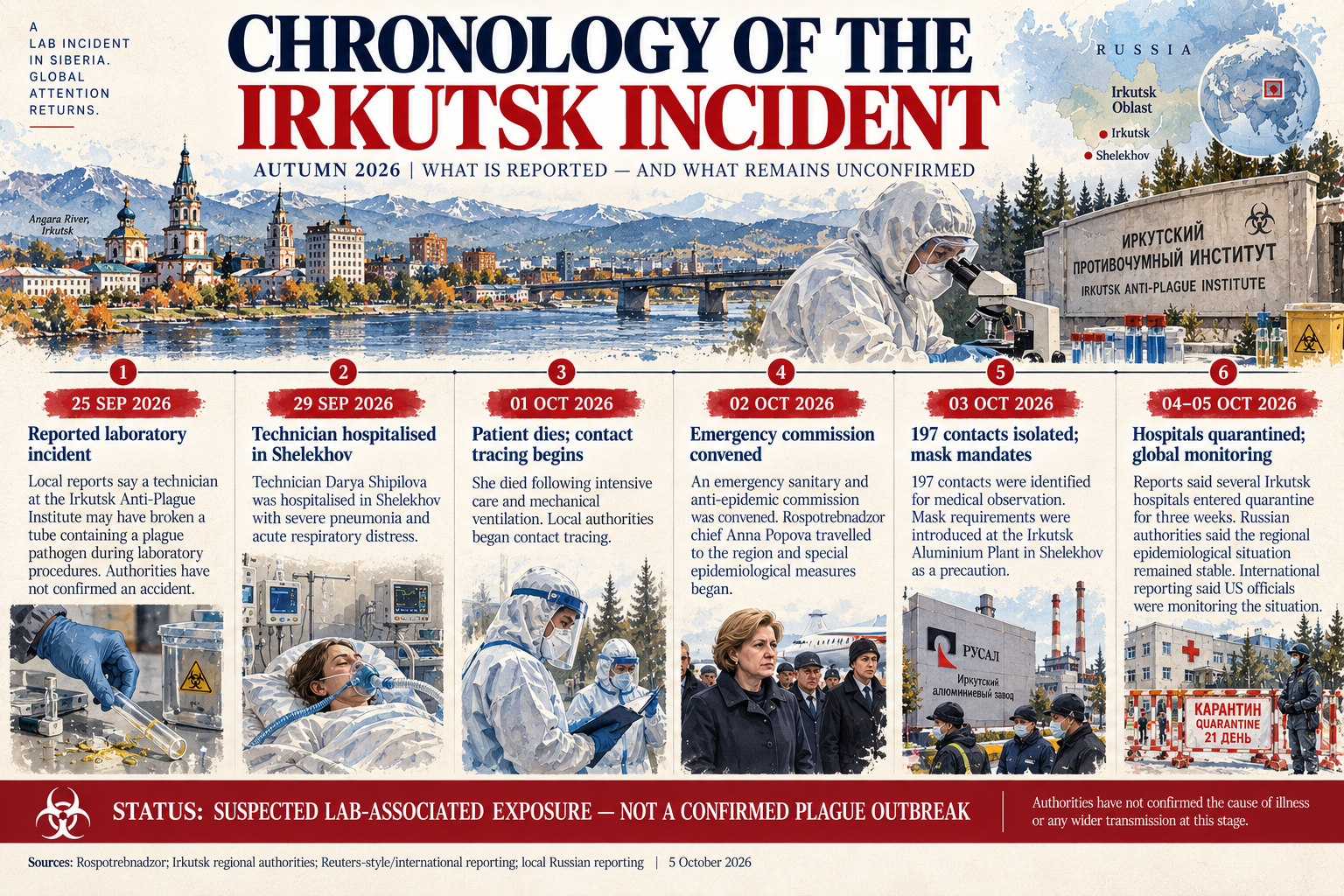
The administrative response on the ground belied this placid assessment. Anna Popova, head of Rospotrebnadzor and Russia's Chief Sanitary Doctor, took the extraordinary step of flying directly from Moscow to Irkutsk to convene an emergency anti-epidemic commission. Local administrations, such as that of nearby Baikalsk, issued travel warnings urging citizens to avoid Shelekhov before abruptly deleting them. State television channels scrubbed preliminary segments regarding plague containment, while regional politicians offered contradictory accounts; Alexey Tsydenov, governor of neighbouring Buryatia, initially posted to Telegram that a woman had "died of plague" before editing his message to state she "may have died" of the disease.
The Superficial Parallel: Why "COVID-19 Redux" Dominates Headlines
The public resonance between Irkutsk in October 2026 and Wuhan in December 2019 is driven by three powerful narrative parallels:
Identical Clinical Taxonomy: The phrase "pneumonia of unknown aetiology" was the precise administrative formulation employed by the Wuhan Municipal Health Commission in late 2019 when early clusters of atypical interstitial pneumonia overwhelmed local wards. To a global public sensitized by years of pandemic trauma, the reuse of this clinical label by a secretive state apparatus sounds an immediate alarm.
Proximity to High-Containment Biorisk: The Irkutsk Anti-Plague Institute is one of a historic network of Soviet-era facilities originally established to counter endemic plague foci across the Eurasian steppe and eastern borders. Like the Wuhan Institute of Virology, it houses repositories of high-consequence pathogens. The specter of an occupational laboratory-acquired infection (LAI) escaping physical containment strikes the exact nerve of the ongoing global lab-leak controversy.
Censorship and Coercive Containment: The deployment of security services to trace contacts, the deletion of municipal bulletins, and the insistence that "all is stable" while simultaneously locking down four municipal hospitals and a maternity ward closely replicate the early information-suppression playbooks observed in past biological crises.
The Biological Reality: Why Yersinia Pestis Is Not SARS-CoV-2
While the institutional optics mirror 2019, the underlying microbiology could not be more divergent. Evaluating the claim of a "COVID-19 in the making" requires comparing the physical properties of the pathogens in question.
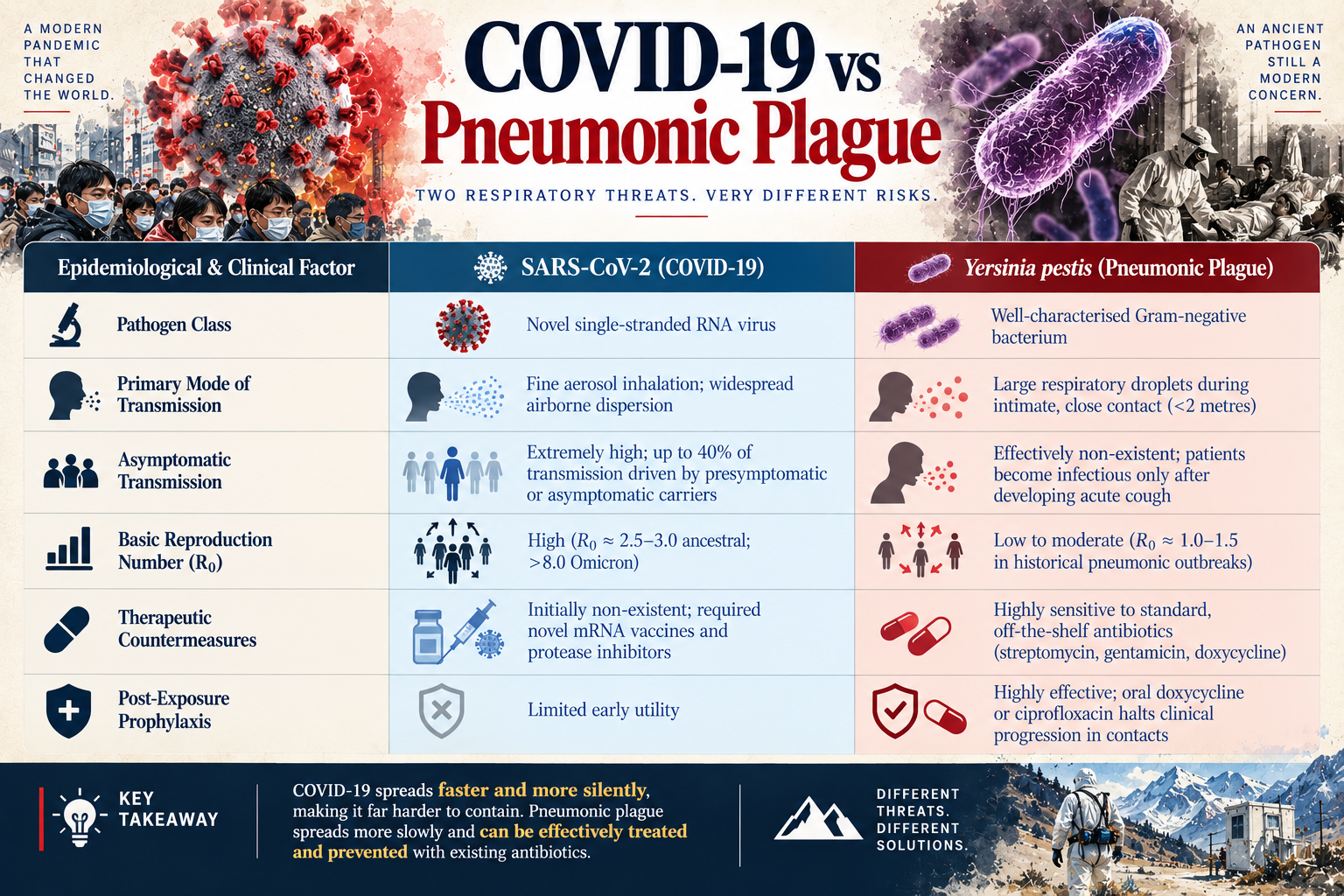
Pneumonic plague is undeniably one of the most lethal bacterial infections known to medicine. If untreated, the case fatality rate approaches 100%, typically causing death from respiratory failure and endotoxic shock within two to four days.
However, its lethality is precisely what limits its pandemic potential. Unlike SARS-CoV-2, which spreads silently through individuals with mild or no symptoms, Yersinia pestis in its pneumonic form incapacitates its host rapidly. Transmission requires the forceful expulsion of heavy sputum droplets, which only occurs once a patient is severely, visibly ill. Because individuals in this state are rapidly bedridden or hospitalised, chains of transmission tend to be short, focal, and self-terminating, provided basic isolation and contact tracing are enforced.
Furthermore, medicine is not defenceless against plague. Bacterial pathogens do not require years of antigen discovery; a regimen of cheap, widely stockpiled aminoglycosides or tetracyclines cures the infection if administered within twenty-four hours of symptom onset, while secondary cases can be entirely prevented via post-exposure prophylaxis.
The Real Risk: Laboratory-Acquired Infections and the IHR Framework
If the primary danger is not a runaway pandemic, what is the legitimate public concern? The answer lies in the persistent threat of Laboratory-Acquired Infections (LAIs) and the fraying of international public health notification treaties.
Accidental laboratory infections have occurred repeatedly throughout modern history:
1978 Birmingham Smallpox Incident: An accidental exposure at a university laboratory killed medical photographer Janet Parker and highlighted deficiencies in institutional containment.
2003–2004 Post-SARS Outbreaks: Following the containment of the original SARS epidemic, secondary outbreaks occurred in laboratories in Singapore, Taiwan, and Beijing due to procedural failures and improper biosafety cabinet maintenance.
2019 Lanzhou Brucellosis Leak: A biopharmaceutical plant in China vented inadequately sterilised waste aerosols, infecting thousands of local residents with brucellosis.
The Irkutsk Anti-Plague Institute operates as a specialised diagnostic and research node. If a technician was able to drop a vial of viable, aerosol-generating pathogen without immediate secondary containment, internal decontamination, and prophylactic quarantine, it points to a serious breach of biosafety level 3 (BSL-3) protocols.
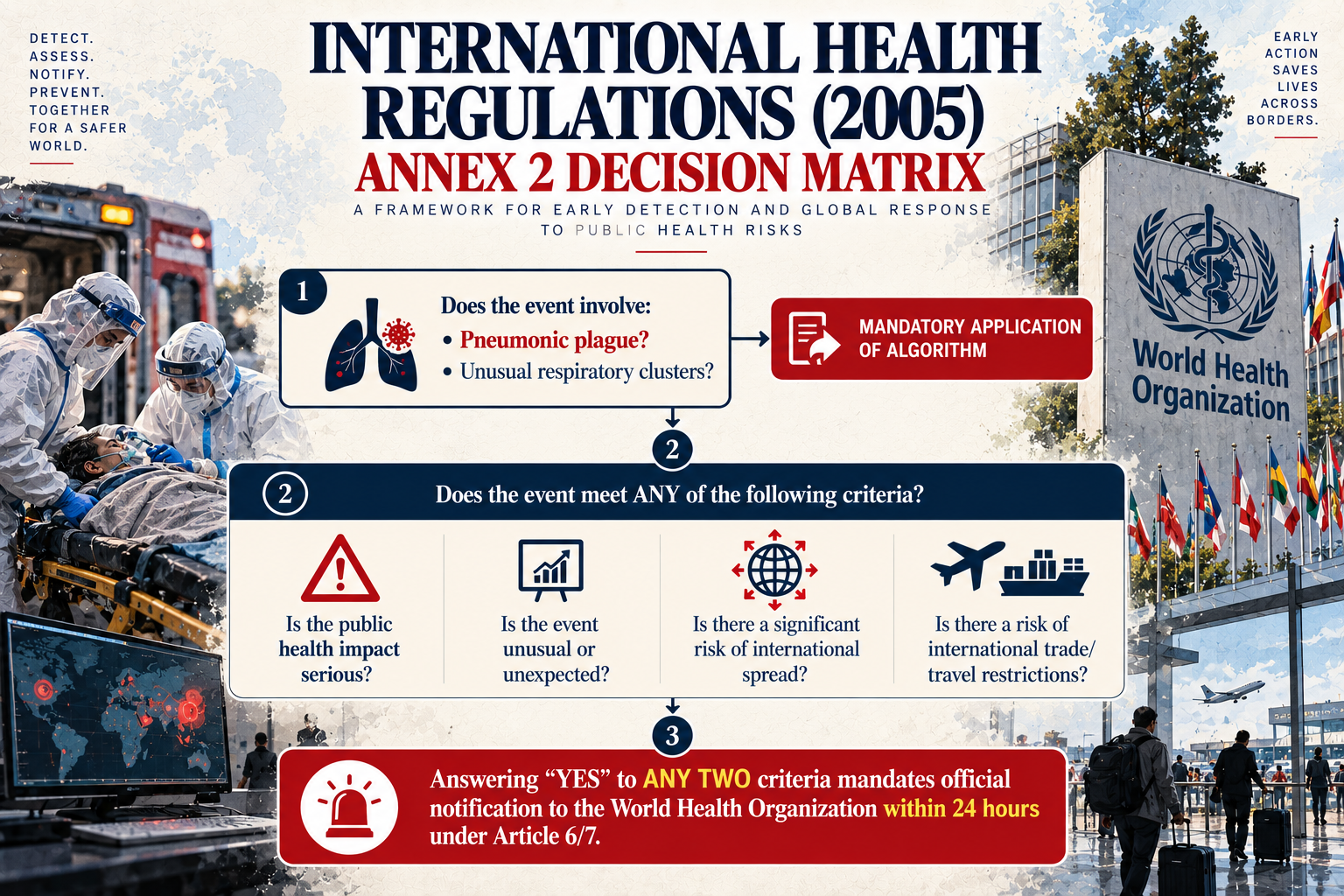
Legally, this event directly engages the International Health Regulations (IHR 2005). Under Annex 2 of the treaty—to which the Russian Federation is a legally bound State Party—pneumonic plague is explicitly classified as an illness that must always trigger the decision instrument. Furthermore, Article 7 stipulates that a state party must share public-health information regarding unusual or unexpected health events irrespective of origin or source, meaning that a laboratory-acquired exposure enjoys no legal exemption from global reporting requirements.
By defaulting to obfuscation and classifying the incident as "pneumonia of unknown aetiology" while isolating 200 citizens behind closed doors, authorities risk repeating the exact failures of communication that eroded global trust during previous outbreaks.
Scientific Conclusions
The tragic death of Darya Shipilova is an alarming case study in biorisk management, but it is not the prelude to an uncontrolled global health emergency.
Epidemiologically Contained: The aggressive isolation of 197 close contacts and hospital staff, combined with the availability of effective antimicrobial therapy, makes broad community transmission highly improbable.
Microbiologically Mismatched: Equating a suspected bacterial plague exposure to the emergence of SARS-CoV-2 ignores basic viral dynamics, reproductive values, and therapeutic vulnerabilities.
Institutional Accountability: The true danger exposed by Irkutsk is political rather than biological: when states prioritize prestige and secrecy over transparent reporting under the IHR, they weaken the global sentinel systems designed to protect humanity from the pathogens that truly could cause the next pandemic.