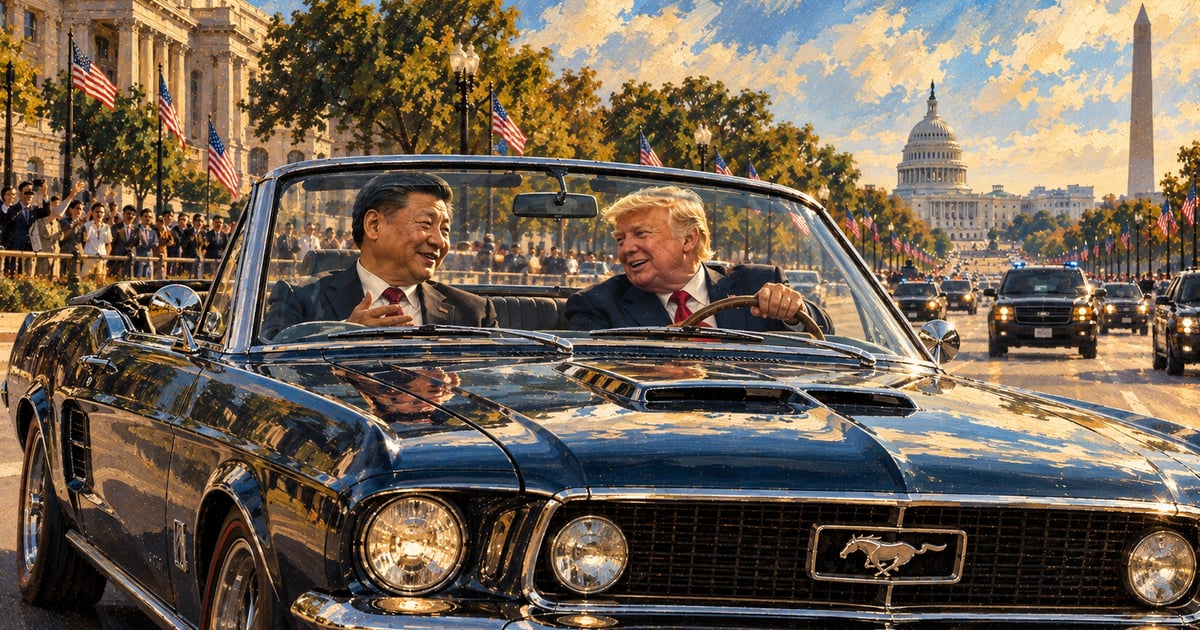
When Air China’s Boeing 747 touched down at Joint Base Andrews on the afternoon of Wednesday, 23 September 2026, it marked Chinese President Xi Jinping’s first official state visit to the American capital in eleven years. The visual choreography that followed was deliberately extraordinary: US President Donald Trump broke more than six decades of diplomatic convention by personally greeting Xi on the tarmac—the first time an American president had met a foreign leader at the airfield since John F. Kennedy received British Prime Minister Harold Macmillan in 1962.
The ceremonial honours that unfolded over the following forty-eight hours—a battery salute, a 479-member honour cordon on the South Lawn, joint flyovers by B-1 Lancer, B-2 Spirit, and F-22 Raptor aircraft, and an East Room state dinner attended by American technology executives—were crafted to project a level of bilateral pomp exceeding even Trump’s May 2026 visit to Beijing.
Yet beneath the choreographed grandeur lies a deeply transactional encounter. Facing pressing domestic deadlines and volatile international crises, both leaders have come to Washington not to forge a comprehensive peace, but to negotiate a tactical floor under an intensifying superpower rivalry.
The Road to Washington: The Busan Architecture
The September 2026 state visit represents the culmination of a reciprocal cycle initiated during the Busan Summit in October 2025. In late 2025, aggressive tariff escalations and retaliatory export controls had threatened to destabilise global supply chains, prompting Washington and Beijing to construct an emergency compromise.
Under the resulting "Busan deal," Washington agreed to freeze additional Section 301 tariffs on Chinese industrial manufactured goods. In return, Beijing committed to unthrottling its export quotas on rare earths and critical minerals essential to American defence, automotive, and semiconductor manufacturers.
Preparations for the Washington summit reached their operational phase on 20 September 2026 in New York, where Chinese Vice Premier He Lifeng met with US Treasury Secretary Scott Bessent and US Trade Representative Jamieson Greer. That meeting established the working parameters for bilateral trade discussions and paved the way for the formal summit in the American capital.
What Is on the Negotiating Table?
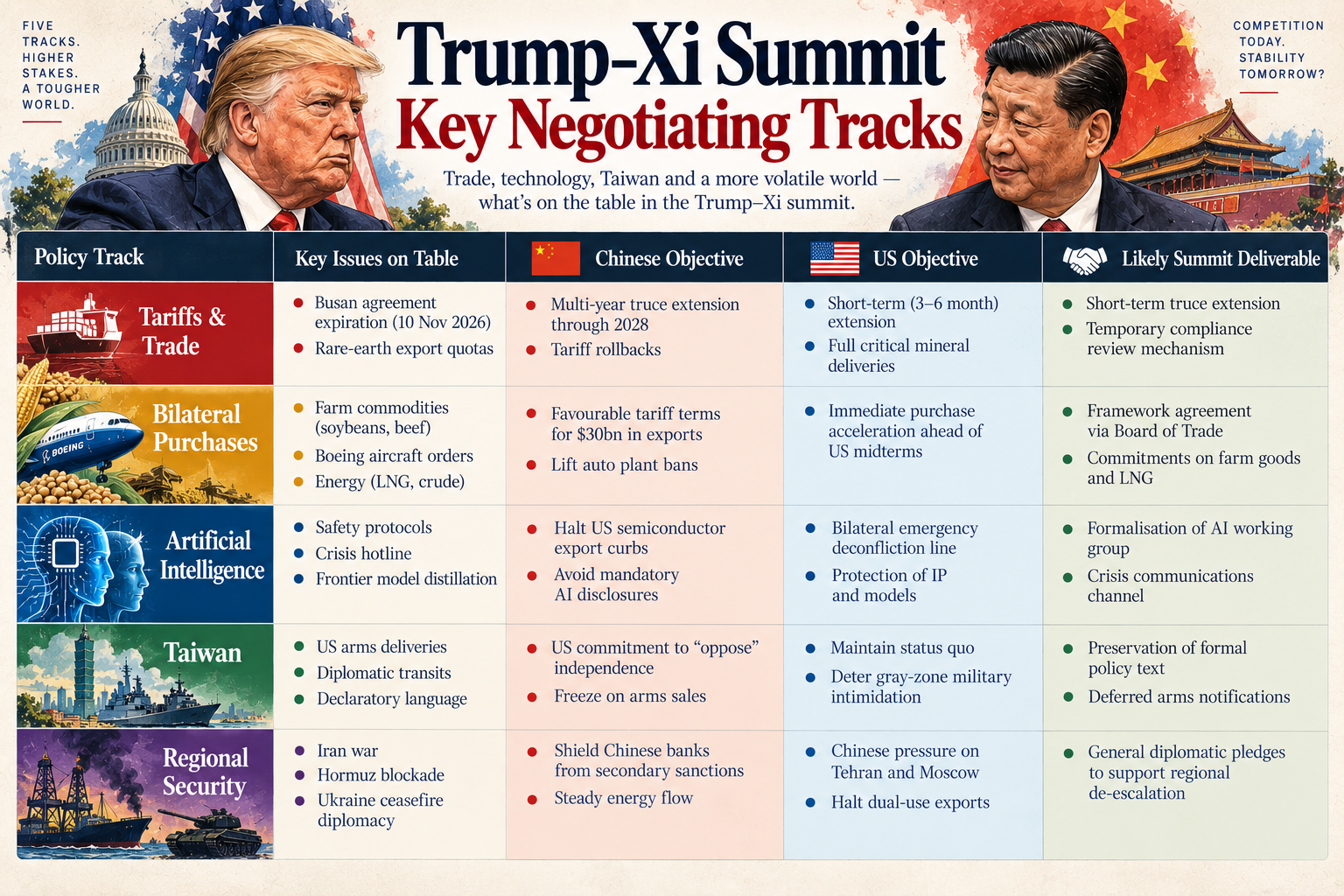
The bilateral agenda is structured around five critical negotiation tracks, each carrying immediate economic and security implications:
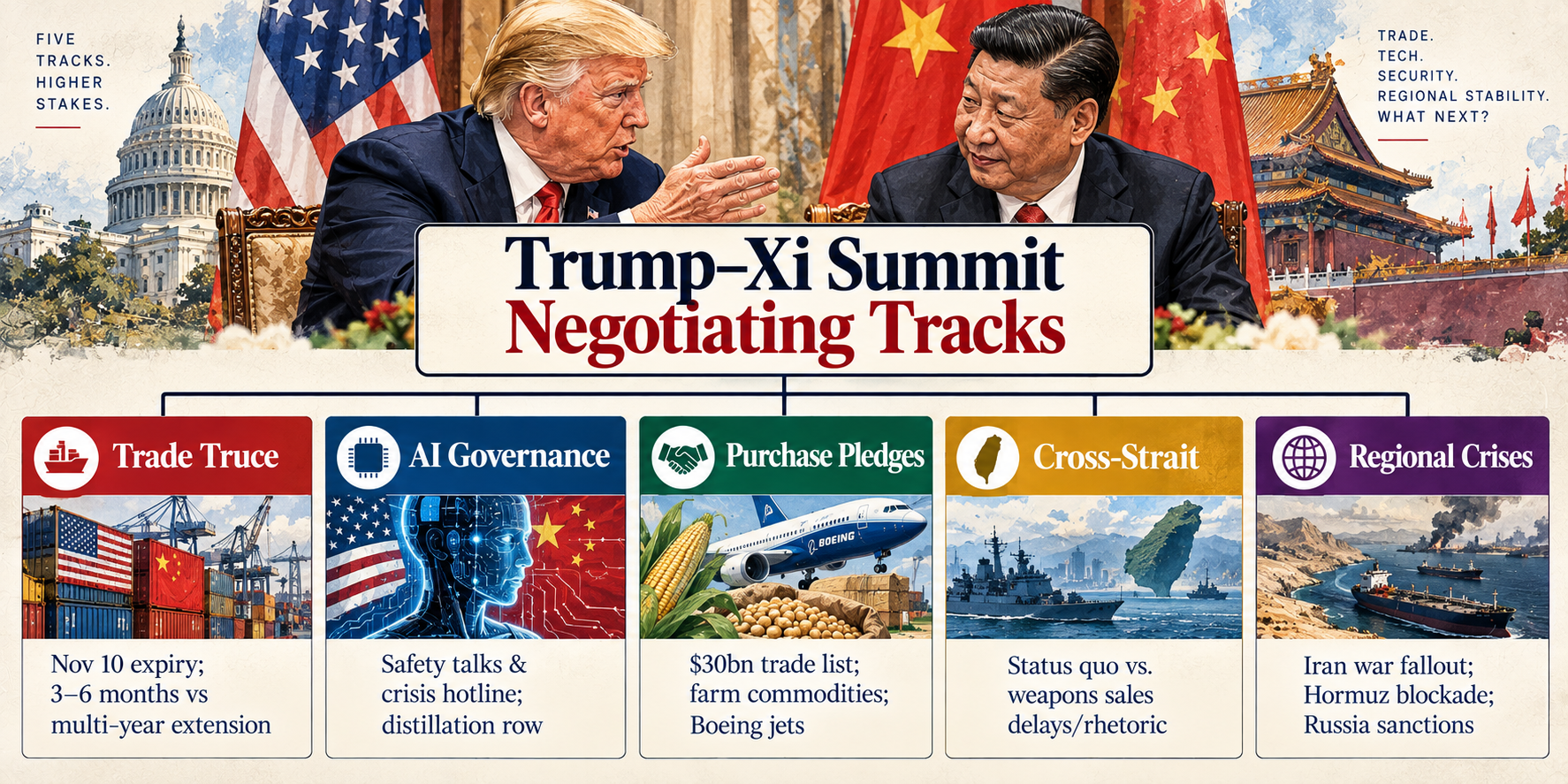
1. The Busan Tariff Truce and Rare Earth Quotas
The primary operational deadline confronting both delegations is the expiration of the Busan trade truce on 10 November 2026.
Beijing's Objective: China is seeking a multi-year extension of the tariff freeze that would run through the remainder of President Trump’s term in 2028, arguing that commercial stability requires long-term regulatory certainty.
Washington's Stance: Treasury Secretary Scott Bessent and USTR Jamieson Greer have pushed back against a long-term commitment, proposing a 3-to-6-month extension instead. The administration contends that China has fulfilled only about two-thirds of its mineral export quotas under the Busan deal, insisting that an abbreviated extension is necessary to maintain a compliance review mechanism.
Levers in Reserve: The White House holds significant unexercised leverage, including a completed Section 301 excess-capacity report recommending an additional 7.5 per cent tariff on select Chinese goods, and statutory authorities under the Sanctioning Russia and Iran Act of 18 September 2026, which permits tariffs of up to 100 per cent on major importers of Russian and Iranian oil and gas.
2. The Board of Trade and Agricultural Purchases
Following the May 2026 summit in Beijing—where Washington announced Chinese pledges to purchase 200 Boeing commercial aircraft that Chinese official releases subsequently declined to confirm—negotiators are seeking a more reliable commercial clearinghouse.
Deliberations are centring on the bilateral "Board of Trade" announced earlier this year. Negotiators are drafting initial target lists covering approximately $30 billion (approx. ₹2.5 lakh crore) in two-way trade. Washington is demanding accelerated shipments of American farm commodities—chiefly soybeans, beef, and wheat—timed directly ahead of the November US midterm elections. In exchange, Beijing is seeking tariff relief for Chinese consumer electronics, clean-energy components, and favourable regulatory conditions for potential Chinese greenfield manufacturing investments in the United States.
3. Artificial Intelligence: Safety Protocols vs Hardware Export Bans
Technology competition remains the most acute fault line in bilateral relations, but the Washington summit introduces formal AI governance into the superpower dialogue.
The Working Group and Crisis Lines: Both governments have agreed in principle to establish an official intergovernmental AI safety dialogue and explore a dedicated emergency communications line to prevent miscalculation driven by autonomous military systems.
The Distillation Dispute: The dialogue opens under substantial strain. On 8 September 2026, the NSA, CISA, and the FBI issued an unprecedented joint advisory accusing six Chinese technology firms of carrying out industrial-scale distillation of American frontier models since late 2024. While Washington has licensed limited shipments of older-generation graphics processors to select Chinese commercial buyers, it maintains sweeping export bans on cutting-edge AI training semiconductors, while Beijing actively directs domestic enterprises toward domestic alternatives such as Huawei.
4. Taiwan and Regional Deterrence
Taiwan remains the primary geopolitical flashpoint for both capitals:
Declaratory Rhetoric: Chinese officials continue to press the White House to shift its formal diplomatic language from "does not support" Taiwan independence to explicitly "opposes" it.
Defensive Arms Deliveries: Beijing has linked ongoing diplomatic stability to American restraint regarding arms shipments. In Washington, foreign policy observers note that the administration has delayed notifying Congress of a major pending defensive arms package for Taipei, prompting heightened concern among defence planners that arms sales are being utilised as a tactical bargaining chip in trade negotiations.
5. Geopolitics: Iran, Ukraine, and Consular Cases
The War in Iran and Maritime Security: With the conflict in Iran continuing and commercial shipping through the Strait of Hormuz severely disrupted, Washington is urging Beijing to utilise its oil purchasing power with Tehran to broker a maritime ceasefire. Concurrently, US officials have raised concerns regarding reports that Chinese commercial entities supplied satellite reconnaissance used in regional attacks against American facilities.
Ukraine Diplomacy: President Trump is pressing Xi to leverage Beijing's relationship with Russian President Vladimir Putin to advance ceasefire deliberations.
Wrongfully Detained Citizens: American negotiators are pursuing the release of US nationals designated by the State Department as wrongfully detained in China, alongside raising the issue of the continued imprisonment of Hong Kong media proprietor Jimmy Lai.
What Are the Big Signals?
Beyond the immediate administrative communiqués, the 2026 Washington summit conveys four major structural signals regarding the international order:
1. Strategic Parity and the Normalisation of Peer Status
The extraordinary visual reception granted to Xi Jinping—from the presidential airport welcome to the joint bomber flyovers—signals that Beijing has successfully compelled Washington to treat it as a structural peer. Having demonstrated in 2025 that its critical mineral controls could inflict reciprocal economic pain on American industry, China enters the White House not as an economic subordinate, but as a co-equal superpower capable of enforcing terms.
2. Domestically Driven Tactical Stabilisation
Neither leadership is pursuing genuine ideological reconciliation; both are seeking operational breathing room driven by domestic timelines.
President Trump faces critical congressional midterm elections in November 2026, requiring stable domestic energy markets, agricultural purchase announcements for Midwestern farm states, and the absence of an external economic crisis.
President Xi faces the Chinese Communist Party’s Fifth Plenum in October 2026 and the preparatory phase for the 21st Party Congress in 2027. Facing domestic property-sector headwinds and sluggish consumer demand, Beijing urgently requires export predictability and an avoidance of erratic tariff shocks.
3. Personalised Leader-to-Leader Diplomacy Over Institutional Channels
The summit illustrates a pronounced shift away from traditional bureaucratic diplomacy toward highly personalised head-of-state dealmaking. Both leaders appear convinced that their direct personal relationship is the only mechanism capable of overcoming entrenched institutional hostility in Washington and Beijing. However, this dynamic introduces severe volatility: agreements brokered at the apex risk breakdown during agency-level implementation, as seen in ongoing disputes over model distillation, export licensing, and aviation parts certification.
4. Heightened Strategic Anxiety Across the Indo-Pacific
The optics of a bilateral superpower accommodation have triggered acute unease among regional allies and partners across the Indo-Pacific:
Taiwan: Officials in Taipei watch with apprehension as defensive arms notifications are delayed, fearing that cross-strait deterrence is being subordinated to bilateral trade objectives.
Japan and South Korea: Tokyo and Seoul observe bilateral economic negotiations warily, concerned that preferential US–China purchasing pacts or semiconductor compromises could undermine their own industrial and technological competitiveness.
India and ASEAN: For New Delhi and Southeast Asian capitals, an extended tariff truce between Washington and Beijing dampens the economic impetus for multinational corporations to shift manufacturing supply chains out of mainland China, complicating regional diversification strategies.
Conclusion: A Floor, Not a Peace
The 2026 state visit to Washington demonstrates that the United States and China have entered a phase of managed strategic rivalry. While both governments are committed to establishing a tactical floor beneath their relationship to avoid catastrophic kinetic or economic escalation, the underlying structural contest—over advanced computing, maritime supremacy, regional alliances, and the governing rules of the international order—remains entirely unmitigated. The state visit delivers stability, but it is a stability built on temporary trade pauses and mutual deterrence rather than enduring partnership.