In brief
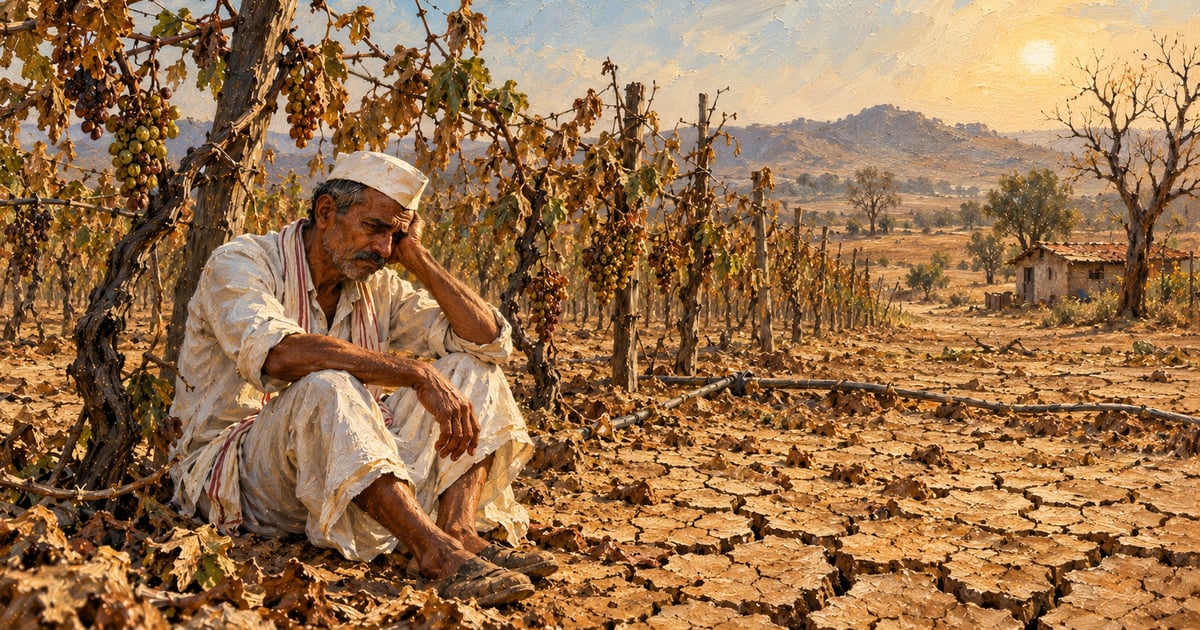
- Maharashtra has declared drought in 265 of its 358 talukas, about 74% of the state’s area. The monsoon ended 18.8% short, and places like Solapur, Latur and Dharashiv got only about half their normal rain. CM Fadnavis says this could be worse than 1972.
- Sugarcane is the big reason it got this bad. It takes up about 4% of the farmland but uses close to 70% of the irrigation water. Farmers have also drilled borewells 150 to 250 metres deep, so the underground water is nearly gone.
- This time the problem is water and fodder, not food, since the country has plenty of grain. The biggest worry is orchards. Maharashtra grows over 69% of India’s grapes, and if the vines die, farmers lose the four years it takes for new plants to bear fruit.
- Relief so far includes loan restructuring, a stay on bank recoveries, waived farm electricity bills, water tankers and fodder depots. The long-term fixes the article lists are strict limits on cane water use, the Marathwada Water Grid, community control over groundwater, and a shift to millets and pulses.
In late September 2026, the Maharashtra government officially notified drought across 265 of the state’s 358 talukas (sub-districts), covering nearly 74% of its geographic area (Hindustan Times). By mid-September, satellite and ground monitoring showed that 84% of the state was abnormally dry, with 56.5% experiencing severe to extreme drought conditions—a steep jump from just 14% a month earlier (India Today).
Following visits to parched fields in Latur, Dharashiv, and Solapur, Chief Minister Devendra Fadnavis stated that the unfolding crisis could prove more severe than the landmark drought of 1972 (Business Standard).
Understanding the gravity of this situation requires looking beyond seasonal rainfall figures. The 2026 drought is not merely a dry spell; it is an acute convergence of erratic weather, depleted aquifers, and a commercial cropping pattern that has pushed the state’s hydrology past its breaking point.
1. Why Did the Drought Occur?
The official declaration was triggered after 32 of Maharashtra's 36 districts satisfied Trigger-1 criteria under the national Drought Management Manual: a dry spell exceeding 21 consecutive days during the monsoon, accompanied by cumulative seasonal rain deficits (Hindustan Times). The underlying drivers stem from both climate volatility and human water management.
The Meteorological Deficit and Erratic Monsoon
The statewide southwest monsoon closed with an overall deficit of 18.8%. However, aggregate numbers obscure sharp regional disparities. Seventeen districts recorded seasonal rainfall between 50% and 75% of their long-term averages (Business Standard):
Solapur recorded just 48.65% of its normal precipitation.
Latur and Dharashiv in Marathwada received roughly 50% of their expected rainfall.
Prolonged dry spells throughout July, August, and early September interrupted critical vegetative growth stages, leaving soil moisture exhausted before the arrival of the rabi (winter) sowing window.
The Sugarcane Imbalance
Meteorological failure turned into hydrological catastrophe because of long-standing cropping patterns. In drought-prone basins across Marathwada and Western Maharashtra, sugarcane occupies roughly 4% of the state’s gross cultivated area but consumes close to 70% of its available irrigation water (Hindustan Times).
Despite repeated recommendations by expert panels—dating back to the 1999 Maharashtra Water and Irrigation Commission headed by Madhav Chitale—to restrict water-intensive cane cultivation in rain-shadow basins, sugar mills have continued to operate at scale (The Hindu). The heavy extraction of surface water for cane crushing and irrigation left major reservoirs such as Jayakwadi and Ujjani with diminished reserves heading into autumn.
Depleted Aquifers and Watershed Bottlenecks
Groundwater extraction has compounded the problem. In districts like Jalna, Beed, and Chhatrapati Sambhajinagar, farmers routinely drill borewells to depths of 150 to 250 metres (500 to 800 feet) into basalt formations.
State watershed interventions, notably the decade-long Jalyukt Shivar Abhiyan, which expended over ₹9,630 crore (about $1.15 billion), faced significant criticism from scientific audits for relying on uncoordinated stream-bed deepening and widening without adequate catchment conservation (Down To Earth). In dry years, these deepened nullahs accelerate evaporative losses rather than recharging deep aquifers.
2. The Impact: Crops, Orchards, and Rural Livelihoods
The consequences of this drought differ fundamentally from historical famines. While staple grains remain available through public distribution networks, rural communities face severe income destruction and an existential threat to long-term agricultural assets.
The Threat to Horticulture: Erasing Multi-Year Capital
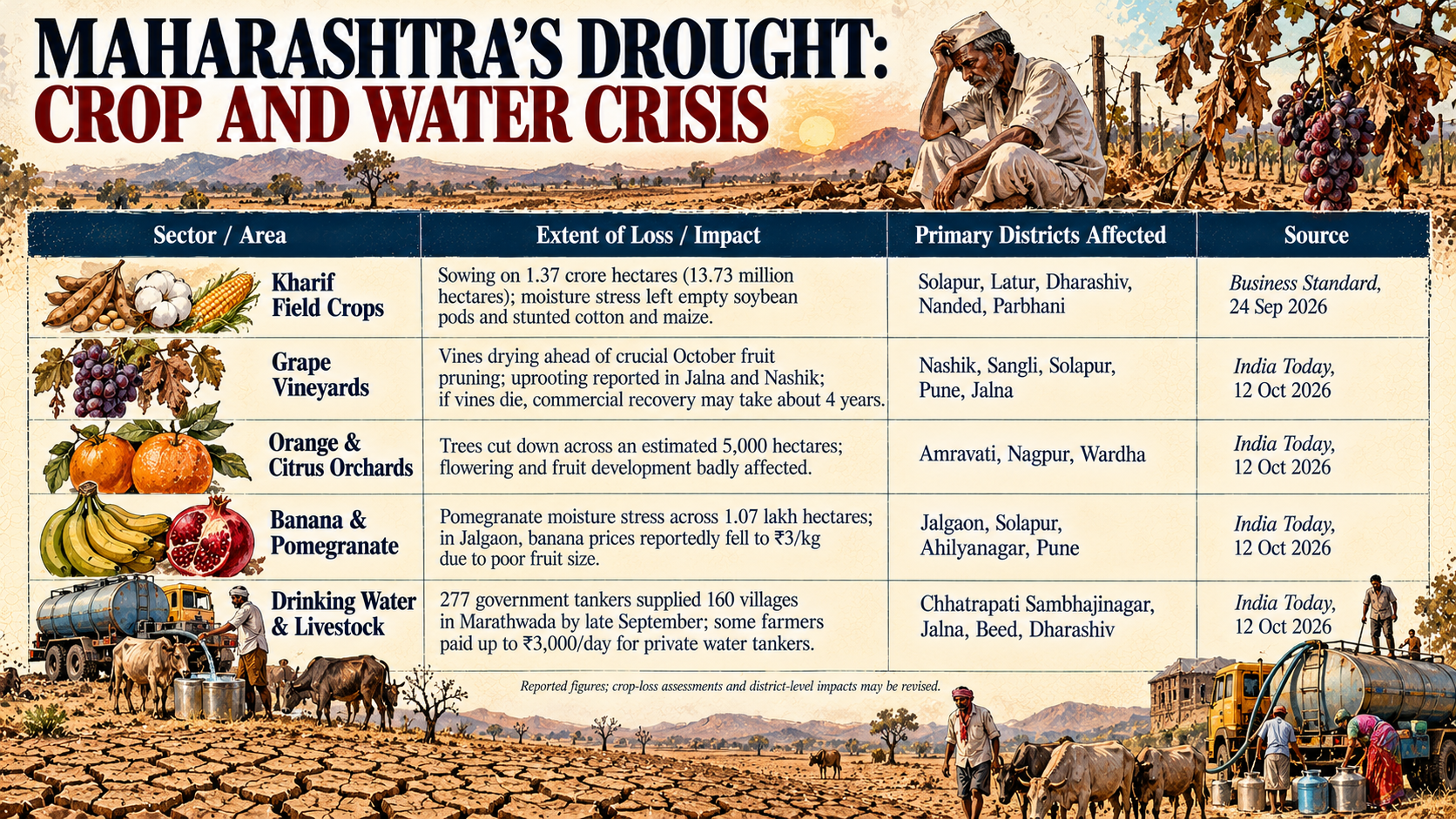
Unlike seasonal crops like soybean or bajra, where a bad monsoon wipes out a single season's investment, orchards represent multi-year capital commitments. Maharashtra accounts for over 69% of India's grape production and exports substantial volumes of grapes, pomegranates, and bananas (India Today).
In Nashik, Sangli, and Jalna, grape growers invest between ₹50,000 and ₹60,000 per acre each season simply on pruning, nutrition, and labour. If vines dry out and die during October, growers lose not just the upcoming crop, but the four years required for replanted saplings to mature and bear commercial fruit. To shield stressed trees from blistering heat, growers require agricultural shade nets that cost ₹69,000 to ₹1.38 lakh ($820 to $1,650) per acre—an expenditure few indebted smallholders can afford without state subsidies.
1972 vs 2026: Why This Drought Is Different
The comparison to 1972 illustrates how drought dynamics in Maharashtra have transformed over 54 years:
The 1972 Crisis (Food Famine): In 1972, nearly 2.5 crore people (25 million) faced an acute shortage of foodgrains (Business Standard). The state relied on emergency imports of American red wheat under PL-480 and public relief camps offering sukhadi (a calorie supplement).
The 2026 Crisis (Water and Fodder Famine): As agricultural expert Vijay Borade observed, today the country possesses substantial national grain reserves, yet rural households face a total absence of drinking water and livestock fodder (India Today). Mechanised borewells have drained deep aquifers, meaning that when surface water vanishes, communities have no secondary buffer.
3. What Happens Next?
Responding to a drought of this scale requires distinguishing between immediate humanitarian relief and the structural overhauls needed to prevent recurring disasters.
Immediate Relief Measures
Following a meeting between the Maharashtra Chief Minister and Union Home Minister Amit Shah, an inter-ministerial central team visited the worst-hit districts of Marathwada and Western Maharashtra between 8 and 11 October 2026 to assess losses for National Disaster Response Fund (NDRF) allocations (The New Indian Express / Daijiworld).
The state government’s initial package includes:
Financial and Credit Relief: Restructuring of agricultural loans, a stay on recovery proceedings by cooperative and commercial banks, and waivers on agricultural electricity bills (Business Standard).
Emergency Water Delivery: Scaling up government tanker allocations and exploring emergency water train services (modelled on the 2016 'Jaldoot Express' to Latur) for municipal centres facing municipal reservoir exhaustion (India Today).
Cattle Camps and Fodder Depots: Establishing subsidised fodder depots to prevent distress sales of milch cattle and working bullocks.
Horticulture Survival Subsidies: Farmer organisations have petitioned for immediate subsidies covering 75% of shade-net costs and water transport allowances to keep perennial rootstocks alive.
Long-Term Structural Reforms
Emergency assistance cannot resolve the ecological contradiction at the heart of Maharashtra’s agricultural economy. State water planners, hydrologists, and farm economists point to four mandatory policy shifts:
Mandatory Drip Irrigation and Cane Regulation: Enforcing strict volumetric water metering on sugarcane and prohibiting flood irrigation across all arid talukas. New crushing licences in Marathwada must be made contingent on closed-loop factory water recycling and 100% micro-irrigation compliance in command areas (The Hindu).
Operationalising the Marathwada Water Grid: Accelerating the long-delayed grid designed to interconnect 11 major dams across the Godavari basin through closed, pressurized pipelines, mitigating the massive seepage and evaporation losses inherent in open earthen canals.
Community Groundwater Governance: Moving beyond drilling deeper borewells by strictly implementing the Maharashtra Groundwater (Development and Management) Act. Villages must be empowered to conduct community water audits that cap extraction in critical and over-exploited watershed units.
Crop Realignment under Climate Resilience Frameworks: Shifting state procurement incentives towards drought-hardy millets (jowar, bajra) and pulses through programmes like the Project on Climate Resilient Agriculture (PoCRA), reducing farmer exposure to high-input commercial mono-cropping in low-rainfall zones.