In brief
- Meta launched Muse Wonder family on 12 October 2026 with two variants: standard Muse Wonder and flagship Muse Wonder Full, directed by former Scale AI chief Alexandr Wang.
- Independent testing shows Muse Wonder Full scores 56 on Artificial Analysis Intelligence Index v4.3, tying Claude Sonnet 5.5 and beating GPT-6 Astra at 53, but trailing Claude Opus 5.5 at 58.
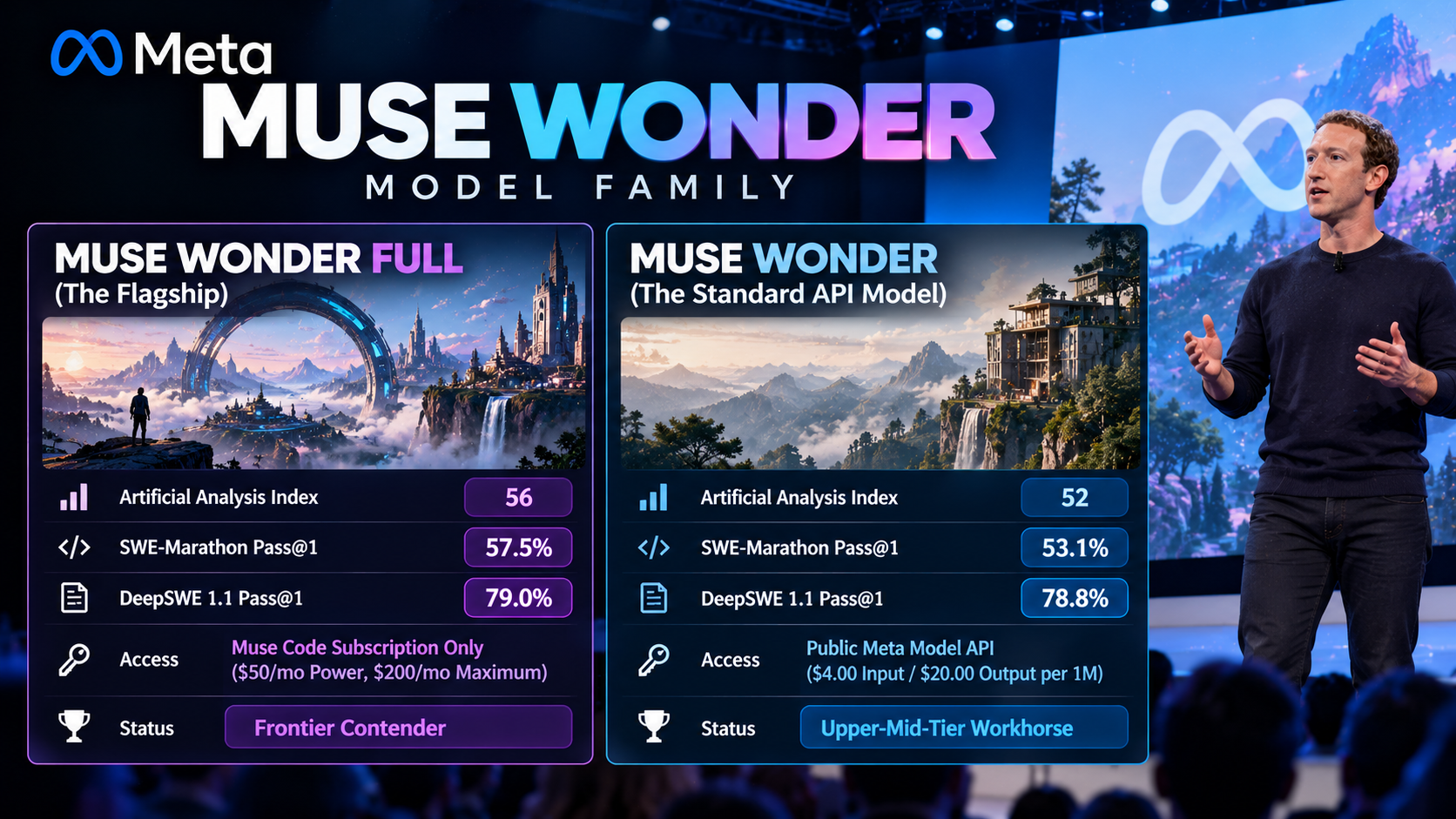
- Muse Wonder Full is only available via Meta's Muse Code desktop subscriptions at $50 or $200 monthly; the public API offers only the weaker base model scoring 52.
- Meta has abandoned open-weight releases, making Muse Wonder fully proprietary; enterprise users face Contributor Mode defaults and Zero Data Retention that disables the model's Active Memory feature.
When Meta Superintelligence Labs (MSL) unveiled the Muse Wonder family on 12 October 2026, the announcement arrived with an explicit assertion: Meta had produced a model that belongs in the frontier class. Directed by former Scale AI chief executive Alexandr Wang following a comprehensive restructuring of Meta’s artificial intelligence division 14 months prior, the laboratory presented two distinct variants: the standard Muse Wonder and the flagship Muse Wonder Full.
Evaluating whether this model family genuinely occupies the technological frontier requires looking past unified corporate marketing. The short answer is affirmative, but strictly conditional.
When measured on long-horizon software engineering, sustained multi-file refactoring, and structured enterprise workflows, Muse Wonder Full demonstrates state-of-the-art proficiency, outperforming OpenAI’s GPT-6 Astra and matching Anthropic’s Claude Sonnet 5.5. However, the overarching technological frontier remains defined by Anthropic’s Claude Opus 5.5. More critically for enterprise architects, Meta has engineered a sharp commercial split: the genuine frontier performer is locked within a desktop subscription tool, while the version offered on the public developer API operates at a distinctly lower performance tier.
The Benchmark Reality: What Independent Audits Reveal
Meta's internal technical disclosures highlight sweeping victories across personal and professional task suites. However, independent testing conducted by Artificial Analysis establishes a more precise hierarchy.
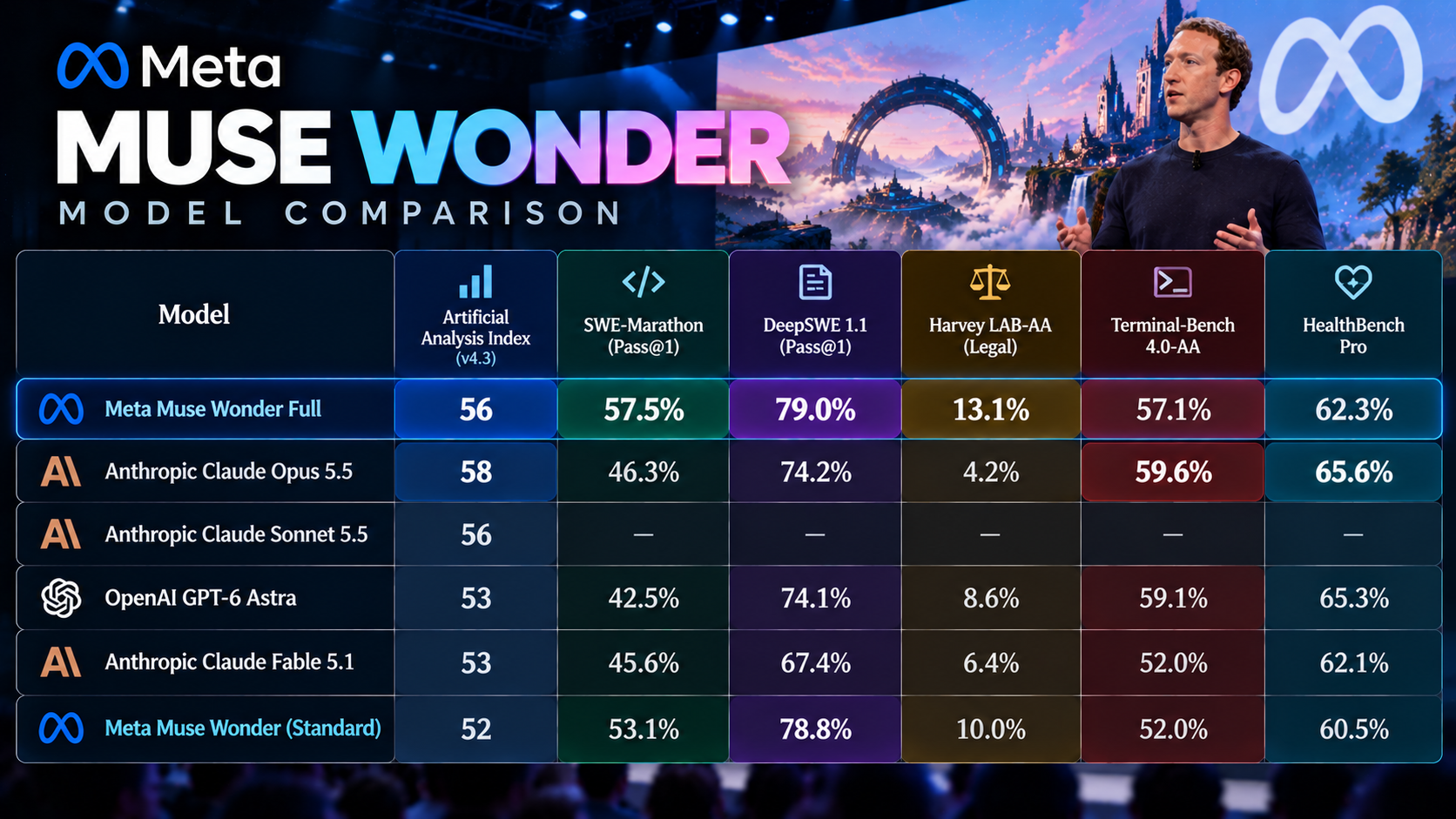
On the Artificial Analysis Intelligence Index v4.3—an aggregate benchmark combining ten independent evaluations spanning reasoning, knowledge retrieval, software development, and professional workflows—Muse Wonder Full registered an overall score of 56.
This score places Wonder Full in a direct tie with Anthropic's Claude Sonnet 5.5 (56) and positions it comfortably ahead of OpenAI's GPT-6 Astra (53), Google's Gemini 4 Argon (53), and Anthropic's Claude Fable 5.1 (53). It also outpaces xAI’s Grok 4.6 (44 at high reasoning effort). Crucially, however, Wonder Full does not claim the top position on the leaderboard: Anthropic’s flagship Claude Opus 5.5 retains the premier position with a composite score of 58.
Meanwhile, the base Muse Wonder model achieved a score of 52, trailing GPT-6 Astra by one point.
Where Wonder Full Outperforms Competitors
The areas where Muse Wonder Full genuinely redefines frontier performance centre on sustained execution over lengthy time horizons:
Ultra-Long Horizon Engineering: On SWE-Marathon, an evaluation administered by Abundant AI testing multi-hour problem-solving across sprawling software repositories, Wonder Full attained a pass@1 rate of 57.5% at extra-high reasoning effort. This substantially outstrips Claude Opus 5.5 (46.3%) and GPT-6 Astra (42.5%).
Repository-Scale Code Generation: On DeepSWE 1.1 (113 tasks across 91 distinct repositories in five programming languages), third-party verification by Datacurve yielded a pass@1 rate of 79.0% for Wonder Full, topping Opus 5.5 (74.2%) and Astra (74.1%).
Structured Document Synthesis: In legal document generation tested via Harvey LAB-AA 1.1 (which requires agents to parse real case materials and generate contract deliverables validated against hallucination verifiers), Wonder Full scored 13.1%, leading GPT-6 Astra (8.6%) and Opus 5.5 (4.2%). While the absolute score illustrates how difficult end-to-end legal drafting remains for AI models, Meta's lead is statistically marked.
End-to-End Business Operations: On AutomationBench-AA, which tests autonomous application state changes within simulated business software, Wonder Full achieved 45.4%, clearing both Opus 5.5 (41.2%) and Astra (41.6%).
Documented Blindspots and Limitations
Despite these peaks, the family exhibits acute vulnerabilities that disqualify it from being considered a universal frontier replacement for Claude Opus 5.5 or GPT-6 Astra:
Interactive Terminal Execution: On Terminal-Bench 4.0-AA, which isolates command-line tasks in containerised Linux environments, Wonder Full scored 57.1%, falling behind Opus 5.5 (59.6%) and Astra (59.1%).
Medical and Clinical Reasoning: On HealthBench Pro (525 complex clinical questions graded against physician rubrics), Wonder Full scored 62.3%, trailing Opus 5.5 (65.6%) and Astra (65.3%).
Visual Layout and Aesthetic Design: The Muse Wonder Model Card explicitly notes: "Visual and spatial reasoning, especially 3D tasks, remains a known limitation." Independent testing published by Lenny's Newsletter verified that while Wonder Full coordinates complex multi-file application back ends with ease, it frequently produces fragmented, illegible front-end interfaces, inconsistent CSS styling, and broken component trees.
Architecture: The Mechanics of Active Memory and Active Focus
Meta trained both Wonder models within its gigawatt-scale Prometheus data centre, utilising extensive pretraining across multilingual corpora followed by targeted reinforcement learning (RL) designed to scale test-time compute. The underlying models feature a native context length of 1 million tokens at inference and accept inputs across text, image, audio, and video modalities.
Rather than optimising purely for single-turn prompt-and-response dynamics, Meta built the Wonder architecture around two operational frameworks designed for persistent software agents:
1. Active Memory
Most long-context models treat context windows as passive storage buffers, relying on basic attention mechanisms that degrade as token counts approach the 1-million boundary. Active Memory functions as an internal retrieval and context-routing layer that tracks user preferences, previous decisions, and system constraints across extended dialogue sessions.
In internal testing on MemoryBench—an evaluation requiring models to recall targeted facts across 64,000 to 100,000 tokens filled with distracting conversations and deliberate contradictions—Wonder Full registered an 85.5% score, compared to 81.5% for Opus 5.5 and 81.4% for Astra.
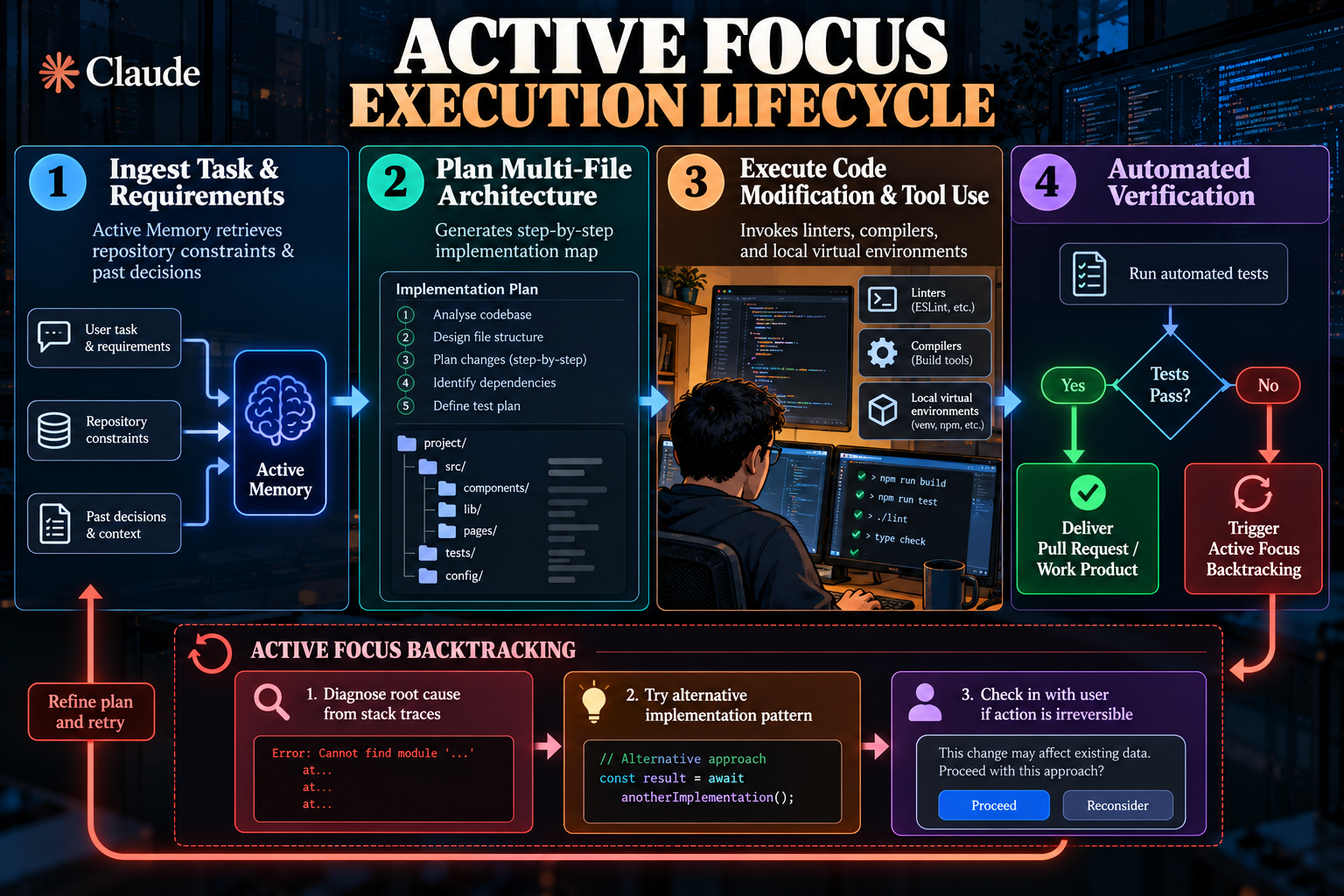
2. Active Focus
Autonomous agents frequently collapse into loops or abandon execution when encountering command failures, missing dependencies, or API rate limits. Active Focus incorporates reinforcement learning specifically tuned to detect execution bottlenecks, backtrack across failed dependency installations, formulate alternate architectural strategies, and query the user for clarification before executing destructive system operations.
This capability underpins the model’s performance on SWE-Marathon: the model does not necessarily write better initial code lines than Opus 5.5, but it demonstrates far higher persistence in running unit tests, inspecting failure logs, and iterating on its own patches until test suites pass.
Commercial Distribution: The Mid-Tier Trap
The most consequential operational reality of the Muse Wonder launch is not technical, but commercial.
Meta has elected not to release Muse Wonder Full through a pay-as-you-go developer API. Organisations wanting to integrate Wonder Full directly into custom production stacks, external customer-facing products, or proprietary agent orchestrators cannot do so.
As reported by VentureBeat, Wonder Full is available exclusively through Meta’s proprietary desktop coding assistant, Muse Code, via two premium subscription tiers:
Power Usage Plan: $50 per month, granting access to Wonder Full with an allowance 20 times higher than the entry-level Everyday Usage tier.
Maximum Usage Plan: $200 per month, granting an allowance 80 times higher than Everyday Usage, resetting on five-hour and weekly intervals.
By contrast, the Meta Model API serves only the base model under the identifier muse-wonder-1.0. While this API uses an OpenAI-compatible SDK endpoint with context windows up to 1 million tokens, developers calling this endpoint are executing the standard Muse Wonder model—which scores 52 on the Intelligence Index, trailing GPT-6 Astra (53) and Claude Sonnet 5.5 (56).
For engineering leaders evaluating technical benchmarks, this creates what industry analysts describe as a "mid-tier trap": the benchmark numbers headlining tech press articles reflect Wonder Full, but the model your software engineers can provision into enterprise applications is the standard, less capable Wonder.
API Pricing and Cost-Efficiency Comparisons
For teams deploying standard Muse Wonder via API, Meta has matched the nominal list pricing of Claude Opus 5.5 while significantly undercutting GPT-6 Astra:
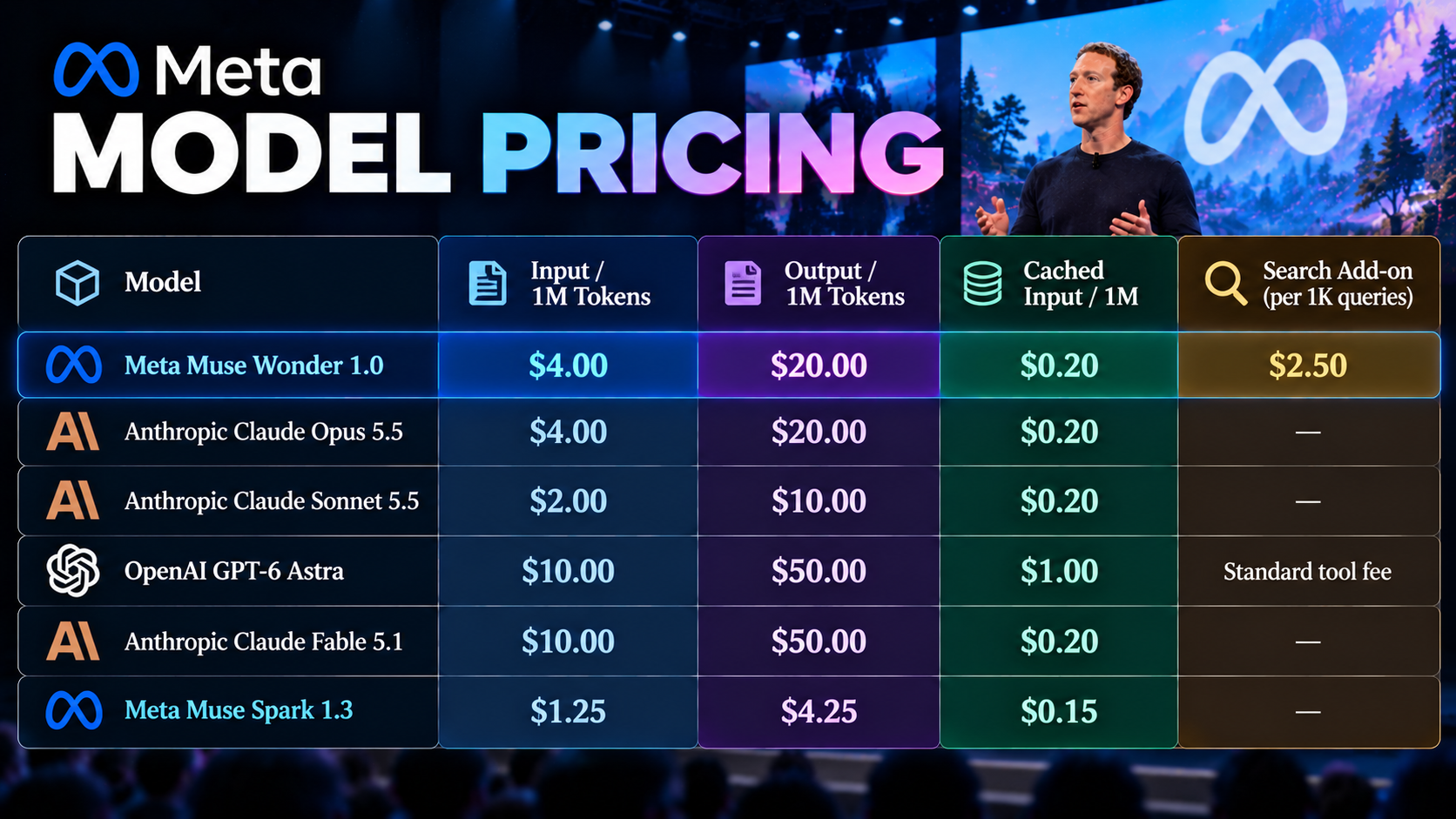
Nominal token costs do not always equate to lower workflow invoices. Because Muse Wonder relies on extended reasoning loops and tool execution chains, token consumption per completed problem is substantial. Artificial Analysis estimates the cost to complete a standardised composite task on the Intelligence Index at $4.52 for Muse Wonder, compared to $3.26 for GPT-6 Astra and $5.98 for Claude Opus 5.5. Astra charges higher per-token prices but generates more concise solutions, balancing out total expenditure.
Enterprise Governance: The Data Retention and Privacy Trilemma
Organisations handling proprietary intellectual property, financial data, or patient records face complex governance configurations under Meta’s enterprise licensing terms.
Meta divides its platform into two operational data modes:
Standard Mode: Meta does not use submitted customer data (prompts, files, code, or completions) to train future AI models. The pay-as-you-go Meta Model API operates exclusively under Standard Mode.
Contributor Mode: Meta retains and reviews submitted prompts, files, code repositories, and completions to train subsequent model generations. Muse Code desktop subscriptions default to Contributor Mode upon installation.
While subscribers can manually toggle Contributor Mode off in application settings, the opt-out is prospective only; it does not purge previously submitted source code. Meta's terms of service explicitly prohibit developers from submitting sensitive, proprietary, or personal data while operating in Contributor Mode.
For enterprises requiring Zero Data Retention (ZDR), Meta offers an approved-customer tier that bypasses standard logging. However, ZDR creates a severe functional penalty: Meta’s infrastructure documentation confirms that ZDR endpoints cannot maintain server-side conversation state, background batch tasks, file uploads, or native web search. Deploying Muse Wonder under strict enterprise ZDR effectively disables Active Memory, undermining the core architectural feature that justifies selecting the model in the first place.
The Strategic Shift: The End of Open-Weight Parity
Beyond benchmark percentages and API rates, the release of Muse Wonder marks a watershed moment in corporate AI strategy: Meta has stepped away from its open-source lineage.
From 2023 through mid-2025, Meta served as the global patron of open-weight artificial intelligence through the Llama project, releasing model weights that universities, startups, and sovereign nations could self-host, audit, and fine-tune on private hardware.
Under Alexandr Wang and Meta Superintelligence Labs, the company’s frontier releases are entirely proprietary. While Meta released its compact, lightweight Muse Glimmer model under an Apache 2.0 license, neither Muse Wonder nor Muse Wonder Full is downloadable. There are no model weights on Hugging Face, no local quantised GGML files for Ollama, and no self-hosted vLLM containers.
By reserving its premier technology for proprietary hosting, Meta has adopted the closed, vertically integrated commercial playbook pioneered by OpenAI and Anthropic. The strategic imperative has transitioned from democratising open-weight compute to capturing recurring developer revenue through proprietary subscriptions and managed API infrastructure.
Verdict: How Technical Leaders Should Navigate Muse Wonder
Is Meta's new Muse Wonder model family frontier class?
For In-Terminal Software Engineering: Yes. If your engineering organisation equips developers with Muse Code under the $50 or $200 monthly tiers, Muse Wonder Full delivers legitimate frontier-tier performance. On sustained code refactoring, complex repository debugging, and multi-file project assembly, it matches or exceeds anything currently offered by Anthropic or OpenAI.
For General Enterprise Reasoning: Partially. Wonder Full ties Claude Sonnet 5.5 but remains inferior to Claude Opus 5.5 in broad analytical synthesis, medical queries, and command-line execution. It also struggles with visual and front-end interface design.
For API Integration and Custom Products: No. The model exposed via the Meta Model API is standard Muse Wonder, which operates at an upper-mid-tier level (52 on the Intelligence Index), lagging behind Sonnet 5.5 and GPT-6 Astra.
For Privacy-Restricted Workloads: Approach with caution. Default telemetry settings in Muse Code require active mitigation, and the functional limitations imposed by Meta's Zero Data Retention configurations strip away the model's primary memory advantages.
Meta has engineered a formidable AI model in Muse Wonder Full. Whether it transforms your technical organisation depends entirely on whether your workflows fit inside Meta's walled garden.