In brief
- At the Bundeli Samagam on 5 October 2026, 12‑year‑old Binnu Rani asked Madhya Pradesh Chief Minister Mohan Yadav about the Ladli Behna scheme, prompting him to admit it was a costly burden on state finances.
- The Mukhyamantri Ladli Behna Yojana was launched on 28 January 2023 by then Chief Minister Shivraj Singh Chouhan, with payments starting in June and raised to ₹1,250 before the November 2023 election, helping the BJP win 163 of 230 seats.
- In the 2026‑27 budget Madhya Pradesh allocated ₹23,883 crore to Ladli Behna, 6.14% of its net budgeted expenditure of ₹3,88,923 crore. State debt passed ₹5 lakh crore and beneficiary numbers fell from 1.29 crore to 1.25 crore after registrations closed.
- Other states copied the model: Maharashtra’s Mukhyamantri Majhi Ladki Bahin Yojana (mid-2024) gives ₹1,500 to over 1 crore women at ~₹45,000 crore yearly; Jharkhand raised its stipend to ₹2,500; Karnataka pays ₹2,000; Odisha gives ₹10,000 yearly; Assam pays ₹1,250 monthly.
When 12-year-old digital creator Binnu Rani took the microphone at Bhopal’s Ravindra Bhawan during the Bundeli Samagam on 5 October 2026, she asked what appeared to be an innocent regional question: having taken care of the state's jijjis (elder sisters), what did the Chief Minister plan to do for the binnus (young daughters)?
The candid response from Madhya Pradesh Chief Minister Dr Mohan Yadav was sharper than anyone in the auditorium anticipated.
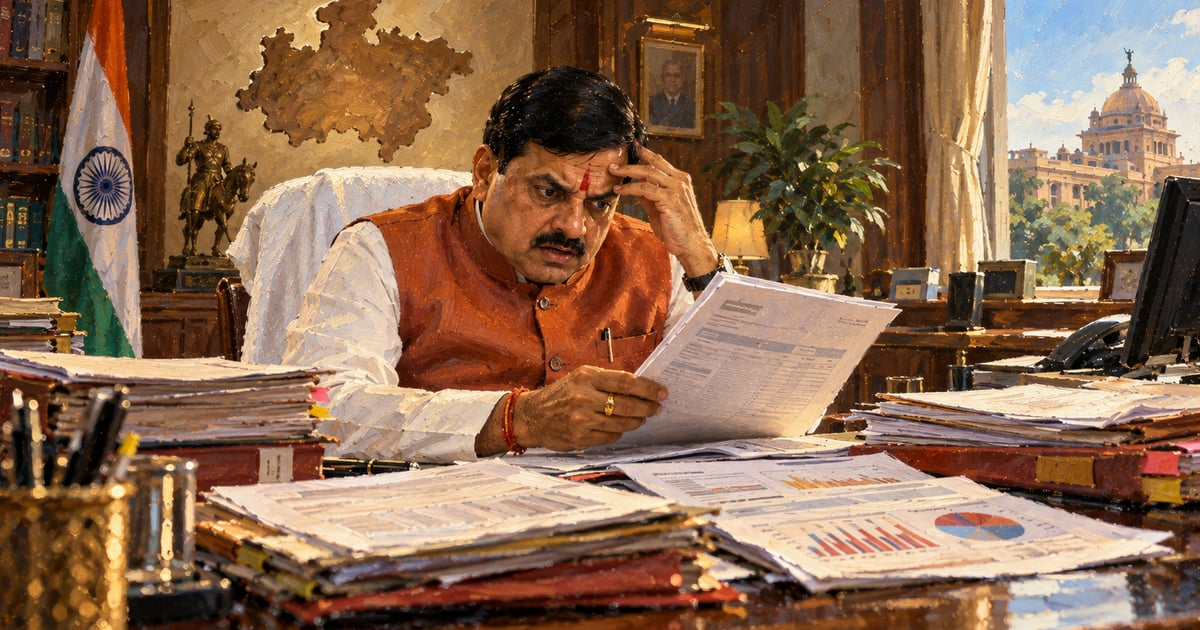
"Binnu, this is a very inside matter," Yadav remarked in a widely circulated exchange reported by the Hindustan Times. "How would I know that becoming Chief Minister would hit me so hard? You don’t know, Ladli Behna has turned out to be a very expensive affair."
Yadav quickly softened the blow, assuring his audience that the government would neither halt the monthly stipend nor compromise on women’s welfare. Yet, his off-the-cuff admission blew open an open secret across state secretariats: the pioneering unconditional cash transfer scheme that rescued the Bharatiya Janata Party (BJP) from severe anti-incumbency in late 2023 has evolved into an inflexible fiscal millstone.
Madhya Pradesh is not merely managing another expensive subsidy. It is the cradle of contemporary India's direct benefit transfer (DBT) revolution for women. How Bhopal handles this burden carries direct consequences for treasuries from Mumbai to Bengaluru.
The Scheme That Upended Indian Electoral Calculus
To understand the weight on Mohan Yadav’s shoulders, one must revisit late 2023. Facing nearly two decades of anti-incumbency and a resurgent Congress, then Chief Minister Shivraj Singh Chouhan unveiled the Mukhyamantri Ladli Behna Yojana on 28 January 2023, rolling out payments in June.
The proposition was simple, universal, and unmediated: ₹1,000 ($10.32) per month deposited directly into the bank accounts of women aged 21 to 60 whose family income was under ₹2.5 lakh ($2,580) per annum. Weeks before the November 2023 Assembly poll, Chouhan raised the stipend to ₹1,250 ($12.90) and promised an eventual escalation to ₹3,000 ($30.96).
The electoral dividend was decisive. Female turnout surged, women voted in historic proportions for the ruling party, and the BJP swept 163 of the state's 230 seats. Analysts widely acknowledged the scheme as the single most effective voting bloc consolidator in modern state elections.
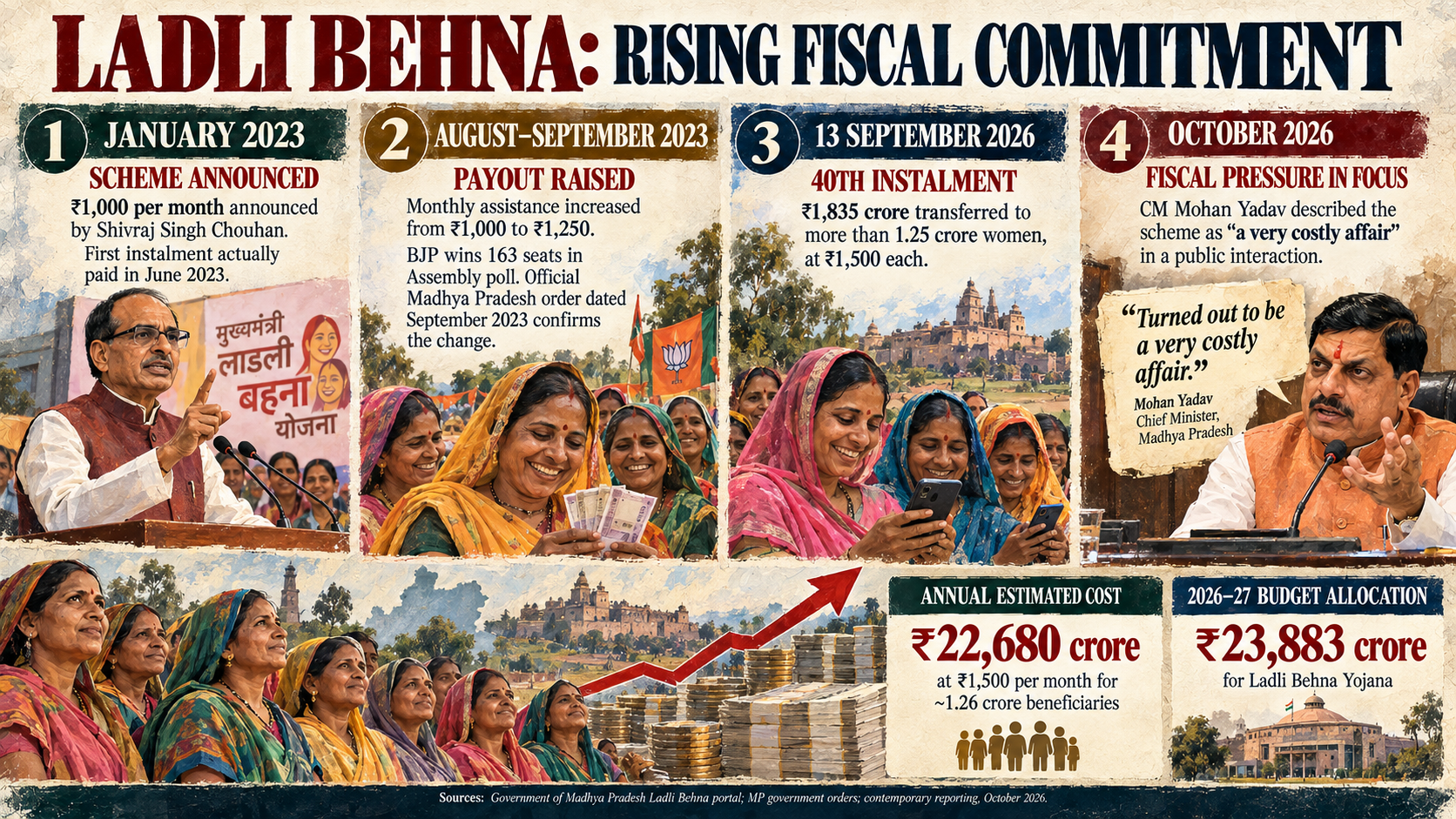
Yet, political triumph immediately collided with succession politics. The BJP central leadership bypassed Chouhan, installing Mohan Yadav in December 2023. Yadav inherited both the political mandate and an entrenched, recurring entitlement. Payouts were subsequently raised to ₹1,500 ($15.48) per month, but the political author of the scheme was gone, leaving his successor to fund the bill.
The Arithmetic of a Fiscal Iron Cage
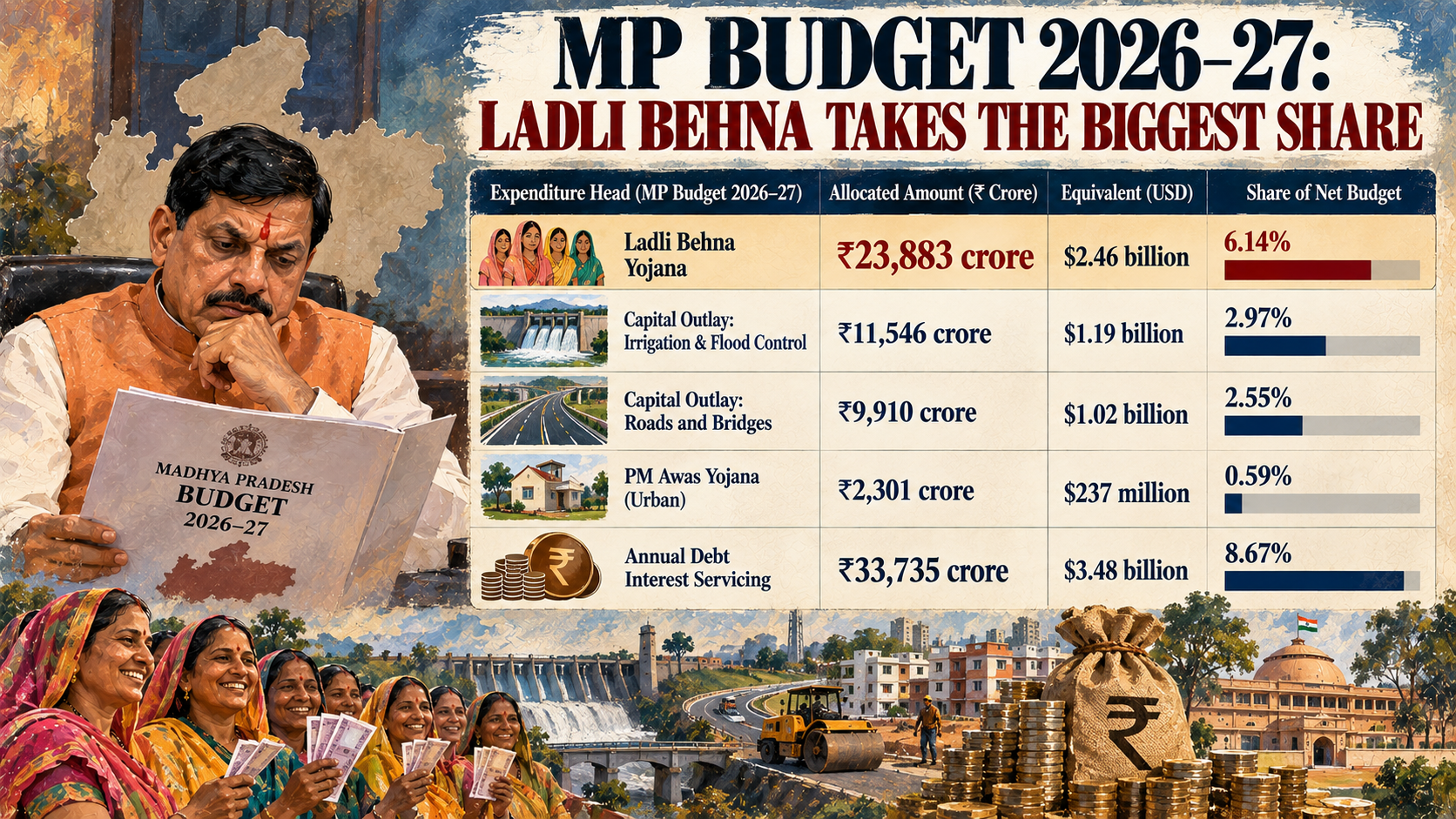
The scale of Ladli Behna's draw on state coffers is staggering. According to official budget documentation analysed by PRS Legislative Research, the Madhya Pradesh government allocated ₹23,883 crore ($2.46 billion) specifically for the Ladli Behna Yojana in its 2026–27 budget.
To place that single line item in context:
The state's net budgeted expenditure for 2026–27 stands at ₹3,88,923 crore ($40.14 billion). Ladli Behna alone accounts for 6.14% of every rupee spent by the state government.
In September 2026, the state disbursed its 40th instalment, transferring ₹1,835.09 crore ($189.4 million) in a single day to 1.25 crore (12.5 million) beneficiaries.
Ladli Behna's annual outlay of ₹23,883 crore dwarfs capital investments that build long-term economic capacity: the state earmarked only ₹9,910 crore ($1.02 billion) for capital outlay on roads and bridges, and ₹11,546 crore ($1.19 billion) for capital expenditure on irrigation and flood control.
Data Source: PRS Legislative Research MP Budget Analysis 2026–27.
Meanwhile, the state's broader balance sheet is deeply strained. Madhya Pradesh's total outstanding debt crossed the ₹5 lakh crore ($51.6 billion) threshold in 2026, prompting the state finance department to institute an internal austerity drive. Annual borrowing is projected to exceed ₹89,000 crore ($9.19 billion) to meet revenue deficits and debt servicing, with annual interest payments climbing to ₹33,735 crore ($3.48 billion).
The 16th Finance Commission had earlier noted that Madhya Pradesh spends 4.1% of its Gross State Domestic Product (GSDP) on subsidies and cash transfers—far outpacing the all-state average of 2.5%.
The Silent Attrition: Capping the Beneficiary Pool
Caught between fiscal boundaries and political penalties, the state administration has resorted to what welfare economists term "administrative cooling".
While the payout per recipient has risen from ₹1,000 to ₹1,500, the beneficiary rolls have quietly shrunk. When the scheme hit its peak in 2023, over 1.29 crore (12.9 million) women were enrolled. By the 40th instalment in September 2026, that number dropped to 1.25 crore (12.5 million) women.
The reason is simple: the government has not reopened registration portals for a "third phase" since the 2023 elections. As enrolled women cross the upper age threshold of 60 (transferring to old-age pensions) or see family circumstances change, they exit the ledger. But younger women turning 21 cannot get in.
This dynamic has handed the opposition Congress potent political ammunition. Reacting to Mohan Yadav's comments, Congress spokesperson KK Mishra charged: "Does the BJP-led state government introduce schemes without analysing systemic challenges? Now the state government is unwilling to add new names to the beneficiary list, which shows they are running it half-heartedly."
The legal system has also begun asking uncomfortable questions. On 16 September 2026, a Division Bench of the Madhya Pradesh High Court in Gwalior issued notices to the state finance and women welfare departments on a Public Interest Litigation filed by Sudha Dubey. The petition challenges the sustainability of unconditional recurring allowances, questioning whether taxpayer funds are being deployed for genuine socio-economic capacity building or short-term electoral procurement at the expense of basic infrastructure and public health.
The National Contagion of Competitive Welfarism
The dilemma unfolding in Bhopal matters far beyond Madhya Pradesh’s borders because Ladli Behna became the blueprint for Indian electoral strategy over the past three years:
Maharashtra: The Mahayuti government launched the Mukhyamantri Majhi Ladki Bahin Yojana in mid-2024, providing ₹1,500 monthly to over 1 crore women at an annual exchequer cost of approximately ₹45,000 crore ($4.64 billion). Senior ministers have already complained that departmental capital outlays face severe fund crunches.
Jharkhand: The Hemant Soren administration raised its Mukhyamantri Maiyan Samman Yojana stipend from ₹1,000 to ₹2,500 ($25.80) per month in late 2024 to lock in the female electorate.
Karnataka: The Congress government’s Gruha Lakshmi transfer commits ₹2,000 ($20.64) monthly to female household heads, requiring more than ₹28,000 crore ($2.89 billion) annually.
Odisha & Assam: Schemes such as Subhadra (₹10,000 annually) and Orunodoi (₹1,250 monthly) reflect the same universal cash doctrine.
Political scientists call this the "ratchet effect": an entitlement that delivers sweeping electoral margins cannot easily be reversed or reduced by any incoming administration without immediate political suicide.
When Shivraj Singh Chouhan devised Ladli Behna, he proved that unconditional cash delivered straight to a woman’s Jan Dhan account could decisively overpower traditional caste arithmetic and party loyalties. But Mohan Yadav’s unscripted admission in Bhopal highlights the inevitable hangover of that strategy.
When a state commits over 6% of its gross expenditure to a single recurring cash transfer while its overall debt breaches ₹5 lakh crore, the debate is no longer about whether cash transfers empower women—they undeniably put liquidity into vulnerable hands. The question is how long a developing sub-national economy can finance cash handouts before its hospitals, irrigation canals, and rural roads run out of capital.