
In brief
- Musk mocked Mukesh Ambani as the “real boss of India” on X, highlighting the regulatory bottlenecks delaying Starlink’s commercial launch in India due to spectrum and security rules.
- India exempted satellite spectrum from auctions under the Telecommunications Act 2023, but Starlink must still meet security checks: local gateways, lawful interception, ownership disclosure; Starlink has built 20 ground gateway sites in India.
- The USA has banned Huawei and ZTE equipment, forced TikTok divestment, raised Chinese EV tariffs to 100% and granted $52.7 billion in CHIPS Act subsidies, all citing national security or industrial policy.
- India’s security vetting of foreign satcom mirrors US, EU and China practice; Musk must satisfy the same security parameters to sell Starlink bandwidth in India, as technological sovereignty is now the global norm.
When Elon Musk took to X to mockingly address Reliance Industries chairman Mukesh Ambani as the “real boss of India”, his sarcasm was aimed at the regulatory bottlenecks delaying Starlink’s commercial debut in the country. Writing “Dear Prime Minister Ambani, please accept my humble apologies for not realising that you are the real boss of India,” Musk followed up on earlier remarks accusing “certain oligarchs” of orchestrating a monopolistic chokehold to shut foreign competition out of India's digital economy.
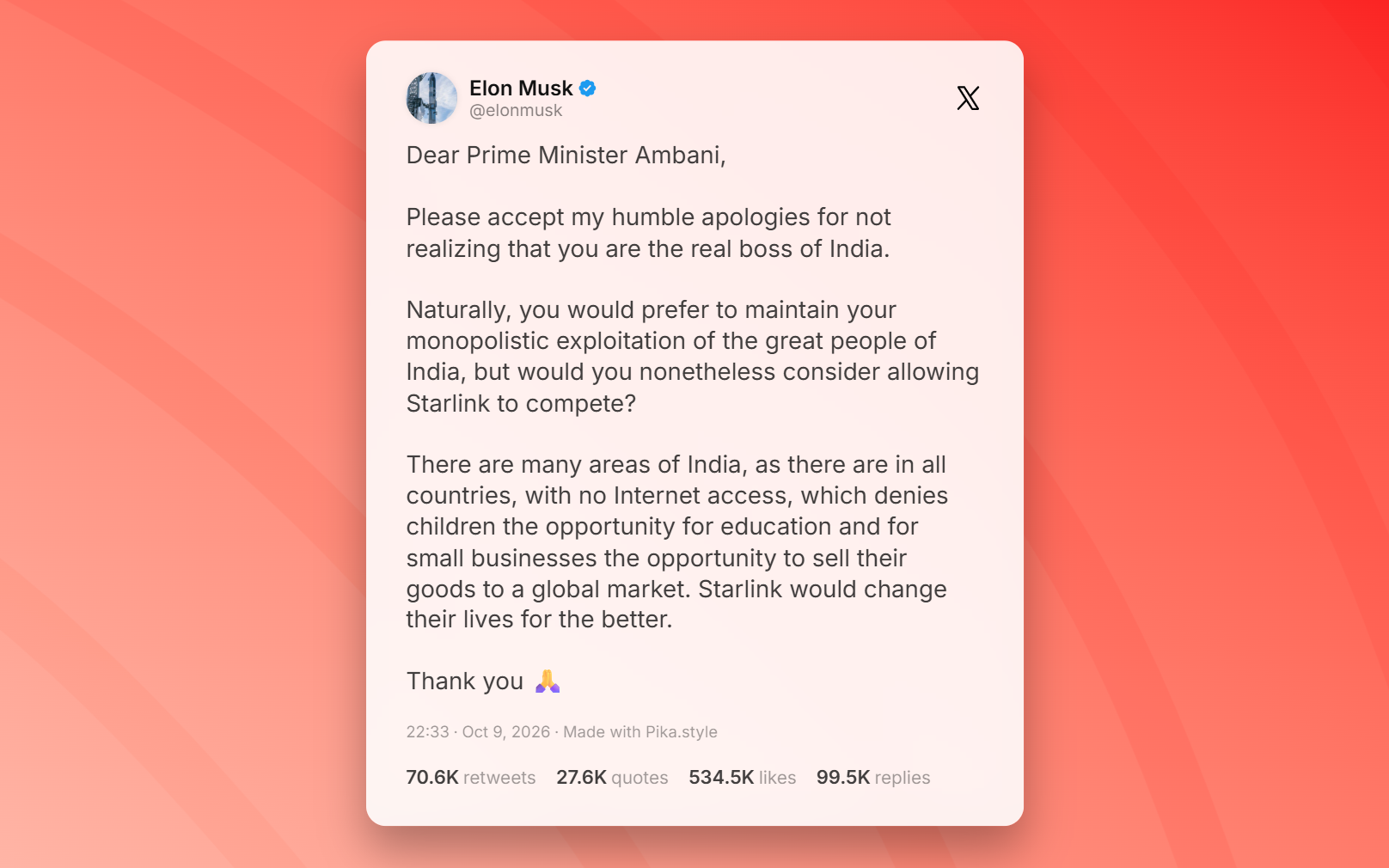
The retort was designed to play directly to international tropes: an enterprising American innovator thwarted by domestic corporate patronage and entrenched Asian protectionism. Commentators quickly dusted off familiar critiques of India's business landscape, arguing that New Delhi was once again shielding domestic conglomerates from foreign market discipline.
Yet this narrative omits the geopolitical reality of modern technology markets. The accusation that India is uniquely protectionist ignores the fact that the United States has spent the past decade constructing the most comprehensive apparatus of state-directed technological protectionism in modern history. From banning telecommunications hardware to forcing the fire sale of consumer apps and slapping triple-digit tariffs on electric vehicles, Washington has made clear that when critical markets, digital infrastructure, or industrial leadership are at stake, classical free-market orthodoxies are discarded.
The Satellite Squabble: Auctions, Gateways, and Sovereignty
To understand why Musk is frustrated, one has to examine what is actually happening in New Delhi's corridors of power. The standoff between Starlink and India’s domestic telecom giants—primarily Ambani’s Reliance Jio and Sunil Bharti Mittal’s Bharti Airtel—has centred on two contentious issues: how satellite spectrum should be awarded, and how foreign constellations must comply with Indian national security mandates.
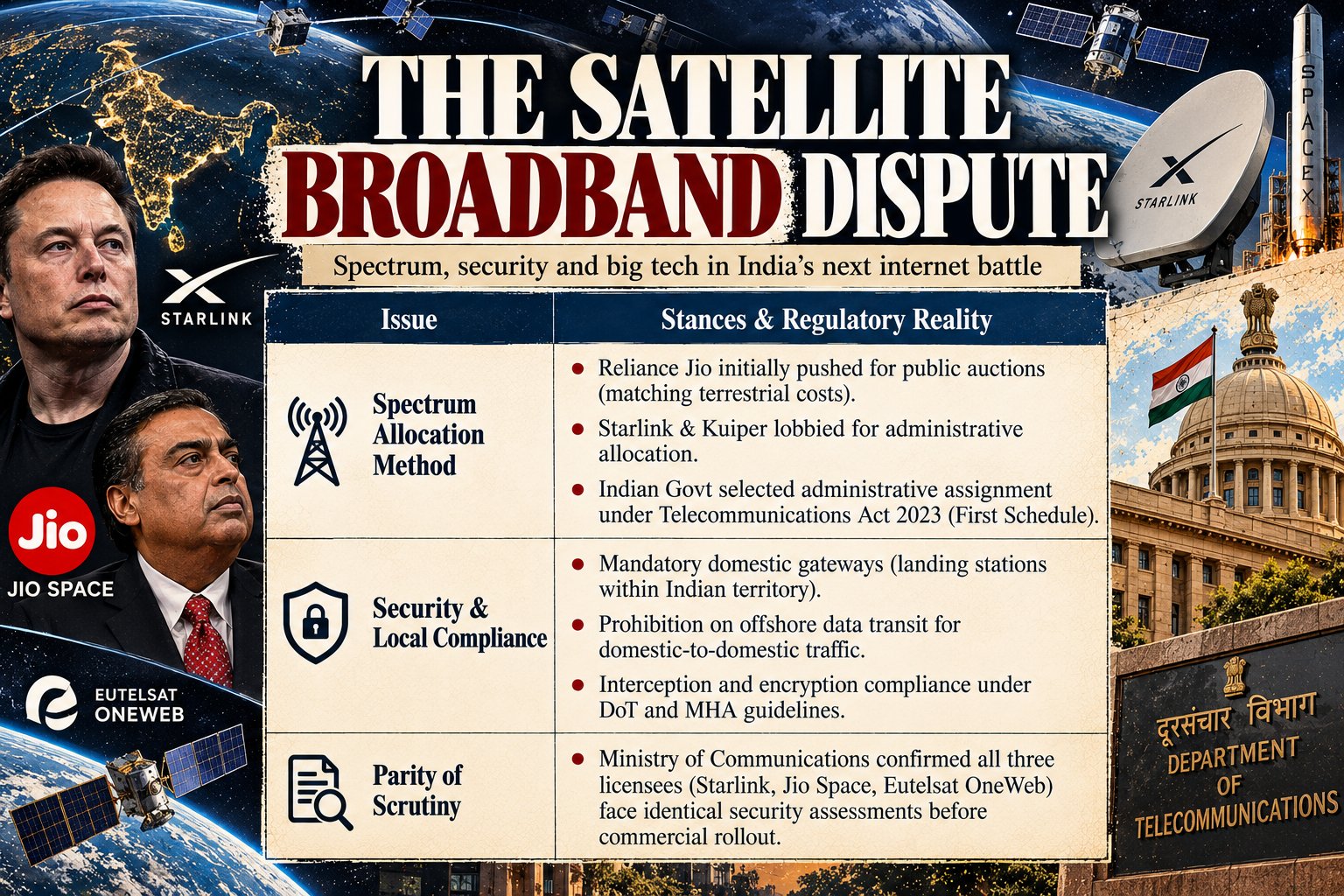
For months, Reliance Jio lobbied the Telecom Regulatory Authority of India (TRAI) to auction satellite broadband spectrum, arguing that administrative grants would confer an unfair windfall on foreign low-Earth orbit (LEO) operators at the expense of domestic telcos who have collectively invested upwards of ₹2 lakh crore ($24 billion) in auctioned terrestrial spectrum. Musk countered that spectrum for space communications is a shared resource that the International Telecommunication Union (ITU) recommends assigning administratively.
The Indian government sided with Musk on the core mechanism. Under Section 4 and the First Schedule of the Telecommunications Act 2023, New Delhi explicitly exempted satellite communication services from mandatory auctions, paving the way for administrative allocation.
The remaining delay is not commercial favouritism, but national security compliance. The Ministry of Communications confirmed that Starlink, Bharti-backed Eutelsat OneWeb, and Reliance-backed Jio Satellite Communications are all undergoing the same security assessment. Indian regulators require satcom operators to route domestic data through local ground stations, maintain lawful interception capabilities under the Ministry of Home Affairs, and disclose ownership patterns.
Lauren Dreyer, Starlink's vice president of business operations, acknowledged at the India Mobile Congress that the company has built 20 ground gateway sites in India to ensure domestic user data remains within sovereign borders. A country that borders volatile neighbours and manages complex internal security challenges cannot simply wave through an offshore-controlled satellite constellation without verifying where the signals land, who holds the cryptographic keys, and how data is archived.
The Beltway’s Iron Curtain: Huawei, ZTE, and the "Covered List"
While American corporate leaders lament regulatory scrutiny in foreign jurisdictions, Washington routinely invokes national security to exclude competitors that threaten American market dominance or strategic autonomy.
The primary example remains the systemic dismantling of Chinese telecommunications equipment makers in the American market:
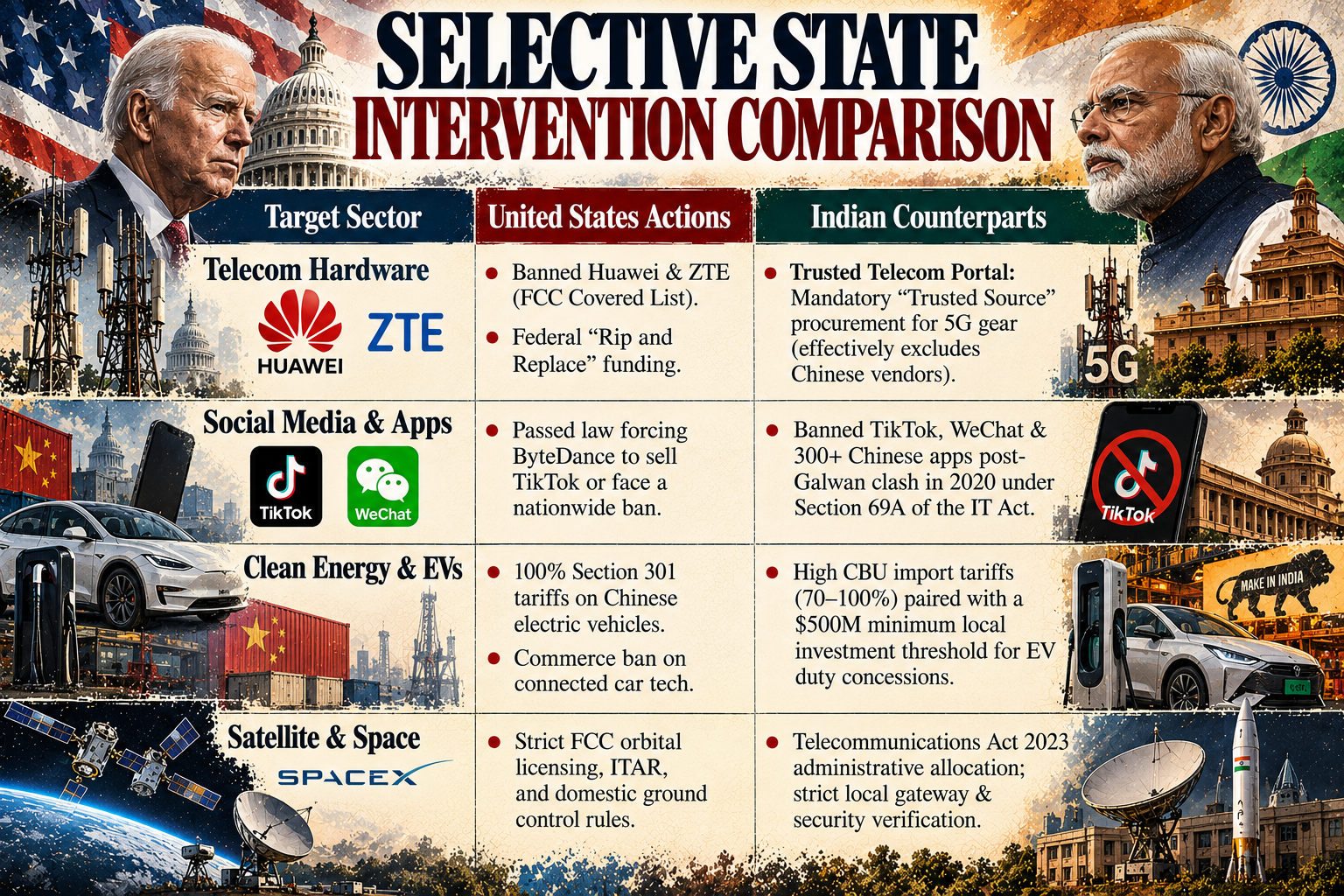
Statutory Prohibition: Under the Secure and Trusted Communications Networks Act of 2019, the Federal Communications Commission (FCC) prohibited US carriers from using universal service subsidies to purchase equipment from companies deemed to pose an unacceptable risk to national security.
The "Rip and Replace" Mandate: In November 2022, the FCC went further, formally banning the sale and import of all new telecommunications equipment manufactured by Huawei Technologies and ZTE. Congress appropriated billions of dollars to forcibly rip out existing hardware from American rural networks.
Export Controls and Choke points: The US Department of Commerce placed Huawei on its Entity List, cutting off access to American software, Google Mobile Services, and advanced semiconductor foundries like TSMC that rely on American EDA tools and lithography technology.
Washington’s core justification was straightforward: telecommunications networks are critical national infrastructure. Having foreign hardware embedded in switching centres and cell towers creates intolerable espionage and sabotage vulnerabilities.
That logic is coherent. But it is fundamentally the same logic New Delhi applies when examining foreign satcom terminals and low-Earth orbit satellite routing. If the United States cannot tolerate Huawei selling base stations to rural carriers in Montana, it is difficult to see why India must permit an offshore satellite fleet to operate across its borders without thorough domestic security verification.
Banning the Algorithmic Challenger: The TikTok Divestment
If hardware bans were not enough to demonstrate Washington’s willingness to deploy state power against foreign platforms, the bipartisan crusade against TikTok established a far more aggressive precedent.
In April 2024, the US Congress passed, and the President signed into law, the Protecting Americans from Foreign Adversary Controlled Applications Act. The statute presented ByteDance with an ultimatum: sell TikTok’s American operations to a vetted non-adversary buyer within 270 days, or face a complete prohibition across American app stores and hosting infrastructure.
The TikTok measure was not framed by lawmakers as anti-competitive protectionism to benefit Meta or Alphabet, though it directly insulated American digital ad duopolies from an aggressive foreign challenger. It was framed as an essential measure of digital sovereignty—protecting the personal data of 17 crore American users (170 million users) from foreign intelligence laws and preventing algorithmic manipulation.
India took the lead on this exact policy four years earlier. In June 2020, following military clashes along the Line of Actual Control in Galwan, New Delhi banned TikTok along with over 300 Chinese applications under Section 69A of the Information Technology Act. At the time, Western media outlets questioned whether the move was an overreach. Today, Washington has adopted the exact same playbook, codifying state-mandated digital expulsion as mainstream statecraft.
The 100% Wall Against BYD and Clean Tech
The double standard becomes starker when shifting from data to physical manufacturing—particularly the electric vehicle sector that forms the bedrock of Musk's personal fortune.
In May 2024, the Biden administration finalised a sweeping tariff revision under Section 301 of the Trade Act of 1974, quadrupling import tariffs on Chinese electric vehicles from 25% to 100%. The tariff effectively barred BYD, Geely, and other Chinese EV manufacturers from competing in the US market. The White House followed this with a proposed Department of Commerce rule prohibiting connected-vehicle hardware and software from Chinese suppliers, citing data privacy and remote takeover risks.
The economic reality is indisputable: BYD sells fully capable, mass-market electric cars such as the Seagull for well under $12,000 in overseas markets—a price point no American car manufacturer can match. Were open competition and market efficiency the primary concern, American consumers would be driving affordable Chinese EVs.
Instead, Washington enacted a complete barrier to protect domestic automakers (including Tesla, General Motors, and Ford) and to shelter the United States' domestic transition under the Inflation Reduction Act’s domestic-content rules.
Musk himself endorsed trade restrictions when Chinese competition was discussed. Speaking during a Tesla earnings call in January 2024, Musk acknowledged that Chinese EV makers were the most competitive in the world, stating:
"Frankly, I think if there are not trade barriers established, they will pretty much demolish most other car companies in the world."
When Western corporate interests face superior state-subsidised foreign competition, erecting tariff walls is framed as pragmatic industrial policy. But when India maintains high Completely Built Unit (CBU) import duties (70% to 100%) on luxury electric cars to force companies like Tesla to invest locally and manufacture in India, it is routinely branded as retrograde protectionism.
The Ukraine Precedent and Orbital Sovereignty
Beyond trade balances, there is an operational reason why sovereign nations hesitate to grant unregulated access to Starlink: the geopolitical reality of privatised space infrastructure.
The war in Ukraine transformed Starlink into an essential battlefield utility, providing resilient communications to Ukrainian frontline units when terrestrial networks were destroyed. But it also exposed the acute vulnerability of relying on a commercial enterprise run by an idiosyncratic executive:
Unilateral Operational Control: Musk publicly acknowledged denying Ukrainian requests to activate Starlink connectivity around Russian-occupied Crimea to support drone strikes on the Russian Black Sea Fleet, stating he wanted to prevent an escalation of the conflict.
Sovereignty Subordination: For sovereign defense establishments, the episode demonstrated that an offshore civilian satellite fleet could dictate the tactical parameters of a sovereign nation's military operations.
Dual-Use Capabilities: Low-Earth orbit satellite networks carry encrypted traffic, command-and-control capabilities, and critical telemetry. They are strategic infrastructure, not consumer novelties like video-streaming services.
For India—a nuclear-armed state managing active territorial disputes along its northern and western borders—granting a foreign entity an unregulated footprint in domestic telecommunications without domestic gateway termination, verifiable audit trails, and strict licensing conditions would be a major strategic oversight.
Beyond Semantic Laundering: Techno-Nationalism as the Global Baseline
The debate sparked by Musk’s attack on Ambani reveals a profound asymmetry in how international economic policy is described.
When a Western power excludes foreign competitors, allocates $52.7 billion in semiconductor subsidies under the CHIPS Act, conditions consumer tax credits on domestic assembly, and forces foreign platforms to divest, the policy is praised as "strategic resilience", "friendshoring", and "de-risking".
When India asks foreign corporations to build local manufacturing plants under Production-Linked Incentive (PLI) programmes, retain user data inside national borders, or submit satellite constellations to the same national security vetting applied to domestic incumbents, it is denounced as "crony capitalism", "bureaucratic obstruction", and "oligarchic protectionism".
India is not immune to corporate lobbying. Reliance Jio and Bharti Airtel are fierce defenders of their commercial turf, and Indian industrial policy has long navigated the influence of domestic conglomerates. But New Delhi’s refusal to grant Starlink a regulatory pass is not a product of backroom deference to Ambani.
It is the application of the same principle that Washington, Brussels, and Beijing follow daily: critical digital and physical infrastructure must remain subordinate to sovereign national law.
If Elon Musk wishes to sell satellite bandwidth in the world’s most populous democracy, he will have to satisfy the same security parameters that foreign operators must navigate in any sovereign nation—including the United States. Blaming "Prime Minister Ambani" on social media makes for viral content, but it cannot disguise the fact that in the 21st century, technological sovereignty is the rule, not the exception.