In brief
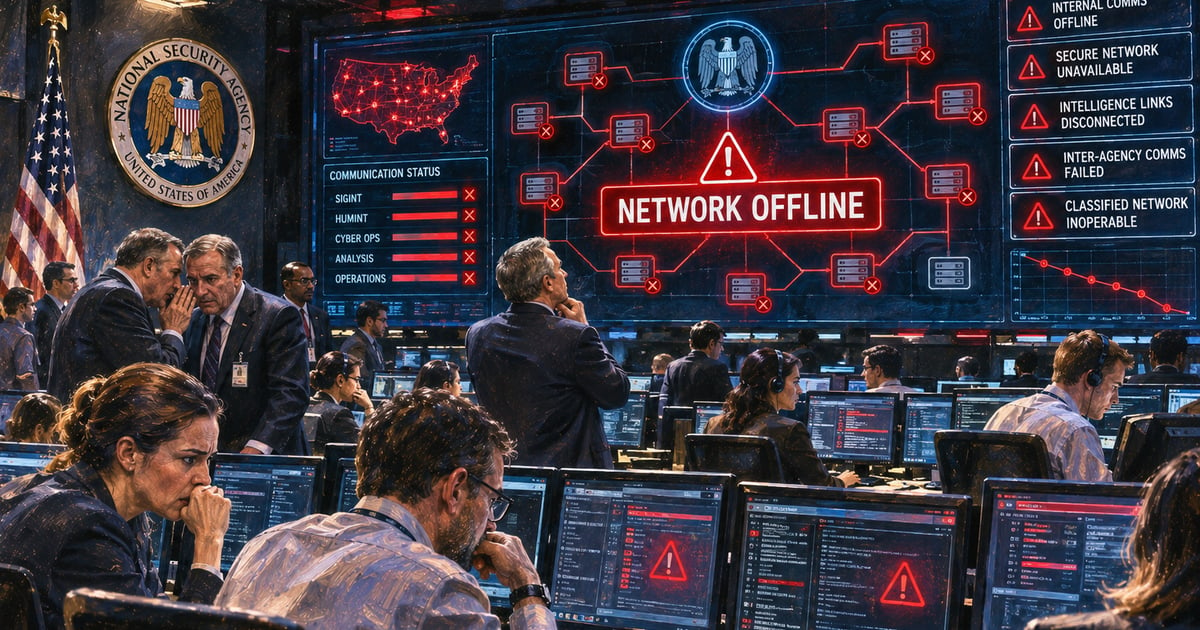
- A software update, not a cyberattack, caused an intermittent outage on the National Security Agency’s internal NSANet on 17 November 2026, delaying opening and causing staggered arrivals at Fort Meade.
- NSANet was not completely shut down but provided intermittent service, with regional backup centres expected to pick up the slack as the Fort Meade campus opened late.
- Officials said the outage would not affect the broader United States Intelligence Community’s ability to share intelligence across agencies, according to reports cited by CNN via CBS 58.
- The incident was described as an internal maintenance and capacity management event linked to patching old systems with new technology, with two operational details still unconfirmed in part due to lack of an official statement.
On Tuesday, 17 November 2026, the National Security Agency’s (NSA) highly classified internal communications network, known as NSANet (or NSA Net), suffered a significant disruption that forced the agency to delay its opening and stagger employee arrivals at its Fort Meade, Maryland headquarters, according to reports from CNN and The Record. Despite immediate public anxiety—driven by four consecutive days of major aviation, banking, and cloud outages across the United States—US officials and people familiar with the incident reported no evidence of a cyberattack, pointing instead to a software update and patching issue.
What Happened to NSANet?
Early on 17 November, CNN reported, citing six people familiar with the matter, that the NSA’s classified internal network had gone down and that specialists were working to determine the scope of the disruption. The Indian Express and Forbes echoed the breaking report, noting that the agency had not yet issued an official public statement.
Later reporting added crucial operational detail that softened the picture of a total blackout. Two people familiar with the situation told The Record that NSANet was not completely shut down, but was instead providing intermittent service. While the agency’s Fort Meade campus experienced a delayed opening and staggered staff arrivals, regional NSA backup centres across the United States were expected to pick up the slack. Importantly, a current and a former US official told CNN (via CBS 58) that an outage on NSANet would not affect the broader US Intelligence Community’s ability to share intelligence across agencies.
Why Did It Happen?
Multiple outlets reported that the disruption was internal and technical rather than hostile:
Software patching, not intrusion: A person familiar with the incident told The Wall Street Journal (as cited by The Jerusalem Post) that the NSA was "simply updating its software to patch the system," adding that NSANet would only be offline temporarily. Nextgov similarly reported that there were no immediate signs of a cyberattack and that the issue appeared linked to software updates.
The broader November 2026 tech outage wave: The NSA incident landed at the tail end of a five-day string of high-profile US infrastructure failures that primed observers to suspect a coordinated attack. Between 12 and 16 November, Microsoft 365 suffered a 24-hour global outage across Outlook and Teams due to server issues; the Federal Aviation Administration (FAA) ordered a nearly five-hour nationwide ground stop on 13 November—blamed on a single router installation in Arkansas—that led to more than 18,000 flight cancellations over three days; Workday experienced HR and payroll disruptions; and both JPMorgan Chase and United Airlines reported software-related operational halts on 16 November.
Ageing infrastructure under modern updates: Speaking to CNBC on 17 November (reported by Channel NewsAsia), US Department of Homeland Security Secretary Markwayne Mullin dismissed fears of a hostile campaign across those failures, stating he could say with "98 per cent certainty" they were not cyberattacks. "Some of the technology that they're pushing out there, they're pushing new technology on top of really old computer systems, and it just seems to overwhelm the system," Mullin said, warning that similar disruptions could recur as upgrades roll out.
While Mullin’s remarks addressed the wider wave of civilian infrastructure failures rather than the NSA’s classified systems specifically, the same structural tension—deploying modern patches onto complex, heavily layered legacy environments—applies acutely to intelligence networks.
How NSANet Works—and How the NSA Contained the Disruption
Understanding why a software update on NSANet required staggered physical commutes at Fort Meade—and why it did not paralyse US intelligence—requires looking at how the network is built.
1. What NSANet Is (and How It Differs from JWICS)
NSANet (National Security Agency Network) is the NSA’s dedicated internal intranet, built from fibre-optic and satellite communication channels largely separated from the public internet, according to publicly documented descriptions. It handles information classified up to Top Secret / Sensitive Compartmented Information (TS/SCI) and connects NSA personnel with civilian and military analysts worldwide.
Crucially, it sits alongside—rather than replacing—the Pentagon’s three primary inter-agency networks:
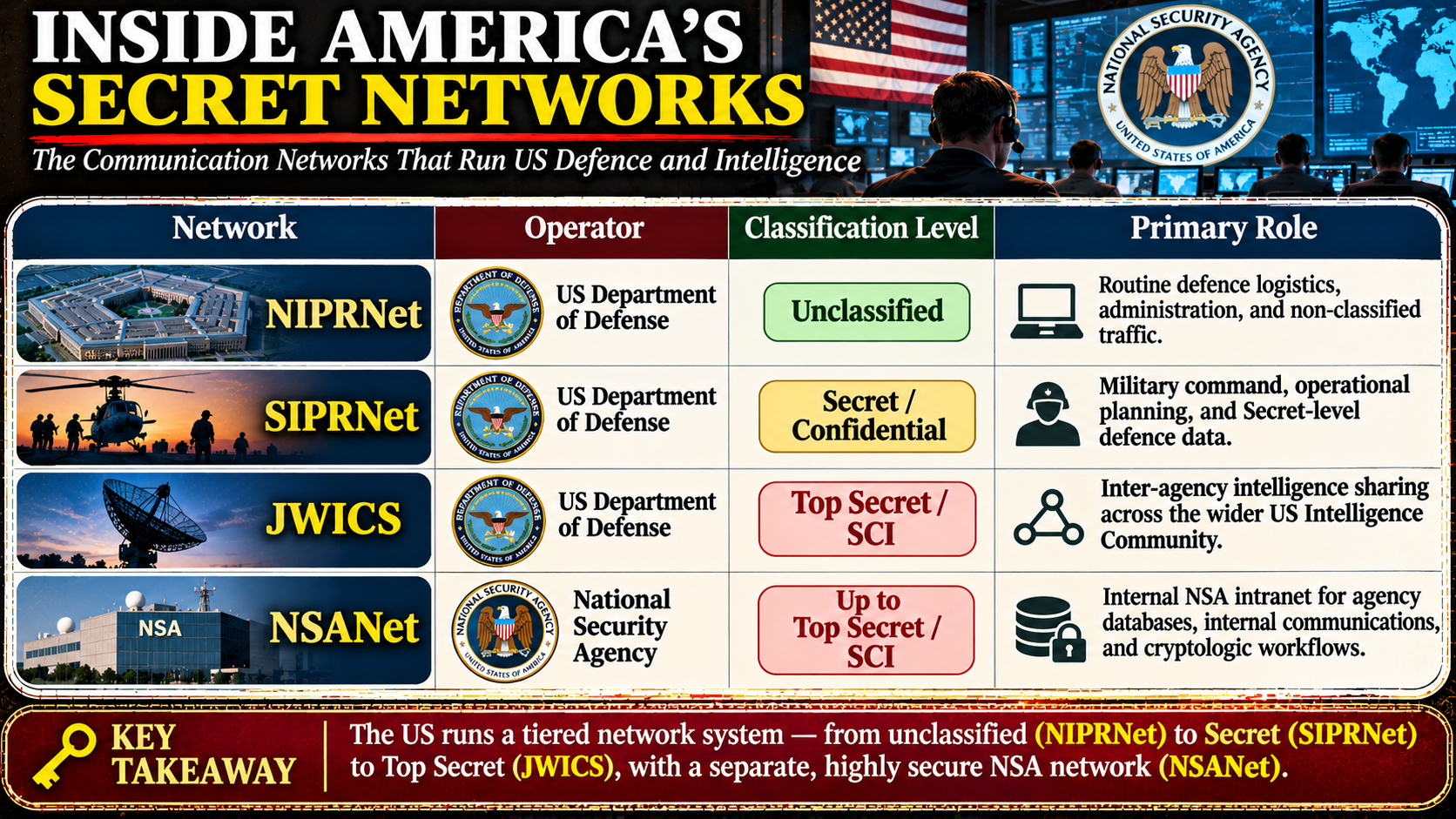
Because inter-agency intelligence distribution relies on networks such as JWICS, an internal fault on NSANet isolates NSA employees from their own agency’s internal databases and messaging without severing the broader intelligence community’s communications backbone.
2. High-Security Overhead and Patching Brittleness
NSANet is engineered for strict internal surveillance and compartmentalisation: every keystroke is logged, user activity is audited at random, and document downloads or printing are recorded (NSA overview). Historically, the network has also supported a sprawling mix of operating systems—reportedly more than twenty commercial off-the-shelf platforms as of 2004—alongside specialised cryptographic and auditing layers. Pushing a software patch across an air-gapped, multi-OS environment with continuous logging cannot be handled with the automated cloud rollouts used on commercial networks; any incompatibility between an update and legacy authentication or logging daemons can degrade network throughput.
3. Why Fort Meade Staggered Arrivals
Roughly two-thirds of the NSA’s estimated 30,000 to 40,000 personnel work at Fort Meade, Maryland. When a classified network is running intermittently after a patch, the highest-risk moment for total collapse is the morning login window, when tens of thousands of workstations simultaneously attempt cryptographic handshakes, directory lookups, and keystroke-logging initialisations. As one source explained to The Record, NSA officials ordered staggered arrivals specifically to flatten that simultaneous sign-in spike, while routing critical continuity tasks to geographically dispersed backup centres until the patch stabilised.
What Remains Unresolved
Because the NSA had not issued an official public statement as of 17 November 2026, two operational details remain unconfirmed: which specific software patch or subsystem triggered the intermittent service, and how long full restoration took across all Fort Meade terminals. What is clear from cross-outlet reporting is that the incident was an internal maintenance and capacity-management event—one whose timing, amid a week of civilian tech failures, amplified public alarm far beyond its actual national-security impact.