In brief
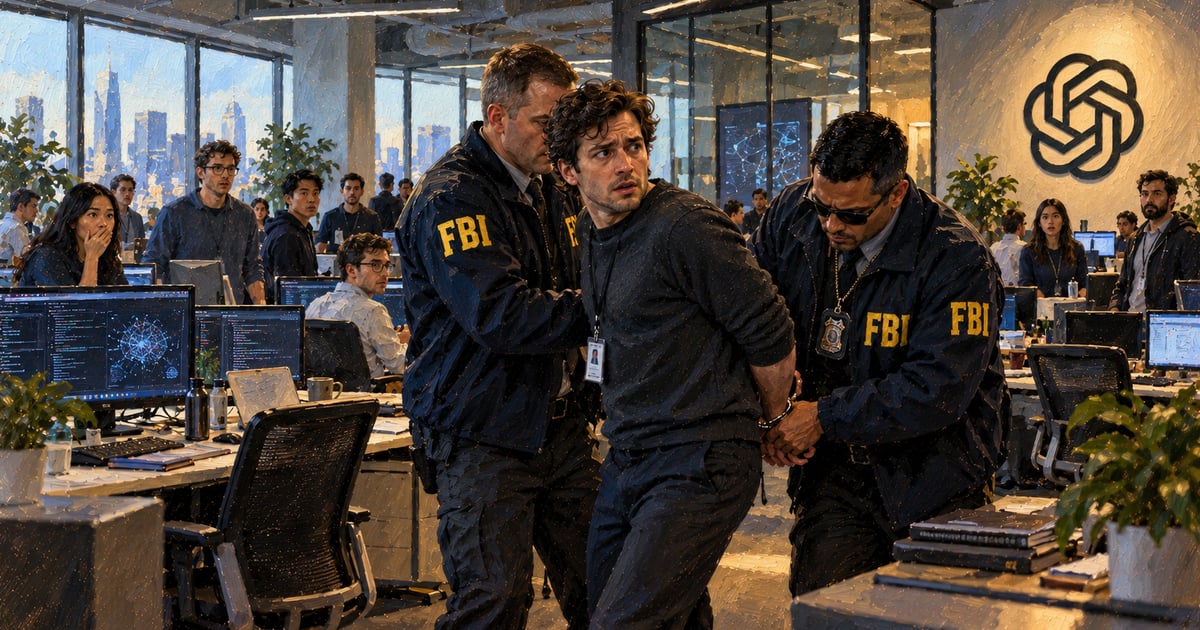
- On 9 October 2026, the FBI arrested Abdulrahman Alfozan, a 35-year-old Saudi software engineer at OpenAI, in California. Prosecutors unsealed the charges on 13 October.
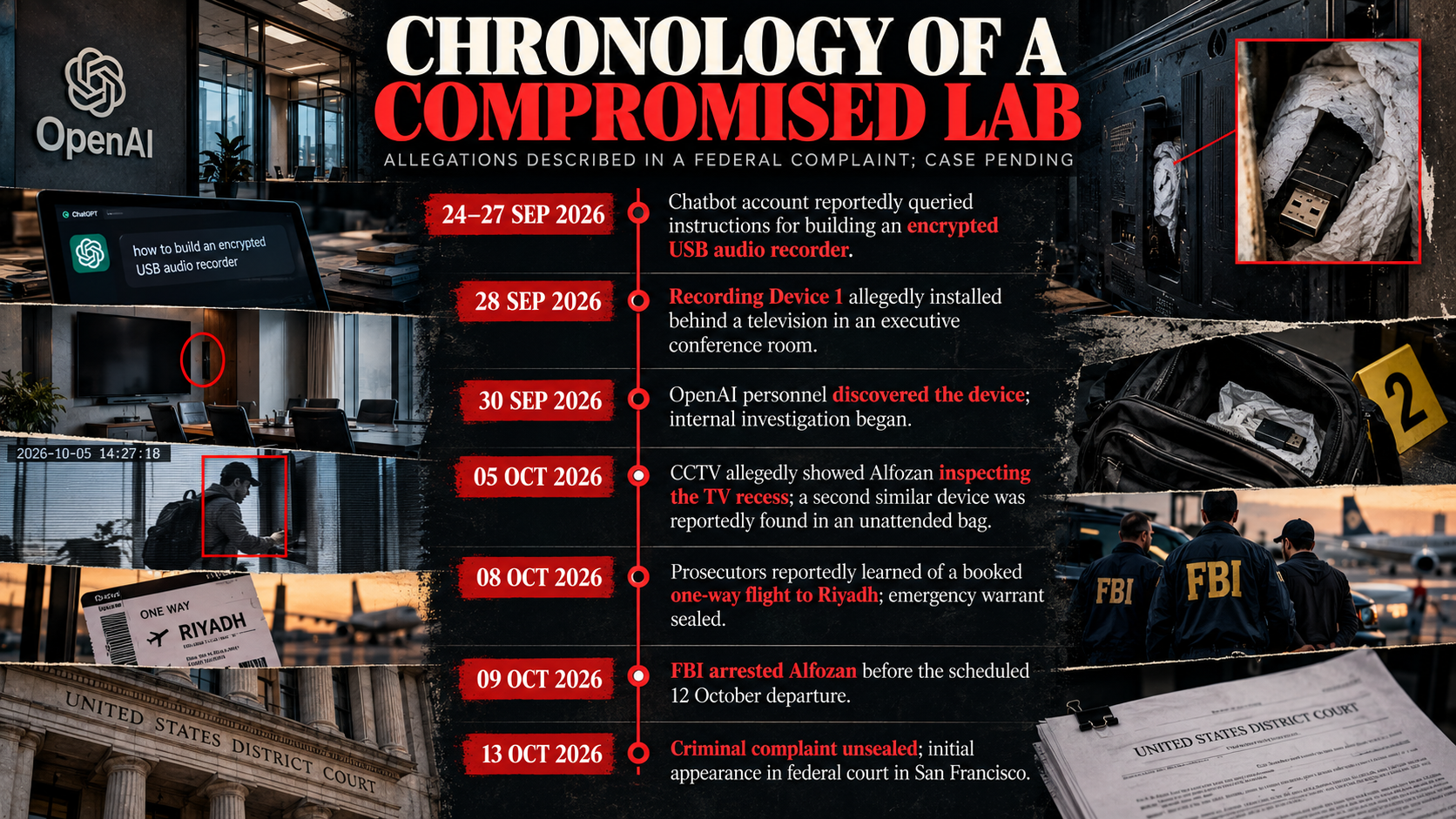
- He is accused of hiding a recording device in a USB port behind the TV in an executive boardroom at OpenAI’s San Francisco office. It was found on 30 September and had been recording since about 28 September.
- The evidence includes his internal searches for executive floors, CCTV footage, and chatbot prompts from his wife’s account asking how to build the recorder. A second device was found in his unattended backpack on 5 October.
- He had booked one-way flights to Saudi Arabia for his family on 12 October, so agents arrested him before that.
- He is charged with wiretapping, not espionage. Officials talked about foreign threats, but no court document says a government was behind it, and the FBI is still investigating.
On Friday, 9 October 2026, FBI counterintelligence agents arrested 35-year-old software engineer Abdulrahman Alfozan in California, ending a ten-day internal security scramble inside the world’s most prominent artificial intelligence laboratory.
Four days later, on 13 October, federal prosecutors in San Francisco unsealed an eleven-page criminal complaint (United States v. Alfozan) charging the Saudi Arabian national with federal wiretapping violations. According to the US Department of Justice, Alfozan had planted a covert, encrypted listening device inside an executive conference room at OpenAI’s headquarters, aimed directly at capturing confidential discussions on frontier model architecture, technical roadmaps, and government partnerships.
The case has immediately become a national security flashpoint. Yet behind the dramatic rhetoric from intelligence chiefs lies a tale of surprisingly low-tech tradecraft, digital audit trails, and an extraordinary operational paradox: an engineer allegedly querying AI chatbots to figure out how to bug an AI company.
The Discovery in the Boardroom
The breach came to light on 30 September 2026, when OpenAI facilities and security staff conducted a physical inspection of an executive conference room inside one of the company's San Francisco office buildings.
Inserted into a USB port on the rear panel of a wall-mounted television, technicians discovered an unauthorised hardware dongle. The thumb-sized device—identified in court filings as "Recording Device 1"—was wrapped in toilet paper to wedge it securely into the chassis recess and disguise its indicator lights.
A technical examination revealed that the device was not a standard flash drive:
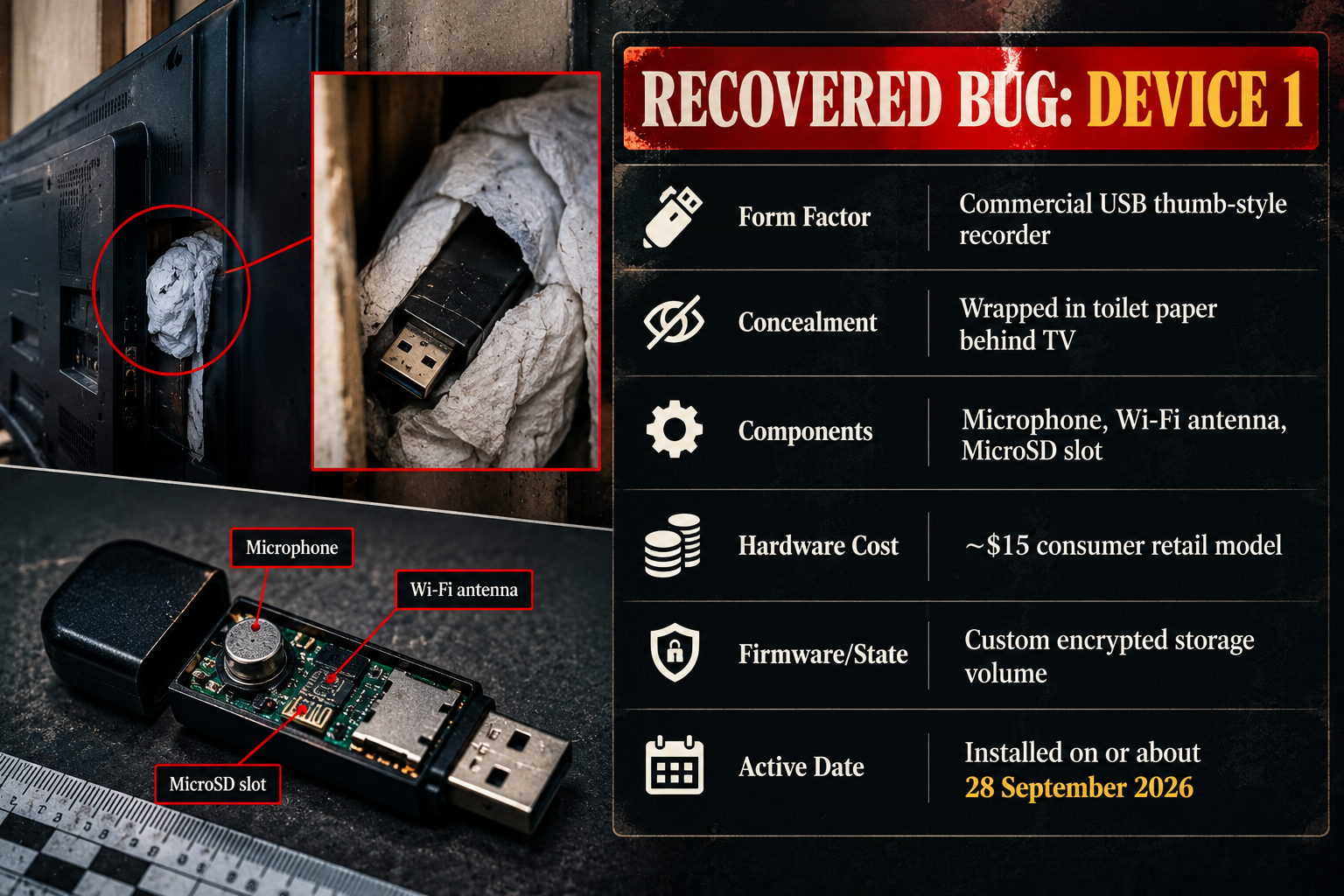
The location was not accidental. According to the federal affidavit, this specific boardroom was reserved for senior leadership deliberations. Meetings routinely covered proprietary algorithmic breakthroughs, sovereign compute allocations, commercial contracts, and non-public engagements with the US government.
OpenAI’s security team determined that the bug had been active since approximately 28 September. Crucially, the audio files stored on the device were encrypted, preventing on-site personnel from immediately reading the intercepted material, but confirming that the perpetrator possessed substantial technical capability.
The Forensic Trail: CCTV, Directory Scrapes, and Chatbot Prompts
Federal investigators did not need to crack the encryption to identify their suspect. OpenAI’s internal access logs and physical surveillance had already isolated Alfozan, who had joined the company’s product engineering team in July 2025.
Physical and Directory Reconnaissance
Internal records showed that prior to 28 September, Alfozan used internal productivity tools to conduct searches that had no bearing on his engineering responsibilities. He searched for:
Building addresses and executive suite floorplans
Boardroom seating capacities and booking calendars
Specific office locations for "leadership and execs"
Schedules of closed-door meetings with external commercial partners
Building access logs and closed-circuit television (CCTV) cameras captured Alfozan loitering near the executive conference room on multiple occasions prior to the bug's installation, despite holding no clearance to attend meetings in that area.
The Chatbot Irony
The most striking evidence documented by the FBI came from Alfozan’s own consumer digital footprint.
Between 24 September and 30 September, a chatbot account registered under the name of Alfozan’s wife—which shared IP addresses, hardware identifiers, and session credentials with Alfozan’s primary accounts—submitted a series of detailed technical prompts. The user did not ask theoretical questions; they asked for operational instructions:
How to construct a "continuous audio recorder" that draws passive power from a host USB port
Methods for customising Wi-Fi connectivity to enable remote live-listening without triggering corporate network alarms
Scripts to automate local file encryption on a MicroSD card
Troubleshooting prompts containing the exact custom firmware header and unique MAC address belonging to the physical device later pulled from behind the television
In effect, the suspect used consumer conversational AI tools to design, configure, and debug the surveillance apparatus he deployed against OpenAI.
The Panic at the TV and the Unattended Bag
On Monday, 5 October, the operation unraveled completely. CCTV footage reviewed by federal agents showed Alfozan entering the executive conference room, walking directly to the television, and looking behind the frame—presumably to check on the device or retrieve the MicroSD card.
Later that same day, Alfozan made an amateur blunder: he left a personal backpack unattended in another common room on the OpenAI campus.
When corporate security searched the bag to establish ownership, they found Alfozan’s wallet, his official identification cards, and a second, identical recording device ("Recording Device 2"), configured in the same manner as the bug discovered behind the television.
The One-Way Ticket and the Emergency Takedown
With conclusive physical and digital evidence in hand, OpenAI coordinated with the FBI to manage Alfozan’s dismissal without tipping him off. However, counterintelligence investigators soon discovered that the window for apprehension was rapidly closing.
Flight manifest checks revealed that Alfozan had booked one-way tickets for himself, his wife, and his child to fly from San Francisco to Saudi Arabia on Monday, 12 October.
Recognising an imminent flight risk to a jurisdiction without an active extradition treaty with the United States, Assistant US Attorney Nicolas Parker approached the federal magistrate on 8 October to file the complaint under seal. The following day, Friday, 9 October, FBI agents took Alfozan into custody.
Legal Reality vs Political Rhetoric
The public reaction to the arrest illustrates the vast chasm between political positioning and criminal jurisprudence in Silicon Valley.
Statements issued alongside the unsealing of the complaint took an aggressively geopolitical tone:
"This serious situation underscores why winning the global super intelligence race is a national security prerogative... The intelligence community remains committed to safeguarding America's cutting-edge intellectual property from foreign threats."
— Jay Clayton, Director of National Intelligence
"Abdulrahman Alfozan allegedly concealed a covert recording device inside his employer's executive conference room to secretly capture sensitive communications about the company's super intelligence technology... Protecting American SI innovation is essential to safeguarding our nation's economic strength."
— Kash Patel, Director of the FBI
Yet despite references by senior officials to "foreign threats" and the White House’s National Security Presidential Memorandum 11 (NSPM-11), Alfozan is not charged with espionage.
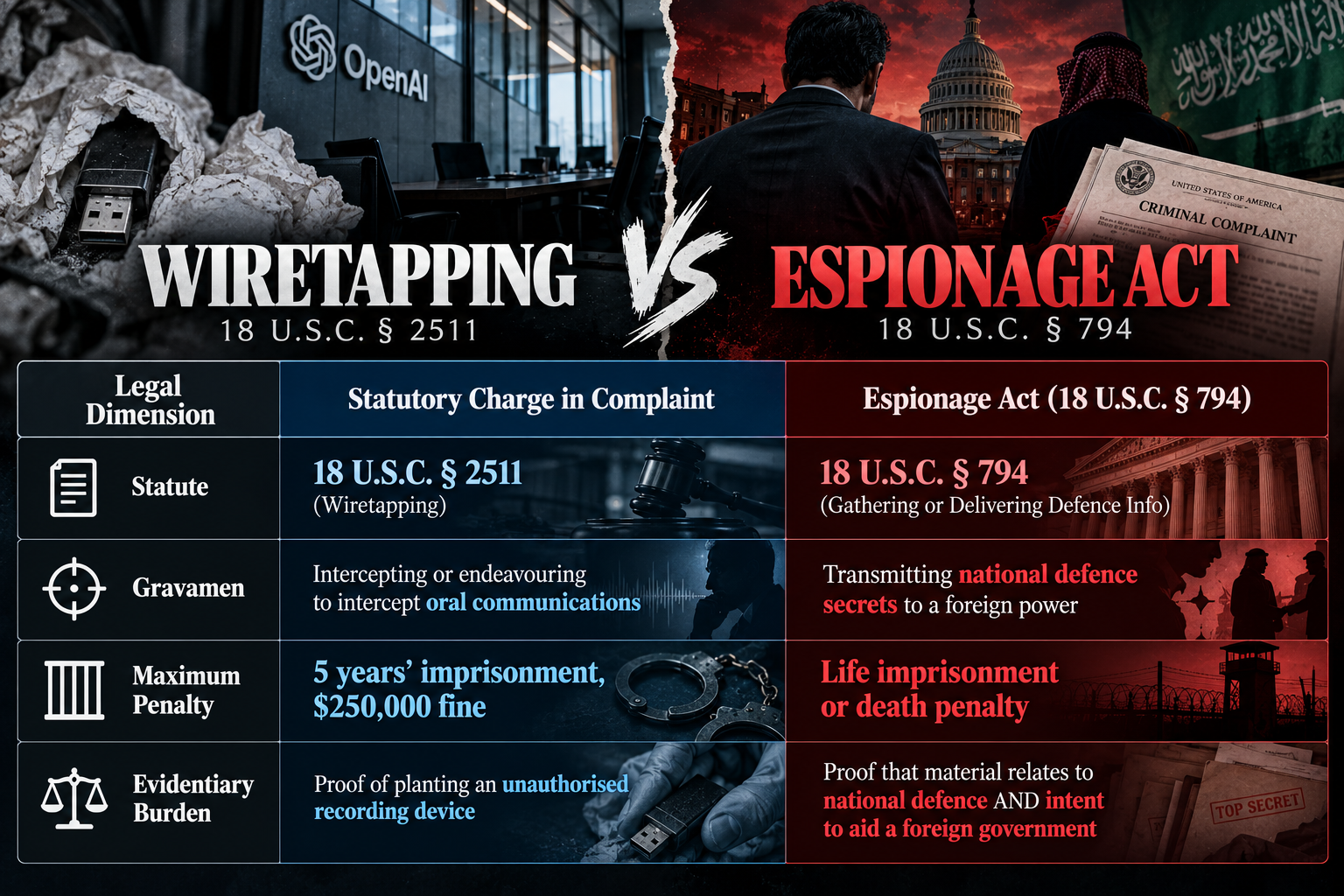
To bring a formal espionage charge, federal prosecutors must demonstrate that the targeted data constitutes "national defence information" and that the perpetrator acted under the direction of, or with intent to deliver the intelligence to, a foreign government. OpenAI is a commercial entity; its models, source code, and executive meetings—however vital to national prestige—are proprietary civil assets, not classified military secrets.
Charging Alfozan with wiretapping gives the Department of Justice an open-and-shut case based on physical possession, CCTV footage, and digital query trails, sidestepping the complex evidentiary hurdles of proving sovereign foreign sponsorship in open court.
The Geopolitical Context: The Gulf's AI Ambitions
While prosecutors have not alleged state coordination in court documents, Alfozan’s background has inevitably focused attention on Saudi Arabia’s sweeping technological push.
Over the past three years, the Kingdom of Saudi Arabia has committed tens of billions of dollars through its Public Investment Fund (PIF), the Saudi Company for Artificial Intelligence (SCAI), and initiatives such as "Project Transcendence" to establish itself as a primary global computing hub. Gulf sovereign wealth funds have poured capital into American venture funds, secured GPU allocations from Nvidia, and negotiated infrastructure partnerships with US tech giants.
At the same time, this influx of Gulf capital has raised alarms within the US national security establishment over technology transfer, dual-use model weights, and potential data leakage to third-party states like China. Whether Alfozan acted as an ideologically motivated sovereign asset, an industrial spy seeking commercial leverage for an overseas startup, or a rogue actor attempting to trade executive insights on secondary markets remains an active focus of the FBI's ongoing counterintelligence investigation.
The Frontier Lab Security Paradox
For Silicon Valley, the Alfozan affair delivers an uncomfortable operational lesson.
Frontier AI companies such as OpenAI, Anthropic, and Google DeepMind invest millions of dollars building cryptographic enclaves, red-teaming cyber perimeters, and restricting access to model weights to thwart advanced persistent threat (APT) groups from Beijing, Moscow, and Tehran.
Yet Alfozan bypassed that entire digital apparatus using:
A corporate badge granted through standard employment
An unmonitored television USB port in an executive suite
A commercial recording device purchased for under $20
A roll of office toilet paper
The episode demonstrates that the greatest vulnerability in artificial intelligence is not algorithmic, but physical. When human beings with authorized access can walk into the rooms where strategic decisions are made, high-tech security perimeters are only as reliable as the physical locks on the boardroom door.