In brief
- Pakistan's political establishment is pushing to redraw provincial borders for the first time since 1970, proposing 12-15 new provinces via a 28th Constitutional Amendment, which analysts say would strengthen military control.
- Four giant provinces concentrate power and budgets in four capitals, leaving rural areas underserved and Islamabad fiscally squeezed with only 4.7% of GDP spent locally despite provinces receiving 57.5% of divisible tax pool.
- The 2025 27th Amendment gave Field Marshal Asim Munir sweeping powers; splitting provinces would break civilian political bases, force NFC rewrite, weaken resource bargaining, and reduce provincial resistance to security centralisation.
- Constitutional vetoes, unresolved FATA merger costs, and insurgency risks block the plan; empowering 160 district governments under existing Article 140-A would fix services without dismantling provincial autonomy.
Pakistan has not redrawn its internal provincial borders since 1970, when General Yahya Khan dissolved the "One Unit" scheme that had lumped all of West Pakistan into a single administrative bloc. In the autumn of 2026, however, the country’s political establishment has reopened that map with unusual urgency.
On 9 November 2026, Defence Minister Khawaja Asif publicly endorsed creating up to 12 provinces, arguing to Geo News that Pakistan’s population growth has outgrown four oversized provincial capitals (Dawn, 9 November 2026). His remarks followed similar interventions from Interior Minister Mohsin Naqvi—who floated a nationwide referendum—and Planning Minister Ahsan Iqbal, who proposed either 15 provinces or empowering 160 district governments (Arab News Pakistan, 4 September 2026).
No formal bill has reached Parliament. Yet reporting in The Economist and Pakistani outlets describes a draft concept—potentially packaged into a 28th Constitutional Amendment in 2027—that would split Punjab into four provinces, Khyber Pakhtunkhwa (KP) and Balochistan into three each, and Sindh into two (Gulf News, 9 November 2026).
To understand why this idea has returned now—and why critics warn it would hand the Pakistan Army unprecedented leverage—requires looking at two things at once: the genuine dysfunction of Pakistan’s four-province federation, and the sweeping centralisation of military power already enacted in 2025.
The Structural Problem: Four Giant Provinces and a Fiscal Squeeze
Pakistan’s federal map is one of the most skewed in the developing world. According to the 2023 Digital Census, the country’s four provinces and Islamabad Capital Territory (ICT) hold 241.50 million people (24.15 crore, rising to 247.54 million when Gilgit-Baltistan and Azad Kashmir are included), yet power and budgets are concentrated in just four provincial capitals (Pakistan Bureau of Statistics / Census 2023).
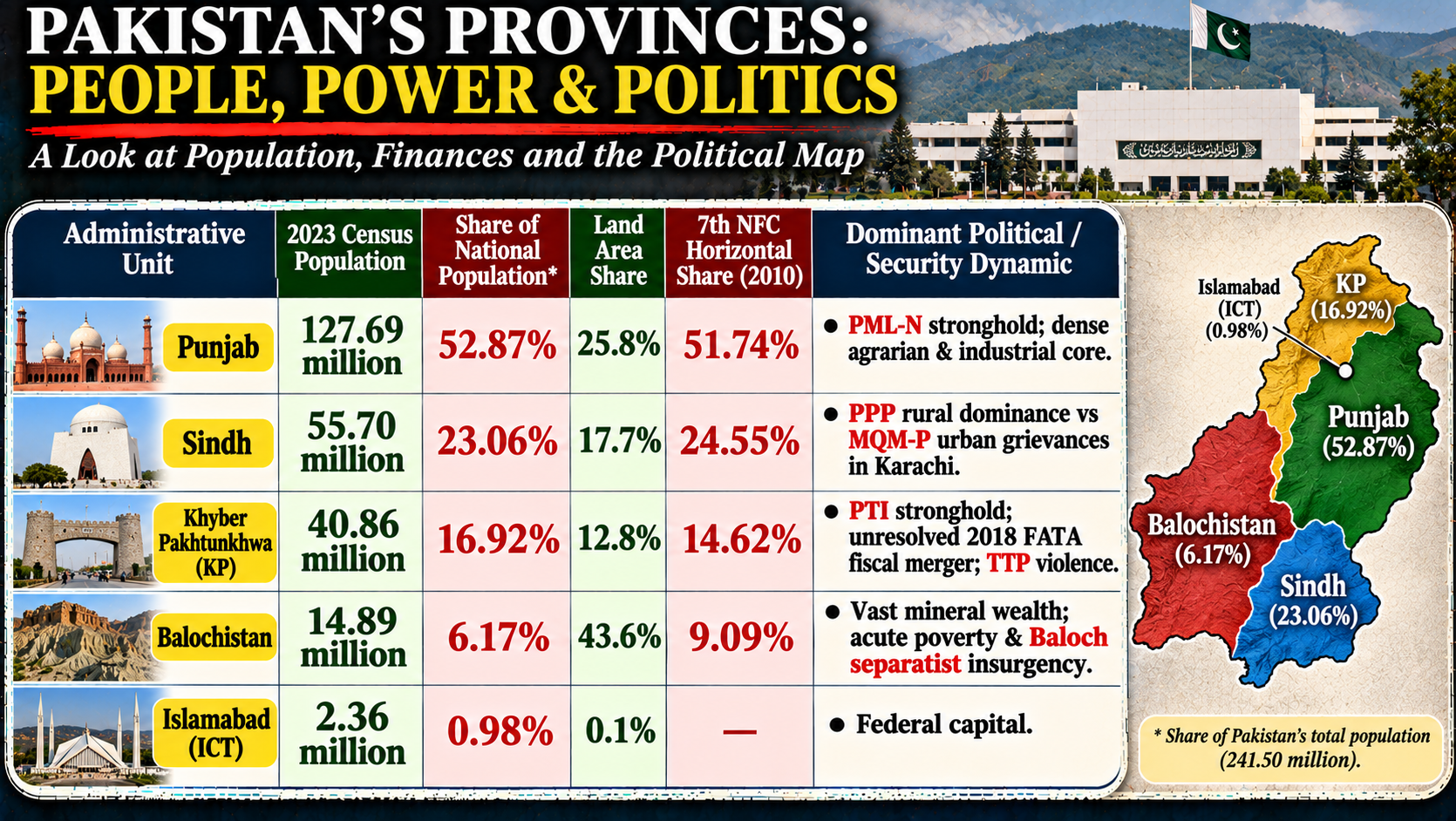
*Shares across the four provinces and ICT (241.50 million total). Sources: Pakistan Bureau of Statistics / Census 2023 and 7th NFC Award (2010).
Two grievances flow directly from this imbalance:
Over-centralised provincial capitals: In rural southern Punjab (the Saraiki and Bahawalpur belts) or Hazara in KP, citizens travel hours to reach Lahore or Peshawar for basic administrative work. In Karachi—Pakistan’s commercial engine—the Muttahida Qaumi Movement-Pakistan (MQM-P) has renewed its demand for new administrative units in urban Sindh, arguing that rural-dominated provincial governments starve Karachi of municipal funds (Dawn, 9 November 2026).
Islamabad’s NFC fiscal trap: Under the 18th Constitutional Amendment (2010) and the 7th National Finance Commission (NFC) Award, the federal government’s share of the divisible tax pool was cut to 42.5%, while 57.5% was handed to the provinces—distributed horizontally using a formula weighted 82% by population, 10.3% by poverty, 5% by revenue generation, and 2.7% by inverse population density (7th NFC Award Document). Crucially, Article 160(3A) bars the centre from reducing any province’s share below the previous award. With federal provincial transfers hitting roughly PKR 8.4 trillion in FY 2025–26 (Dawn, September 2025), Islamabad is left paying debt service and defence bills out of a shrinking slice while provincial capitals sit on devolved powers—and pass very little down. Former finance ministry adviser Khaqan Najeeb told Arab News that only 4.7% of Pakistan’s GDP is spent locally (Arab News Pakistan, 4 September 2026).
How Splitting the Provinces Could Empower the Pakistani Army
If the fiscal and administrative complaints are real, why do international analysts and Pakistani opposition figures see the hand of Rawalpindi behind the 12-to-15-province push?
The answer lies in what happened a year earlier. On 13 November 2025, Parliament passed the 27th Constitutional Amendment, creating the post of Chief of Defence Forces (CDF)—held concurrently by Field Marshal Asim Munir (promoted in May 2025)—giving him formal primacy over the air force and navy, direct command over the Strategic Plans Division (which oversees Pakistan’s nuclear arsenal), lifetime immunity from prosecution, and a reset five-year term running until 2030, beyond the next general election (Chatham House, 2 December 2025; Al Jazeera, 4 September 2026).
In December 2025, Chatham House warned that a follow-on 28th Constitutional Amendment could seek to "re-organize Pakistan’s existing federal structure and restrict smaller provinces’—such as Balochistan—share of federal revenues" (Chatham House). In October 2026, The Economist reported that Field Marshal Munir was weighing precisely such a 12-to-15-province map. Analysts identify four concrete ways that restructuring strengthens the military establishment:
1. Breaking Civilian Political Counterweights
Pakistan’s four provinces are not merely administrative lines; they are entrenched political power bases. Punjab (PML-N) and Sindh (PPP) command large civil bureaucracies, multi-trillion-rupee budgets, and cohesive electoral machines that have historically forced even military rulers to negotiate. Splitting Punjab into four and Sindh into two replaces two heavyweight chief ministers with six smaller provincial administrations—each narrower in tax base, weaker in political clout, and easier for a military-backed centre to manage or play against one another (Times of India / The Economist, 15 October 2026).
2. Reopening the 18th Amendment and NFC Lock-In
Because Article 160(3A) freezes provincial revenue shares under the existing four-province compact, Islamabad has struggled to claw back fiscal space for federal and defence spending. Dissolving and reconstituting the four provinces into 12 or 15 new entities would force a complete rewrite of the NFC Award and potentially the 18th Amendment’s devolution framework—giving the centre a once-in-a-generation opening to recentralise revenue and authority.
3. Tipping Leverage Over Mineral and Natural Resources
Under revised Article 172 of the 18th Amendment, mineral oil, natural gas, and subsoil resources vest jointly and equally in the province and the federal government (Publius / Oxford Academic). A unified Balochistan or Sindh government can bargain hard—or stall—over mining royalties and mega-projects. Smaller, fiscally dependent sub-provinces carved out of Balochistan and KP would lack the independent revenue and political weight to push back against federally and military-backed extraction initiatives (Times of India / The Economist).
4. Weakening Provincial Resistance to Security Centralisation
With Imran Khan jailed and his Pakistan Tehreek-e-Insaf (PTI) party governing KP amid escalating TTP militancy, a fragmented provincial map also weakens the ability of any single provincial assembly to act as a platform for anti-establishment mobilisation. Combined with the 27th Amendment’s overhaul of judicial and military appointments—and the military’s expanding footprint in foreign policy, such as troop deployments to Saudi Arabia without parliamentary approval noted by Reuters in October 2026 (Times of India)—smaller provinces would leave fewer institutional buffers between Rawalpindi and the citizen.
Why the Plan Faces Steep Constitutional, Fiscal, and Security Hurdles
Even with backing from federal ministers, turning a 12-to-15-province sketch into law faces three formidable roadblocks:
The Article 239(4) Veto: Under Article 239(4) of Pakistan’s Constitution, altering the boundaries of any province requires a two-thirds majority in both the National Assembly and the Senate, plus a two-thirds majority in the provincial assembly of the affected province (ConstitutionNet, 10 November 2026). The PPP, which governs Sindh and props up Shehbaz Sharif’s coalition in Islamabad, flatly opposes dividing Sindh, and the Sindh Assembly passed a resolution rejecting any split (Times of India). Floating a referendum, as Interior Minister Naqvi has suggested, cannot legally bypass provincial assembly consent without first amending Article 239 itself.
The 2018 FATA Warning & Cost Explosion: Creating 8 to 11 new provinces means funding 8 to 11 new provincial assemblies, chief ministers’ secretariats, governors’ houses, and high courts. KP Finance Adviser Muzzammil Aslam pointed Arab News to Pakistan’s last territorial change—the 2018 merger of seven former tribal districts (FATA) into KP—noting that its financial integration into the NFC Award remains unresolved eight years later: "Imagine, in 8 years they have not sorted just one merger. How can they do it when 15 provinces split?" (Arab News Pakistan, 4 September 2026).
Insurgency & Ethnic Blowback: In Balochistan and KP, where separatist and militant violence already strains state capacity, Chatham House and legal commentators warn that redrawing provincial borders from the centre without local consent—or cutting provincial resource shares—could fuel nationalist anger rather than calm it (Chatham House; Jurist.org, 10 September 2026).
The Alternative Islamabad Keeps Avoiding
Economists and legal scholars argue that Pakistan does not need 12 new governors and provincial cabinets to fix broken policing, schools, or sewage. Article 140-A of the Constitution already obliges provinces to devolve political, administrative, and financial responsibility to elected local governments. Yet across all four provinces, provincial assemblies have routinely delayed local elections or starved municipal bodies of funds, keeping local spending at 4.7% of GDP (Arab News).
That is the revealing clue behind the November 2026 debate. Empowering 160 district governments would fix local service delivery without dismantling provincial autonomy. Splitting four provinces into 12 or 15 smaller ones achieves something quite different: it breaks up the regional political bases capable of standing up to Islamabad and Rawalpindi, at the exact moment Field Marshal Munir’s post-27th Amendment authority is at its peak.