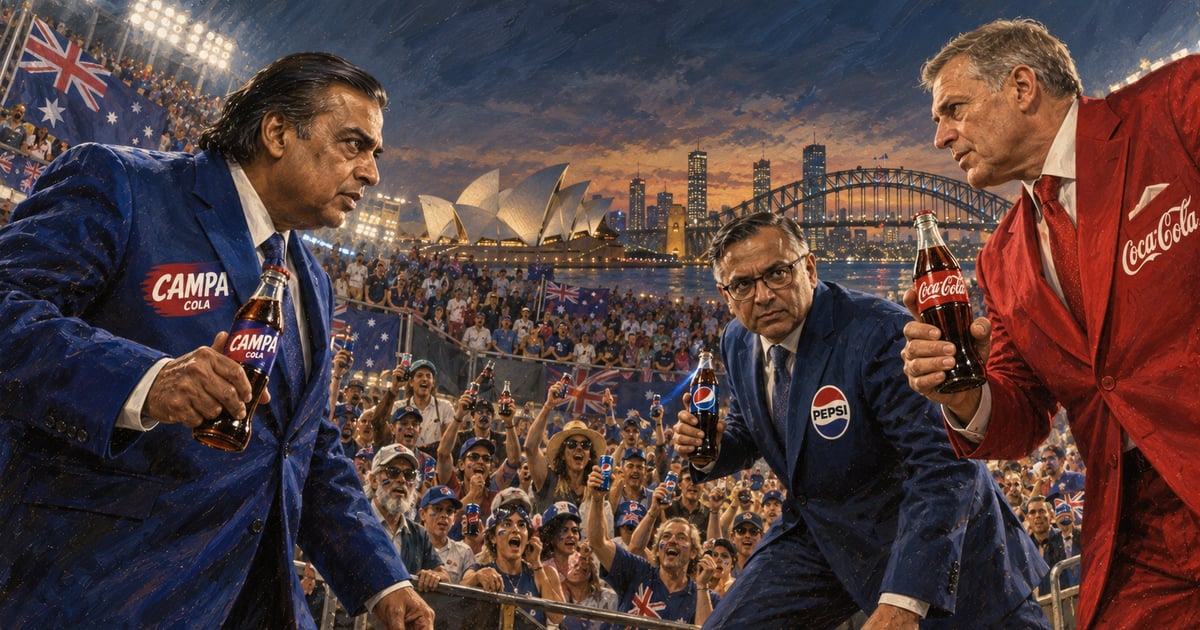
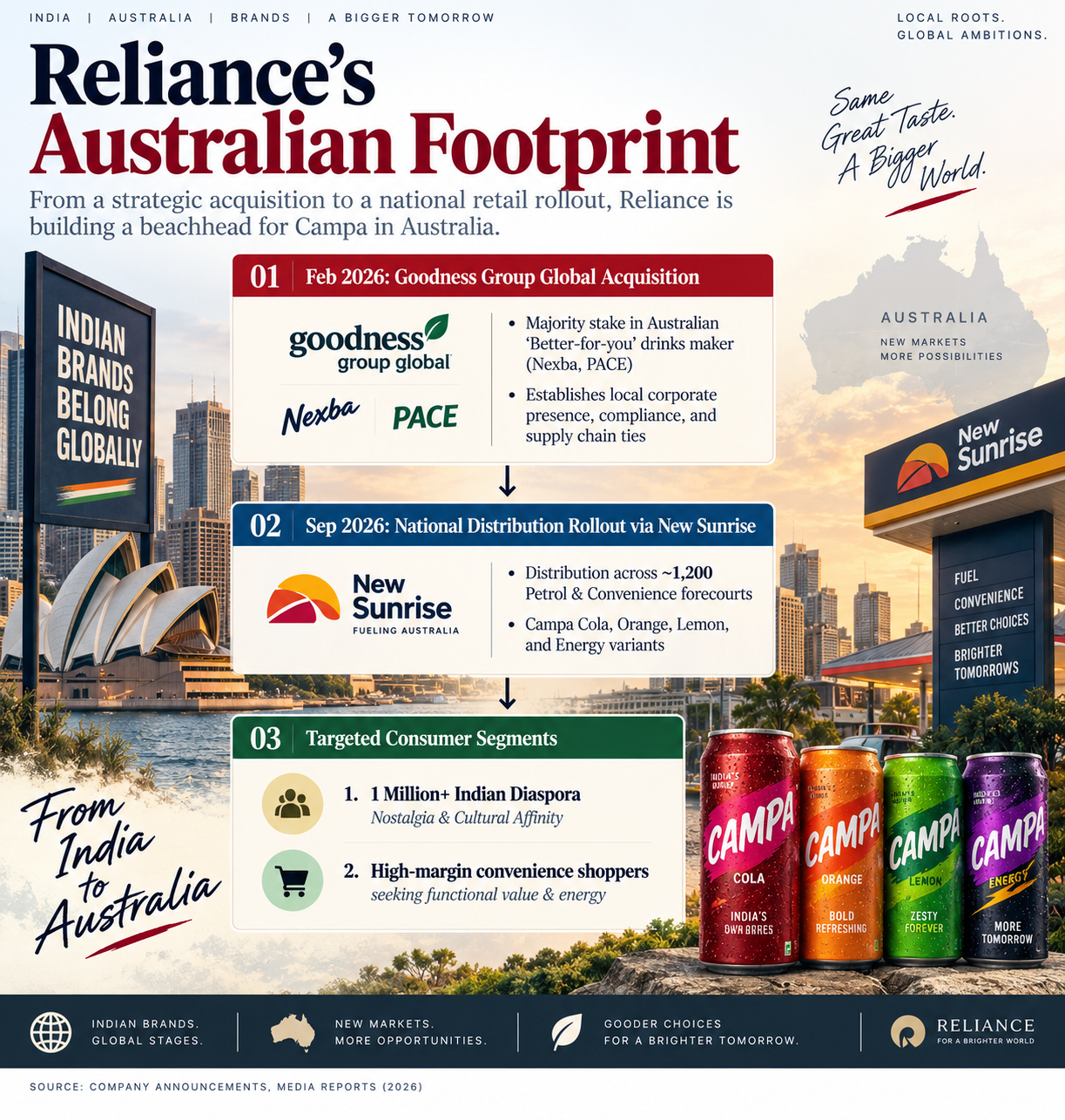
In September 2026, Reliance Consumer Products Limited (RCPL), the fast-moving consumer goods arm of Reliance Industries, took its beverage flagship across the Indian Ocean. Through an exclusive retail partnership with New Sunrise, an independent petrol and convenience network, Campa made its official debut on Australian shelves, stocking Campa Cola, Campa Orange, Campa Lemon, and Campa Energy across approximately 1,200 convenience stores nationwide.
The Australian launch follows entries into the United Arab Emirates, Oman, and Sri Lanka. Yet the true catalyst for Reliance’s international momentum lies in its domestic performance. Over the past three years, RCPL has executed a fierce, low-cost disruption inside India’s carbonated soft drink market, shaking a 30-year duopoly long held by The Coca-Cola Company and PepsiCo.
Understanding why Campa has entered Australia requires examining both the battlefield it reshaped at home and the international consumer goods conglomerate it is attempting to construct.
1. The Indian Battlefield: Breaking a 30-Year Duopoly
Since 1993, when Coca-Cola re-entered India and acquired Parle’s homegrown portfolio—including Thums Up, Limca, and Gold Spot—the Indian carbonated soft drinks market has operated as an effective duopoly. Together with PepsiCo, whose operations are managed by its exclusive bottling franchisee, Varun Beverages Limited (VBL), the two multinational giants controlled between 85% and 90% of the organized fizzy drinks market.
When Reliance acquired the dormant Campa brand from the Pure Drinks Group in August 2022 for ₹22 crore ($2.6 million) and relaunched it in March 2023, industry observers questioned whether a vintage legacy name could appeal to Generation Z. Reliance answered not with nostalgic advertising, but with aggressive structural pricing reminiscent of its telecom disruption with Jio.
The ₹10 Disruption and Margin Mechanics
India's packaged beverage market is hyper-sensitive to price elasticity at the ₹10 and ₹20 price points. Reliance deployed capital to reset industry price benchmarks:
Entry Pack Disruption: While Coca-Cola and PepsiCo sold 250ml PET bottles at ₹20, Campa introduced a 200ml pack at ₹10.
Mid and Large Volumes: Campa priced its 500ml SKU at ₹20 (against ₹30 to ₹40 from incumbents) and its 2-litre family pack at ₹45 to ₹50 (against ₹80 to ₹90 from Coke and Pepsi).
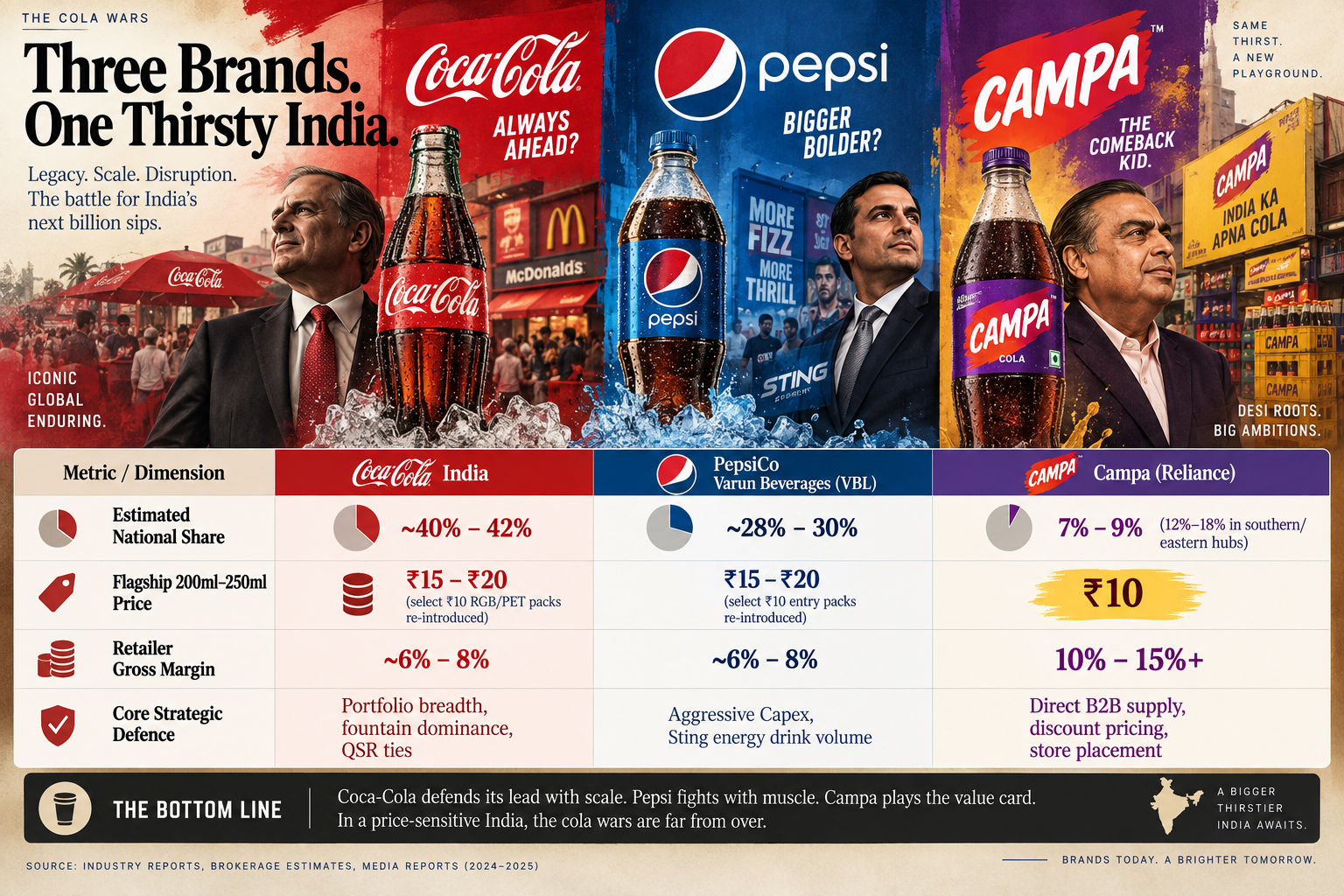
Retailer Incentives: Recognizing that mom-and-pop (kirana) grocers determine cold-beverage visibility, Reliance offered trade margins of 10% to 15%, with periodic schemes pushing returns near 18%. Incumbent bottlers had long restricted retailer margins to 6% to 8%.
Distribution Muscle: Reliance bypassed conventional wholesaler bottlenecks by distributing through its captive retail ecosystem—comprising thousands of Reliance Retail stores, JioMart B2B, and the former wholesale network of Metro Cash & Carry, which Reliance acquired in 2022 for ₹2,850 crore ($342 million).
2. Market Share and Competitive Impact: The Latest Numbers
By 2025 and 2026, the structural assault produced measurable shifts across India's soft drink sector, valued at approximately ₹60,000 crore ($7.2 billion) to ₹70,000 crore ($8.4 billion).
National and Regional Market Share Shifts
Data from retail tracking agencies, including NielsenIQ, underscores the shifting balance of power:
National Footprint: Campa has captured an estimated 7% to 9% national volume share in carbonated soft drinks, establishing itself as the fourth-largest soft drink brand in India.
Regional Strongholds: In high-consumption states such as Andhra Pradesh, Telangana, Odisha, West Bengal, and pockets of Uttar Pradesh and Madhya Pradesh, Campa’s market share reached double digits, ranging between 12% and 18%.
The Rise of the Challengers: Driven by Campa alongside local value-focused disruptors like Lahori Zeera, challenger beverage brands doubled their collective market share to approximately 15%. This reduced the combined market grip of Coca-Cola and PepsiCo from nearly 85% down toward 70% to 75%.
Revenue Trajectory: Analysts tracking consumer goods note that Campa crossed an annualised sales run-rate exceeding ₹4,100 crore ($493 million) during the FY26 cycle, representing one of the fastest ramp-ups for an acquired consumer brand in Indian commercial history.
Incumbent Reactions: Price Matching and the "500,000 Fridge War"
The multinational incumbents responded vigorously:
Return to ₹10 SKUs: Facing value-share slippage in key operating quarters, Coca-Cola India and Varun Beverages reinstated 200ml returnable glass bottles (RGBs) and light PET variants priced at ₹10 in semi-urban and rural markets to defend their customer base.
The Commercial Cooler War: In Indian retail, chilled beverages generate more than 80% of immediate-consumption sales. When traditional bottlers invoked contract clauses forbidding retailers from cooling Campa bottles inside Coke- or Pepsi-branded refrigerators, Reliance initiated its own distribution offensive. This triggered an infrastructure wave where beverage companies and independent store owners deployed an estimated 400,000 to 500,000 new commercial refrigerators across India.
3. Why Reliance Launched Campa in Australia
With intense domestic competition in India, expanding into an advanced OECD market like Australia might appear unexpected. However, the move is rooted in practical commercial and logistical strategy.
1. Capitalising on the Goodness Group Acquisition
In February 2026, Reliance Consumer Products acquired a controlling stake in Australia-based Goodness Group Global, the beverage company behind sugar-free brand Nexba, protein brand Bison, and PACE—a hydration beverage co-created with high-profile athletes.
The acquisition gave Reliance immediate operational assets:
An active corporate footprint in Sydney and Melbourne.
Established regulatory compliance frameworks under Food Standards Australia New Zealand (FSANZ).
Direct operational ties with local logistics, co-packing, and retail procurement teams.
Launching Campa in Australia leverages existing organizational capacity rather than requiring fresh greenfield infrastructure.
2. High-Velocity Distribution Through New Sunrise
Entering foreign retail often falters on supermarket slotting fees and slow inventory turnover. By partnering with New Sunrise, RCPL secured immediate access to approximately 1,200 petrol and convenience (P&C) locations.
In Australia, the P&C channel represents the primary sales point for impulse and ready-to-drink beverages. Placing Campa cans and Energy variants alongside fuel checkouts provides immediate nationwide visibility, sidestepping extended supermarket shelf negotiations.
3. Diaspora Affinity and Mainstream Positioning
Australia is home to one of the fastest-growing Indian diasporas in the world, with people of Indian origin numbering nearly 1 million (accounting for roughly 3.5% to 4% of the national population). Concentrated in metropolitan hubs like Western Sydney, Melbourne’s western and northern suburbs, and Brisbane, this demographic offers ready brand recognition. Campa provides nostalgic appeal for older generations and cultural familiarity for younger arrivals, providing immediate baseline demand while the brand tests mainstream appeal with its citrus and energy SKUs.
4. High-Margin Arbitrage
In India, a 200ml bottle of Campa sells for ₹10 ($0.12), generating narrow per-unit margins that require massive volume to support. In Australian convenience retail, ready-to-drink soft drinks and energy cans routinely command AUD $3.50 to $5.50 (₹190 to ₹300; $2.30 to $3.60).
Even when positioned below legacy brands to offer clear value, Campa’s gross unit economics in Australia remain significantly higher than domestic Indian margins. The Australian business therefore offers attractive cash flow that can assist in underwriting brand-building efforts across the region.
4. The Bigger Picture: Building a Global FMCG Giant
Campa’s Australian rollout represents one component of a broader, multi-phase corporate campaign overseen by Isha Ambani at Reliance Retail Ventures. Reliance intends to construct an integrated consumer goods conglomerate capable of competing directly with global leaders such as Unilever, Nestlé, PepsiCo, and The Coca-Cola Company.
The Two-Way Brand Corridor
Reliance’s strategy relies on two-way brand movement rather than purely one-directional exports:
Inward Technology & Premium IP: Through its majority holding in Goodness Group, RCPL is introducing patented sugar-free formulations (such as Goodsweet) and functional sports hydration brands like Nexba and PACE to urban Indian consumers seeking healthier alternatives.
Outward Indian Scale: Simultaneously, Reliance is deploying its Indian industrial production scale to export heritage brands—including Campa, Sosyo juices, and Lotus Chocolates—to global markets.
Methodical Geographic Expansion
Reliance’s international beverage expansion has followed a deliberate sequence:
The Gulf & Middle East (Early 2025): RCPL debuted Campa across the GCC at Gulfood 2025 in Dubai, partnering with the UAE’s Agthia Group and subsequent distributors in Oman.
South Asian Neighbourhood (Mid 2025): In August 2025, RCPL formed a strategic manufacturing and distribution alliance with Ceylon Cold Stores in Sri Lanka, using local bottling to serve island markets alongside exports to Nepal.
Developed Western Markets (2026): Australia serves as the initial test case for distribution within a high-income, developed retail landscape.
Challenging the Multinationals at Their Own Game
For thirty years, western multinational companies operated with an asymmetrical advantage: they derived high operating cash flows from developed markets to subsidise competitive campaigns across emerging economies like India.
Reliance is reversing that equation. By pairing a dominant, low-cost domestic manufacturing base with captive Indian distribution, RCPL has built an engine resilient enough to disrupt the domestic duopoly. As it secures retail partnerships in the Gulf, South Asia, and Australia, Reliance is demonstrating that its retail disruption model is designed for global scale.