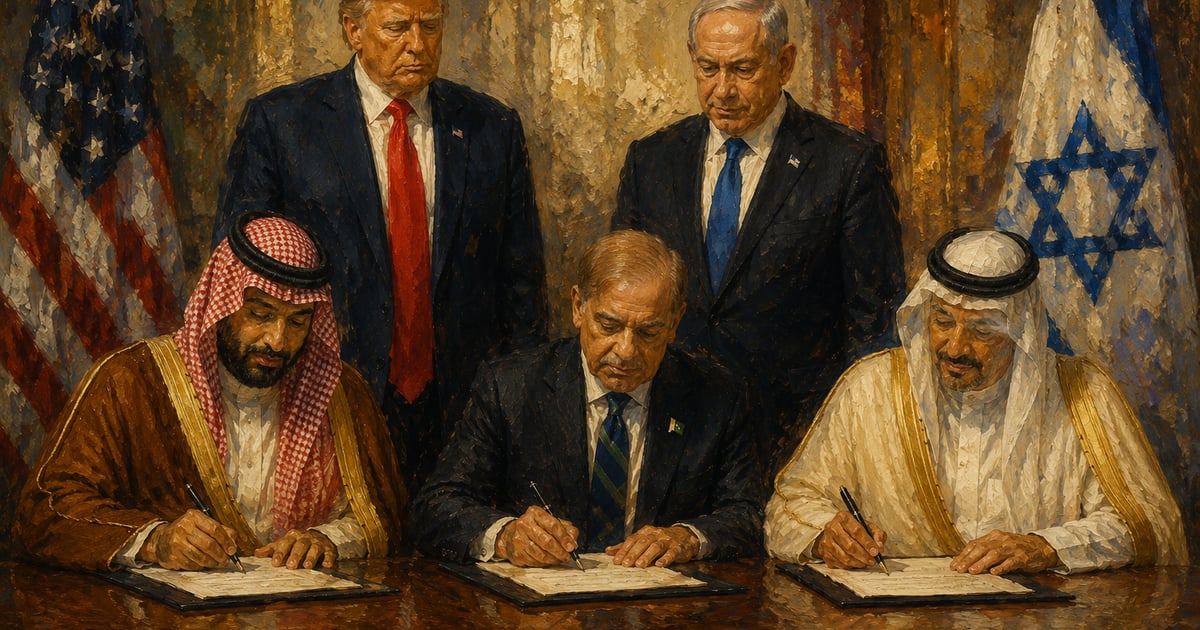
On 25 May 2026, Donald Trump posted on Truth Social with a demand that would have seemed unthinkable five years ago. He wants Saudi Arabia, Qatar, Pakistan, Turkey, Egypt, and Jordan to sign the Abraham Accords simultaneously, as a mandatory condition for any Iran peace deal. He even floated the idea of Iran itself eventually joining.
One man is trying to redraw the entire Islamic world's relationship with Israel in a single transaction.
To understand why this is the most audacious geopolitical gamble of 2026, you need to understand what the Abraham Accords actually are, how they were built, and what they cost.
What the Abraham Accords Actually Are
Most people think the Abraham Accords are a single peace agreement. They are not. They are a three-tier architecture, and the tiers matter enormously.
The first tier is the Declaration — a short, vague, aspirational statement signed by all parties. It mentions "mutual understanding" and the Abrahamic faiths. It mentions Palestinian statehood exactly once, in passing.
The second tier is where the real substance lives. Each country signed a separate bilateral treaty with Israel covering full diplomatic recognition, exchange of ambassadors, mutual security commitments, and cooperation across 16 sectors including defence, civil aviation, finance, healthcare, space, tourism, energy, and agriculture.
The third tier is what actually made countries sign.
The UAE received a $23 billion US arms deal: 50 F-35A jets and 18 armed Reaper drones. Bahrain got full integration into the US Central Command's regional air and missile defence network. Sudan was removed from the US State Sponsors of Terrorism list and gained access to World Bank lending. Morocco received US recognition of its sovereignty over Western Sahara, a territorial prize it had been seeking for decades.
Every signatory got paid. None of the payments went to Palestinians.
Why These Deals Were Made
The Abraham Accords were never purely about Israel-Arab peace. They were about building a formal anti-Iran coalition under American leadership.
The UAE, Bahrain, and Saudi Arabia had been quietly cooperating with Israel on intelligence and security against Iran for years before 2020. Israeli and Gulf intelligence services had been sharing data for at least half a decade before any public deal existed. The Accords did not create new relationships. They made existing secret ones legal and visible.
The economic results were genuine. UAE-Israel trade grew from $200 million in 2020 to over $3 billion by 2024. Direct flights between Tel Aviv and Dubai launched within weeks of signing. Israeli cybersecurity and agricultural technology companies gained immediate access to Gulf markets. A new geopolitical grouping emerged, the I2U2, connecting India, Israel, the UAE, and the United States — linking South Asian industrial scale with Israeli technology, Gulf capital, and American military reach.
What the Accords Destroyed
In 1967, after the Six-Day War, Arab states passed the Khartoum Resolution: no peace, no negotiations, no recognition of Israel until Palestinian statehood. For 53 years, that was the unified Arab position. Every negotiation, every back-channel, every diplomatic overture to Israel carried that condition as its baseline.
The Abraham Accords shattered it permanently. For the first time in history, Arab states normalised relations with Israel without any Palestinian concession in return.
The Palestinian Authority recalled its ambassador from Abu Dhabi in protest the day the deals were signed. Their alarm was not misplaced.
The 2002 Arab Peace Initiative had offered Israel exactly what it had always wanted: full Arab normalisation. The price was one thing — a Palestinian state on 1967 borders. The Abraham Accords gave Israel full normalisation for free. The Arab states cashed in 53 years of accumulated leverage for fighter jets, trade agreements, and territorial recognition.
The settlement data tells the rest of the story. Within one year of the Accords being signed, Israeli settler attacks on Palestinians increased by nearly 15%. By 2022, those attacks had risen 123% compared to 2020. The logic is straightforward: Israeli leadership correctly read the Accords as proof that Arab normalisation was achievable without any Palestinian concessions whatsoever. The diplomatic pressure to freeze settlements or engage the Palestinian Authority simply disappeared.
After signing, both the UAE and Bahrain cut their financial contributions to UNRWA, the UN agency supporting Palestinian refugees, following the Trump administration's own decision to end American funding. The countries that publicly claimed normalisation would protect Palestinian interests immediately defunded Palestinian refugees.
The Case for the Accords
It is worth being precise about what the Accords actually achieved, because the pro-Accords arguments are not weak.
UAE-Israel trade tripling in four years is real economic integration. The I2U2 corridor represents genuine new architecture connecting four major economies. When Iran launched missile attacks on Israel in April and October 2024, Abraham Accords countries cooperated in air defence. The security compact worked under real conditions.
There is also a harder argument: the two-state solution may have already been functionally dead before 2020. By the time the Accords were signed, over 700,000 Israeli settlers were living in the West Bank. The territory required for a viable Palestinian state was already physically fragmented. The Accords did not kill a living patient. They removed the diplomatic fiction that the patient was still alive.
Supporters also argue that UAE and Bahrain, as formal partners of Israel, now have leverage to influence Israeli behaviour in ways they could not as adversaries. A partner's criticism carries different weight than an enemy's condemnation.
The Accords also proved remarkably durable. Despite the Gaza war killing over 64,500 Palestinians and generating the largest wave of pro-Palestinian sentiment in the Arab world in decades, the Accords held. UAE and Bahrain maintained formal relations with Israel throughout. The framework survived the single biggest stress test imaginable.
The Historical Pattern Nobody Wants to Acknowledge
This is not the first time a major power has tried to resolve the Middle East by working around Palestinians.
In 1978, Egypt's Anwar Sadat normalised with Israel at Camp David in exchange for the return of Sinai. Egypt was expelled from the Arab League. Every Arab country cut diplomatic ties with Cairo. Sadat was assassinated in 1981. But the peace held, and Egypt was eventually readmitted to the Arab League. The lesson was clear: Arab governments can absorb the domestic cost of normalisation if the strategic prize is large enough.
In 1993, the Oslo Accords gave Palestinians themselves a path to statehood in exchange for recognising Israel. It was the high watermark of the two-state framework. Within a decade, settlements had tripled, the Palestinian Authority had become a security subcontractor for Israeli occupation, and Hamas had taken Gaza.
Each successive deal gave Israel more while asking Palestinians for less. Each deal was called a breakthrough for peace. Each deal made the next Palestinian concession harder to achieve.
Trump's 2026 Gamble and the India Angle
Kazakhstan joined the Abraham Accords in November 2025, the first expansion of the framework under Trump's second term. Now Trump is pushing for simultaneous accession by Saudi Arabia, Qatar, Turkey, Pakistan, Egypt, and Jordan, bundled as a condition for an Iran deal.
If Saudi Arabia signs, the stakes are categorically higher than every previous signing combined. Saudi Arabia is the custodian of Mecca and Medina, the symbolic centre of the Islamic world. Saudi normalisation would represent the complete collapse of the Khartoum consensus and the permanent geopolitical isolation of the Palestinian cause.
Saudi Arabia's stated asking price is a clear, credible path to Palestinian statehood. Trump's offer is an Iran deal as cover. The gap between those two positions is where the entire future of the Middle East currently lives.
India's position in all of this is worth understanding carefully, because it represents the most sophisticated diplomatic balancing act in the story.
India voted for Palestinian statehood at the UN in September 2025, among 142 nations, against the US and Israel. Simultaneously, Modi visited the Israeli Knesset in February 2026, called the India-Israel relationship a "Special Strategic Partnership," and signed a dozen bilateral agreements on defence, cybersecurity, space, and trade.
Most significantly, India used Israeli weapons in Operation Sindoor against Pakistan in 2025. Harop and Harpy loitering munitions, Sky Striker drones, Heron UAVs, Barak-8 missiles. India fought a real military operation using Israeli technology whilst simultaneously voting for Palestinian rights at the United Nations.
Indian diplomats call this "de-hyphenation" — treating the Israel relationship and the Palestine relationship as completely separate tracks that do not cancel each other out.
The logic behind it is straightforward. Nine million Indians work in Gulf countries, remitting approximately $50 billion annually. India cannot alienate the UAE, Saudi Arabia, or Qatar. India also cannot afford to lose Israeli defence technology, which proved decisive in a real conflict. India needs Iran's Chabahar port for Central Asia access. And India needs the US partnership for the Quad and Indo-Pacific strategy.
The Abraham Accords architecture, by normalising the Israel-Gulf relationship, actually made India's balancing act easier. India no longer has to choose between Israeli technology and Gulf relations. The Gulf states resolved that tension themselves.
The Real Question
The Abraham Accords did not bring peace to the Middle East. They brought a new order — one where national interests replaced pan-Arab solidarity, where Israel gained normalisation without concessions, where the Palestinian cause lost its only structural leverage, and where countries like India discovered they could profit from all sides simultaneously.
Trump's 2026 push to bundle mass Islamic normalisation into an Iran deal is the logical endpoint of that order. If it works, Palestine stops being a political question. It becomes a humanitarian footnote — a problem to be managed, not solved.
The question is not whether the Accords are good or bad. The question is: for whom?