On May 31, 2026, Nepal's Prime Minister Balendra "Balen" Shah stood before Parliament and delivered a statement that fractured decades of diplomatic protocol. "You will be surprised to know a fact I have learnt recently, only after becoming Prime Minister," he told lawmakers. "It is not only India that has encroached on Nepali land, but Nepal has also encroached on India's land in multiple places."
The political fallout was immediate. Nepal's foreign ministry scrambled into damage-control mode within hours. Opposition lawmakers disrupted Parliament demanding an apology, while former ambassadors criticized the statement as technically incorrect. New Delhi, which has never officially complained about Nepal occupying its land, found itself handed an unexpected diplomatic gift.
The shockwave expanded the very next morning. On June 1, Rastriya Swatantra Party (RSP) chief Rabi Lamichhane flew to Delhi to meet Indian Prime Minister Narendra Modi, External Affairs Minister S. Jaishankar, and National Security Advisor Ajit Doval. The critical question hanging over Kathmandu is not just what the prime minister said, but why he chose this exact moment to say it.
Who is Balen Shah? Nepal's Maverick Prime Minister
Balen Shah is Nepal's 40th Prime Minister, sworn into office on March 27, 2026, at just 35 years old. A structural engineer turned rapper and former Kathmandu mayor, his meteoric rise mirrors the anti-establishment energy of the 2025 youth uprising. That movement drove former Prime Minister KP Sharma Oli from office and dismantled the traditional political guard. Shah's party, the RSP, rode this wave of anti-corruption fury to secure 182 of 275 parliamentary seats, establishing a near two-thirds supermajority.
What is the Rastriya Swatantra Party (RSP)? The RSP is Nepal's ruling political party, co-led by Prime Minister Balen Shah and Rabi Lamichhane. It built its brand on radical transparency, accountability, and a fierce critique of the country's legacy political factions.
Despite his anti-corruption platform, Shah's alliance with party co-leader Rabi Lamichhane introduced early contradictions. Lamichhane, a former television personality, faces active charges in the Surya Darshan Cooperative fraud case regarding the alleged diversion of funds to his media network. Lamichhane's legal status remains under active review by Nepal's Supreme Court, creating a permanent vulnerability at the heart of the ruling coalition.
The Domestic Walls Close In: A Multi-Front Crisis
By late May 2026, just two months into its tenure, the Shah administration faced severe internal instability across multiple fronts. The government that promised to eradicate the patronage culture of Nepal’s old guard began buckling under the weight of its own governance failures.
Cabinet Resignations: Labour Minister Deepak Sah was recalled within weeks of taking office after appointing his spouse to the Health Insurance Board. Shortly after, Home Minister Sudan Gurung resigned amid allegations linking him to a businessman under active investigation.
Rule of Law Overreach: The government ordered the arrests of former Prime Minister KP Sharma Oli and former Home Minister Ramesh Lekhak without proper documentation, forcing courts to mandate their immediate release. Human rights groups quickly questioned whether anti-corruption tools were being weaponised for political vendettas.
Self-Protection Moves: The RSP actively sought to amend parliamentary rules to delay the disqualification of lawmakers until a formal indictment is issued. This legislative manoeuvre serves as a direct buffer to protect Lamichhane from losing his seat while his fraud case winds through the judiciary.
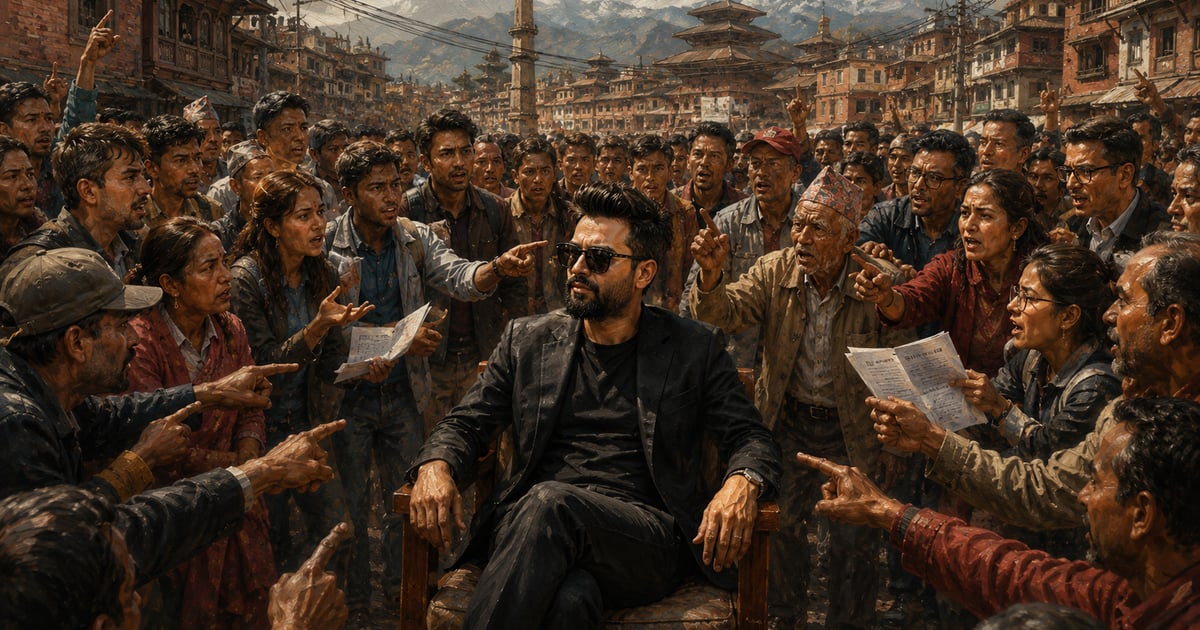
The Squatter Crisis: Expanding on his controversial 2022 eviction drives as Kathmandu mayor, Shah launched a national campaign targeting riverside squatter settlements. On May 1, the discovery of a resident's body, Indra Bahadur Rai, in the Bagmati River near a bulldozed settlement ignited widespread protests. Amnesty International, Human Rights Watch, and the International Commission of Jurists issued a joint condemnation of the evictions.
Youth Disillusionment: The Gen Z demographic that fueled Shah's rise has begun expressing open skepticism. Public silence from the Prime Minister’s Office on Lamichhane’s fraud case, combined with a total lack of formal press conferences since taking office, eroded his image of radical openness.
Balen Shah's May 2026
Crisis Immediate Outcome: Cabinet Attrition. Two ministers exit over corruption and nepotism within weeks.
Legal Overreach: Courts overturn rogue opposition arrests due to zero evidence.
Squatter Protests: HRW and Amnesty condemn fatal riverbed eviction drives.
Rule Changes: RSP alters internal laws to shield Lamichhane from court ouster
The Good Cop, Bad Cop Diplomatic Strategy
The strategic utility of the border statement becomes clear when contrasted with Lamichhane’s five-day itinerary in New Delhi from June 1 to June 5. While the Prime Minister played the nationalist antagonist in Kathmandu, his party co-leader received full state-level treatment in India.
An invitation extended specifically by the Bharatiya Janata Party (BJP) bypassed Prime Minister Shah entirely, focusing instead on Lamichhane. While Narendra Modi extended an official state visit invitation to Shah back in March, that trip remains unscheduled. A planned visit to Kathmandu by Indian Foreign Secretary Vikram Misri in early May was abruptly cancelled after Shah took a hard line on the Lipulekh dispute regarding the Kailash Mansarovar Yatra route.
This division of labour allows the RSP to operate a dual-track foreign policy. Shah secures domestic nationalist points by challenging India on the house floor. Simultaneously, Lamichhane lands in Delhi as the reasonable face of the administration, signalling to Indian leadership that the bilateral relationship remains intact and that parliamentary outbursts are merely domestic political noise.
Breaking Down the Border Data: Fact vs. Friction
The most charitable interpretation of Shah's statement is that it represented a blunt assessment of technical data. The 2007 joint boundary survey between India and Nepal confirms that roughly 1,200 hectares of Nepali land are occupied by Indian citizens, while approximately 1,250 hectares of Indian land host cross-border Nepali civilian occupation. These anomalies occur primarily in the Dasgaja no-man's land strips where local farmers routinely cultivate across invisible lines.
However, the political context contradicts this charitable view. The Dasgaja issue is a long-standing technical matter managed quietly by bilateral working groups. No previous Nepali prime minister has elevated civilian farming overlaps to the level of state-sponsored territorial encroachment during a plenary session.
Shah chose the most volatile possible venue, a parliamentary Q&A concerning the highly sensitive Kalapani-Lipulekh dispute, to deliver this uncoordinated announcement. The immediate scramble by the foreign ministry to clarify that the remarks referred strictly to civilian farming overlaps proves the move was not a coordinated policy shift, but a sudden political pivot designed to reset a damaging domestic news cycle.
Replicating the Old Political Playbook
This tactic is not new in Nepali politics. The strategy of using relations with India as a domestic pressure release valve has been a staple of Kathmandu's political class for over a decade.
2015 (K.P. Oli): Signed connectivity pacts with China during the Indian economic blockade to build massive domestic nationalist capital.
2020 (K.P. Oli): Issued a revised constitutional map incorporating Kalapani and Lipulekh to successfully deflect an internal party rebellion.
2024 (Prachanda): Placed disputed tri-junction territories on national currency notes during a period of severe economic duress and coalition strain.
2026 (Balen Shah): Declared mutual border encroachment to erase front-page coverage of a cabinet collapse and fatal squatter riots.
The RSP's innovation is institutionalising this pattern. Rather than requiring a single leader to swing between hostility and diplomacy over time, the party splits the roles between two individuals simultaneously.
The Long-Term Strategic Cost
By voluntarily introducing the concept of mutual encroachment on the floor of Parliament without bilateral coordination, Shah has altered the mechanics of future border negotiations. India has never formally accused Nepal of territorial theft. A future Indian government seeking to counter Nepal’s claims over Kalapani or Lipulekh can now cite a sitting Nepali prime minister’s own parliamentary testimony as precedent.
Furthermore, this arrangement relies entirely on both political actors remaining viable. With Rabi Lamichhane’s cooperative fraud case still active before the Supreme Court, any adverse legal ruling risks removing the diplomatic counterweight from the equation. If the coalition loses its institutional intermediary, Nepal's foreign policy will depend entirely on a prime minister whose political career has been defined by performative defiance against external neighbours and domestic institutions alike.