In brief
- On 8 October 2026, the US Labor Department stopped Microsoft, Adobe, TCS, Infosys, Cognizant, Wipro, HCL and Capgemini from using PERM, the first step toward a green card through a job.
- The government says these firms laid off American workers while still hiring foreign ones. Its main example was Microsoft, with about 6,000 layoffs and 3,682 PERM filings in a year.
- It’s a suspension, not a full ban. It can last up to 180 days and be extended, and lawyers say it’s easy to challenge in court.
- Microsoft and Adobe could lose key engineers, while TCS says it expects no big impact since it already cut green card sponsorship.
- Nobody is being deported and current H-1B visas stay valid, but pending PERM cases are frozen. Indian workers, who already wait decades, will feel it most.
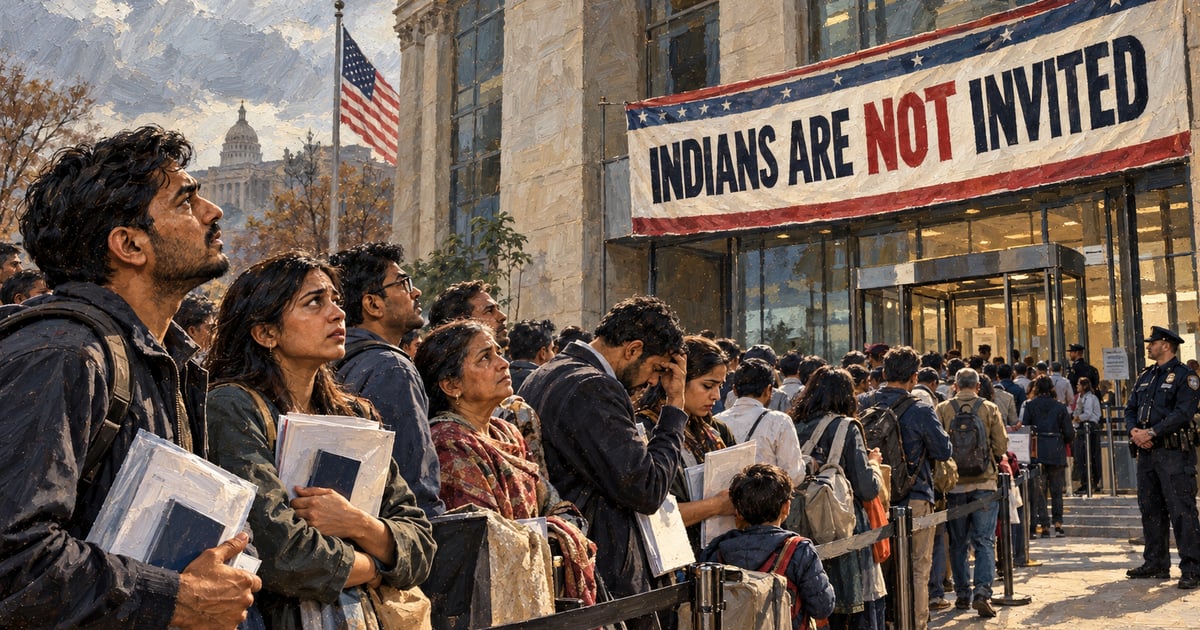
On 8 October 2026, the US federal government enacted one of the most aggressive enforcement actions in the modern history of employment-based immigration. During a joint press conference in Washington, D.C., US Vice President JD Vance and Secretary of Labor Keith Sonderling announced that the Department of Labor (DOL) had suspended eight major technology and consulting corporations from participating in the Permanent Labor Certification (PERM) programme.
The eight named organisations span two distinct pillars of the global technology sector:
US enterprise technology leaders: Microsoft Corporation and Adobe Inc.
Global and Indian IT services giants: Tata Consultancy Services (TCS), Infosys, Cognizant, Wipro, HCL Technologies, and Capgemini.
Under the order, the Department of Labor’s Office of Foreign Labor Certification (OFLC) ceased accepting new PERM applications from these employers and halted the processing of all their pending applications. Flanked by Labor Inspector General Anthony D'Esposito, administration officials described the move as an intervention against corporate misuse of immigration statutes, alleging that employers used foreign labour schemes to displace qualified American professionals following widespread industry redundancies.
The announcement sparked immediate turbulence across global markets and intense anxiety among hundreds of thousands of foreign workers residing in the United States on temporary visas. Yet beneath the political rhetoric lies a complex regulatory manoeuvre. Understanding what this suspension actually entails requires separating the legal realities of labour certification from the widespread misconceptions surrounding H-1B work visas.
What Is PERM, and Why Does It Matter?
The Permanent Labor Certification programme, administered under 20 CFR Part 656, is the mandatory foundation of most employer-sponsored permanent residence in the United States. For foreign professionals pursuing permanent residency through the Employment-Based Second Preference (EB-2) or Third Preference (EB-3) categories, an approved PERM certification is the indispensable first step.
The statutory purpose of the process is protective. Before an employer may sponsor an immigrant worker for permanent employment, the Immigration and Nationality Act (INA) requires the Secretary of Labor to certify two findings:
There are not sufficient qualified, able, willing, and available US workers in the area of intended employment to fill the open role.
Employing the foreign national will not adversely affect the wages and working conditions of similarly employed American workers.
To satisfy these statutory mandates, an employer must conduct a rigid test of the domestic labour market. This entails requesting a formal Prevailing Wage Determination (PWD) from the DOL, placing mandatory newspaper advertisements, posting physical job notices at the worksite, registering the position with the relevant State Workforce Agency, and running additional recruitment campaigns across professional channels.
Only after an employer documents that no qualified US worker applied or met the minimum job requirements may it submit Form ETA 9089 to the Department of Labor. Once the DOL approves the certification, the employer submits the approved PERM alongside Form I-140 (Immigrant Petition for Alien Worker) to US Citizenship and Immigration Services (USCIS).
By freezing PERM access, the federal government does not merely add bureaucratic friction. It effectively cuts the primary pipeline through which skilled foreign workers transition from temporary work visas into permanent American residency.
Why the Administration Targeted These Eight Companies
The government’s public justification centres on the intersection of recent tech redundancies and continued foreign labour filings. During the press conference, Vice President Vance focused specifically on Microsoft, contrasting its workforce reductions with its high-volume immigration sponsorship.
Vance asserted that over the preceding year, Microsoft had laid off approximately 6,000 workers whilst simultaneously securing approval for roughly 6,000 temporary H-1B visas and submitting 3,682 PERM labour certifications. He claimed that this dual pattern violated the core principle of domestic worker protection, alleging that corporations were running perfunctory recruitment advertisements designed to yield zero hires to justify retaining or onboarding lower-cost international personnel.
Federal officials also highlighted historical filing volumes, noting that the eight targeted firms had collectively accounted for more than 1,00,000 (100,000) permanent labour certifications since 2009.
The Department of Labor’s Inspector General announced that the suspension accompanied active federal fraud investigations and the formation of a dedicated visa fraud strike team, confirming that administrative subpoenas had already been served. In tandem, the administration stated it was launching investigations into nine universities—including Harvard, Yale, and Stanford—regarding the alleged use of J-1 exchange visitor visas to undercut domestic wages in academic research.
The Legal Framework: Suspension Versus Debarment
To grasp the vulnerability of the government’s action, one must examine the specific regulatory mechanism employed by the Department of Labor.
The administration did not formally debar these companies under 20 CFR § 656.31(f). Statutory debarment is a severe, quasi-judicial penalty that bars an employer, attorney, or agent from filing labour certifications for up to three years. However, statutory debarment requires a formal finding of a "pattern or practice" of willful failure to comply with programme rules, accompanied by formal notice, an opportunity to provide evidence, and appeal rights before an Administrative Law Judge at the Board of Alien Labor Certification Appeals (BALCA).
Instead, the DOL invoked 20 CFR § 656.31(b). This provision permits the certifying officer to suspend the processing of PERM applications involving an employer when the agency learns that the employer is the subject of an active investigation involving fraud or willful misrepresentation.
The critical legal nuances of 20 CFR § 656.31(b) include:
180-Day Cap: The regulation states that an initial suspension may last up to 180 days.
Investigation Extensions: The suspension can be renewed or extended beyond 180 days if a criminal indictment or civil proceeding remains unresolved.
Collective Versus Individual Targeting: Historically, the DOL has applied § 656.31(b) suspensions narrowly to specific applications or disreputable staffing agencies accused of sham filings. Freezing the entire PERM intake of multi-billion-dollar enterprise corporations across all job categories is an extraordinary, employer-level sanction.
Immigration litigators have already noted that applying blanket employer-wide suspensions without specific individualised fraud determinations exposes the DOL to immediate legal challenges under the Administrative Procedure Act (APA), alleging arbitrary and capricious agency action.
Corporate Responses: Enterprise Tech Versus Outsourcing
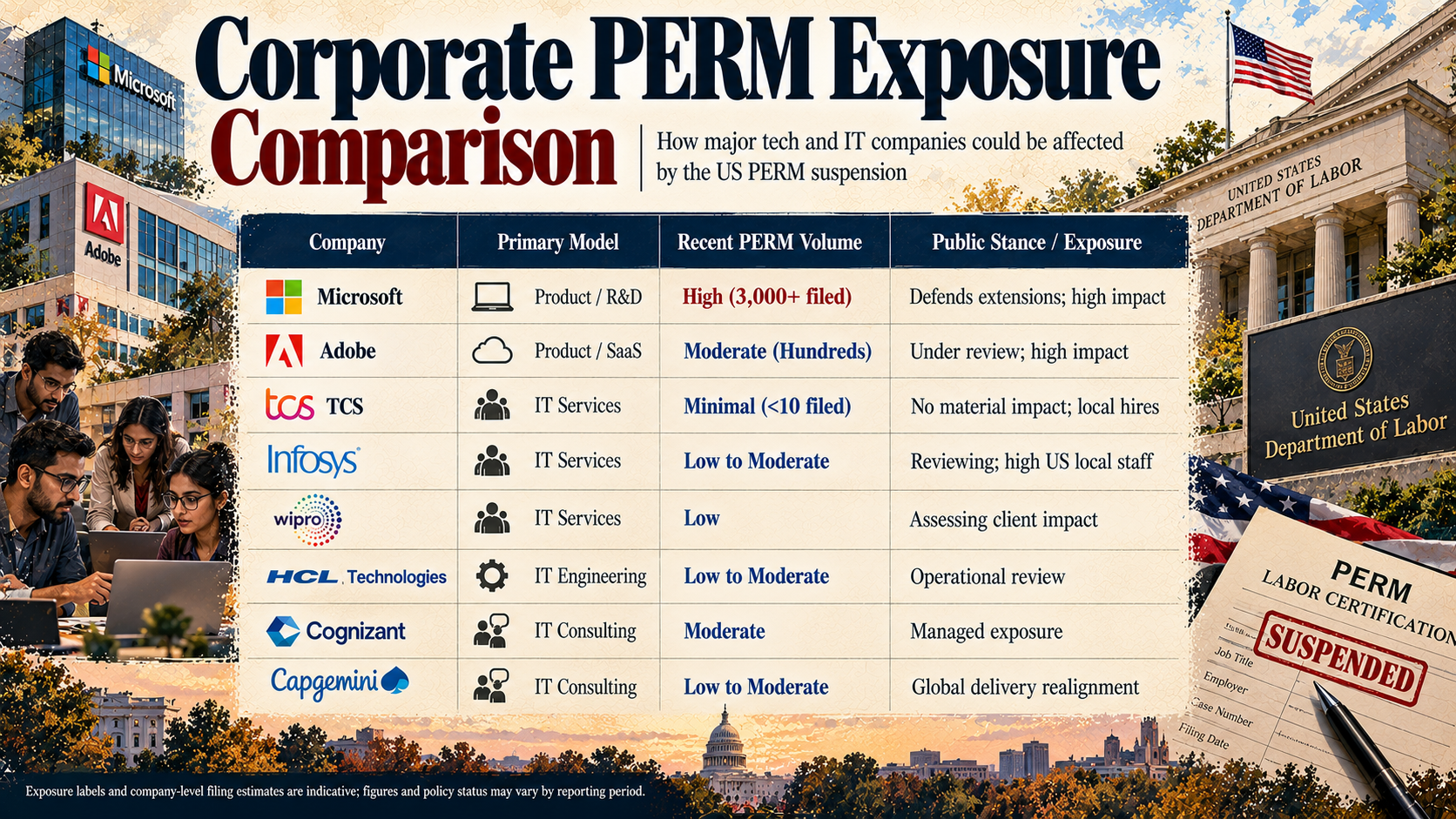
The eight affected corporations face vastly different degrees of operational exposure, and their public stances reflect those structural differences.
Microsoft’s Defence
Microsoft swiftly pushed back against the administration’s characterisation. The company issued a statement clarifying that approximately 80% of the 6,000 H-1B petitions it filed in the preceding fiscal year were not for new personnel arriving from abroad. Instead, they were filed to extend the existing legal status of personnel already employed inside the United States.
Microsoft stated that new visa hires accounted for just 1% of its total domestic workforce, and that all of those individuals were already residing legally within the country (such as international graduates transitioning from F-1 student visas). For Microsoft and Adobe, whose domestic technical teams include software engineers, AI researchers, and architects seeking permanent residence, an extended PERM freeze threatens key talent retention.
The Indian IT Services Reality
Conversely, Tata Consultancy Services (TCS) issued a statement confirming that it expects no material impact on its workforce strategy or client engagements.
Whilst Indian IT consultancies were historically heavy users of visa programmes, Indian IT majors spent the past decade fundamentally altering their delivery models. Prompted by previous immigration clampdowns and client demands for onshore presence, firms like TCS, Infosys, and Wipro dramatically curtailed their permanent green card sponsorships. In fact, TCS’s recent PERM filings have been in the single digits, with the company publicly targeting 15,000 new local American hires.
For the IT services sector, revenues are tied to commercial client deliverables, remote delivery, and local US recruitment. The reputational headline is severe, but the operational disruption to business operations is far lighter for TCS than it is for Microsoft.
What the Freeze Means for Workers: A Practical Guide
Widespread social media reports have generated significant confusion, with some claiming that all foreign workers at these eight firms face immediate deportation. This is incorrect.
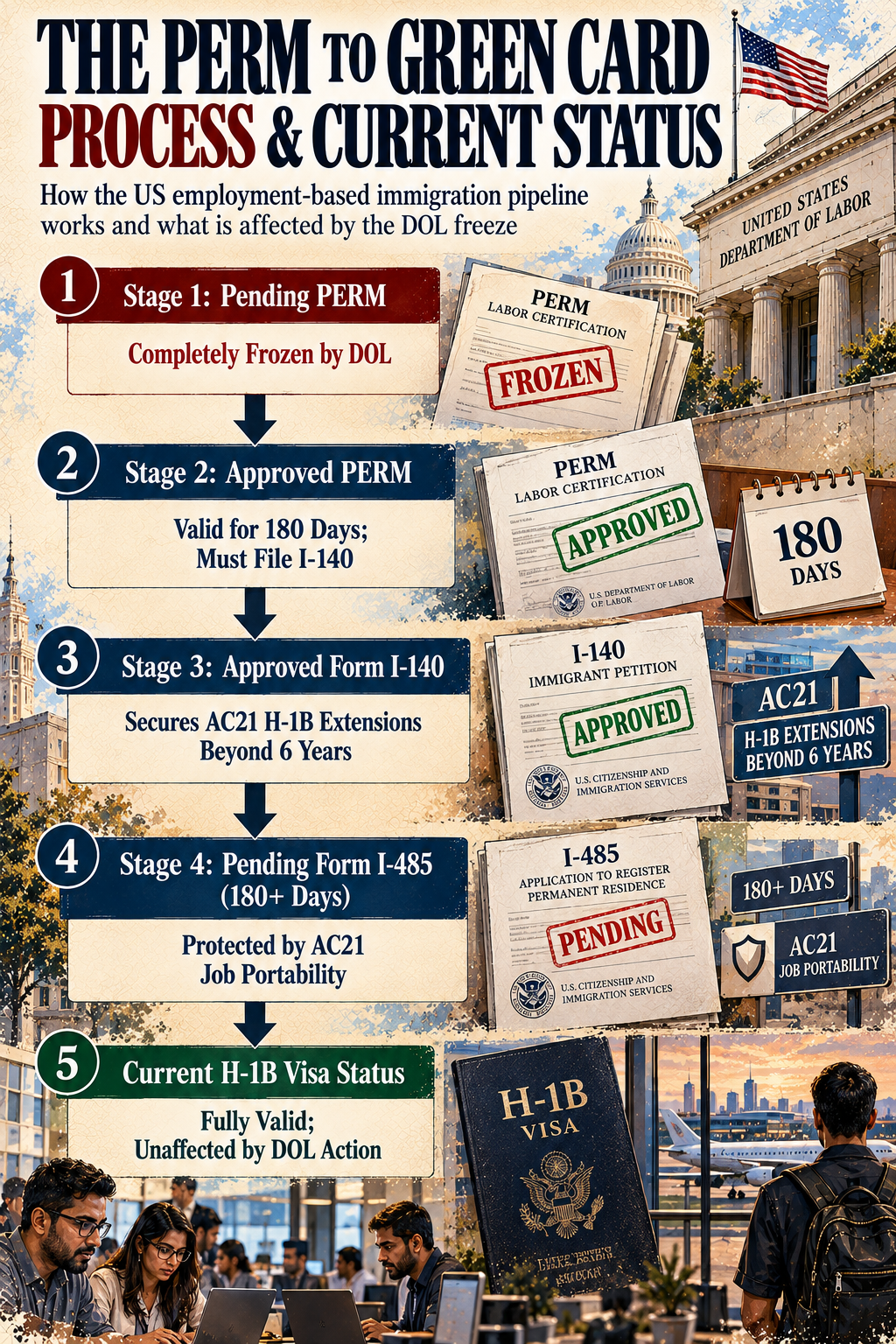
The Department of Labor oversees labour certification; it does not issue or cancel visas. That authority rests with USCIS and the Department of State. To understand how individual professionals are affected, their status must be examined across five specific stages of the immigration pipeline.
1. Existing H-1B Visa Status Remains Valid
The PERM suspension does not invalidate an employee’s lawful H-1B status. Professionals currently working for Microsoft, Adobe, Infosys, or any of the named employers remain fully authorised to work in the United States until their Form I-94 status expires. They are not working illegally, nor are they subject to summary removal proceedings.
2. Workers with Pending PERMs: A Complete Halt
Employees whose employers have submitted Form ETA 9089 to the DOL, or who are currently undergoing mandatory recruitment advertising, are directly impacted. The DOL will not process pending applications for the eight companies. For these individuals, the green card clock has stopped. Those approaching the statutory six-year limit on their H-1B status without a certified PERM or approved I-140 face an acute problem, as they may run out of time to secure extensions.
3. Workers with Approved PERMs
A certified PERM remains legally valid for 180 days from the date of DOL approval. An employee holding an approved PERM whose employer has not yet submitted Form I-140 to USCIS must ensure that the petition is filed before that 180-day window expires. Unless USCIS explicitly issues an administrative directive refusing to accept petitions supported by these certifications, existing approvals remain valid documentation of labour market clearance.
4. Workers with Approved Form I-140 Petitions
Under the American Competitiveness in the Twenty-First Century Act (AC21), an approved Form I-140 is a vital milestone. Once an I-140 has been approved for 180 days, it cannot be automatically revoked by USCIS simply because an employer withdraws it or faces commercial difficulties.
Priority Date Retention: The worker retains their original priority date permanently, which can be ported to any future employer.
Three-Year H-1B Extensions: Under AC21 § 104(c), workers subject to per-country visa backlogs (such as Indian nationals facing multi-decade EB-2 and EB-3 waits) remain eligible to extend their H-1B status in three-year increments beyond the standard six-year maximum.
Existing approved I-140s are USCIS determinations, not DOL certifications. They remain legally sound unless USCIS proves that the underlying individual petition was fraudulent.
5. Workers with Pending Adjustment of Status (Form I-485)
Employees who have already filed Form I-485 to adjust their status to permanent residence, and whose applications have been pending with USCIS for 180 days or more, are protected under AC21 § 106(c) (codified as INA § 204(j)). These individuals have statutory "green card portability." They are legally permitted to switch employers without invalidating their green card application, provided the new role is in the same or a similar occupational classification.
Broader Implications for Global Tech and Skilled Mobility
While the administrative suspension is currently confined to eight named companies, its structural implications reverberate across the wider economy.
First, the Department of Labor has demonstrated a willingness to use employer-level access as an aggressive enforcement weapon. Historically, compliance issues were addressed through targeted audits, supervised recruitment, or individual petition denials. By freezing an entire corporate portfolio at once, the administration has established a precedent that corporate layoffs documented in state Worker Adjustment and Retraining Notification (WARN) notices can be used to freeze broad immigration operations. Any major employer undertaking restructuring whilst sponsoring foreign professionals now faces heightened scrutiny.
Second, the action disproportionately impacts the Indian professional diaspora. Because employment-based per-country caps have created massive backlogs for Indian nationals, these workers often remain on H-1B extensions for over a decade waiting for their priority dates to become current. Any disruption in their PERM pipeline threatens status continuity, family stability, and the legal status of dependent children nearing the age of 21.
Finally, this enforcement climate is likely to accelerate cross-border talent decentralisation. Multinational enterprises unable to provide predictable long-term residency pathways in the United States will increasingly expand their operations across nearshore hubs in Canada and Latin America, or enlarge their Global Capability Centres (GCCs) in Bengaluru, Hyderabad, and Pune.