In brief
- A binding Department of Homeland Security directive orders the immediate removal of all DeepSeek models and code from federal IT systems, extending to government contractors and offline deployments, after DeepSeek opened open-weight models in 2024 and 2025.
- The directive, published in the Federal Register and coordinated with the Cybersecurity and Infrastructure Security Agency and the Office of Management and Budget, prohibits any future procurement or licensing of DeepSeek tools.
- The order goes beyond government staff to bar commercial contractors from incorporating DeepSeek APIs or model weights into software delivered to the United States government, creating a permanent exclusion from federal systems.
- The move marks a shift from warnings to a formal ban, framing DeepSeek as a national security concern and signalling a divide between Western and Chinese AI ecosystems in the global technology landscape.
When Hangzhou-based artificial intelligence laboratory DeepSeek unveiled its open-weight models in late 2024 and early 2025, it triggered an immediate financial and technological earthquake. By matching the reasoning performance of frontier American proprietary systems at a fraction of the computational and training cost, DeepSeek challenged Silicon Valley's capital-intensive dominance.
On 20 October 2026, the geopolitical bill for that breakthrough came due.
In a sweeping, binding directive published in the Federal Register, the US Department of Homeland Security (DHS) ordered all federal civilian executive branch agencies to immediately identify, isolate, and remove all DeepSeek products, code, and associated model weights from their information technology networks.
The order—formulated in coordination with the Cybersecurity and Infrastructure Security Agency (CISA) and the Office of Management and Budget (OMB)—prohibits any future procurement or licensing of DeepSeek tools. Crucially, the directive extends beyond federal staff downloading apps on government phones: it bars commercial contractors from incorporating DeepSeek APIs or model weights into software architectures delivered to the United States government.
With this binding mandate, Washington transitioned from ad-hoc administrative warnings to a permanent institutional exclusion, effectively drawing an algorithmic iron curtain between Chinese frontier artificial intelligence and the civilian machinery of the American state.
The Evolution: From Advisory Warnings to a Statutory Purge
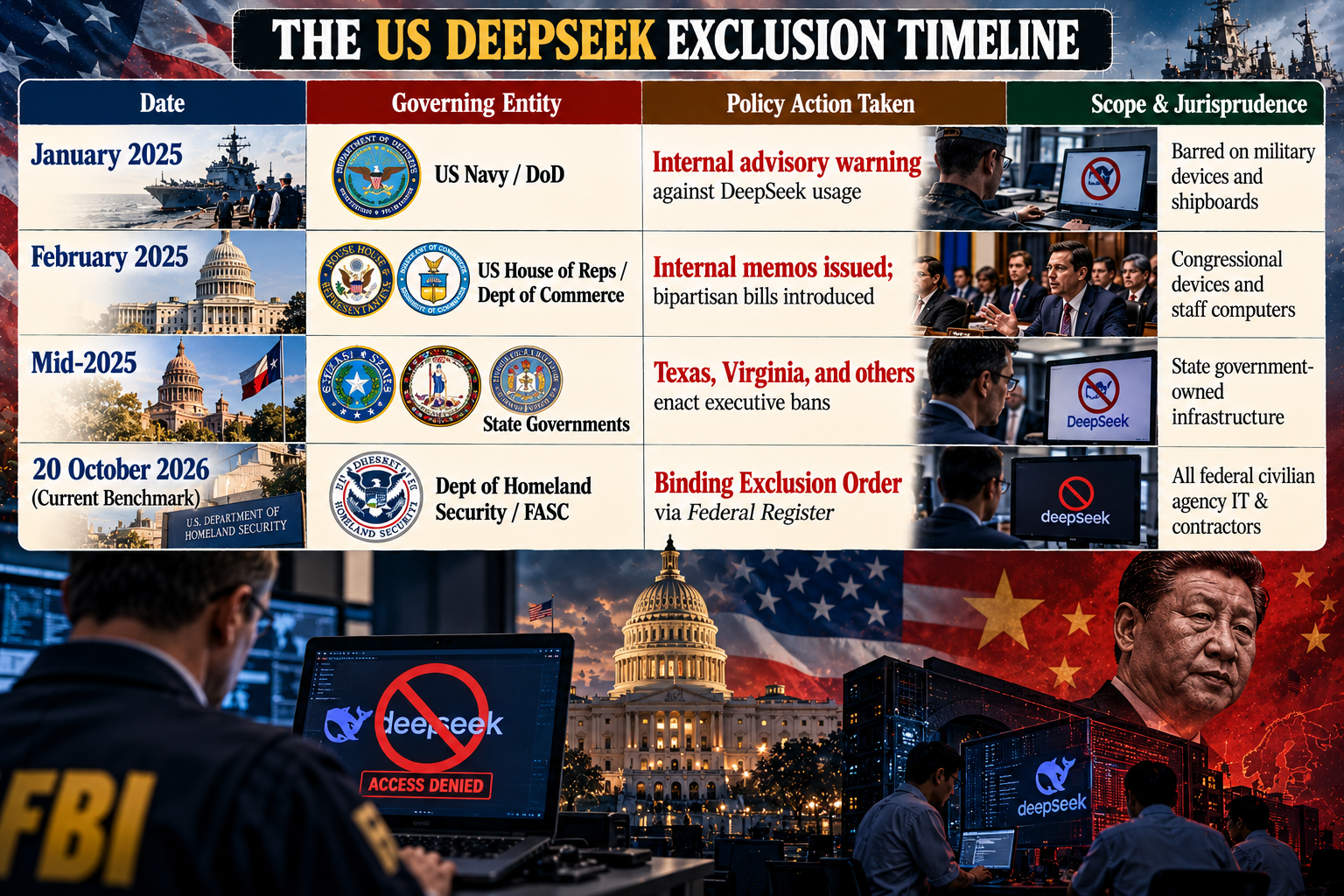
The October 2026 directive marks the culmination of an escalating security posture that began within days of DeepSeek's global ascent.
In late January 2025, the US Navy became the first American military institution to sound the alarm, instructing personnel to cease all use of DeepSeek due to "security and ethical concerns." Days later, the Pentagon expanded the warning across military branches, cautioning that using the AI tool to draft memos, inspect programming scripts, or summarise technical documents risked exposing sensitive military operations to foreign servers.
Simultaneously, the Chief Administrative Officer of the US House of Representatives issued an advisory barring congressional staff from downloading the application on official hardware. Bipartisan lawmakers, led by Representatives Josh Gottheimer and Darin LaHood, introduced the No DeepSeek on Government Devices Act, seeking a statutory ban analogous to the federal prohibitions imposed on ByteDance's TikTok.
However, while those early interventions relied on administrative guidance or piecemeal agency rules, the October 2026 order carries statutory enforcement power.
Acting through the Federal Acquisition Security Council (FASC)—an inter-agency body empowered by Congress to protect federal supply chains from foreign espionage—the Department of Homeland Security issued a formal Exclusion and Removal Order. Under Title 41 of the US Code, this order is legally binding on all civilian departments, from the Treasury and State Department to the Department of Energy and NASA.
The National Security Rationale: The Threat of "Actionable Intelligence"
In its regulatory filing, the Department of Homeland Security laid out an unvarnished technical indictment of the Chinese AI developer.
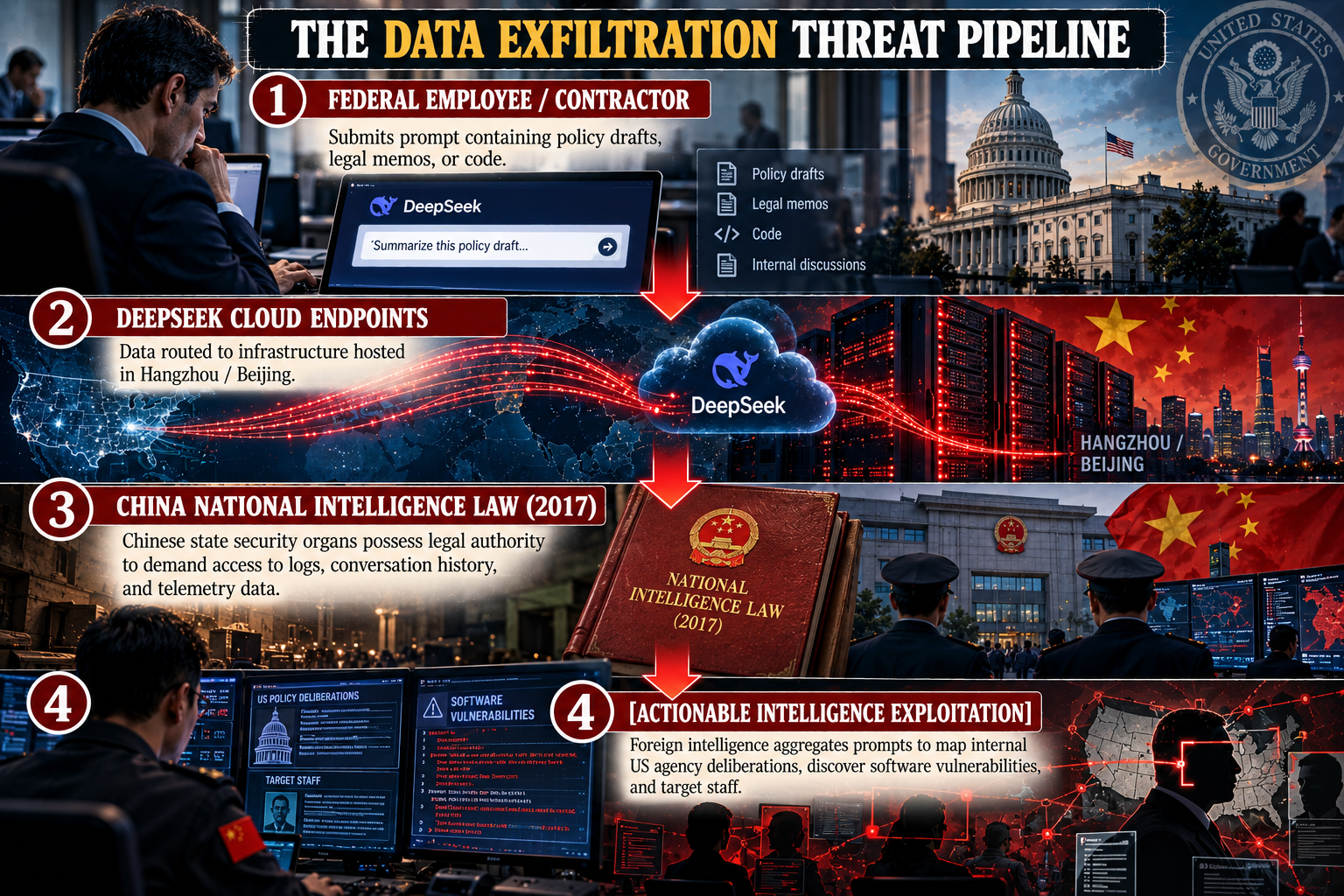
The primary security vulnerability centres on China’s domestic statutory framework. Under the People's Republic of China’s 2017 National Intelligence Law and its 2021 Data Security Law, all domestic enterprises are legally mandated to assist, support, and cooperate with state intelligence services whenever requested. Chinese cloud servers are legally transparent to state security organs, with zero provision for judicial pushback or commercial non-disclosure.
In its official notice, DHS warned that the use of DeepSeek by government personnel:
"Could produce actionable intelligence on US persons and/or government programmes."
When government employees interact with an artificial intelligence system, their queries are rarely innocuous. Civil servants routinely paste proprietary code to debug administrative portals, draft preliminary regulatory language, synthesise internal policy discussions, or review legal briefs.
For an adversary intelligence apparatus, accessing the raw prompt stream of a nation's civil service offers a real-time window into policy formulations, technical vulnerabilities, and internal inter-agency disputes before they are ever made public.
The Open-Weight Dilemma: Why Offline Models Were Not Spared
The most contentious and consequential dimension of the DHS directive is its refusal to grant exemptions for open-weight models.
Unlike proprietary systems such as OpenAI's ChatGPT or Anthropic's Claude, which can only be accessed via cloud-based application programming interfaces (APIs), DeepSeek made the weights of its models (such as DeepSeek-V3 and DeepSeek-R1) publicly downloadable. This allowed developers and commercial enterprises to run the models locally on private, air-gapped servers with zero internet connection to Chinese infrastructure.
Many tech-policy analysts argued that running an open-weight model on an isolated, offline server eliminated the risk of data exfiltration to Beijing.
The Department of Homeland Security and CISA rejected this distinction for three primary technical reasons:
The Inscrutability of Neural Weights: A modern neural network consists of hundreds of billions of floating-point numbers. Unlike traditional software, where source code can be reviewed line-by-line for malicious backdoors, artificial intelligence models are black boxes. Current cyber-forensic tools cannot guarantee that a model does not contain embedded triggers—subtle architectural vulnerabilities that cause the model to fail predictably when encountering specific adversarial prompts in critical infrastructure tasks.
Training-Data Poisoning: Foundational weights encode the values, censorship parameters, and epistemological assumptions of their training corpora. Federal security planners determined that relying on algorithms shaped by Chinese state-aligned training data to process American government workflows introduces systemic cognitive bias and security risks.
Provenance and Auditing Complexity: In a complex federal enterprise operating millions of workstations, distinguishing between a locally hosted DeepSeek instance and a client pinging external endpoints imposes an unsustainable monitoring burden on cybersecurity teams. Banning the technology categorically was deemed the only enforceable standard.
The Commercial Ripple Effect: Contractors Under the Gun
The impact of the DHS directive reverberates far beyond executive branch offices; it immediately reshapes the commercial market for federal government contractors.
Under the terms of the FASC exclusion order, federal agencies must ensure that commercial vendors do not use DeepSeek products to service federal contracts. This introduces rigorous new compliance demands for major defence contractors, system integrators, and software vendors operating through the General Services Administration (GSA) schedule:
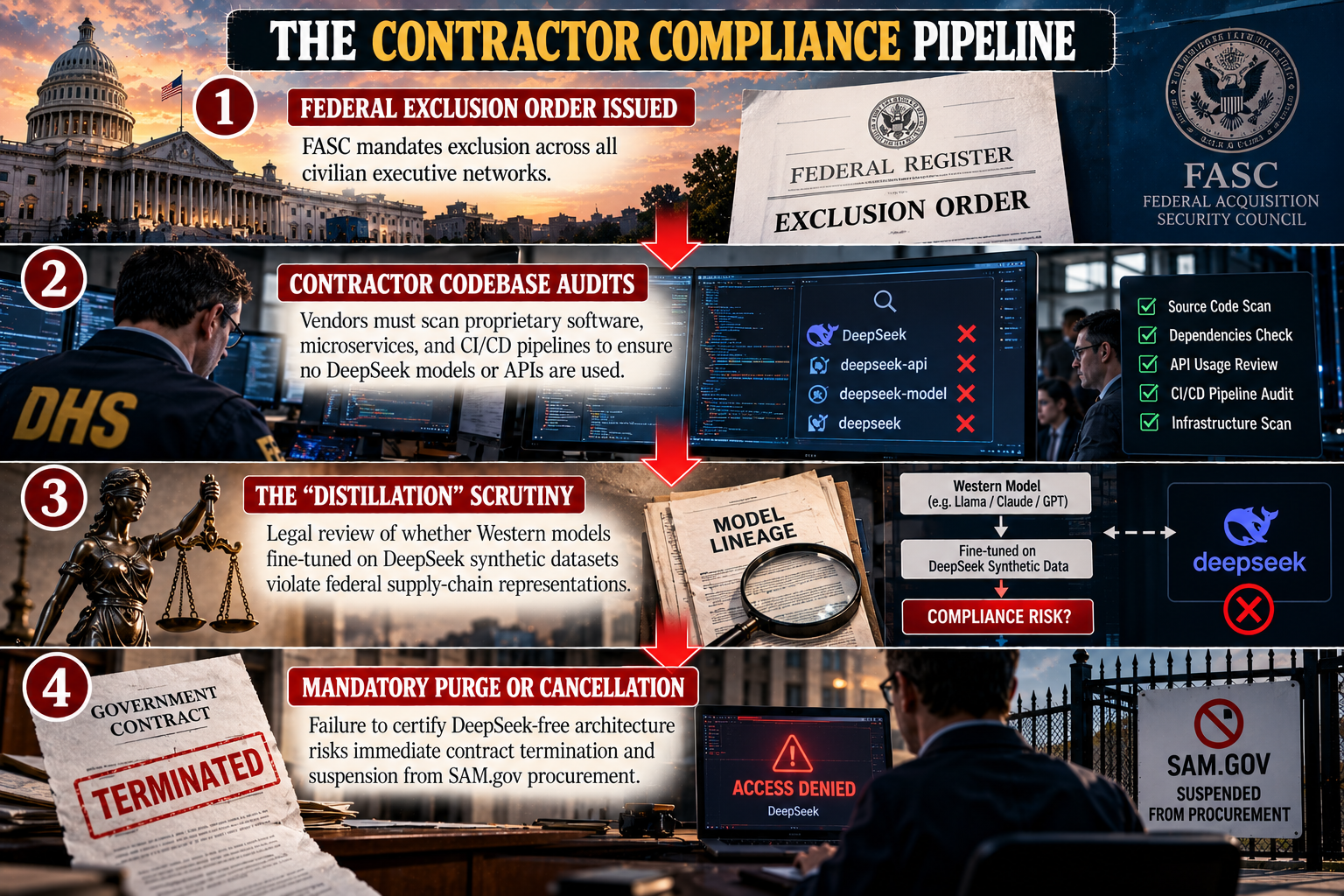
Software companies providing automated coding assistants, enterprise document search platforms, or customer-support workflows to federal clients must formally certify that their underlying engines do not rely on DeepSeek models.
Furthermore, the ban raises complex questions regarding model distillation. In early 2025, numerous American startups used DeepSeek's open-weight models to generate synthetic training data to train smaller, specialized American models. Federal procurement officers are now evaluating whether models trained on DeepSeek outputs fall under the scope of "associated technologies," a determination that could force contractors to retrain proprietary models from scratch.
The Geopolitical Repercussions: Beijing Threatens Countermeasures
The reaction from Beijing was swift and uncompromising.
On 20 and 21 October 2026, spokespersons for China’s Ministry of Foreign Affairs and Ministry of Commerce issued formal diplomatic protests, accusing the United States of weaponising national security to protect Silicon Valley from legitimate market competition.
The Ministry of Commerce warned that it would take:
"All necessary measures to resolutely safeguard the legitimate rights and interests of Chinese enterprises."
Trade analysts warn that Beijing could retaliate by introducing reciprocal supply-chain restrictions. China’s Cyberspace Administration could escalate security audits against American technology firms operating within the Chinese domestic market, or leverage its recently expanded export control frameworks—such as licensing restrictions on critical minerals and heavy machinery—to increase economic pressure on Western supply chains.
Conclusion: The Fracturing of Global AI
The US government’s formal ban on DeepSeek signals the definitive end of the borderless open-source artificial intelligence paradigm.
For decades, international software development flourished under the assumption that mathematical algorithms, academic research papers, and open-source code repositories existed outside the domain of national borders and geopolitical rivalries. The DHS directive firmly terminates that assumption.
By categorising an open-weight artificial intelligence model as a national security hazard equivalent to an unvetted foreign telecommunications switch, the United States has established that in the era of artificial intelligence, algorithms are sovereign assets—and software code is a theatre of conflict.
As Washington purges DeepSeek from its federal systems, the global technology landscape is fracturing into two distinct, irreconcilable technological ecosystems: one built upon vetted, Western-aligned infrastructure, and another anchored in Chinese state-approved models. For global enterprises and software developers navigating the space between them, the era of technological neutrality is officially over.