In brief
- Prem Watsa, 76, is the founder and CEO of Canada’s Fairfax Financial, often called the “Warren Buffett of Canada”. Fairfax manages over $100 billion, and Forbes puts his own wealth at about $2.5 billion.
- He was born near Hyderabad and studied at IIT Madras. He moved to Canada in 1972 with about $8, paid for his MBA by selling appliances door to door, and took over a failing insurer in 1985 to build Fairfax.
- His style is value investing. He uses insurance premium money as long-term capital to buy undervalued companies, and he let those companies run themselves.
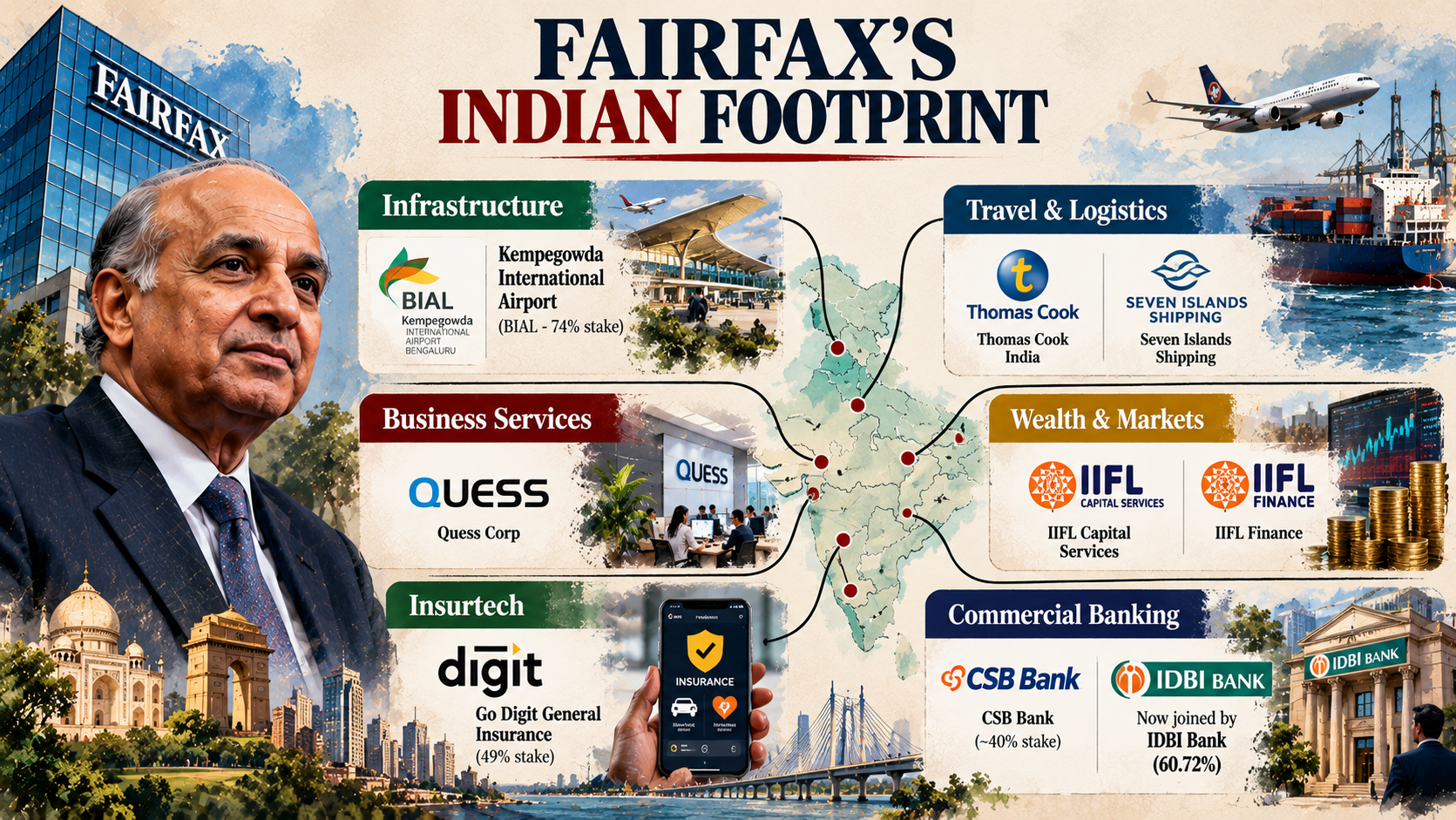
- His Indian bets include Bangalore Airport (74%), Go Digit, Quess, Thomas Cook India, IIFL, and CSB Bank, which he rescued in 2018.
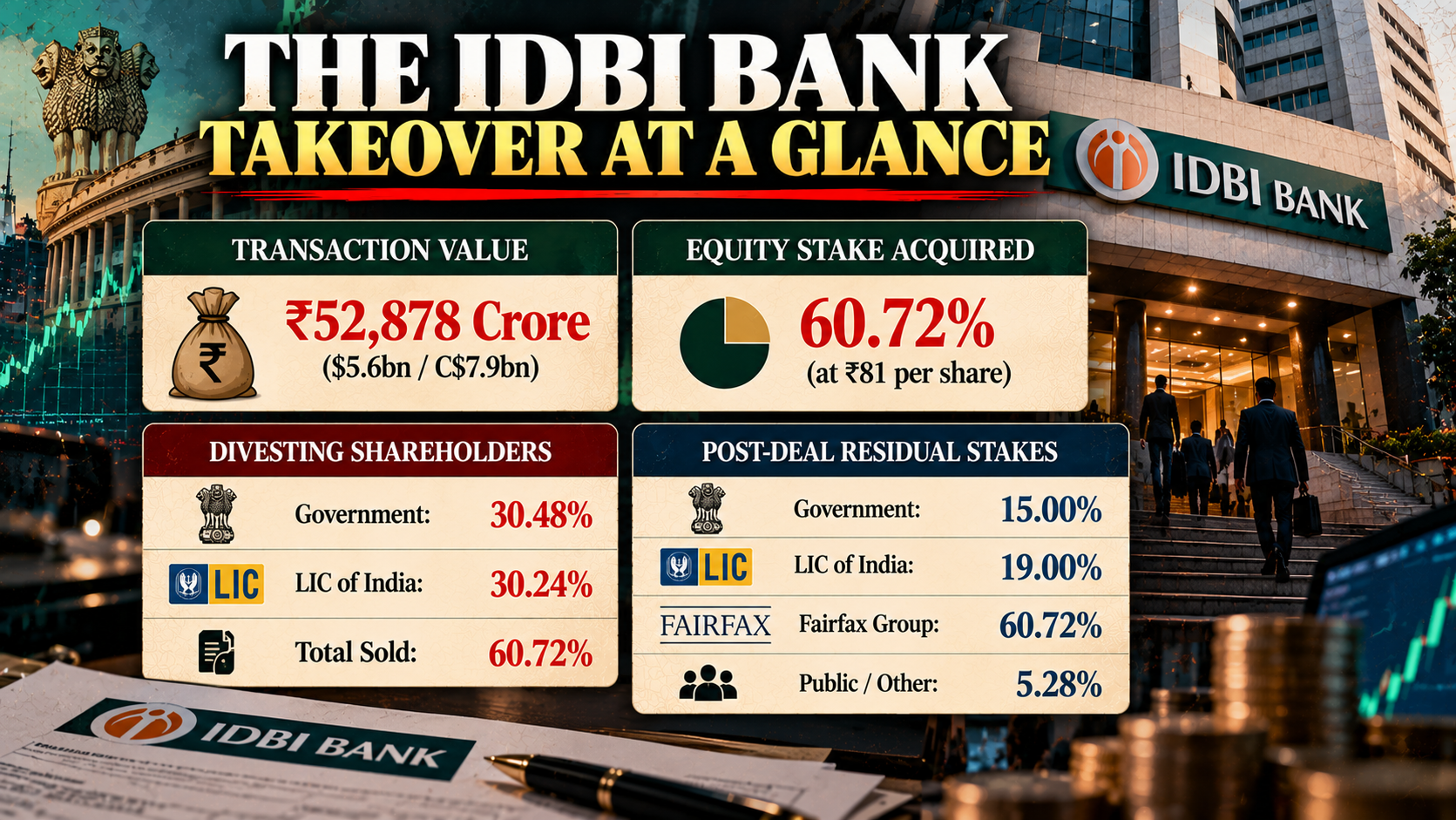
- On 14 October 2026, the Cabinet approved selling him 60.72% of IDBI Bank for ₹52,878 crore. He plans to fold Go Digit and IIFL Capital into it, with Rakesh Sharma staying as CEO and N.S. Kannan proposed as chairman.
On 14 October 2026, the Cabinet Committee on Economic Affairs (CCEA) approved the sale of a controlling 60.72% stake in IDBI Bank Ltd to Canada-based Fairfax Financial Holdings for ₹52,878 crore ($5.6 billion / C$7.9 billion). The deal marks the largest Foreign Direct Investment (FDI) in the history of Indian financial services and the first time a foreign institutional investor has taken majority ownership of a major domestic commercial lender.
Conducted without the customary army of Wall Street advisory firms, the deal was orchestrated by Prem Watsa, the 76-year-old founder, chairman, and chief executive of Fairfax Financial. Known throughout global finance as the ‘Warren Buffett of Canada’, Watsa has engineered one of the most consequential private capital investments in modern Indian banking.
1. The Immigrant Who Arrived with Eight Dollars
Virsa Prem Watsa was born on 5 August 1950 near Hyderabad. His father was a mathematics and English teacher who later became a school principal, instilling in Watsa an early discipline in quantitative analysis and ethics.
After completing his schooling at The Hyderabad Public School, Begumpet, Watsa earned a degree in chemical engineering from the Indian Institute of Technology (IIT) Madras in 1971. Although trained as an engineer, his interest shifted decisively toward business and financial markets during his university years.
In 1972, Watsa emigrated to Canada to join his brother in London, Ontario, carrying just $8 in his pocket. To finance his MBA at the Richard Ivey School of Business at the University of Western Ontario, Watsa spent summers and evenings selling air conditioners, furnaces, and heaters door-to-door—an experience he frequently credits with teaching him resilience and human psychology.
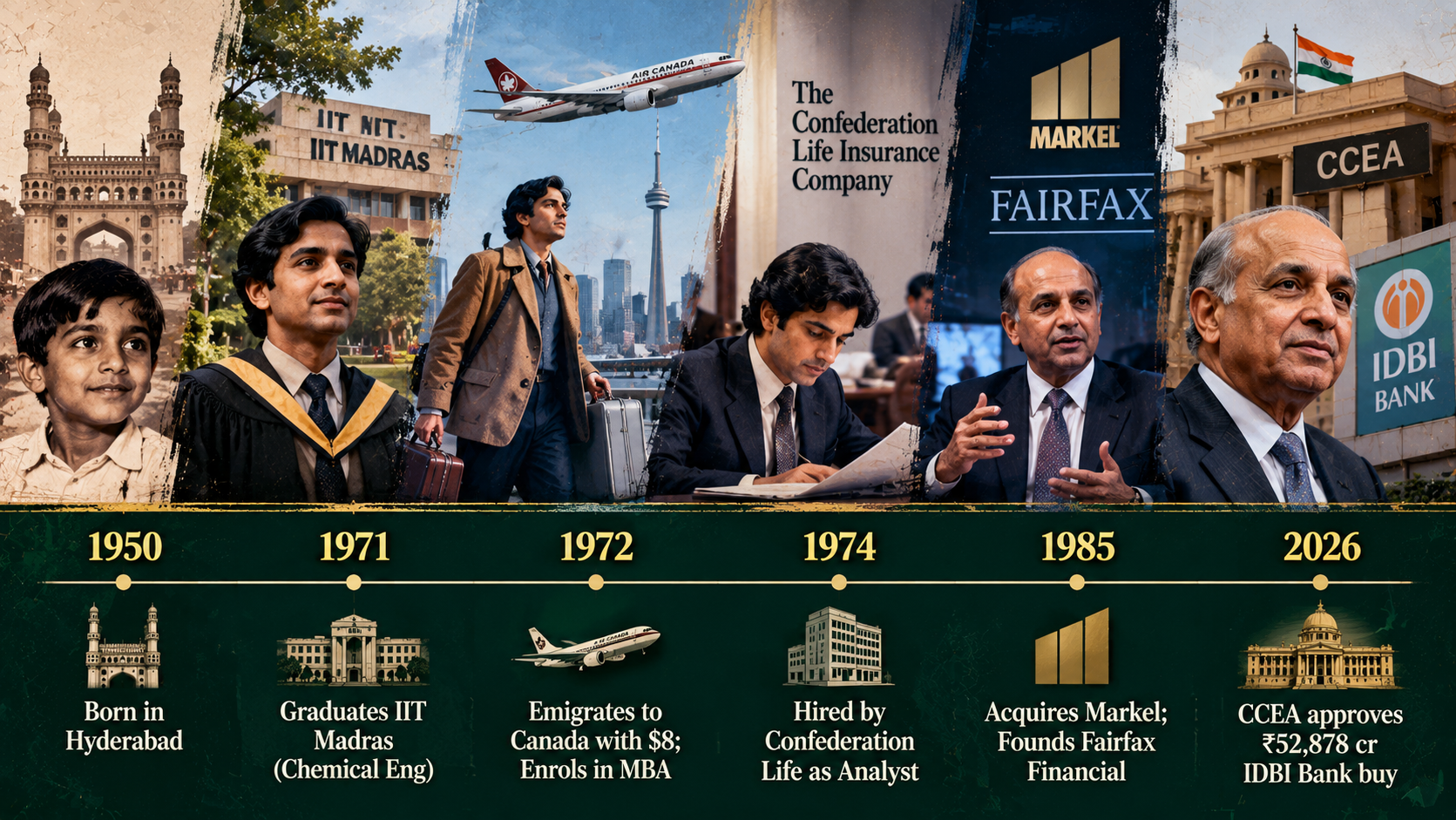
After graduating in 1974, Watsa joined Confederation Life Insurance in Toronto as an equity research analyst. It was there that his mentor, John Watson, introduced him to the value-investing principles of Benjamin Graham and David Dodd. Watsa immersed himself in Graham’s Security Analysis and The Intelligent Investor, adopting the philosophy that would govern his entire career: buying sound, durable assets at a margin of safety when market sentiment is unduly pessimistic.
2. Building Fairfax: The Canadian Berkshire Hathaway
In 1985, after co-founding Hamblin Watsa Investment Counsel, Watsa identified a distressed, specialised Canadian trucking insurer named Markel Financial. Organising a group of private investors, he took control of the company and subsequently reorganised it as Fairfax Financial Holdings—an acronym for ‘Fair and Friendly Exchange’.
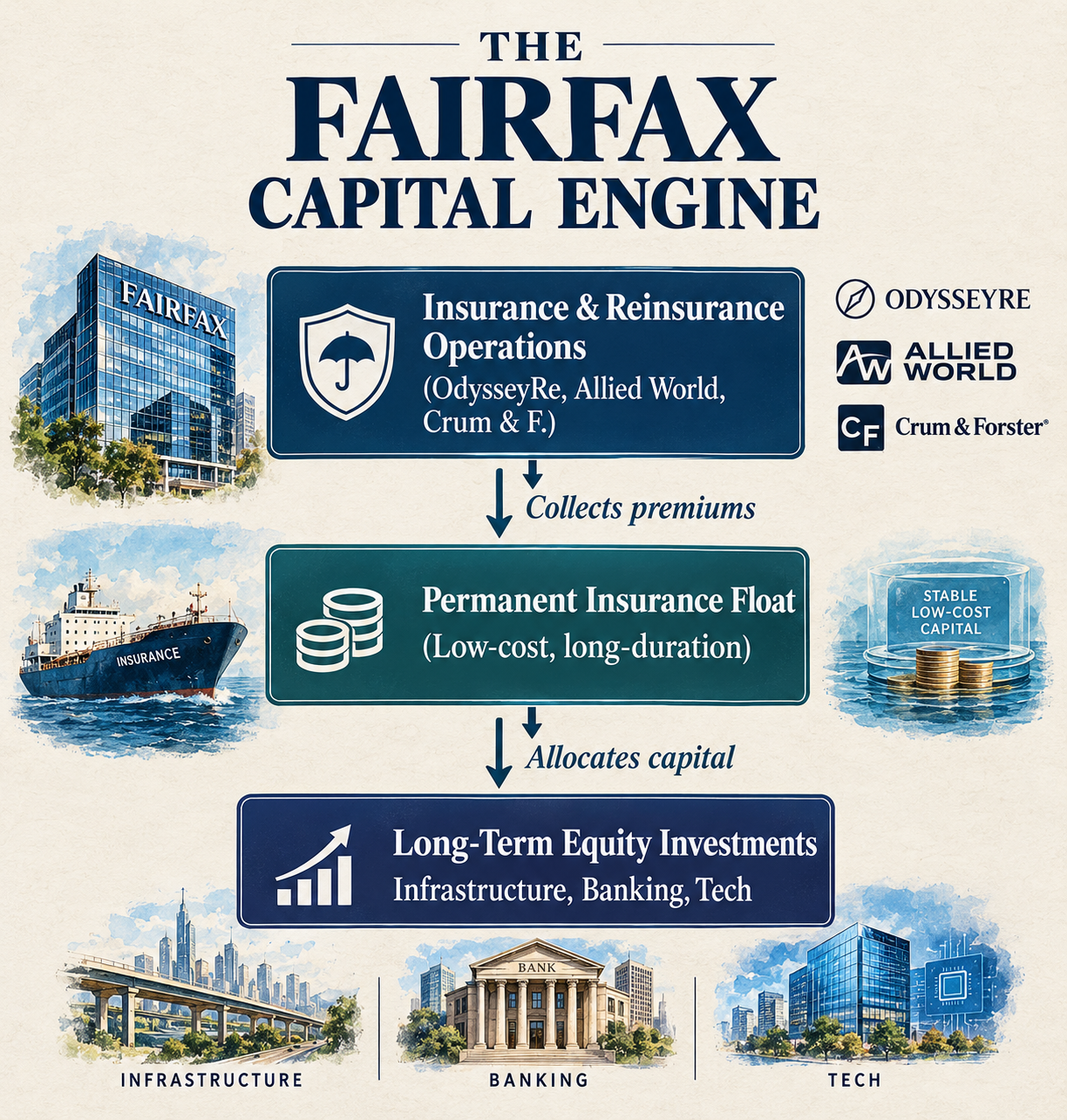
Watsa mirrored the structural architecture pioneered by Warren Buffett at Berkshire Hathaway:
Deploying Insurance Float: Fairfax focused on property, casualty, and specialty reinsurance companies (building and acquiring businesses like OdysseyRe, Crum & Forster, Zenith National, and Allied World). The premiums collected ahead of potential claims—known as insurance float—provided a low-cost, long-duration capital base.
Patient, Value-Driven Reinvestment: Rather than managing earnings to satisfy quarterly expectations, Watsa invested this float into publicly listed and private operating companies trading significantly below intrinsic worth.
Preserving Decentralisation: Fairfax allowed operating subsidiaries complete executive autonomy. Watsa avoided administrative integration, focusing his attention on capital allocation.
Watsa’s reputation as an astute contrarian investor solidified during major market disruptions. He anticipated the 1987 Black Monday market crash, avoided the dot-com bubble, and generated billions of dollars in profit during the 2007–2008 global financial crisis by purchasing credit default swaps against toxic US subprime mortgages while Wall Street institutions faltered. Today, Forbes estimates his personal net worth at approximately $2.5 billion, while Fairfax manages over $100 billion in global assets.
3. The Indian Playbook: Infrastructure, Insurance, and Banks
While many Western funds treated India as a tactical, emerging-market equity play, Watsa took a permanent, long-term approach. In 2015, he established Fairfax India Holdings Corporation, a dedicated, Toronto-listed vehicle created specifically to invest in long-duration Indian assets.
Before the IDBI Bank transaction, Fairfax had already deployed billions of dollars across critical sectors of the Indian economy:
Aviation and Gateways: Fairfax acquired a controlling 74% stake in Bangalore International Airport Limited (BIAL), transforming Kempegowda International Airport into one of the fastest-growing aviation hubs in the world.
Staffing and Services: Controlling stakes in Quess Corp and travel major Thomas Cook India.
Insurtech and Wealth Management: Backing Kamesh Goyal to establish Go Digit General Insurance (retaining a 49% stake) and holding significant equity in Nirmal Jain’s IIFL Group (including IIFL Capital and IIFL Finance).
Banking Precedent (CSB Bank): In 2018, Fairfax made history when the Reserve Bank of India granted special regulatory dispensation allowing Fairfax to acquire a 51% controlling stake in the troubled, Kerala-based Catholic Syrian Bank (CSB Bank), which was subsequently turned around and listed.
4. The Turnaround: What Fairfax Is Actually Buying in IDBI Bank
IDBI Bank’s journey to this acquisition represents one of the most dramatic rehabilitations in Indian corporate history.
Originally founded in 1964 as a state-owned development finance institution (the Industrial Development Bank of India), it was converted into a full commercial bank in 2004. Over the following decade, excessive exposure to debt-laden infrastructure projects, thermal power plants, and steel mills pushed the balance sheet into systemic distress. By 2017, the bank’s Gross Non-Performing Asset (GNPA) ratio exceeded 30%, triggering strict RBI Prompt Corrective Action (PCA) lending curbs.
In January 2019, the central government intervened, orchestrating an emergency recapitalisation in which the Life Insurance Corporation of India infused ₹21,624 crore ($2.6 billion) to acquire a 51% controlling interest, reclassifying IDBI Bank as a private lender under RBI supervision.
Under managing director and chief executive Rakesh Sharma, the bank executed a comprehensive balance-sheet clean-up:
Fairfax is not acquiring an insolvent balance sheet requiring fresh capital infusion; it is acquiring a solvent, highly capitalised retail banking franchise with over 1,900 domestic branches, a diversified deposit base, and an established distribution footprint.
5. The Financial Supermarket: Watsa’s Strategy for IDBI Bank
Rather than treating IDBI Bank as a standalone asset, Watsa plans to position the lender as the anchor of a comprehensive financial services conglomerate.
Immediately following the government’s approval, Fairfax announced plans to contribute its existing Indian financial businesses into IDBI Bank at market valuation, subject to regulatory clearances:
Folding Go Digit (Insurtech): Fairfax proposes transferring its 49% stake in Go Digit’s general and life insurance operations into IDBI Bank. This brings digital-first insurance underwriting directly into the bank’s national branch network.
Integrating IIFL Capital (Wealth & Equities): Fairfax, which is raising its equity stake in IIFL Capital to 51% via an open offer, plans to contribute this interest to IDBI Bank, creating immediate capabilities in equity brokerage, institutional research, and investment banking.
Preserving Decentralisation: Rejecting conventional corporate consolidation, Watsa made clear that the units will retain independent operational management:
‘We never believed in synergies. We believe in decentralised operation. That is one of the reasons for our success. Our focus is to build the best global Indian bank in India. Not a Canadian bank, not an American bank. An Indian bank run by Indians.’
Watsa confirmed that Rakesh Sharma will continue as managing director and chief executive. To reinforce governance, Fairfax proposed N.S. Kannan—former managing director of ICICI Prudential Life and former CFO of ICICI Bank—as non-executive chairman. Watsa has also enlisted seasoned banking veterans Deepak Parekh and Paresh Sukthankar in senior advisory roles.
6. Regulatory Conditions and Policy Precedents
Because Indian banking regulations tightly limit long-term foreign ownership in commercial lenders, the RBI has attached strict prudential covenants to the transaction:
The 15-Year Glide Path: While Fairfax is permitted to acquire 60.72% today, it is legally required under RBI promoter ownership rules to pare its holding down to 26% over a 15-year period.
The CSB Bank Overlap: Under central bank rules, a single promoter group cannot own controlling stakes in two separately operating scheduled commercial banks. Because Fairfax holds roughly 40% of CSB Bank, the RBI granted Fairfax a two-year window to resolve the overlap—either by merging CSB Bank into IDBI Bank or divesting its CSB Bank shares entirely.
Protection of Public Commitments: As confirmed by the Department of Investment and Public Asset Management (DIPAM), all existing employee pension covenants, service conditions, deposit guarantees up to ₹5 lakh under the DICGC, and mandatory 40% Priority Sector Lending (PSL) requirements remain legally binding.
The transaction sets an important precedent for India’s broader economic policy. By demonstrating that an unviable state-backed lender can be cleaned up, recapitalised, and successfully sold to long-term foreign capital for ₹52,878 crore, the government has established an empirical template for future banking sector divestments.