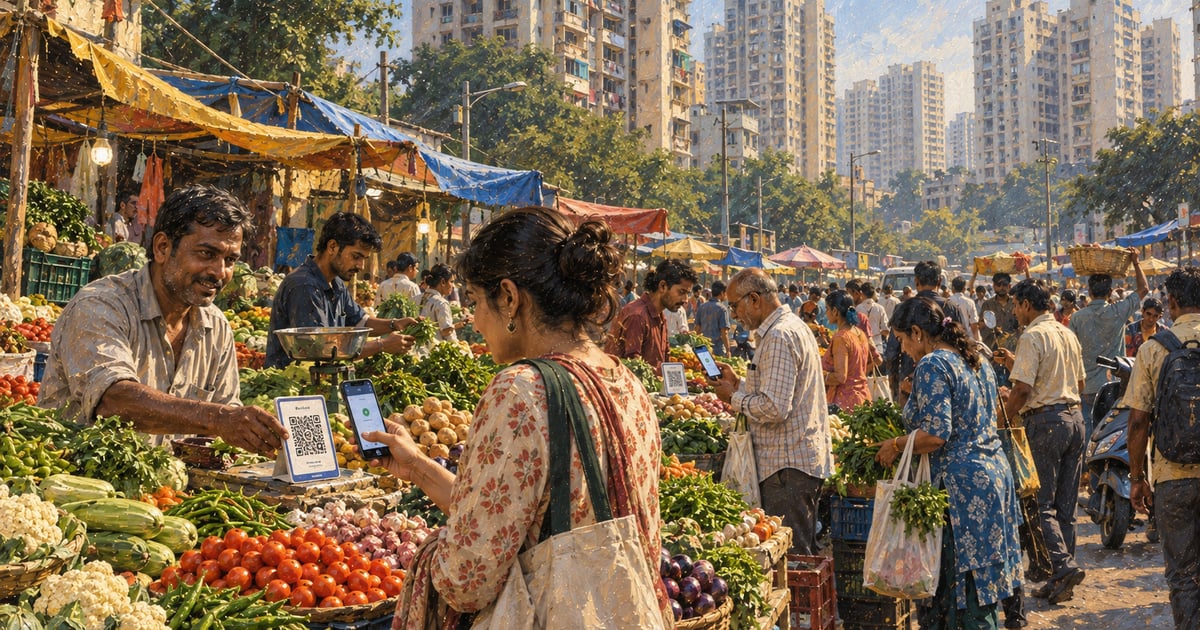
On 15 September 2026, the Union Ministry of Finance and the National Payments Corporation of India (NPCI) confirmed what banking executives had quietly advocated for years: the era of blanket, unconditional zero-fee UPI is officially over.
Under the revised framework announced by the Press Information Bureau (PIB) following an enabling amendment to the Payment and Settlement Systems (PSS) Act, 2007, person-to-merchant (P2M) payments exceeding ₹2,000 will attract a nominal Merchant Discount Rate (MDR) of 0.4%, capped at ₹300 for high-value transactions.
The public reaction was swift, marked by scepticism and confusion. For nearly a decade, the Unified Payments Interface (UPI) had been heralded not merely as a convenient payment channel, but as the world's pre-eminent Digital Public Infrastructure (DPI)—a sovereign public good engineered to democratise payments and permanently eliminate private gatekeepers. If UPI was designed as national infrastructure comparable to highways or digital electricity, why has the state introduced a commercial charge?
The answer lies in the harsh mathematical reality of payment processing: free for the user has never meant free to operate. As transaction volumes scaled to astronomical levels, India’s zero-MDR policy evolved from a brilliant adoption engine into an unsustainable financial drag on the banking sector.
What Actually Changed: Dissecting the New Rules
Public discourse frequently conflates consumer fees with merchant charges. The official framework detailed by PIB and reported by DD News establishes clear operational ring-fences:
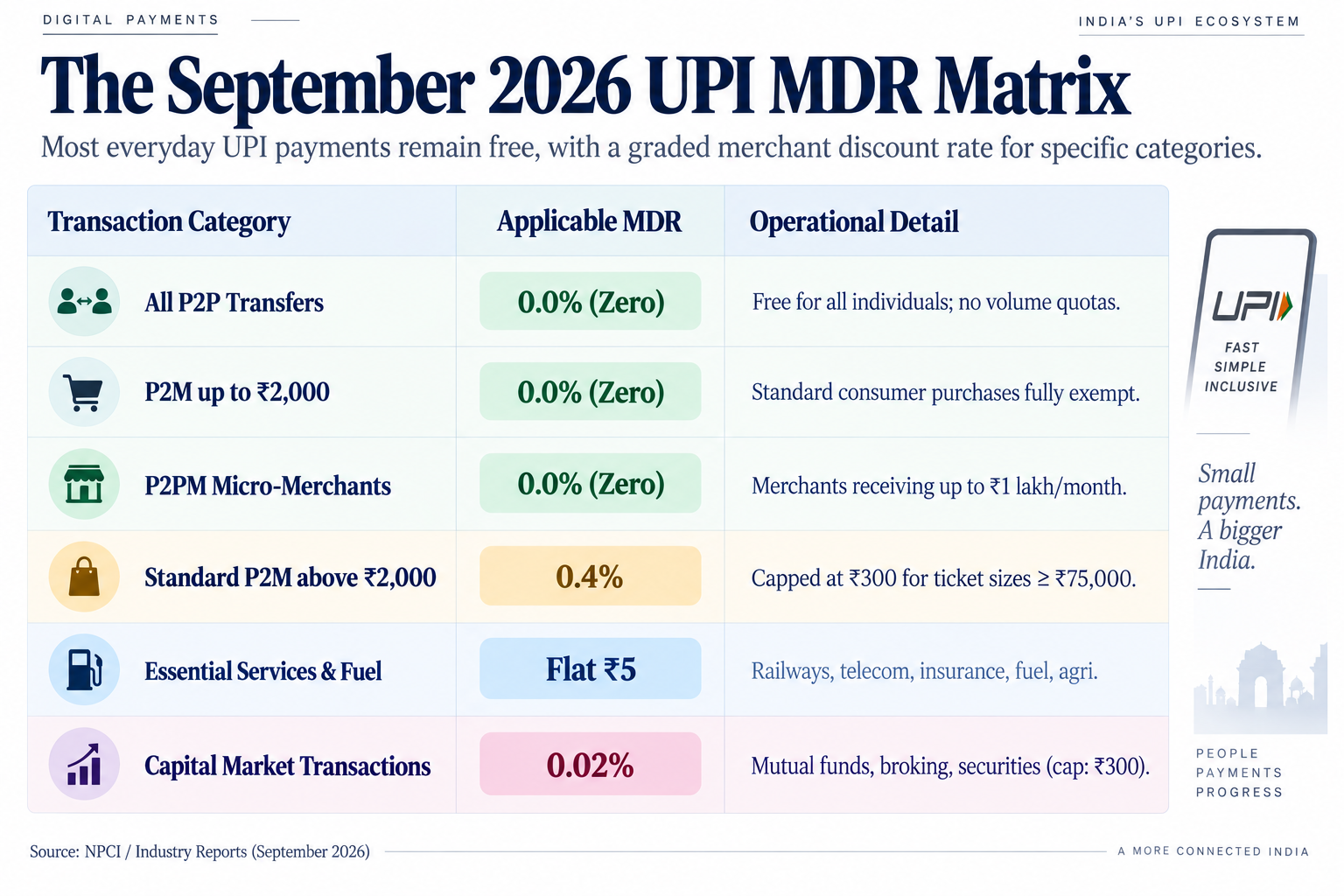
Four critical protections govern this rollout:
Consumers Pay Nothing: MDR is legally classified as an acquirer-merchant commercial commission. Banks and payment apps are strictly prohibited from passing this fee to retail payers.
Platform Fees Banned: Third-party application providers (TPAPs) such as PhonePe, Google Pay, and Paytm cannot levy platform or convenience fees on standard UPI transfers.
96% of Merchant Payments Remain Free: Because micro-merchants earning under ₹1 lakh ($1,200) monthly under the Person-to-Person-Merchant (P2PM) classification and all sub-₹2,000 payments remain exempt, government impact models show that 96% of all merchant transactions will incur zero fees.
Infrastructure Reinvestment: Exactly 5% of all MDR collected under the new system is ring-fenced into a dedicated Small Merchant UPI Adoption Fund to deepen terminal penetration in tier-3 to tier-6 towns.
The Genesis: Why Zero-MDR Was Introduced in 2020
To understand why MDR returned, one must examine why it was abolished in the first place.
In the Union Budget of July 2019, the central government inserted Section 10A into the Payment and Settlement Systems Act, 2007 (enforced from 1 January 2020). The statute mandated that no bank or system provider could impose any fee or MDR on transactions carried out via prescribed digital modes, specifically UPI and RuPay debit cards.
The strategic rationale was unassailable at the time:
Overcoming Cash Friction: Indian merchants had spent decades avoiding point-of-sale (POS) card terminals due to onerous 1.5% to 2.5% MDR levies, terminal rental fees, and fear of tax scrutiny.
Catalysing Network Effects: By driving merchant onboarding costs to absolute zero, an ordinary roadside vendor had zero economic barrier to pasting a QR code onto a wooden cart.
Financial Inclusion as a Public Good: Cash handling imposed an estimated annual cost of over 1.5% of GDP on the Indian economy in currency printing, physical transit, security, and counterfeit management. Subsidising digital payments was cheaper than managing paper money.
The strategy succeeded beyond all projections. By July 2026, UPI was processing 2,366 crore transactions (23.66 billion transactions) worth ₹29.9 lakh crore ($360 billion) in a single month, as noted in the Ministry of Finance Briefing. India accounted for nearly 46% of real-time digital payments globally.
However, zero-MDR had introduced an artificial economic distortion: it removed the fee without removing the underlying cost of production.
The Hidden Bill: Why "Free" UPI Was Bleeding Banks
Every UPI transaction appears instantaneous to the user, but under the hood it triggers a chain of computational and financial actions across multiple institutions:
For every tap or QR scan, systems must query account balances, verify encrypted PINs, update ledgers on core banking systems (CBS), run anti-money laundering and fraud heuristics, transmit confirmation payloads through the NPCI switch, and execute bilateral interbank settlement.
This architecture incurs substantial, ongoing operational expenditures:
1. Server Load and CBS Upgrades
Traditional bank core banking platforms were architected in the 2000s for salary deposits, occasional cheque clearances, and ATM withdrawals—handling perhaps 20 to 50 transactions per customer per month. Under UPI, an active user executes multiple micro-transactions daily: buying tea for ₹10, vegetables for ₹45, or groceries for ₹150. Banks found their servers processing billions of API queries that yielded zero revenue. Major public and private banks were forced to invest hundreds of crores annually in server farms, load balancers, and database licensing merely to prevent server downtime and transaction timeouts.
2. Cybersecurity and Fraud Detection
With volume came financial fraud. As phishing, account takeovers, and social engineering escalated, payment system operators had to deploy continuous risk-engine upgrades, machine-learning fraud monitoring, and round-the-clock dispute redressal mechanisms.
3. The Budgetary Subsidy Shortfall
Recognising the cost burden, the Ministry of Electronics and Information Technology (MeitY) introduced an annual incentive scheme for low-value BHIM-UPI and RuPay transactions. In recent fiscal cycles, this budgetary grant was typically pegged around ₹1,500 crore to ₹2,600 crore ($180 million to $312 million) across all participating institutions.
However, studies submitted by the Payments Council of India (PCI) and the Indian Banks’ Association (IBA) revealed that the true operational cost of sustaining the UPI network exceeded ₹8,000 crore to ₹12,000 crore ($960 million to $1.44 billion) annually. The state subsidy covered less than a quarter of actual industry overheads, leaving public and private sector lenders to absorb the remaining deficit on their balance sheets.
Market Distortion: The Accidental Duopoly
Beyond bank balance sheets, zero-MDR produced an unintended and dangerous structural consequence: it entrenched a private duopoly.
Because pure UPI processing generated no merchant transaction revenue, technology startups could not build a standalone business around payment acquiring. The only players capable of surviving were massive, well-capitalised entities that could afford to burn hundreds of millions of dollars in capital, treating payments as a loss-leader to cross-sell financial services (personal loans, insurance, mutual funds, credit cards) or capture merchant data.
As a result, Walmart-backed PhonePe and Google Pay captured over 80% to 85% of total UPI transaction volume. Domestic fintechs and regional banks could not compete on payment processing alone. NPCI repeatedly postponed the implementation of its proposed 30% market-share cap because artificially restricting the market leaders would have triggered widespread transaction failures across the retail economy.
Introducing an MDR on transactions above ₹2,000 injects sustainable revenue directly into the acquiring ecosystem. Payment aggregators, acquiring banks, and new fintech entrants can now earn a legitimate processing margin on commercial business, fostering competition and weakening duopolistic concentration.
The Regulatory Pivot: From Discussion Paper to Statutory Reform
The return of MDR was neither impulsive nor sudden. It represents the culmination of a four-year institutional reckoning:
The August 2022 RBI Discussion Paper: The Reserve Bank of India published its comprehensive Discussion Paper on Charges in Payment Systems, asking stakeholders whether payment systems should operate on cost recovery and whether a tiered MDR based on transaction value could sustain digital growth without impeding financial inclusion.
The 32nd Report of the Standing Committee on Finance: Parliament's Standing Committee on Finance explicitly warned that perpetual subsidies risked starving the digital payments network of capital investments, recommending that a transparent revenue model be instituted to safeguard national financial infrastructure.
The Taxation and Other Laws (Amendment) Act, 2026: Parliament amended Section 10A of the PSS Act, replacing the blunt statutory ban on fees with an enabling provision that empowers the government and NPCI’s Steering Committee to calibrate fee exemptions selectively.
DPI Theory: Does Public Infrastructure Mean Free Forever?
The philosophical heart of the debate concerns what it means to be a "Digital Public Infrastructure".
India’s DPI paradigm—frequently referred to as the India Stack—distinguishes itself from Western private card networks (Visa, Mastercard) and Chinese walled gardens (Alipay, WeChat Pay). In the Western model, private rail operators charge high interchange fees (typically 1.5% to 3.0%), extracting private rents. In China, proprietary platforms create closed ecosystems.
India’s innovation was separating the rails from the apps. The rails are public, open, and interoperable; the applications are market-driven and competitive.
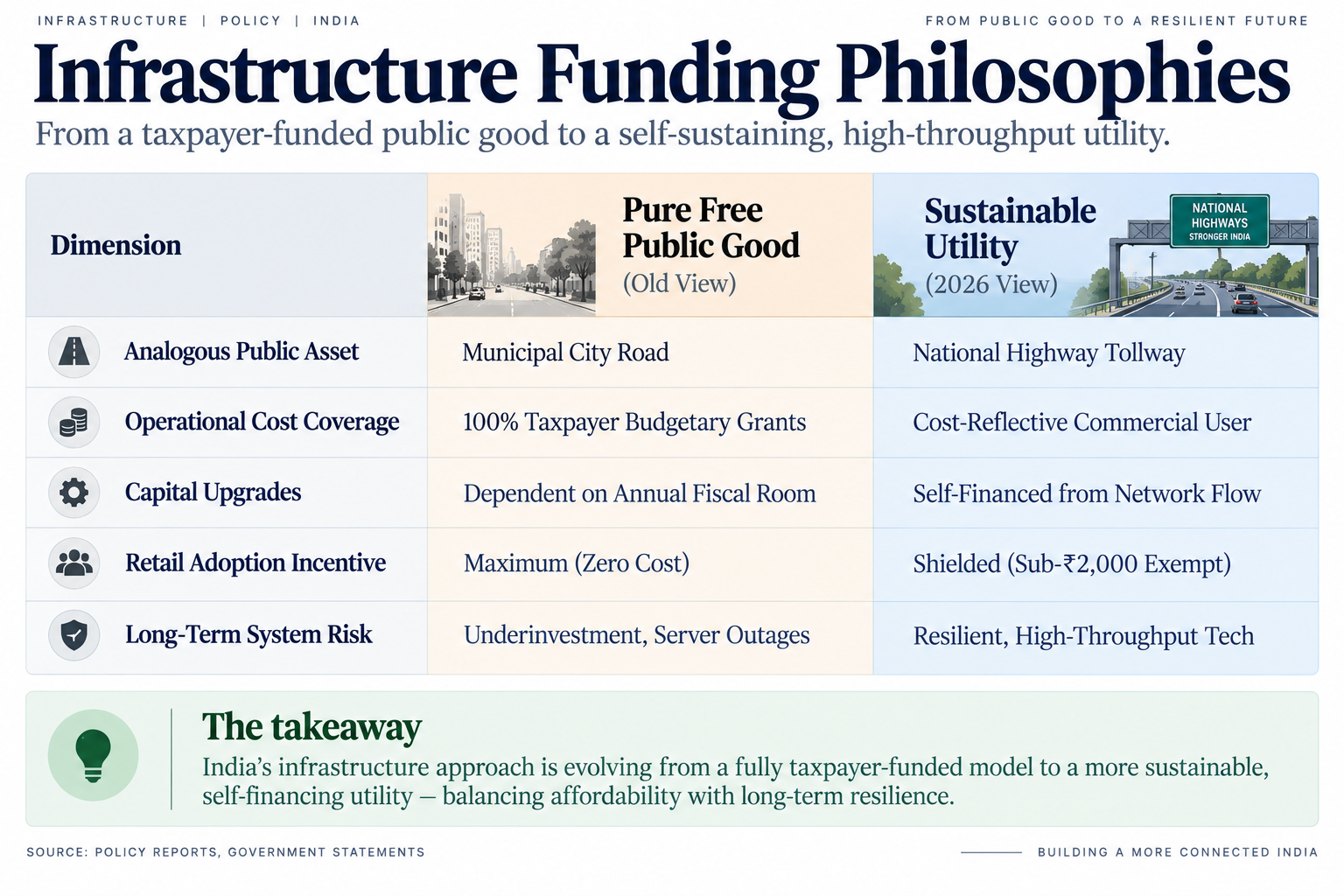
As public infrastructure matures, treating it as an entirely free good financed permanently by general taxation leads to predictable failures: capital starvation, degraded reliability, and an inability to expand server bandwidth to keep pace with demand. National highways provide open public transit, yet commercial freight pays toll tariffs to maintain asphalt quality; similarly, a commercial boutique processing a ₹15,000 transaction pays a modest 0.4% processing fee to support the digital switchboard, while the citizen buying groceries under ₹2,000 passes through untaxed.
Conclusion: A Maturing Network
India's decision to introduce a targeted MDR on UPI represents the pragmatic maturation of a national network. Zero-MDR was a necessary, visionary intervention that dismantled cash addiction and established universal digital literacy. But keeping an infrastructure that settles nearly ₹30 lakh crore monthly on artificial budgetary life support was neither equitable nor technically viable.
By preserving complete zero-fee transfers for citizens, protecting micro-merchants earning up to ₹1 lakh a month, and capping large-value commercial fees at a fraction of credit card rates, the 2026 framework seeks an enduring balance: protecting the social compact of financial inclusion while ensuring that the infrastructure powering it remains solvent, secure, and technologically world-class.