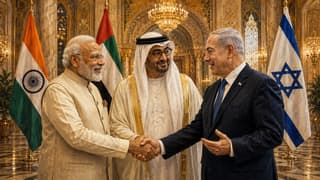
On May 15, 2026, Air India One adjusted its flight path mid-journey. Added at the final moment to Prime Minister Narendra Modi’s five-nation European tour, a brief window in Abu Dhabi became a masterclass in compressed diplomacy. The entire stopover lasted barely three hours. Yet, as United Arab Emirates F-16 fighter jets escorted the Indian prime minister's aircraft into Emirati airspace, the strategic urgency was undeniable. West Asia was sliding into open conflict. The Iran-US-Israel crisis had frozen shipping lanes. Back home, Indian consumers woke up to a petrol and diesel price hike of ₹3 per litre, the first major upward adjustment in four years. Modi landed, signed five multi-billion-dollar bilateral agreements, and took off again. The financial headline read USD 5 billion, roughly ₹42,000 crore, in fresh commitments. The actual prize was immediate energy insurance.
The Strategic Blueprint: The Five Agreements Signed in Abu Dhabi
The whirlwind engagement transformed a series of long-gestating economic discussions into binding security pacts. Rather than relying on vague diplomatic communiqués, the two states formalized operational protocols across energy, finance, and defense production.
Agreement 1: Strategic Defence Partnership Framework
This agreement converted the preliminary Letter of Intent signed in January 2026 into a binding defense pact. The framework shifts the relationship from simple military exercises to joint defense industrial collaboration. It details shared development protocols for maritime security tech, cyber defense systems, secure communication arrays, and counter-terrorism intelligence sharing in the western Indian Ocean.
Agreement 2: Strategic Petroleum Reserves (SPR) MoU
The Indian Strategic Petroleum Reserves Limited (ISPRL) and the Abu Dhabi National Oil Company (ADNOC) established a mechanism allowing ADNOC to hold up to 30 million barrels of crude oil inside Indian storage caverns. This includes the existing Visakhapatnam facility in Andhra Pradesh and the upcoming Phase II facility at Chandikhol in Odisha. Crucially, the pact includes a reciprocal clause permitting India to stock crude at the UAE’s Fujairah port, establishing an immediate commercial backup system.
Agreement 3: Long-Term LPG Supply Agreement
The Indian Oil Corporation Limited (IOCL) locked in an expanded, long-term supply framework with ADNOC Gas for Liquefied Petroleum Gas (LPG). The UAE already fulfills nearly 40% of India’s domestic LPG requirements. This agreement establishes fixed volume guarantees to insulate Indian households from sudden spot-market price spikes during regional blockades.
Agreement 4: The Vadinar Ship Repair Cluster
An MoU was executed to build a specialized Ship Repair Cluster at Vadinar in Gujarat. By integrating UAE maritime capital with Indian port infrastructure, this cluster targets the maintenance of large crude carriers, cutting down the transit times required for Indian vessels to undergo dry-dock repairs in distant international shipyards.
Agreement 5: The USD 5 Billion Capital Injection
The UAE government formalized an immediate USD 5 billion investment package. This capital flows directly into Indian infrastructure development pipelines, alongside strategic equity investments in RBL Bank and Samman Capital, anchoring Emirati sovereign wealth inside the expanding Indian financial services market.
Why Does India Face an Energy Vulnerability Crisis?
India faces an acute energy vulnerability crisis because it imports 88% of its raw crude oil requirements while maintaining a strategic reserve capacity that covers fewer than ten days of national consumption. This thin margin leaves the domestic economy exposed to sudden international supply disruptions, maritime blockades, and speculative price volatility.
The physical architecture of India's current Strategic Petroleum Reserve system highlights this exposure. The country manages 5.33 million tonnes of underground storage across three designated locations: Visakhapatnam, Mangalore, and Padur. As of March 2026, these caverns sat at just 64% of their total operational capacity.
This volume provides approximately 9.5 days of emergency fuel coverage. When contrasted against the International Energy Agency (IEA) global safety benchmark of 90 days of net import protection, India’s domestic buffer is exceptionally lean. The ADNOC agreement serves to utilize empty domestic cavern capacity, altering this risk profile without draining the central treasury.
The Strait of Hormuz Emergency and the Fujairah Bypass
The timing of the Abu Dhabi stopover corresponds directly with maritime gridlock. Iran’s de facto closure of the Strait of Hormuz in March 2026 disrupted a shipping lane responsible for 21 million barrels of oil per day, roughly 21% of global petroleum liquid consumption. The sudden halt triggered an emergency stock release by Western IEA member states. For New Delhi, the disruption manifested instantly. Because India relies on external oil for the vast majority of its industrial and transport needs, a sustained 10% jump in global Brent crude prices inflicts an extra USD 50 million in daily import costs, translating to an annualized macroeconomic drain of USD 18 billion.
The inclusion of the Fujairah port storage clause addresses this exact geographic chokepoint. Fujairah sits on the eastern coast of the UAE, facing the Gulf of Oman. It completely avoids the inside waters of the Persian Gulf, meaning vessels loading cargo at its berths do not need to navigate the narrow Strait of Hormuz.
By securing space in Fujairah’s massive underground storage complex, India gains a dual-advantage system. If the Persian Gulf becomes entirely unnavigable due to active military operations, Indian tankers can still collect oil from outside the chokepoint, ensuring a continuous supply line to refineries in Gujarat and Maharashtra.
The Economics of Commercialized Crude Storage
The financial framework governing the new ADNOC arrangement relies on a commercialized safety model approved by the Indian cabinet. Building underground storage caverns requires significant public capital, India’s Phase I assets cost approximately ₹5,000 crore to construct. Leaving 36% of that space empty represents a poor return on infrastructure capital.
Under the expanded 30-million-barrel framework, ADNOC assumes the financial burden of filling these vacant spaces with its own inventory. The state-owned Emirati oil company gains a significant commercial advantage by pre-positioning millions of barrels of crude directly inside the Indian market, lowering its transport costs and speed-to-market when selling to Asian industrial buyers.
In return, India acquires physical custody of the oil without spending state funds on procurement. The operational contract grants the Indian government the sovereign right to requisition and refine the stored oil during a national energy emergency.
The underlying asset values are substantial. At a base market price of USD 80 per barrel, 30 million barrels of physical crude represent USD 2.4 billion in sovereign inventory resting on Indian soil. If regional escalation drives prices to USD 120 per barrel, that physical asset appreciates to a value of USD 3.6 billion. The arrangement yields a massive paper cushion that protects the state against inflation without requiring upfront capital outlays.
Unpacking the Friction: Counter-Arguments and Critiques
Despite the scale of the announcements, the stopover faces intense scrutiny from energy analysts and political opposition groups who question the long-term structural value of these treaties.
The Stopgap Vulnerability Argument
Independent energy analysts argue that expanding storage capacity fails to fix India’s fundamental structural issue, its fixed 88% import dependency. Even if the state completes its Phase II storage expansions at Chandikhol (4 million tonnes) and Padur (2.5 million tonnes), the absolute maximum national buffer scales up to roughly 16 days of consumption. This volume remains distant from the 90-day international safety standard, meaning a prolonged war in West Asia would still deplete India's reserves within weeks.
Aspirational Defense Language
Skeptics within the security establishment note that the Strategic Defence Partnership Framework functions as an administrative roadmap rather than a commercial procurement order. The text includes no binding hardware purchase agreements, zero explicit technology transfer timelines, and no co-production manufacturing factories. Critics characterize the document as a list of shared interests rather than a hard military alliance.
Execution Realities of Sovereign Wealth
The USD 5 Billion investment announcement faces skepticism regarding actual deployment timelines. Historically, major investment declarations made during bilateral visits take years to clear local regulatory friction, land acquisition hurdles, and state-level compliance checks. Furthermore, critics observe that directing portions of this capital into RBL Bank and Samman Capital constitutes a financial portfolio play rather than immediate capital expenditure into manufacturing or infrastructure sectors that produce industrial employment.
The Geopolitical Repercussions and Domestic Resistance
The diplomatic repositioning required to secure these deals has generated domestic political pushback. During his meetings in Abu Dhabi, Prime Minister Modi departed from India’s historic stance of strict neutrality in West Asian rivalries, explicitly condemning the drone and missile attacks directed at the UAE while praising the Emirates' restraint.
Opposition parties claim this explicit political alignment compromises India's relationship with Tehran. New Delhi has spent over a decade investing economic capital into Iran's Chabahar port to secure a trade route into Central Asia that bypasses Pakistan. Taking a clear political side in an active conflict risks alienating a critical long-term geopolitical partner.
Furthermore, domestic critics highlight that the agreements offer no direct price discounts on raw crude. India does not receive cheap oil, it simply receives closer access to oil it must still purchase at prevailing global market rates during a crisis. Other defense analysts suggest that the sudden integration with the UAE military apparatus draws New Delhi into regional alliance structures, acting as a direct counterweight to the Pakistan-Saudi Arabia mutual defense pact executed in September 2025. This entanglement risks involving India in deep-seated sectarian rivalries rather than keeping the national focus on broad economic trade.
How Indian Energy Diplomacy Follows a Historical Crisis Cycle
The sudden addition of Abu Dhabi to the prime minister's schedule matches a long-standing historical behavior pattern. Indian energy policy rarely evolves through gradual adjustments, instead, it shifts through rapid, defensive reactions to international supply shocks.
The 1973 OPEC Shock: The global oil embargo exposed India's absolute exposure to external energy cartels, prompting the first serious policy discussions regarding the creation of state-controlled storage facilities.
The 1991 Gulf War: The conflict drove oil prices up and drained India's foreign exchange reserves to a point where the country could fund only three weeks of imports, forcing the liberalization of the national economy.
The 2018 ADNOC-Mangalore Deal: Severe instability in the Middle East led to the first commercial storage contract, allowing the UAE to stock 5.86 million barrels in Karnataka, establishing the operational template used today.
The January 2026 Delhi Summit: UAE President Sheikh Mohamed bin Zayed Al Nahyan made a brief visit to New Delhi, delivering a USD 3 billion LNG supply pact and creating the initial Letter of Intent.
The May 15, 2026 stopover represents the direct operationalization of this cycle. When international shipping routes close, diplomatic execution accelerates to secure immediate national safeguards.
Actionable Next Steps for Indian Energy Policy
To convert this short-term diplomatic victory into permanent institutional security, Indian energy administrators must focus on four distinct operational priorities:
Accelerate Phase II Storage Construction: Prioritize the civil engineering work at the Chandikhol and Padur expansion sites to ensure the extra 6.5 million tonnes of storage capacity comes online ahead of the current 2028 target.
Diversify Reciprocal Storage Partners: Use the commercial template established with ADNOC to negotiate similar reciprocal storage treaties with alternative global producers, such as Saudi Aramco, utilizing western Indian ports.
Establish Clear Requisition Protocols: Formalize the exact legal and financial triggers required for the Indian state to seize commercially leased crude during an active maritime blockade, eliminating bureaucratic delays during a crisis.
Operationalize Maritime Security Clusters: Move the Vadinar Ship Repair Cluster from an MoU to an active construction timeline within twelve months, anchoring joint naval logistics firmly on the coast of Gujarat.
Securing 30 million barrels of crude oil outside the unstable shipping channels of the Persian Gulf provides India with a valuable strategic buffer. The short-term price increase facing domestic consumers highlights the constant vulnerability of global supply lines. While a three-hour stopover cannot eliminate an 88% import dependency, pre-positioning billions of dollars in physical crude on domestic soil ensures that when the next maritime chokepoint closes, India possesses the inventory required to keep its industrial economy running.
What are your thoughts on this strategic shift? Do you think India's deeper alignment with the UAE justifies the potential diplomatic friction with Iran?