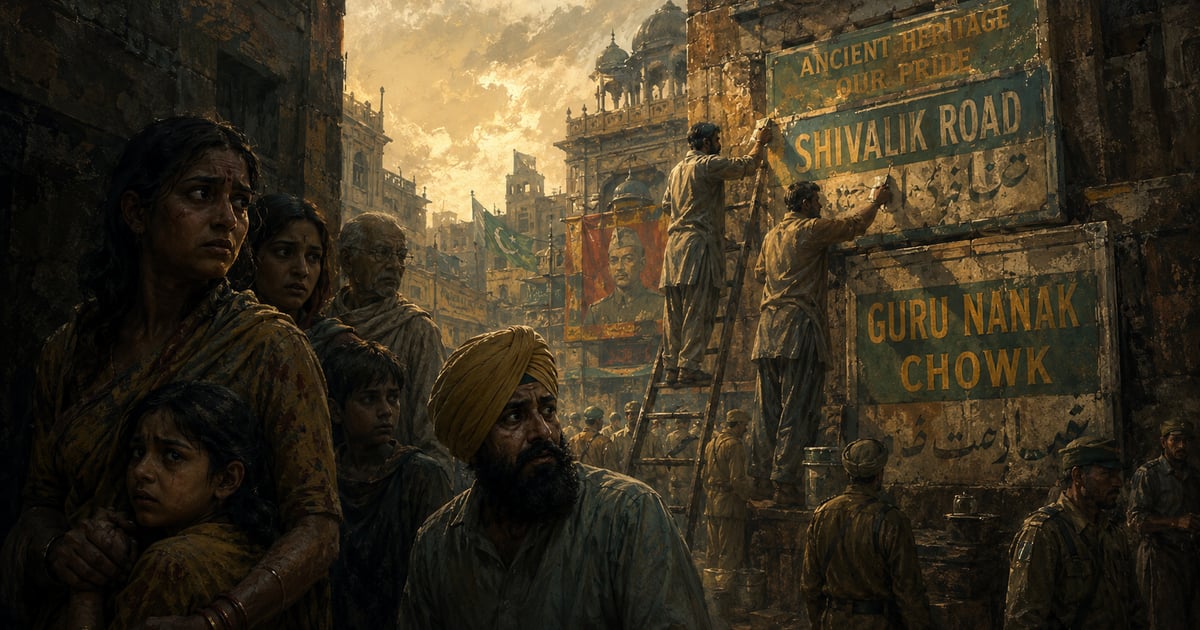
Lahore's Punjab Cabinet, chaired by Chief Minister Maryam Nawaz, recently approved a 50 billion PKR heritage project. The headline feature is striking: restoring pre-Partition Hindu and Sikh names to iconic neighborhoods and streets. Spaces like Krishan Nagar, Sant Nagar, Laxmi Chowk, and Jain Mandir Road are getting their identities back.
Simultaneously, Pakistani nationalist social media accounts are aggressively pushing a specific historical revision. They claim the Indus Valley Civilisation, featuring Mohenjo-daro and Harappa, belongs strictly to Pakistan, not India.
These are not isolated cultural events. They are coordinated moves on a geopolitical chessboard. To understand what game is being played, one must look at how modern nations weaponize ancient history.
What Is a Civilisation State and Why Does It Matter?
A civilisation state is a political entity that derives its national sovereignty and legitimacy from thousands of years of unbroken cultural, philosophical, and historical continuity, rather than a modern constitution or a single revolutionary event.
While a standard nation-state relies on borders drawn in recent centuries, a civilisation state presents itself as a living fragment of history. Only a few global actors can credibly make this claim: China, Iran, Turkey, and India.
India's claim relies on five specific historical anchors:
Linguistic and Textual Continuity: The Vedas, composed around 1500 BCE, are still recited in their original phonetic tradition.
Living Urban Centers: Varanasi has been continuously inhabited for over 3,000 years. It predates Rome and Athens, yet it still functions as the active center of the same spiritual tradition it housed three millennia ago. The Kumbh Mela, documented for over two millennia, drew the largest peaceful human gathering in recorded history in 2025.
Philosophical Expansion: Systems of thought like Buddhism originated in the Gangetic plains and spread across East and Southeast Asia. Mathematical concepts like the zero and the decimal system became the foundation of global science.
Civilisational Footprint: Sanskrit-derived scripts still dictate vocabulary across Southeast Asia. The royal courts of Bali maintain Sanskrit rituals, and the temples of Angkor Wat stand as geographic markers of this historical reach.
Cultural Assimilation: The region historically absorbed external groups without losing its core identity. Ruling powers like the Mughals adopted local customs, architecture, and food, producing the Persian-Sanskrit synthesis known as Urdu.
This deep historical footprint serves as a powerful long-term geopolitical asset. It provides India with a distinct form of soft power in the Global South that does not depend on quarterly GDP numbers or military hardware. Pakistan recognizes this asset, and has deployed a three-part counter-strategy.
The Three Moves Behind Pakistan's Cultural Pivot
Move 1: Securing the Indus Valley Civilisation
The Indus Valley Civilisation is the oldest root of subcontinental urban history. Pakistan's geographic argument is straightforward: Mohenjo-daro sits in Sindh, Harappa is in Pakistani Punjab, and the Indus River runs the length of Pakistan. By claiming exclusive ownership of this heritage, the narrative attempts to cut India's 5,000-year civilisational timeline down to a 3,500-year regional tradition.
Move 2: Co-opting Pluralist History
By spending 50 billion PKR to restore names like Krishan Nagar, Pakistan positions itself as a responsible custodian of the subcontinent's multi-faith past. This move allows the state to project an image of tolerance to international observers, while giving its domestic urban middle class a historical identity outside of standard religious nationalism.
Move 3: Framing Continuity as Modern Politics
Pakistani academic and digital spaces frequently frame India's civilisational narrative as a modern invention. They argue that the concept of an unbroken historical thread is merely a 20th-century political project retrofitted onto a historically fragmented region.
The Data Behind Pakistan's Structural Contradiction
While the strategy is sophisticated, it faces immediate friction when analyzed alongside Pakistan's legal, political, and demographic realities.
Metric / FeaturePakistan's Constitutional & Demographic RealityState ReligionArticle 2 of the Constitution explicitly declares Islam as the state religion.Political ExclusionArticles 41 and 91 bar non-Muslims from holding the office of President or Prime Minister.Minority DemographicsAt Partition in 1947, Hindus comprised roughly 15% of West Pakistan's population. Today, they make up between 1.6% and 2.3%.Legal RestrictionsOrdinance XX of 1984 criminalizes the Ahmadiyya community for using Islamic terminology or practicing their faith openly.
The Human Rights Commission of Pakistan consistently documents structural issues facing minorites, including temple destruction and forced conversions in rural Sindh. Notable cases include the demolition of the Terrain Chowk temple in 2020 and the attacks on the Shri Krishna Mandir in 2021. Furthermore, the historic erasure of names was state-directed. Krishan Nagar was not renamed during the chaos of 1947; it was changed to Islampura in 1992 under pressure from religious groups during a systematic renaming campaign.
The claim to the Indus Valley Civilisation also creates a fundamental ideological conflict inside Pakistan. The nation was founded on the Two-Nation Theory: the premise that Hindus and Muslims represent two incompatible civilisations.
The Indus Valley Civilisation is entirely pre-Islamic and pre-Vedic. By claiming it, Pakistan implicitly argues that civilisational identity is tied to geography rather than religion. If identity is defined by the soil, then the foundational logic used by Muhammad Ali Jinnah to justify Partition collapses.
Geopolitics Masked as Heritage
This is part of an established pattern where cultural openness is used to gain external legitimacy. The Kartarpur Corridor opened in 2019 to facilitate Sikh pilgrims, arriving exactly when Pakistan faced financial scrutiny on the FATF grey list.
Today, the 50 billion PKR Lahore project emerges while the country navigates strict IMF loan conditions and seeks to stabilize its international image following years of political volatility. When hard power and economic sovereignty face constraints, states frequently deploy heritage assets as diplomatic tools.
A genuine civilisation state requires institutional continuity, not just geographic proximity. India’s framework relies on living traditions that never stopped: the languages are spoken, the rituals persist, and minority communities have reached the highest offices of state.
Pakistan holds the soil where ancient cultures once lived, but its state apparatus spent decades dismantling the pluralism that defined it. Restoring a street sign while constitutionally barring minorities from state leadership is a geopolitical tactic, not cultural preservation. The names are returning, but the communities that built them are gone.