
In brief
- On 7 October 2026 Musk claimed Starlink was blocked by oligarchs; the Indian government called the allegations baseless and said Starlink, Bharti-backed Eutelsat OneWeb and Reliance Jio‑SES are undergoing the same security assessment before spectrum can be assigned.
- The government affirmed that satcom spectrum would be assigned administratively under the Telecommunications Act 2023, rejecting demands by Reliance Jio and Bharti Airtel for an auction.
- Security agencies require data localisation, lawful interception access, hardware geofencing and ownership transparency; Starlink has built 20 gateway sites in India but technical verification is still in progress.
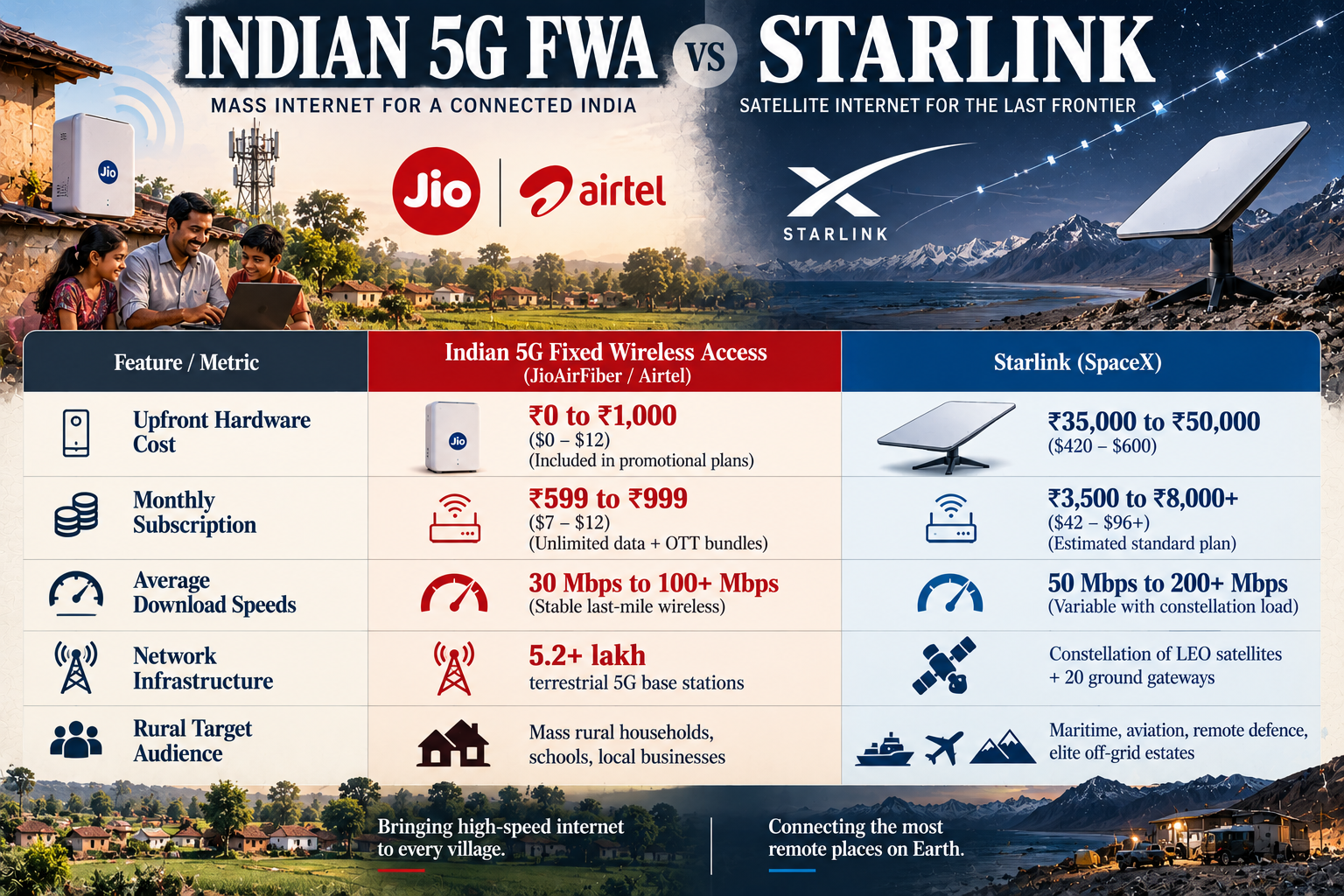
- By early 2026 India had over 5.2 lakh 5G base stations and Jio had 1.3 crore FWA households; Starlink’s hardware cost ₹35,000 to ₹50,000 and monthly fees several thousand rupees, limiting it to maritime, aviation, border, emergency, backhaul and niche luxury uses.
When Elon Musk took to X on 7 October 2026 to allege that SpaceX’s satellite internet service, Starlink, was being blocked by "certain oligarchs" seeking to preserve their "monopolistic chokehold on the Indian people", he ignited a familiar narrative: the insurgent Silicon Valley disruptor thwarted by entrenched domestic tycoons. Calling the delay a "crime against the people of India", Musk pointed the finger squarely at domestic telecom incumbents.
Hours earlier, Lauren Dreyer, Vice President of Starlink Business Operations at SpaceX, had delivered a measured address at the India Mobile Congress (IMC) in New Delhi, announcing that Starlink had built 20 ground gateway sites across India and committed to keeping domestic user data within the country’s borders, expressing hope for a commercial debut by 2027.
The Indian Government was swift to dismantle Musk’s framing. On 8 October 2026, the Ministry of Communications described his allegations as "baseless and misconceived", noting that three separate Global Mobile Personal Communication by Satellite (GMPCS) licensees—Starlink, Bharti-backed Eutelsat OneWeb, and Reliance Jio’s joint venture with SES—are undergoing the exact same security assessment before spectrum can be assigned.
The reality of Starlink’s stalled Indian deployment cannot be explained away as a corporate conspiracy. Musk already secured his most contentious legislative victory over Indian telecom titans nearly two years ago. The ongoing impasse is driven instead by a combination of non-negotiable national security doctrines, unyielding data sovereignty mandates, and an extraordinary terrestrial broadband build-out that has rendered satellite internet largely irrelevant to the vast majority of Indian consumers.
The Spectrum Battle: A War Musk Already Won
The accusation that domestic telecom operators have locked Starlink out ignores the recent legislative history of Indian telecommunications.
Throughout 2023 and 2024, Reliance Jio and Bharti Airtel waged an aggressive lobbying campaign demanding that satellite communication (satcom) spectrum be auctioned rather than allocated administratively. Their argument was commercial parity: Indian operators had collectively spent hundreds of thousands of crores at government auctions—including over ₹1.5 lakh crore ($18 billion) in the 5G spectrum auctions alone, with Reliance Jio contributing more than ₹88,000 crore ($10.5 billion)—to acquire airwaves. Allowing foreign satellite operators to secure spectrum via an administrative fiat, they argued, would create an uneven playing field. Reliance even submitted formal legal opinions to the Union Government, including counsel from retired Supreme Court Justice L. Nageshwar Rao, citing the landmark 2012 Supreme Court ruling in the 2G case that mandated competitive auctions for scarce natural resources.
Musk vehemently resisted this, pointing out on X that the International Telecommunication Union (ITU) designates satellite frequencies as shared spectrum, making individual auctions technically impractical and globally unprecedented.
The Indian Government sided with Musk. Telecom Minister Jyotiraditya Scindia affirmed that India would align with international norms by assigning satcom spectrum administratively under the provisions of the Telecommunications Act, 2023. The Telecom Regulatory Authority of India (TRAI) was tasked simply with determining the formula for administrative charges and pricing.
Far from bowing to domestic "oligarchs", the government explicitly rebuffed their demands on the single biggest regulatory point of contention. The impediment stalling Starlink today is not spectrum policy; it is national security clearance.
National Security and the "Musk Factor"
India’s regulatory wariness towards foreign-controlled communication infrastructure is forged by geographic vulnerability and historical trauma. Following the 26/11 Mumbai terror attacks in 2008, where attackers and their handlers coordinated operations using Thuraya satellite phones that bypassed Indian terrestrial networks, the Ministry of Home Affairs (MHA) instituted an ironclad policy: no satellite communication provider may operate within Indian territory without establishing local ground stations capable of lawful interception and data monitoring.
For Starlink, compliance with these conditions has involved protracted negotiations with India's intelligence agencies, including the Intelligence Bureau (IB) and the National Technical Research Organisation (NTRO). Security agencies have insisted on four non-negotiable stipulations:
Complete Data Localisation: Indian user data must not traverse international links before being processed. All telemetry and communications must land at domestic ground gateways and remain hosted on servers within Indian jurisdiction. Dreyer’s announcement that Starlink has established 20 gateway sites represents an effort to satisfy this condition, but technical verification of these gateways remains in progress.
Lawful Interception Access: Under Section 5(2) of the Indian Telegraph Act and corresponding provisions of the Telecommunications Act, 2023, security agencies must possess the technical architecture to intercept, monitor, and decrypt communications when authorised by the Union Home Secretary. Proprietary, end-to-end encrypted satcom pipes that cannot be audited locally are prohibited.
Hardware Geofencing and Grey-Market Control: The DoT has mandated that SpaceX prevent terminals purchased abroad from operating within Indian territory, and disable terminals sold inside India from roaming across disputed borders. This concern is not theoretical: in December 2024, the Indian Army recovered an unlicensed Starlink terminal alongside arms and ammunition in Manipur, pointing to cross-border smuggling from Myanmar.
Ownership Transparency: New Delhi requires foreign satcom applicants to disclose complete shareholding structures to confirm that no capital or influence traces back to adversarial neighbouring states.
Beyond statutory rules sits a broader geopolitical calculation: the risk of sovereign dependence on a single foreign commercial entity. During the war in Ukraine, Musk unilaterally restricted Starlink connectivity over Crimea, thwarting a Ukrainian naval drone operation against Russian vessels. For Indian military planners and national security strategists managing sensitive borders across Ladakh, Jammu and Kashmir, and the Northeast, the prospect of mission-critical communication links being subject to the operational discretion of a foreign executive represents an unacceptable point of failure.
The Commercial Reality: 5G FWA vs Orbital Broadband
Behind the political rhetoric lies an economic divide that exposes the flaw in Starlink’s pitch as a champion of universal Indian connectivity.
Musk’s marketing has long positioned Starlink as a vital lifeline for bridging India’s rural digital divide. Yet India’s telecommunications market has evolved in a direction fundamentally hostile to the unit economics of low-Earth orbit satellite internet.
India’s Terrestrial Broadband Fortress
Over the past four years, Indian telecom operators have executed the fastest nationwide 5G rollout in history. By early 2026, the Department of Telecommunications recorded more than 5.2 lakh (520,000) 5G Base Transceiver Stations (BTS) installed across all 22 telecom circles, covering over 99% of districts.
To conquer the last mile in semi-urban and rural areas where digging optical fibre trenches is uneconomic, Indian operators turned to 5G Fixed Wireless Access (FWA). Relying on dedicated mid-band (3.5 GHz) and millimetre-wave (26 GHz) airwaves, services such as JioAirFiber and Airtel Xstream AirFiber deliver high-speed broadband straight to rooftop antennas.
Reliance Jio alone has surpassed 1.3 crore (13 million) connected FWA households, adding hundreds of thousands of new homes every month. These setups require no physical dish pointing at orbital planes, experience negligible weather attenuation compared to Ku/Ka satellite bands, and bundle unlimited high-speed data, television feeds, and streaming subscriptions into a single domestic package.
The Arithmetic of Indian Telecom
India’s telecommunications landscape is defined by extreme price sensitivity and immense volume.
The country consumes more mobile data per smartphone than almost any other nation—averaging over 24 GB per user every month—while paying between ₹10 and ₹15 ($0.12–$0.18) per gigabyte. The monthly blended Average Revenue Per User (ARPU) across Indian telecom carriers sits between ₹180 and ₹220 ($2.15–$2.60).
In this environment, an upfront capital expenditure of ₹35,000 to ₹50,000 ($420–$600) for a phased-array satellite dish, paired with a recurring monthly bill of several thousand rupees, places Starlink far beyond the reach of ordinary rural households. Even if Starlink were to heavily discount its hardware or offer a subsidised Indian tariff, the cost profile remains an order of magnitude higher than domestic mobile and fixed wireless alternatives.
Starlink's true commercial market in India is not rural villager empowerment; it is enterprise connectivity:
Maritime and Aviation: Commercial container shipping, deep-sea fishing fleets, and in-flight Wi-Fi for domestic carriers.
Border and Emergency Infrastructure: Remote border posts in Ladakh and Arunachal Pradesh, high-altitude disaster relief management, and disaster recovery fallback links.
Cellular Backhaul: Feeding isolated 4G and 5G cellular towers in forested or mountainous terrains where fibre backhaul cannot be laid.
Niche Luxury: Eco-tourism resorts, high-end plantations, and industrial mining projects far outside the grid.
A Regulatory Balancing Act, Not a Blockade
The portrayal of Starlink as an embattled pioneer blocked by protectionist tycoons makes for an engaging soundbite, but it collapses under scrutiny.
SpaceX is not being singled out. Its direct competitors in the satellite space, Eutelsat OneWeb and Jio-SES, have spent years navigating the same security audits, building the same ground infrastructure, and awaiting the same final operational clearances from the DoT and the Ministry of Home Affairs.
India’s regulators are navigating a delicate balance: integrating advanced satellite internet into the national matrix to connect isolated outposts, while preserving the national security safeguards established over decades. In a nation where 5G reaches deep into the hinterlands and FWA delivers broadband to millions for the price of two cups of coffee, satellite internet is a valuable redundancy—not an urgent social rescue.
Musk may find New Delhi’s security bureaucracy frustratingly deliberate, but invoking "oligarchs" mistakes a sovereign security doctrine for an economic blockade.
The Arithmetic of Indian Telecom
India’s telecommunications landscape is defined by extreme price sensitivity and immense volume.
The country consumes more mobile data per smartphone than almost any other nation—averaging over 24 GB per user every month—while paying between ₹10 and ₹15 ($0.12–$0.18) per gigabyte. The monthly blended Average Revenue Per User (ARPU) across Indian telecom carriers sits between ₹180 and ₹220 ($2.15–$2.60).
In this environment, an upfront capital expenditure of ₹35,000 to ₹50,000 ($420–$600) for a phased-array satellite dish, paired with a recurring monthly bill of several thousand rupees, places Starlink far beyond the reach of ordinary rural households. Even if Starlink were to heavily discount its hardware or offer a subsidised Indian tariff, the cost profile remains an order of magnitude higher than domestic mobile and fixed wireless alternatives.
Starlink's true commercial market in India is not rural villager empowerment; it is enterprise connectivity:
Maritime and Aviation: Commercial container shipping, deep-sea fishing fleets, and in-flight Wi-Fi for domestic carriers.
Border and Emergency Infrastructure: Remote border posts in Ladakh and Arunachal Pradesh, high-altitude disaster relief management, and disaster recovery fallback links.
Cellular Backhaul: Feeding isolated 4G and 5G cellular towers in forested or mountainous terrains where fibre backhaul cannot be laid.
Niche Luxury: Eco-tourism resorts, high-end plantations, and industrial mining projects far outside the grid.
A Regulatory Balancing Act, Not a Blockade
The portrayal of Starlink as an embattled pioneer blocked by protectionist tycoons makes for an engaging soundbite, but it collapses under scrutiny.
SpaceX is not being singled out. Its direct competitors in the satellite space, Eutelsat OneWeb and Jio-SES, have spent years navigating the same security audits, building the same ground infrastructure, and awaiting the same final operational clearances from the DoT and the Ministry of Home Affairs.
India’s regulators are navigating a delicate balance: integrating advanced satellite internet into the national matrix to connect isolated outposts, while preserving the national security safeguards established over decades. In a nation where 5G reaches deep into the hinterlands and FWA delivers broadband to millions for the price of two cups of coffee, satellite internet is a valuable redundancy—not an urgent social rescue.
Musk may find New Delhi’s security bureaucracy frustratingly deliberate, but invoking "oligarchs" mistakes a sovereign security doctrine for an economic blockade.